
Quick summary: Learn what to look for in a rice traceability and sustainability platform, including farm-level traceability, batch tracking, ESG monitoring, and compliance-ready reporting for global buyers.

As global rice supply chains come under increasing scrutiny, traceability and sustainability are no longer optional they are buyer and regulatory requirements. A rice traceability and sustainability platform should provide farm-level traceability, batch-to-lot tracking, sustainability monitoring, and compliance-ready reporting. Buyers look for digital farmer onboarding, GPS-mapped farms, input tracking, deforestation and water-use monitoring, and end-to-end visibility from farm to export-ready rice.
From water-intensive cultivation and smallholder sourcing to complex milling and export processes, rice carries inherent environmental, social, and compliance risks. Buyers now expect clear, verifiable proof of origin, farming practices, and sustainability impact backed by data, not declarations.
Many rice businesses still rely on fragmented systems, manual records, and limited farm-level visibility. This makes it difficult to track paddy back to individual farmers, monitor sustainable practices, prevent mixing during milling, or produce audit-ready compliance reports. Choosing the right rice traceability and sustainability platform is therefore critical not just to meet compliance, but to protect market access, reduce risk, and build long-term buyer trust.
Key Takeaways
Rice buyers across global markets are fundamentally changing how they evaluate suppliers. Traceability and sustainability have moved from optional differentiators to non-negotiable buying criteria, driven by regulation, risk exposure, and rising stakeholder expectations. For rice producers, millers, and exporters, the ability to provide verifiable, data-backed proof is now essential.
Governments and regulators are introducing stricter rules that directly impact rice supply chains.
For rice suppliers, this means traceability is now a regulatory prerequisite, not a value-add.
Rice cultivation is increasingly under scrutiny due to its environmental and social footprint.
Environmental concerns:
Social concerns:
Buyers now expect visibility into how rice is grown, not just where it comes from, making sustainable rice sourcing a key requirement.
Buyers Want Proof, Not Declarations
Traditional sourcing relied on:
This model no longer meets buyer or regulatory expectations.
Today’s buyers demand:
In short, claims without traceable data are treated as high risk.
For rice buyers especially in export, retail, and branded food segments traceability determines:
Suppliers unable to demonstrate rice supply chain traceability and sustainable rice sourcing increasingly face exclusion, while those with robust systems gain preferred supplier status.
Rice buyers now demand traceability and sustainability because regulations are tightening, environmental and social risks are under the spotlight, and trust must be proven with data. In today’s market, traceable, sustainable rice is not a premium offering it is the baseline expectation for doing business.
Learn how end-to-end tracking from farm to export ensures quality, compliance, and sustainability in modern rice supply chains.
Explore our blogs on rice traceability solutions
Discover how GPS mapping, input monitoring, and farmer digitization improve productivity, ESG performance, and supply chain transparency.
Read our blog on digital farm management for sustainable agriculture
Farm-level traceability is the cornerstone of a credible rice traceability and sustainability platform. Without verified, origin-level data, downstream tracking, sustainability claims, and compliance reporting lose their credibility. Rice buyers and regulators increasingly expect traceability to begin at the farm where environmental, social, and quality risks first emerge.
Rice supply chains often involve thousands of smallholder farmers, making accurate identification a major challenge.
Buyer expectations include:
Digitized onboarding eliminates ghost farmers, reduces fraud risk, and ensures that every kilogram of rice can be traced back to a real, verified producer.
Buyers now require precise geolocation data for rice farms.
Key requirements:
Plot-level mapping enables buyers to verify sourcing locations, support regulatory compliance, and confirm sustainability commitments with geospatial evidence.
Sustainable rice sourcing depends on how rice is grown, not just where.
Platforms must capture:
This visibility helps buyers assess environmental impact, food safety risks, and compliance with sustainability standards, while supporting productivity improvements for farmers.
Read the case study to see how TraceX’s Digital Crop Management Solution helped smallholder farmers optimize crop planning, boost yields, and make data-driven decisions
Ethical sourcing requirements increasingly extend to the social conditions at the farm level.
Buyers expect visibility into:
Capturing social indicators at the farm level allows buyers to demonstrate responsible sourcing and meet ESG and human rights reporting obligations.
Farm-level rice traceability transforms fragmented sourcing networks into transparent, auditable supply chains. Through digitized farmer management, GPS-mapped fields, crop and water-use monitoring, and social compliance tracking, rice platforms provide the foundation needed for sustainable sourcing, regulatory compliance, and long-term buyer trust.
Effective rice traceability platforms go beyond origin tracking to provide deep visibility into crop management and sustainability performance. Monitoring crops, inputs, and environmental indicators is essential for meeting buyer expectations, regulatory requirements, and ESG commitments in rice supply chains.
Rice buyers increasingly require transparency into what goes into the crop.
A robust platform should capture:
This data helps:
Support for Sustainable and Climate-Smart Rice Practices
Rice farming has a significant environmental footprint, particularly in water use and emissions.
Digital monitoring enables:
Platforms that support sustainable rice practices help suppliers demonstrate measurable environmental improvements, not just intent.
Rice cultivation is a major source of agricultural methane emissions.
Buyers and regulators increasingly expect:
Capturing this data supports ESG disclosures and helps buyers quantify climate impact across their rice supply chains.
Sustainable rice sourcing also depends on protecting ecosystems and maintaining soil fertility.
Key indicators include:
Tracking biodiversity and soil health demonstrates long-term land stewardship and aligns rice sourcing with regenerative agriculture principles.
As rice moves from paddy to milled product, milling and processing become the most critical points for traceability and quality control. Buyers expect uninterrupted visibility through these stages to ensure product integrity, food safety, and compliance with global standards.
Batch-level traceability ensures that each lot of milled rice can be traced back to the specific paddy batches and farms it originated from.
This requires:
This linkage is essential for validating origin claims, sustainability data, and quality parameters associated with each shipment.
Milling operations often handle rice from multiple sources, increasing the risk of:
Batch and lot controls supported by digital tracking, physical segregation, and standard operating procedures help preserve product integrity and buyer trust.
Buyers require clarity on how traceability is maintained through processing.
Identity Preserved (IP):
Mass Balance:
The chosen model must align with buyer claims, certification requirements, and regulatory expectations.
Recall Readiness and Quality Audits
Batch- and lot-level traceability enables:
Regulators and buyers increasingly expect suppliers to demonstrate one-step-back, one-step-forward traceability something only robust batch systems can provide.
For rice exporters, traceability data only delivers value when it can be converted into clear, compliant, and buyer-ready reports. Global markets increasingly require structured, auditable documentation that demonstrates food safety, sustainability, and regulatory compliance. Compliance-ready reporting bridges the gap between operational data and market access.
Rice exporters must meet stringent import and food safety requirements across different regions.
Compliance-ready platforms support:
Digitized documentation reduces errors, shortens clearance timelines, and lowers the risk of shipment rejections.
Buyers now expect transparent reporting on environmental and social impact.
Traceability platforms enable:
This data supports compliance with regulations such as EUDR and corporate sustainability reporting frameworks.
Manual spreadsheets and paper records are no longer acceptable for regulated markets.
Compliance-ready systems provide:
Auditors and buyers gain confidence from consistent, verifiable data, rather than fragmented documentation.
Different buyers require different levels of transparency.
Modern reporting platforms offer:
This flexibility accelerates buyer onboarding and strengthens long-term commercial relationships.
Certifications and sustainability programs play a critical role in rice supply chains, but buyers increasingly expect proof that certification claims are accurate, current, and aligned with real sourcing data. A strong rice traceability and sustainability platform ensures certifications are not just labels, but living systems backed by verifiable evidence.
Rice buyers often require compliance with certifications related to food safety, sustainability, and ethical sourcing.
A robust platform should support:
This ensures that certified rice meets both regulatory and buyer expectations without duplicative manual processes.
One of the most common certification risks is scope mismatch when certified volumes exceed what certified farms can realistically produce.
Traceability platforms address this by:
This creates credibility with buyers and auditors by ensuring certification claims are grounded in real, traceable data.
Traditional certification models rely on annual audits, which provide only a snapshot in time.
Modern platforms enable:
Buyers increasingly favor suppliers who can demonstrate continuous compliance, not just audit-day readiness.
For rice traceability and sustainability platforms to be effective, they must combine data integrity, scalability, and user-friendly adoption, particularly in complex supply chains involving smallholder farmers across diverse geographies. Without these elements, traceability initiatives risk incomplete data, low adoption, and unreliable reporting.
Smallholder farmers often lack access to desktops or advanced IT infrastructure. Mobile-first solutions enable:
This ensures high adoption rates and consistent data collection from the field.
Many rice-growing regions face poor network connectivity. Offline-capable platforms allow:
Offline functionality is critical for continuous, reliable farm-level monitoring.
Rice supply chains often span thousands of farmers and multiple regions. A scalable platform should provide:
Scalability ensures the platform can support long-term growth without system bottlenecks.
Traceability data must be tamper-proof, verifiable, and accessible for audits and compliance reporting. Key features include:
Secure and auditable data builds trust with global buyers, regulators, and certification bodies.
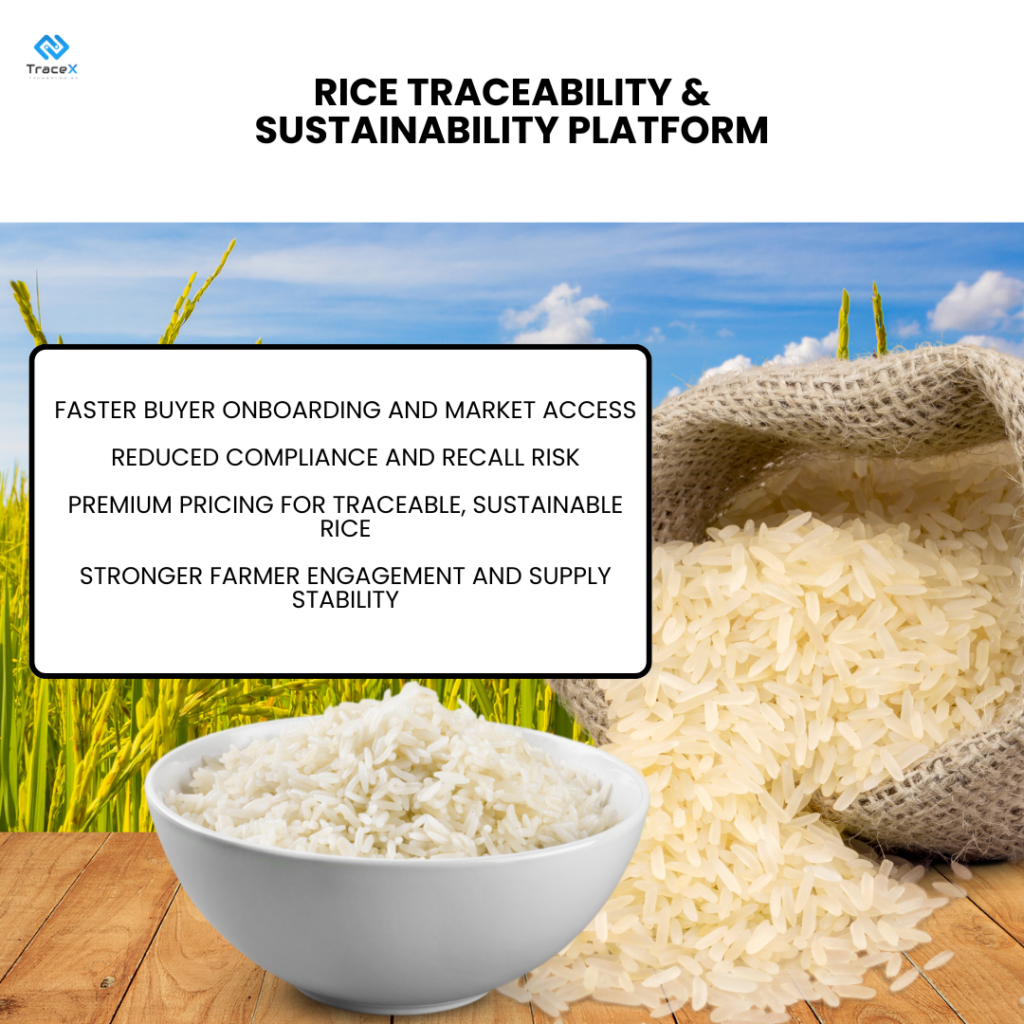
TraceX Sustainable Sourcing Platform provides a comprehensive digital solution designed to enable rice suppliers, millers, and exporters to meet the growing demands for traceability, sustainability, and compliance. By integrating farm-level data, processing information, and sustainability metrics, TraceX ensures that every step of the rice supply chain is visible, auditable, and verifiable.
TraceX connects all stages of the rice supply chain, from individual farms to final export-ready products. Features include:
This end-to-end visibility allows suppliers to trace every kilogram of rice back to its origin, supporting both buyer requirements and regulatory compliance.
Read the case study to see how TraceX transformed basmati rice production with advanced traceability and sustainability solutions.
Discover how the platform enabled end-to-end farm-to-export visibility, reduced environmental impact, improved resource efficiency, and set new standards for responsible sourcing in the rice industry.
TraceX embeds sustainability and ESG tracking directly into operational workflows:
By integrating sustainability data from the field to the export stage, TraceX ensures that rice sourcing is verifiable, responsible, and aligned with global ESG standards.
Processing and milling are critical points where traceability is often lost. TraceX maintains:
Batch-level tracking ensures premium rice quality is maintained and facilitates rapid recall or quality investigations if needed.
TraceX platform transforms operational data into auditable, buyer-ready reports:
These capabilities allow rice suppliers to meet global market requirements, streamline audits, and strengthen buyer trust without manual spreadsheets or fragmented records.
Selecting the right rice traceability and sustainability platform is no longer optional it is a critical business decision. The ideal platform provides end-to-end visibility from farm to export, batch-level tracking through processing, real-time sustainability and ESG monitoring, and compliance-ready reporting for global buyers. By integrating digital farmer management, crop and input monitoring, and audit-ready documentation, rice suppliers can reduce risk, demonstrate responsible sourcing, and secure market access in increasingly regulated and sustainability-focused markets.
Learn how eco-friendly practices, water stewardship, and smallholder engagement are transforming rice cultivation for long-term sustainability.
Explore our blog on sustainable rice farming
Discover how end-to-end tracking, batch-level monitoring, and real-time data improve transparency, compliance, and food safety.
Read our blog on digital traceability in food supply chains
See how digital platforms help companies ensure ethical sourcing, ESG compliance, and traceable supply chains from farm to market.
Explore our blog on sustainable sourcing in agribusiness
A traceability platform ensures end-to-end visibility, maintains batch integrity, supports sustainability claims, and enables compliance with food safety and ESG regulations.
Key features include farm-level digitized onboarding, GPS-mapped plots, batch-level tracking, sustainability and ESG monitoring, and compliance-ready reporting.
It reduces operational and compliance risks, enables access to premium and regulated markets, builds buyer trust, and provides verifiable proof of ethical and sustainable sourcing.