
Quick summary: Traceability in the sesame supply chain in Nigeria ensures verified origin, quality control, and regulatory compliance, helping exporters meet global buyer standards and secure sustainable market access.

Traceability in the Sesame Supply Chain in Nigeria is limited but increasingly critical. Sesame production is dominated by smallholder farmers with fragmented, rain-fed plots, leading to inconsistent record-keeping. As sesame moves through village collectors, local traders, and regional aggregators, batch commingling often breaks traceability. Lack of GPS farm mapping, digital farmer records, and standardized documentation makes proving origin and quality challenging for exporters. Implementing end-to-end traceability from farm-level identification to processing and export is essential to meet international quality standards, comply with buyer and regulatory requirements, and enable premium market access.
Nigeria is a major sesame producer in West Africa, contributing substantially to global sesame seed supply. Key production regions such as Katsina, Jigawa, Kaduna, Kano, and Kebbi are dominated by smallholder farmers cultivating sesame on scattered and often fragmented plots. Nigeria produces approximately 300,000 – 400,000 metric tons of raw sesame seeds annually, with major exports directed to China, India, the EU, and the Middle East for processing into oil, tahini, snacks, and confectionery products. The Nigerian sesame supply chain typically follows a multi-tiered structure: smallholder farmers → local collectors → regional aggregators → processors/traders → exporters.
Nigeria’s sesame export landscape positions it as Africa’s second-largest and the world’s fifth-largest exporter, with $323.26 million in 2024 (8.3% global share from ~2.4 million tonnes total exports worth $3.9 billion, +43% value YoY), surging 59.19% over five years from $288.6 million in 2019 to $459.4 million in 2023, and up 73% in 2022 alone. In Q1 2025, sesame drove over N5 billion (~$3.2 million) within N30 billion total ag exports, led by firms like Johnvents Group ($200 million+ revenues, 4th globally), with major markets China, Japan, Turkey, Europe, and UAE favoring high-oil-content seeds .Production supports this via smallholders on favorable northern lands, projecting further growth toward $5 billion global exports in 2025 amid tightening supply and premium pricing ($1,772/tonne avg.).
While this system enables broad participation, it also creates significant traceability and quality-control challenges. Heavy reliance on informal intermediaries often leads to mixed or aggregated sourcing, making it difficult to track farm-level origins. Most farmers lack digital records, field mapping, or land documentation, limiting visibility into planting practices, seed varieties, and yields.
These structural constraints result in major traceability gaps, including weak chain-of-custody tracking, inconsistent quality documentation, and minimal verification of environmental or social compliance. With global buyers increasingly demanding ethically sourced, non-GMO, and fully traceable sesame, traditional manual systems are increasingly insufficient. To maintain export competitiveness and meet rising compliance standards, Nigeria’s sesame industry must transition toward digitized, transparent, and verifiable supply chains that ensure full origin traceability and sustainable market access.
Discover how digital tools can streamline documentation, verify origin, and strengthen buyer confidence.
Explore the full guide to Traceability in Sesame Supply Chains
From farm mapping to blockchain traceability, our Guide to Food Traceability breaks it all down. Read it now.
Nigeria is a significant sesame producer, yet the sector faces multiple structural, operational, and sustainability challenges that affect productivity, quality, and export competitiveness.
Nigeria’s sesame sector faces a combination of structural, operational, and sustainability challenges that affect traceability, quality, and competitiveness. Addressing these issues through digital traceability, better supply chain management, improved post-harvest handling, and farmer empowerment is essential for unlocking export potential, ensuring sustainable production, and meeting global buyer standards.
The TraceX Traceability Platform provides the digital backbone needed to bring visibility, compliance, and trust into Nigeria’s sesame supply chain. By digitizing every step from farm-level production to aggregation, processing, and export the platform enables exporters, processors, cooperatives, and buyers to verify origin, monitor quality, and meet international regulatory and sustainability standards.
TraceX platform connects all supply chain actors smallholder farmers, local collectors, cooperatives, aggregators, processors, and exporters into a single digital ecosystem, enabling:
• Real-time visibility of product movement
• Seamless data exchange across supply chain nodes
• Centralized monitoring of production, aggregation, processing, and export
This integrated system eliminates blind spots, ensuring only compliant, verified sesame seeds enter the export value chain.
The platform captures precise GPS coordinates or polygon maps for each sesame farm, allowing exporters to:
• Verify farm boundaries and production areas
• Confirm land-use rights and legality
• Demonstrate deforestation-free and responsible sourcing
• Maintain geospatial records for audits and buyer requirements
Accurate farm mapping is essential for building credible, origin-verified sesame supply chains.
Using mobile-enabled tools, farmers are digitally registered with structured, authenticated data, including:
• Farmer identity and contact information
• Farm location linked to GPS data
• Land-use or tenure documentation (where available)
• Planting, harvest, and yield records
• Cooperative or collector affiliations
This creates a verified digital farmer network and closes critical data gaps at the root of the supply chain.
Each sesame batch receives a unique digital identity from harvest through export, ensuring full chain-of-custody across:
• Farm-level harvesting
• Local collection points
• Aggregation centers
• Processing and cleaning facilities
• Export documentation
Exporters can trace every shipment back to specific farms, production seasons, and handling points.
TraceX platform secures all traceability records on blockchain infrastructure, ensuring data is:
• Immutable and tamper-proof
• Time-stamped and audit-ready
• Transparently accessible to authorized stakeholders
This gives international buyers verifiable proof of origin and compliance critical for premium and regulated markets.
Digitized supply chain data allows TraceX to automatically generate:
• Origin and chain-of-custody reports
• Sustainability and ESG documentation
• Due diligence files aligned with international regulations
• Buyer-specific compliance reports
• End-to-end digital audit trails
This significantly reduces manual paperwork and ensures exports remain compliant and market-ready.
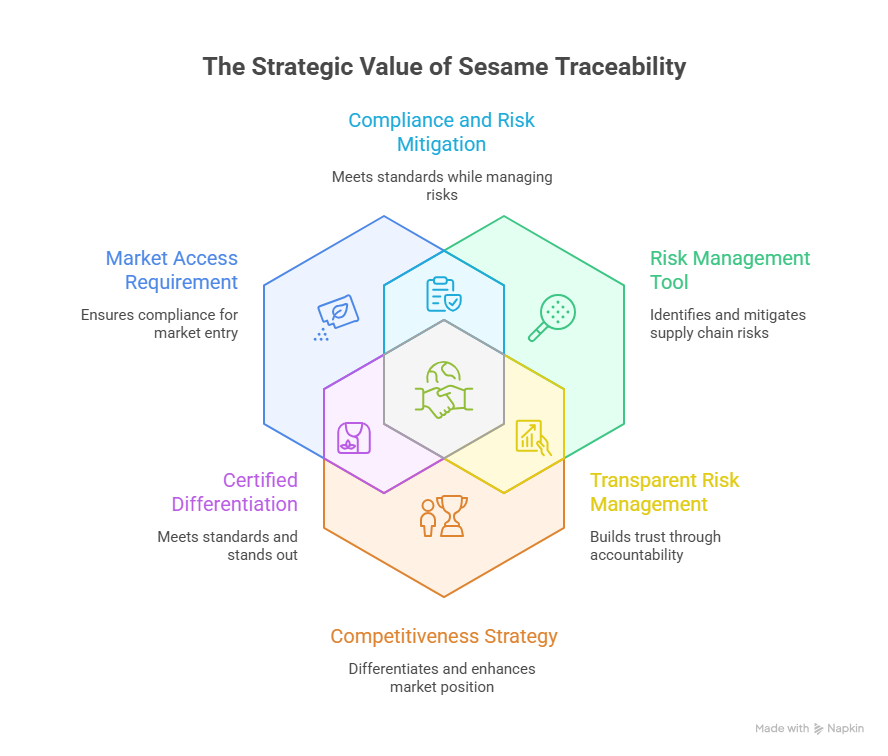
Nigeria is one of the world’s leading sesame producers, but global regulatory shifts and changing buyer expectations are redefining how sesame must be produced, documented, and exported. Market access is no longer determined solely by volume and price traceability, compliance, and verified sustainability are becoming decisive factors.
International markets, especially the EU, UK, and North America, are implementing stricter due-diligence and sustainability regulations that directly affect agricultural imports.
Key regulatory trends include:
For sesame exporters, this means batch-level traceability, farm location data (GPS/polygons), and digital audit trails are becoming prerequisites—not optional extras.
Without credible traceability, Nigerian sesame risks:
Major global buyers processors, food brands, and traders are restructuring procurement around risk management and transparency.
Buyer expectations increasingly include:
Even in traditionally price-driven markets like China and India, large buyers are beginning to demand:
Traceability is now viewed as insurance against supply chain risk, not just a compliance tool.
Nigeria’s sesame sector still relies heavily on:
These systems cannot:
As regulations and buyer audits increase, exporters using manual systems face higher costs, slower response times, and greater exposure to rejection or penalties.
Digitally traceable sesame unlocks:
Instead of competing only on volume, Nigeria can compete on:
verified origin, compliance, and reliability.
Traceability allows exporters to move from commodity sellers to trusted suppliers.
At a national level, traceable sesame supply chains:
Countries that digitize supply chains early will dominate future agricultural trade. Those that do not risk marginalization.
Traceability is no longer a peripheral concern for Nigeria’s sesame industry it is the foundation upon which future competitiveness, market access, and sustainability will depend. As global regulations tighten and buyers demand greater transparency, Nigeria’s ability to prove origin, legality, and responsible production will determine whether the sector grows or risks exclusion from premium and regulated markets. Implementing digital, end-to-end traceability strengthens trust across the value chain, reduces export risk, improves quality management, and positions Nigerian sesame as a reliable, compliant, and high-value product. By embracing traceability now, Nigeria can protect its export base, unlock new market opportunities, and ensure long-term value for farmers, exporters, and the national economy.
Struggling with visibility gaps? Discover how traceability can fix them in our Supply Chain Traceability Blog.
Transform your food supply chain with digital tools—explore the Digital Traceability for Food Systems Blog.
See how blockchain improves trust, transparency, and auditability—start with our Blockchain Traceability Blog.
Traceability in the sesame supply chain in Nigeria refers to the ability to track sesame seeds from farm-level production through aggregation, processing, and export using digital records, batch identification, and chain-of-custody systems.
Traceability helps Nigerian exporters meet international regulations, manage food safety and quality risks, and satisfy buyer requirements for ethical, non-GMO, and responsibly sourced sesame.
Key challenges include fragmented smallholder farming, multi-tiered informal aggregation, lack of digital farm records, poor post-harvest handling, and limited land-use documentation.
Digital traceability enables GPS farm mapping, digital farmer onboarding, batch-level tracking, and automated compliance reporting, improving transparency, efficiency, and export readiness.
Yes. Buyers in the EU, Asia, and the Middle East increasingly prefer traceable sesame. Verified origin and compliance allow Nigerian exporters to reduce rejection risk and access premium or long-term contracts.