
Quick summary: Discover how traceability in the sandalwood supply chain prevents illegal trade, verifies authenticity, ensures sustainability, and increases transparency using digital technologies.

Sandalwood is one of the world’s most valuable natural resources prized for its fragrance, therapeutic properties, and cultural significance. Traceability in the Sandalwood Supply Chain ensures that every stage from plantation and harvesting to transport, processing, and final product can be verified for legality, authenticity, and sustainability. Because sandalwood faces high risks of illegal logging, species misidentification, and fraudulent trade, robust traceability systems are essential. Modern digital tools such as blockchain, QR/RFID tagging, geolocation mapping, and digital permits create tamper-proof records that track the wood’s origin and movement. Effective Traceability in the Sandalwood Supply Chain strengthens regulatory compliance, prevents illegal trade, protects endangered species, and builds trust for global buyers and consumers.
As global demand surges across perfumery, wellness, cosmetics, and religious markets, the pressure on sandalwood-producing regions has intensified. This high value has also made sandalwood a target for illegal logging, poaching, species substitution, and black-market trade, threatening both biodiversity and the long-term viability of the industry.
Most sandalwood supply chains still rely on fragmented records, paper-based permits, and unverifiable sourcing claims. Without reliable traceability, regulators struggle to control illegal trade, exporters face compliance risks, and consumers cannot trust the authenticity of what they purchase.
To address these challenges, governments, conservation bodies, and industry leaders are rapidly prioritizing end-to-end supply-chain transparency. Digital traceability systems from blockchain to geolocation-linked tagging are emerging as essential tools to validate legality, protect endangered species, and ensure the credibility of sandalwood products in global markets.
In an industry defined by scarcity and risk, traceability is no longer optional it is the foundation for sustainability, compliance, and trust.
Key Takeaways
Sandalwood traceability is the systematic process of tracking sandalwood and its derivatives through every stage of the supply chain from cultivation and harvesting to transport, processing, and final consumer products. It provides a verifiable record of where the wood came from, how it was handled, and whether it meets legal and sustainability requirements.
Because sandalwood is one of the most heavily regulated and poached forest resources in the world, traceability ensures that only legally harvested and ethically sourced material enters global markets. This is especially critical for high-value products such as essential oils, incense, handicrafts, cosmetics, and pharmaceutical extracts, where authenticity and purity directly impact value.
Modern traceability relies on digital tools such as blockchain, QR/RFID tagging, GPS/polygon-based geolocation, digital permits, and tamper-proof chain-of-custody records. These technologies create a transparent and immutable data trail that regulators, brands, and consumers can trust. By linking each log or batch to its verified origin, traceability protects endangered species, prevents illegal trade, and enhances brand credibility.
In essence, sandalwood traceability transforms a traditionally opaque and high-risk supply chain into a transparent, accountable, and sustainably managed ecosystem.
Dive into our expert blog to understand why blockchain is becoming the backbone of transparent, tamper-proof supply chains.
Explore More: How Blockchain is Revolutionizing Traceability
Read our in-depth guide on designing, implementing, and scaling effective traceability frameworks across agri and commodity value chains.
Learn Best Practices for Building a Robust Traceability System
Despite its high commercial and cultural value, the sandalwood supply chain remains one of the most vulnerable and least transparent in the forestry sector. Multiple systemic challenges from illegal harvesting to fragmented sourcing make it difficult for regulators, producers, and buyers to ensure authenticity and sustainability. Below are the major obstacles that traceability solutions must address.
The global shortage of naturally occurring sandalwood has fuelled a thriving black market, driving illegal harvesting across India, Southeast Asia, and the Pacific.
High black-market demand: Sandalwood’s high price per kilogram makes it a prime target for timber poaching and smuggling networks who exploit loose monitoring.
Threats to endangered species: Species like Santalum album are highly vulnerable, and illegal extraction accelerates their depletion, threatening long-term ecological balance.
Weak monitoring in remote forest regions: Large, inaccessible forest areas lack adequate surveillance. Manual checkpoints, paper-based permits, and limited enforcement allow illegal wood to enter legitimate supply chains undetected.
This challenge creates huge compliance risks for processors and exporters who must prove their products are legally sourced.
The sandalwood supply chain is riddled with inconsistent and unreliable documentation, making verification extremely difficult.
Inconsistent or falsified permits: Harvesting and transport permits are often paper-based, making them easy to duplicate or forge. Fraudulent documents are a key loophole exploited by illegal traders.
Gaps in transport and storage records: Chain-of-custody disruptions such as missing transport logs or incomplete warehouse documentation create blind spots that weaken traceability and enable mixing of illegal wood.
A lack of standardized digital records prevents authorities and buyers from validating product origin with confidence.
Not all sandalwood is created equal. High-value species like East Indian sandalwood can be easily substituted or diluted without proper verification.
Difficulty distinguishing species: Different sandalwood species look similar in raw form. Without chemical analysis or digital tagging, misidentification is common even unintentionally.
Fraud in essential oils and wood derivatives: Adulterated or synthetic oils are often passed off as pure sandalwood in global markets, harming both brand credibility and fair-market pricing.
This challenge reinforces the need for reliable, tamper-proof tracking from tree to final product.
A significant portion of sandalwood production comes from dispersed smallholder farmers, making data collection and supply-chain management complex.
Diverse sourcing channels: Wood passes through multiple intermediaries farmers, agents, traders, processors—before reaching exporters. This multi-layered chain increases the risk of data loss, mixing, or misreporting.
No standardized data collection: Most smallholders still rely on manual logs or informal agreements. Without digital tools, it becomes difficult to record farm details, tree age, permit status, or harvest approval in a consistent format.
This fragmentation creates major obstacles for meeting regulatory requirements and proving legal origin to global buyers.
In a supply chain threatened by fraud, opacity, and environmental risk, these challenges highlight why digital traceability systems are essential for the future of sandalwood.
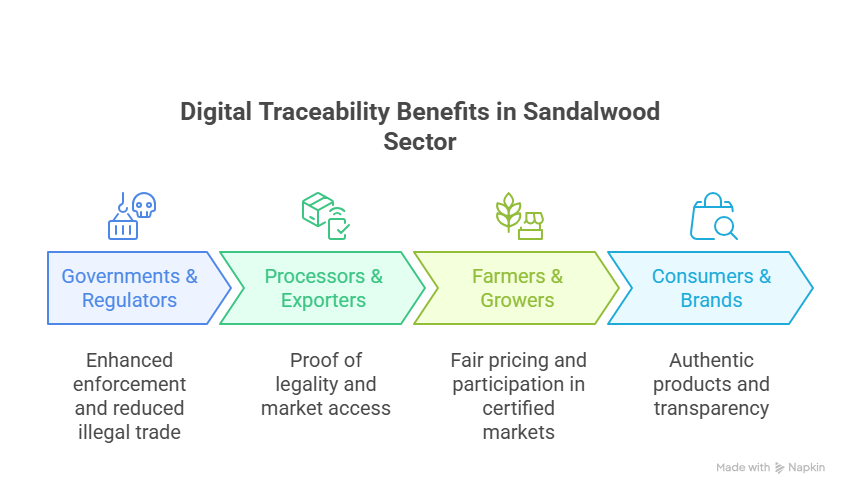
In a market where sandalwood is scarce, highly valuable, and tightly regulated, traditional paper-based systems are no longer sufficient to protect the integrity of the supply chain. Digital traceability has become essential to ensure legality, sustainability, and consumer confidence. Here’s why the future of sandalwood trade depends on transparent, technology-driven tracking systems.
Sandalwood harvesting is heavily regulated, requiring a series of approvals, permits, and compliance checks.
Digital traceability ensures:
With digital records stored securely and immutably, government authorities can audit and validate compliance far more efficiently than with manual paperwork. This reduces regulatory risk for growers, traders, and exporters.
Export markets especially in Europe, Australia, and the Middle East demand strong proof of legality and sustainability.
Traceability provides buyers with:
This assurance is increasingly becoming a prerequisite for high-value markets and long-term buyer relationships.
Illegal logging remains one of the biggest threats to global sandalwood resources.
Digital traceability prevents this by:
With every stakeholder accountable, unauthorized or unregistered wood finds fewer chances to enter legitimate channels.
Species substitution is a common problem in the sandalwood industry. Low-grade or synthetic oils are often mislabelled and sold as premium sandalwood products.
Traceability ensures:
This guarantees product authenticity and helps brands protect their reputation.
Manual audits involving paper documents, scattered records, and inconsistent data can delay certifications and export approvals.
Digital traceability offers:
This significantly reduces audit timelines and operational costs, enabling faster market entry.
Today’s consumers care deeply about ethical sourcing and environmental responsibility. Sandalwood brands especially in luxury, wellness, cosmetics, and perfumery gain a competitive edge with transparent supply chains.
Traceability enables:
Transparency builds lasting trust and enhances brand value in premium markets.
Digital traceability isn’t just a compliance tool it’s a strategic asset that safeguards biodiversity, improves supply-chain integrity, and elevates the credibility of every product derived from sandalwood.
Modern sandalwood supply chains rely on a combination of digital technologies to ensure legality, authenticity, and transparency at every stage—from plantation to finished product.
Blockchain for tamper-proof data: Blockchain creates immutable, timestamped records of harvest, transport, and processing, ensuring that data cannot be altered or manipulated. This builds trust among regulators, brands, and buyers.
IoT sensors for transport monitoring: IoT devices track real-time movement, temperature, storage conditions, and route deviations during transport, helping detect unauthorized stops or suspicious activity.
QR/RFID tagging for log and batch tracking: Each sandalwood log or batch is tagged with a unique QR or RFID code that links to its verified data trail—origin, permits, transport logs, and processing history.
Mobile apps for field data capture: Field officers can digitally record harvest details, tree age, GPS coordinates, and permit approvals directly from plantations, reducing paperwork and human error.
Satellite imagery for deforestation verification: High-resolution satellite data validates that sandalwood trees were grown on legally approved land and confirms no deforestation occurred in protected zones.
AI-driven fraud detection: AI analyzes patterns in sourcing, yield, and transport data to flag anomalies—helping identify potential mixing of illegal wood or inconsistencies in documentation.
Together, these technologies create an end-to-end digital chain of custody that strengthens compliance, sustainability, and trust in the sandalwood ecosystem.
Traceability in the sandalwood sector requires more than basic documentation it demands a secure, end-to-end digital ecosystem that brings together growers, regulators, processors, and exporters. TraceX delivers exactly this through a unified platform built to ensure legal compliance, transparent sourcing, and tamper-proof product verification. Here’s how the platform supports traceability across every stage of the sandalwood supply chain.
TraceX enables digital onboarding of sandalwood growers, estates, and plantations, linking each entity to verified farmer identities, land records, and geolocation data.
This creates the foundation for legally compliant sourcing and accurate farm-to-market transparency.
Sandalwood harvesting requires strict legal approvals. TraceX digitizes this process through structured workflows:
This eliminates paperwork bottlenecks and prevents fraudulent or duplicated permit submissions.
Each harvested log is assigned a unique QR code that captures its digital identity:
QR-based tagging ensures that logs cannot be substituted, mixed, or diverted without detection, enabling seamless tracking through processing and distribution.
TraceX secures every step of the supply chain using blockchain technology.
This gives regulators and buyers uncompromised confidence in product authenticity.
The platform includes intuitive dashboards offering a complete view of operations:
Real-time visibility allows supply chain managers to detect issues early and respond proactively, ensuring smooth and compliant workflows.
With all data digitally captured and linked across the supply chain, TraceX automatically generates:
These reports simplify audit processes for government regulators, certification bodies, and international buyers, ensuring faster approvals and smoother exports.
TraceX brings together traceability, compliance, and transparency into a single platform empowering the sandalwood industry to eliminate illegal trade, safeguard resources, and build trust with global markets.
Building a transparent and ethical sandalwood ecosystem begins with embracing digital transformation across the value chain. When growers, processors, regulators, and brands adopt unified digital traceability systems, the industry moves beyond reactive compliance toward proactive sustainability. By enabling verifiable proof of origin, legal harvesting, and responsible trade practices, traceability becomes the foundation for long-term environmental protection, global market confidence, and consumer trust. A collaborative approach powered by digital tools like blockchain, geolocation mapping, and QR-based tracking ensures that every piece of sandalwood is sustainably sourced, ethically managed, and future-ready.
Explore Our Guide to Traceability in Modern Supply Chains
Understand the fundamentals, frameworks, and tools that make end-to-end traceability achievable.
Read the full guide →
Discover the Impact of Fair Trade in Fragrance Supply Chains
Learn how fair trade principles are reshaping sourcing, empowering communities, and driving sustainable fragrance production.
Read the blog →
Learn How Ethical Sourcing Builds Responsible Value Chains
Dive into best practices and real-world strategies for building ethical, transparent, and consumer-trusted sourcing systems.
Explore the article →
Traceability ensures that sandalwood is legally harvested, sustainably sourced, and authenticated throughout the supply chain. It helps prevent illegal logging, species misidentification, and fraud while meeting regulatory and buyer requirements.
Digital tools like blockchain, QR/RFID tags, GPS mapping, and satellite imagery create secure, tamper-proof records of sandalwood’s origin, movement, and processing. This enables full transparency and real-time verification for regulators and buyers.
Traceability addresses issues such as illegal harvesting, falsified permits, fragmented sourcing, and adulteration of sandalwood oils. It creates a reliable chain of custody that protects endangered species and strengthens market trust.