
Quick summary: Traceability in the Cashew Supply Chain in Togo is essential for global market access. Learn how digital tools enable transparent, compliant, and premium cashew exports.

Traceability in the Cashew Supply Chain in Togo is essential as the country expands its role as a key West African cashew producer and exporter. With thousands of smallholder farmers, multiple intermediaries, and limited digital record-keeping, establishing farm-level visibility is critical for meeting buyer requirements and emerging regulations. Implementing digital farmer onboarding, GPS plot mapping, batch-level tracking, and transparent chain-of-custody systems enables exporters to verify origin, ensure quality, and demonstrate deforestation-free, legally sourced cashews. Strengthening traceability in Togo enhances market access, reduces fraud risks, and positions the sector for sustainable global trade.
Togo is an emerging cashew producer in West Africa, contributing steadily to regional and global supply of raw cashew nuts (RCN). Key growing zones such as Savanes, Kara, Centrale, and Plateaux regions are dominated by smallholder farmers cultivating cashew on fragmented plots. With growing export volumes to major markets including Vietnam, India, the EU, and the Middle East the cashew sector plays an increasingly important role in rural livelihoods and national economic growth. Togo produces approximately 35,000 – 40,000 metric tons of raw cashew nuts annually. The primary destination for Togolese raw cashews is India and Vietnam, where they are sent for processing.
Togo’s cashew supply chain generally follows a multi-tiered structure:
smallholder farmers → village collectors → regional aggregators → processors/traders → exporters.
While this system supports widespread participation, it also creates significant traceability and quality-control challenges. Heavy dependence on informal intermediaries leads to mixed or aggregated sourcing, making it difficult to identify farm-level origins for each cashew batch. Most farmers lack digital records, land tenure documentation, or GPS-based field mapping, resulting in minimal visibility into plantation boundaries, farming practices, or productivity.
These structural limitations introduce major traceability gaps including weak chain-of-custody tracking, inconsistent quality documentation, and limited verification of land legality or environmental compliance. As global buyers increasingly demand deforestation-free, ethically sourced, and fully traceable cashews, traditional manual sourcing systems in Togo are no longer adequate. To protect export competitiveness and meet stricter compliance requirements, Togo’s cashew industry must transition toward digitized, transparent, and verifiable supply chains that ensure full origin traceability and sustainable market access.
Read the full Sustainable Cashew Blog now.
From farm mapping to blockchain traceability, our Guide to Food Traceability breaks it all down. Read it now.
Togo’s cashew industry is growing rapidly, but achieving full traceability, sustainability, and export readiness requires overcoming several structural and operational obstacles. Addressing these challenges with scalable, digital solutions is essential for building a transparent, compliant, and globally competitive cashew supply chain.
Cashew production in Togo is dominated by smallholder farmers managing small, scattered plots often without formal land documentation, digital records, or structured farm data. This makes it difficult to verify origin, map plantation boundaries, or establish reliable traceability records.
Cashew-growing regions such as Savanes, Kara, and Centrale face limited connectivity, low smartphone penetration, and varying digital literacy among farmers and aggregators. These constraints hinder smooth data collection and real-time tracking.
Cashews typically pass through village collectors, community traders, and regional aggregators before reaching processors or exporters. This multi-layered structure increases the risk of mixing nuts from different farms, breaking the chain of origin and complicating traceability.
Mapping large numbers of smallholder farms and maintaining updated GPS/geospatial information is time-consuming and resource-intensive for local processors and exporters especially without digital tools.
Some farmers, collectors, or aggregators may hesitate to share data due to concerns about price impacts, increased oversight, or lack of clarity about how traceability benefits them. Building trust is essential to drive adoption and transparency.
A coordinated, technology-enabled approach supported by field training, farmer onboarding, and strong industry partnerships can help Togo transition from a fragmented system to a fully traceable, sustainable cashew supply chain that meets global market expectations.
TraceX Traceability platform provides the digital backbone needed to bring visibility, compliance, and trust into Togo’s cashew supply chain. By digitizing every step from farm-level production to export the platform helps exporters, processors, cooperatives, and buyers verify origin, monitor quality, and meet emerging regulatory standards like EUDR.
TraceX connects all supply chain actors smallholder farmers, aggregators, village collectors, traders, processors, and exporters into a single digital ecosystem.
This ensures:
This integrated system eliminates blind spots and prevents non-compliant or mixed-source cashews from entering the value chain.
The platform captures precise GPS coordinates or polygon maps for each cashew plantation, enabling exporters to:
This mapping is crucial for building credible, origin-verified cashew supply chains.
Using mobile tools, farmers are registered into the system with structured and authenticated data, including:
This reduces data gaps and creates a verified digital farmer network.
Every cashew batch receives a unique digital identity from the first point of aggregation. This ID follows the product through:
This ensures a full chain-of-custody, enabling exporters to trace shipments back to specific farms and harvest seasons.
TraceX uses blockchain to secure all records, ensuring they are:
Buyers gain reliable, audit-ready proof of origin critical for premium markets.
With all data digitized, TraceX automatically generates:
This reduces manual administrative work and ensures exporters remain export-ready at all times.
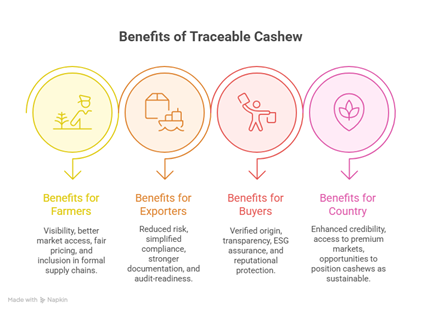
Global market expectations for cashew quality, sustainability, and ethical sourcing are rising rapidly, and this shift directly affects Togo’s cashew export sector. Major buyers in the EU, US, and Asia now require transparent proof of origin, legally sourced commodities, and deforestation-free production. Regulations ,strengthened due-diligence rules, and buyer-led ESG standards mean exporters must demonstrate full visibility from farm to shipment.
For Togo where cashew supply chains are dominated by smallholder farmers and informal intermediaries meeting these requirements is challenging without digital traceability. Lack of farm-level data, mixed-source aggregation, and limited documentation create risks of non-compliance, shipment rejection, and loss of access to premium markets.
Traceability becomes essential because it:
In a market where compliance and transparency now determine who gets buyer preference, traceability is no longer optional it is the key to safeguarding Togo’s cashew export future and unlocking high-value, sustainable trade opportunities.
Traceability in the Cashew Supply Chain in Togo is essential for securing long-term competitiveness, meeting global regulatory expectations, and strengthening buyer confidence. By adopting digital tools for farmer onboarding, geolocation mapping, and batch-level tracking, Togo can transform its fragmented cashew ecosystem into a transparent, compliant, and premium-ready supply chain. Investing in traceability today ensures that Togo’s cashew sector remains resilient, trusted, and fully aligned with the demands of modern international markets.
Struggling with visibility gaps? Discover how traceability can fix them in our Supply Chain Traceability Blog.
Transform your food supply chain with digital tools—explore the Digital Traceability for Food Systems Blog.
See how blockchain improves trust, transparency, and auditability—start with our Blockchain Traceability Blog.
Because global markets especially the EU, US, and Asia now demand verified origin, legal sourcing, and deforestation-free supply chains. Without traceability, shipments risk rejection.
Fragmented smallholder networks, lack of farm mapping, multi-tier aggregation, limited documentation, and poor data visibility across the supply chain.
Digital platforms enable farmer onboarding, plantation mapping, batch-level tracking, blockchain proof of origin, and automated compliance reporting.
Not necessarily. Many solutions offer offline data capture, cooperative-based data entry, and low-tech mobile tools that work even in low-connectivity regions.
It provides better access to formal markets, potential price premiums, stronger buyer relationships, reduced exploitation, and inclusion in certified and compliant export value chains.