
Quick summary: Learn how digital platforms enable supplier collaboration for Digital Product Passports (DPPs) through standardized data, lifecycle visibility, and scalable multi-tier engagement.

You cannot build a Digital Product Passport in isolation suppliers must co-create it. Supplier collaboration is the missing link in DPP success because Digital Product Passports depend on accurate, continuous data from multiple suppliers across Tier 1, Tier 2, and Tier 3. Supplier Collaboration for Digital Product Passports (DPPs) is enabled by digital platforms that centralize, standardize, and automate data exchange across multi-tier supply chains. These platforms replace manual questionnaires with structured, machine-readable workflows that allow Tier-1 to Tier-3 suppliers to securely share verified product, material, and lifecycle data.
While most brands understand the ESPR DPP requirements, they struggle to operationalize them due to fragmented supplier ecosystems, manual data exchanges, and inconsistent data quality. DPPs are not built through one-time data collection exercises they require coordinated, lifecycle-based data sharing across manufacturing, processing, and logistics partners. Without structured collaboration, upstream data gaps, delayed responses, and unverified declarations undermine passport accuracy, increase compliance risk, and threaten EU market access. In practice, enabling collaboration not just requesting data is the core challenge brands must solve to make DPPs work at scale.
By using standardized identifiers, event-based traceability, and automated validation, digital platforms ensure continuous data updates, audit-ready transparency, and regulatory alignment with ESPR requirements. This enables scalable supplier collaboration, reduces compliance risk, and ensures Digital Product Passports remain accurate, trusted, and market ready.
Key Takeaways
Supplier collaboration in the context of Digital Product Passports (DPPs) refers to a structured, ongoing exchange of standardized, verifiable data between brands and their suppliers across the entire product lifecycle. It goes far beyond one-time questionnaires, self-declared certificates, or annual audits. Instead, collaboration means suppliers actively contribute and maintain product, material, and process data as products are designed, manufactured, shipped, used, repaired, and recycled.
Effective supplier collaboration relies on shared data standards, ensuring information is machine-readable, interoperable, and aligned with ESPR requirements. It also requires continuous data updates, so DPPs remain accurate as materials, processes, or suppliers change. Finally, role-based access and accountability ensure each supplier provides only the data they own while brands retain visibility, validation control, and audit readiness. Without this structured collaboration, DPPs cannot remain compliant, trusted, or scalable.
Traditional supplier engagement models struggle to support Digital Product Passports (DPPs) because they were designed for a very different industrial reality one focused on cost, volume, and transactional efficiency rather than continuous, verified, product-level data sharing across the value chain. Below is a detailed, structured explanation of why these models fail when applied to DPP implementation.
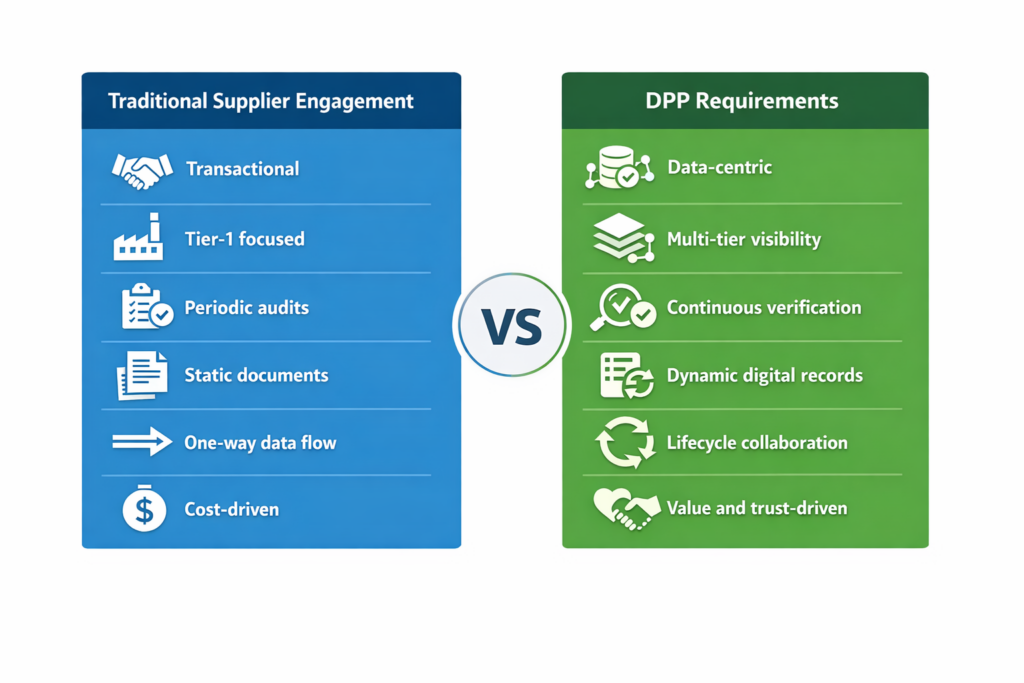
Supplier engagement has historically been built around:
Data exchange is episodic, limited, and often manual (PDFs, spreadsheets, emails).
DPPs require:
Most supplier engagement stops at Tier 1:
DPPs require:
Compliance is typically:
Documentation is often:
DPPs demand:
Suppliers often view data as:
OEMs often:
Successful DPPs require:
DPPs require:
Information flows:
DPPs require:
Supplier contracts focus on:
Data obligations are:
DPPs require contracts to define:
Learn why traditional engagement models fail and how ecosystem collaboration creates trusted, data-driven supply chains. Read the full blog now.
Learn how supplier mapping enables end-to-end traceability →
The DPP is a Multi-Tier Data Aggregator. It requires a level of collaboration that penetrates deep into the upstream supply chain because the most critical “truth” about a product its chemistry, its origin, and its impact is almost always held by Tier-2 and Tier-3 suppliers.
In a typical manufacturing chain (like textiles or batteries), your Tier-1 supplier is often just an assembly point. The “DNA” of the product is decided further upstream:
Historically, brands accepted a “Letter of Guarantee” from their Tier-1 suppliers.This is a high-risk compliance gap for two reasons:
The market has shifted from “Trust” to “Verified Transparency.”
Summary: The Collaboration Shift
| Feature | The Old Way (Tier-1 Only) | The DPP Way (Multi-Tier) |
| Data Source | Email/PDF from Tier-1. | Automated API/Blockchain from Tier-N. |
| Verification | “Trust me” declarations. | Immutable “Event-Based” evidence. |
| Risk Management | Reactive (responding to a scandal). | Proactive (mapping risks at the source). |
| Market Status | Compliance as a checkbox. | Transparency as a competitive asset. |
Digital Product Passports fundamentally change how supplier data must be collected, validated, and shared. Digital platforms act as the collaboration layer that makes this shift operational at scale. Their core value lies in centralization and standardization, without which DPPs cannot function reliably.
A centralized supplier collaboration hub is a single digital environment where all suppliers across tiers interact with the brand or manufacturer for DPP-related data, communication, and updates.
Digital platforms replace this fragmentation with:
Digital platforms:
Centralized platforms establish:
DPPs only work if data can move seamlessly across organizations and systems. Digital platforms enable this by enforcing standardized data structures and globally recognized identifiers.
Use of GS1 standards (GTINs, GLNs)
GS1 identifiers provide:
Digital platforms embed these standards to:
Structured, machine-readable data formats
Unlike PDFs or free-text spreadsheets, digital platforms enforce:
This allows:
Suppliers use different:
Digital platforms act as an interoperability layer by:
Event-based data sharing captures what happened, when, where, and to which product at every key stage manufacturing, processing, shipping, and transformation. Instead of relying on static declarations, suppliers contribute structured event records as activities occur.
By using EPCIS-aligned event data, each event (e.g., production completion, material transformation, shipment) dynamically feeds the Digital Product Passport. This keeps the DPP continuously updated and traceable across organizations and geographies.
As a result, DPPs evolve in near real time rather than remaining frozen snapshots. Changes in materials, locations, or processes are reflected immediately, supporting regulatory compliance, lifecycle transparency, and circular economy use cases.
Digital platforms automatically validate incoming supplier data through completeness and consistency checks, ensuring required fields are filled and values align across datasets. This reduces manual review and prevents errors from propagating downstream.
AI-driven risk scoring further assesses supplier data by identifying anomalies, inconsistencies, or high-risk patterns, allowing companies to focus verification efforts where they matter most.
Shared visibility into data status, validation results, and updates creates transparency across partners. When all parties see the same information, disputes decrease, rework is minimized, and collaboration becomes more efficient.
Supplier collaboration for DPPs only works when data is trusted. Automated validation and shared transparency turn data from a source of friction into a foundation for long-term partnership.
Supplier fatigue is one of the biggest barriers to scalable DPP adoption. Digital platforms reduce this friction by fundamentally changing how suppliers provide and manage data.
Suppliers submit data once in a structured, standardized format and can reuse it across multiple customers, products, and regulatory needs. This eliminates repetitive data requests and manual rework for each brand or compliance initiative.
Clear expectations embedded directly into the platform remove ambiguity. Suppliers know exactly which data fields are required, how they are validated, and how they will be used. Standardized formats replace ad-hoc spreadsheets and PDFs, reducing interpretation errors and resubmissions.
By relying on continuous, digital data flows instead of periodic, document-based audits, platforms significantly reduce audit pressure and duplicate verification requests. Validation is automated, and evidence is always available.
TraceX solutions enable supplier collaboration for DPPs by combining automation, global standards, and lifecycle data capture into a single scalable platform.
AI-powered supplier onboarding and validation guide suppliers through data submission, detect gaps or inconsistencies early, and prioritize high-risk data for review accelerating onboarding while improving trust.
GS1-aligned identifiers ensure that suppliers, products, components, and locations are uniquely and consistently identified across the value chain, enabling multi-tier traceability and interoperability across systems.
EPCIS-based lifecycle event capture allows manufacturing, transformation, and logistics events to feed DPPs dynamically, keeping product passports accurate and up to date throughout the lifecycle.
Finally, TraceX produces DPP-ready outputs aligned with ESPR, CSRD, and EUDR, translating complex regulatory requirements into structured, machine-readable data that can be shared with regulators, customers, and downstream partners.
Digital Product Passports are not a solo effort they succeed only through shared execution across the value chain. DPPs require ecosystem-level collaboration where suppliers, brands, and downstream partners contribute trusted data continuously, not sporadically. Digital platforms make this possible by providing the infrastructure for standardization, transparency, and real-time exchange at scale. Brands that invest in enabling suppliers digitally rather than pushing compliance downstream will move faster, reduce risk, and set the pace in increasingly regulated markets. In the DPP era, leadership will belong to those who build the ecosystem, not just the product.
Learn why lifecycle visibility is the foundation of compliant and circular products.
Discover how standards, identifiers, and data models enable seamless data exchange across systems, suppliers, and borders.
Learn how to collect, validate, and scale supplier data without creating fatigue or friction.
DPPs require data from multiple suppliers across the product lifecycle. Collaboration ensures accurate, complete, and continuously updated information from all tiers, which is essential for compliance and transparency.
Digital platforms centralize supplier interactions, standardize data formats, automate validation, and enable real-time data sharing making collaboration scalable and reliable across complex supply chains.
GS1 identifiers ensure consistent product and supplier identification, while EPCIS enables event-based lifecycle data sharing. Together, they support interoperability and traceability across systems and partners.
Suppliers submit data once in standardized formats and reuse it across customers and regulations. Automated validation and reduced audit duplication further lower effort and friction.
Yes. Digital platforms provide role-based access and standardized data models that enable Tier-1, Tier-2, and Tier-3 suppliers to contribute relevant data securely, supporting end-to-end DPP transparency.