
Quick summary: PPWR Conformity Assessment explained: learn how to evaluate packaging compliance, prepare technical documentation, manage Declarations of Conformity (DoC), and build audit-ready processes before the 12 August 2026 PPWR deadline.

If you are reading this, you are almost certainly inside one of three windows: you have just been told your team owns PPWR readiness, your auditor has asked where your packaging technical files live, or a customer has demanded a Declaration of Conformity (DoC) for an SKU shipping into the EU. What many organizations are only now realizing is that PPWR compliance does not begin with the Declaration of Conformity—it begins with the PPWR conformity assessment process that validates whether packaging meets the regulation’s essential sustainability, recyclability, labeling, and documentation requirements.
All three windows close on the same date: 12 August 2026.
From that day, every packaging type placed on the EU market needs a signed manufacturer DoC backed by a complete technical file. There is no grandfathering, no national exemption, and no transitional period. Stock that was perfectly legal in July becomes non-compliant in September if the paperwork is missing.
| 12 Aug 2026 | Hard deadline. Every packaging type on the EU market needs a DoC + Annex VII technical file from this date. |
| 27 | Member states applying PPWR directly — no national transposition, one set of rules. |
| 5–10 yrs | Mandatory retention period for the DoC and technical file (5 yrs single-use, 10 yrs reusable). |
| €20–50B | Estimated annual savings across the EU if PPWR targets are fully achieved (industry forecast). |
If your company sells packaging into the EU, PPWR conformity assessment is no longer optional it is the process that determines whether your packaging can legally remain on the market after 12 August 2026.
A conformity assessment evaluates whether packaging meets PPWR requirements related to recyclability, material composition, sustainability, labeling, and supporting technical documentation. It forms the foundation of the Declaration of Conformity (DoC) and requires organizations to collect, validate, and maintain packaging data across suppliers, materials, and product portfolios.
The biggest challenge is not completing the declaration itself. It is building the data, documentation, and governance processes needed to prove compliance at scale.
Organizations that start preparing now by centralizing packaging information, engaging suppliers, and establishing audit-ready compliance workflows will be significantly better positioned to avoid disruption, customer inquiries, and regulatory risks as PPWR implementation approaches.
The regulation reaches further than ‘packaging companies.’ Under Article 3, the manufacturer is whoever determines the packaging specifications choosing materials, dimensions, or placing a trademark on it. That single definition pulls brand owners, private-label retailers, and importers into the same compliance scope as packaging converters.
Most PPWR programmes do not fail on technical capability. They fail on data plumbing, supplier responsiveness, and the simple problem of nobody owning the workflow. These are the recurring patterns we see across mid-market and enterprise teams:
| ICP / Role | Primary PPWR Challenge |
|---|---|
| Compliance & Sustainability Leads | Coordinating 200+ packaging SKUs without a single source of truth |
| Packaging Engineers | Translating Articles 5–12 into concrete material and design changes |
| Procurement Teams | Forcing suppliers across Asia, UK, and the EU to deliver verifiable test data |
| Importers & Distributors | Verifying manufacturer DoCs they did not create and cannot easily audit |
| Quality & Regulatory Affairs | Maintaining 5–10 year technical files survivable to market surveillance audit |
| E-commerce & D2C Brands | Hitting the 40% empty-space limit on parcels while protecting fragile goods |
Industry reporting consistently shows most PPWR compliance gaps are caused by missing or unstructured supplier data not by packaging that fails the rules. A DoC cannot be signed without verified PFAS test results, PCR certificates of origin, and full material breakdowns including every coating, ink, and adhesive. Start the supplier engagement programme before the engineering programme.
Explore the key PPWR obligations, timelines, recyclability requirements, packaging design expectations, and compliance responsibilities that businesses must address before the 12 August 2026 deadline.
Read the full blog on PPWR Requirements →
Conformity assessment is the structured process a manufacturer follows to demonstrate, on paper, that a specific packaging type meets the substantive requirements of Articles 5–12 of Regulation (EU) 2025/40. PPWR uses one assessment procedure for nearly all packaging: Module A internal production control set out in Annex VII.
Module A is a self-declaration. There is no notified body, no third-party certification, no external audit step built into the routine path. The manufacturer prepares the technical file, performs the internal checks, signs the DoC, and stands behind both during any subsequent market surveillance review.
If any one of these three is missing or weak, the chain breaks. A DoC without a technical file is unenforceable. A technical file without a signed DoC is a draft. An assessment without either output is institutional knowledge that dies with the engineer who did it.
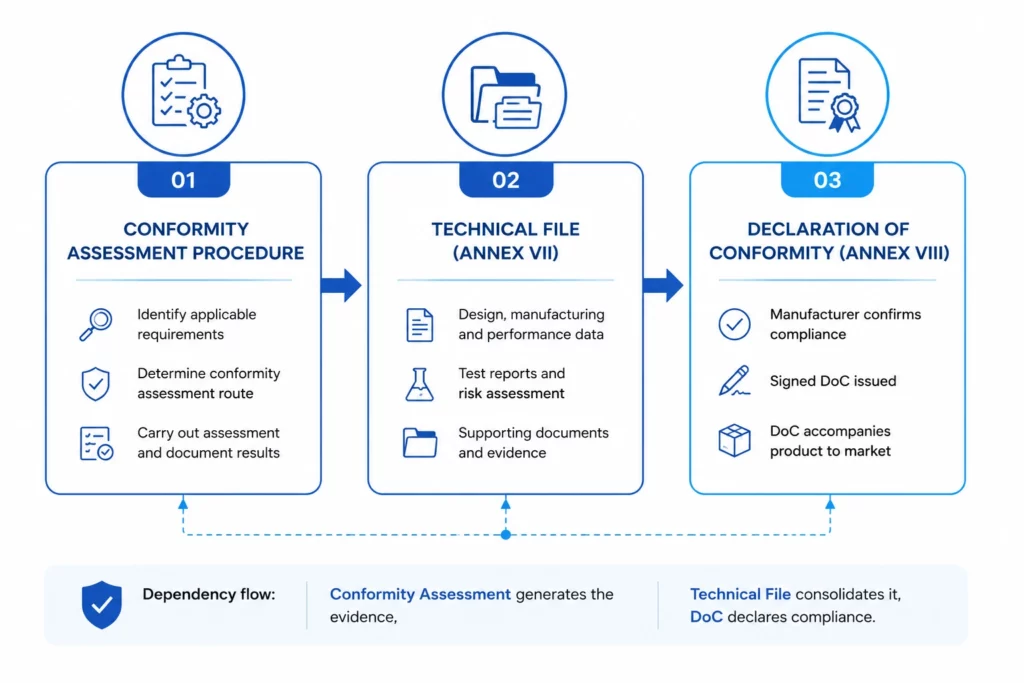
Discover how organizations can move beyond regulatory awareness and build practical, audit-ready PPWR compliance programs that reduce risk, improve data visibility, and support long-term market access in the EU.
Read the full blog on PPWR Compliance →
| Stage | Activity | What Happens |
|---|---|---|
| Step 1 | Packaging Inventory | Catalog every packaging type placed on the EU market by format, materials, weight, and supplier. |
| Step 2 | Applicability Mapping | Map each packaging type to applicable Articles 5–12 (minimization, recyclability, recycled content, substances, labelling). |
| Step 3 | Evidence Collection | Gather supplier declarations, test reports (PFAS, heavy metals), recycled content certificates, and recyclability assessments. |
| Step 4 | Technical File Assembly | Compile Annex VII technical documentation: BOM, drawings, standards used, assessments, test reports. |
| Step 5 | Internal Production Control | Run Module A self-assessment manufacturer verifies conformity without a notified body. |
| Step 6 | Draw Up the DoC | Issue the EU Declaration of Conformity per Annex VIII with a signature and unique reference. |
| Step 7 | Retain & Update | Hold the DoC and technical file 5 years (single-use) or 10 years (reusable); update when materials, suppliers, or rules change. |
PPWR frames the DoC at the packaging type level, not at the SKU level. A workable definition combines four attributes: packaging format, component structure, material composition, and compliance-relevant features. When any of these change in a way that could affect conformity a resin grade swap, a new supplier, a different ink you trigger a new type version with its own DoC.
Getting this granularity right is the single most important architectural decision in a PPWR programme. Define type too narrowly and you drown in DoCs. Define it too broadly and your evidence does not stand up to scrutiny.
The technical file is the documented evidence that gives the DoC legal weight. Under Annex VII, Module A, it must include — at minimum — the following components for each packaging type:
| Chemical and substance thresholds you must evidence For food-contact packaging from 12 August 2026: PFAS ≤25 ppb for any single PFAS, ≤250 ppb for the sum of targeted PFAS, and ≤50 ppm for all PFAS including polymeric PFAS. Heavy metals (lead, cadmium, mercury, hexavalent chromium) remain at the 100 mg/kg cumulative limit, with a Commission report on potential reductions due by 31 December 2026. |
Understanding these requirements early is critical for avoiding compliance gaps, supplier-data challenges, and last-minute remediation efforts as implementation deadlines approach.
Read the full blog on PPWR Packaging Requirements →
Mature teams break the technical file into numbered, version-controlled sections so a market surveillance authority can navigate it without your team in the room. A working scaffold looks like this:
The DoC is short usually a single page but every field matters. Article 39 requires that it follows the Annex VIII model and that it is signed by or on behalf of the manufacturer. Without a valid signature, the document has no legal standing. The required elements are:
| DoC is not CE marking The PPWR Declaration of Conformity is a separate, standalone obligation. It is not an extension of any product DoC and is not linked to CE marking. Teams that try to bolt PPWR onto an existing CE workflow usually end up with documentation that satisfies neither regime. |
Consider a mid-market confectionery brand, headquartered in Belgium, selling a 200g chocolate bar in a printed folding carton across 14 EU countries. The carton is sourced from a converter in Poland; the inner foil wrap is from a supplier in Germany. Here is what conformity assessment looks like in practice.
Type ID: PT-CARTON-200CHOC-v1. Format: folding carton. Components: virgin SBS board, water-based inks, water-based varnish. Compliance-relevant features: direct food contact via the inner foil (not the carton), printed external surfaces, EU-wide distribution.
Article 5 (minimisation): apply. Article 10 (recyclability): apply. Article 11 (recycled content): does not apply Article 11 targets plastic packaging. Article 12 (labelling): apply, with material composition label. Substances of concern: apply. PFAS in food contact: not directly applicable to the carton, but applies to the foil wrap component.
From the Polish carton converter: supplier declaration on heavy metals; test report on substances of concern; recyclability assessment under the prevailing design-for-recycling protocol. From the German foil supplier: PFAS test report at ≤25 ppb individual and ≤250 ppb sum; food-contact compliance statement. From the brand’s own design team: minimisation rationale documenting that the carton volume is the smallest viable given the product dimensions, the inner foil, and the secondary case-pack.
Build TF-01 through TF-08 for PT-CARTON-200CHOC-v1, store in the compliance document management system with version control, restricted edit access, and an audit log. Cross-reference each section to the applicable Article.
Brand’s Head of Packaging signs the Annex VIII DoC, references PT-CARTON-200CHOC-v1 and the technical file ID, and records the date. The DoC is placed on top of the technical file. Both are retained for 5 years from the last unit placed on the market (single-use packaging).
The brand documents what events force a new DoC version: a change of the foil supplier; a switch from water-based to UV-cured inks; a redesign that alters carton weight or dimensions; any new test result that changes a declared value; any future harmonised standard published by the Commission that affects this type.
PPWR is a phased regulation. The 12 August 2026 date is the headline event, but several obligations come in earlier notably the PFAS ban with no transitional period and several substantial design obligations land between 2027 and 2040.
| Date | Requirement | Status |
|---|---|---|
| 11 Feb 2025 | PPWR enters into force across all 27 EU member states. | Past |
| 30 Mar 2026 | Final European Commission Guidance + FAQ published. | Past |
| 12 Aug 2026 | Conformity Assessment, DoC, and Technical File mandatory; PFAS ban in food-contact packaging; 40% empty-space rule for e-commerce parcels. | Critical |
| 2027 | Digital labelling (QR codes) with environmental information. | Upcoming |
| 2029 | Reusable packaging labelling obligations apply (Art. 12(2)). | Upcoming |
| 2030 | Recyclability grades, recycled content minimums, reuse targets begin. | Upcoming |
| 2040 | Highest recycled content thresholds and end-state recyclability grades. | Upcoming |
Before touching templates, inventory every packaging type placed on the EU market. Most teams discover their actual portfolio is 20–40% larger than the SKU master suggests, once secondary and tertiary packaging, point-of-sale display, and e-commerce parcels are counted.
Most PPWR compliance gaps trace back to a supplier who cannot or will not produce a test report on demand. Rewrite supplier contracts in 2026 to include explicit PPWR warranties, audit rights, and indemnification tied to the August deadline. Build a supplier portal or shared workspace where DoCs, test reports, and PCR certificates can be deposited in standard formats.
The data infrastructure PPWR demands verified material composition, recycled content, recyclability grades maps directly onto ESRS E5 (Circularity and Waste Management) for CSRD and onto Ecodesign for Sustainable Products Regulation data points. Collecting it once and feeding multiple frameworks turns a compliance cost into a sustainability disclosure asset.
Article 21 reclassifies an importer or distributor as a manufacturer the moment they modify packaging or place their trademark on it in a way that could affect conformity. Many teams discover too late that an own-brand sticker on a third-party box has shifted the entire compliance burden onto them. Map your role per packaging type now and re-check whenever a product is repackaged or re-labelled.
A DoC without an explicit version, a technical file without a change log, or a supplier declaration without a date stamp creates ambiguity that auditors penalise. Pick the lowest-friction tooling that supports version control and access logs, even if it is a structured shared drive in year one.
| Penalty exposure Industry analysis points to potential fines of up to 4% of turnover for serious non-compliance with EPR registration and reporting (broadly comparable to GDPR-style upper bands), alongside reputational damage and supply chain disruption. The cost of a compliant programme is consistently lower than the cost of remediation under market surveillance pressure. |
PPWR conformity assessment requires organizations to collect, validate, and maintain large volumes of packaging-related data across suppliers, materials, products, and compliance workflows. For many companies, this information is often fragmented across spreadsheets, emails, technical documents, procurement systems, and supplier records.
TraceX helps organizations build a centralized, audit-ready compliance infrastructure that simplifies the PPWR conformity assessment process from data collection through Declaration of Conformity (DoC) preparation.
Centralized Supplier and Packaging Data Management
TraceX enables companies to collect and manage critical packaging information from suppliers. This creates a single source of truth for packaging compliance data.
Automated Supplier Data Collection and Validation
Through digital supplier onboarding workflows, TraceX helps organizations significantly reduce the administrative burden associated with conformity assessments.
Packaging Material Traceability
TraceX provides visibility into packaging materials across the supply chain, helping organizations understand and this supports the documentation and transparency requirements increasingly expected under PPWR.
Technical Documentation Management
PPWR conformity assessments rely heavily on supporting documentation. TraceX centralizes this data ensuring documentation remains accessible, version-controlled, and audit-ready.
Compliance Workflow Automation
Rather than managing conformity assessments through disconnected systems, TraceX helps organizations establish structured workflows and this improves governance and reduces compliance risk.
Declaration of Conformity (DoC) Readiness
By consolidating supplier information, packaging specifications, and supporting evidence, TraceX helps organizations prepare the documentation required to support PPWR Declarations of Conformity. This enables teams to move from reactive document gathering to proactive compliance management.
TraceX helps transform PPWR conformity assessment from a manual compliance exercise into a structured, scalable, and technology-enabled process.
The 12 August 2026 date is not a finish line it is the start of an ongoing operating discipline. Teams that build the workflow now, with version control and supplier data flowing in by default, will spend the second half of 2026 onboarding new SKUs rather than firefighting expired DoCs. Teams that wait will spend it explaining empty shelves.
For many organizations, PPWR conformity assessment may initially appear to be another regulatory obligation. In reality, it is rapidly becoming the foundation for demonstrating packaging compliance across the European market.
As the 12 August 2026 implementation deadline approaches, companies will need to do far more than maintain packaging specifications. They must be able to prove that packaging meets applicable PPWR requirements related to recyclability, material composition, labeling, documentation, and environmental performance. This requires structured supplier data, technical documentation, evidence management, and cross-functional coordination between packaging, procurement, sustainability, quality, and compliance teams.
The organizations that begin building conformity assessment processes now will be better positioned to avoid last-minute compliance risks, customer disruptions, and costly remediation efforts. In the PPWR era, conformity assessment is no longer simply a regulatory checkpoint it is becoming a core component of packaging governance, market access, and long-term operational resilience.
A PPWR conformity assessment is the process used to evaluate whether packaging complies with the requirements of the EU Packaging and Packaging Waste Regulation (PPWR). It involves reviewing packaging against applicable criteria such as recyclability, material composition, labeling requirements, sustainability obligations, and supporting technical documentation before a Declaration of Conformity (DoC) can be issued.
Responsibility typically falls on the economic operator placing the packaging on the EU market. Depending on the supply chain structure, this may include manufacturers, importers, brand owners, distributors, or packaging suppliers. Organizations must ensure they have sufficient evidence to demonstrate compliance and maintain supporting documentation for regulatory review.
The documentation required may include:
The exact requirements may vary depending on packaging type and applicable PPWR provisions.
The conformity assessment process provides the evidence needed to support the Declaration of Conformity. In other words, the DoC is the formal declaration that packaging complies with PPWR requirements, while the conformity assessment is the process used to verify and document that compliance. Without a properly completed conformity assessment, organizations may struggle to produce a defensible Declaration of Conformity.
Organizations should begin by:
Early preparation reduces compliance risk and helps ensure packaging remains eligible for placement on the EU market after PPWR implementation.
Non-compliant packaging cannot be legally placed on the EU market after 12 August 2026. Organizations with incomplete conformity assessments face potential market surveillance enforcement, product seizures, fines, and reputational damage. Starting preparation now significantly reduces compliance risk and ensures organizations are ready for regulatory requirements.