
Quick summary: Learn everything about PPWR compliance requirements, including packaging design standards, conformity assessment, declaration obligations, producer registration, recyclability rules, and EU packaging compliance workflows.
The EU Packaging and Packaging Waste Regulation (PPWR) requires every company that places packaging on the EU market to meet four core compliance obligations: (1) packaging design rules covering recyclability, minimization, and recycled content; (2) a conformity assessment with supporting technical documentation; (3) a formal Declaration of Conformity; and (4) registration in each EU member state’s producer responsibility register. PPWR Compliance Requirements help businesses understand packaging sustainability obligations, recyclability standards, reporting workflows, and material regulations needed to achieve full PPWR compliance across EU packaging supply chains.
Non-compliance can result in fines, market access restrictions, and inability to legally sell products in the EU.
1. PPWR is a regulation applies directly and uniformly across all EU member states.
2. Four obligations matter: design, conformity assessment, Declaration of Conformity, and producer registration.
3. Packaging compliance is now a lifecycle problem design feeds documentation, which feeds market access.
4. Data and traceability are the new compliance bottlenecks not paperwork.
5. Non-compliance puts EU market access at risk: fines, blocked shipments, and lost retailer trust.
The EU Packaging and Packaging Waste Regulation (PPWR) is a regulation that replaces the previous Packaging and Packaging Waste Directive with a directly-applicable, harmonized rulebook across all EU member states. Unlike a directive, a regulation does not need national transposition it applies uniformly and immediately.
PPWR transforms packaging compliance from a downstream waste-reporting exercise into a full lifecycle compliance system covering design, traceability, documentation, and market access.
PPWR (Packaging and Packaging Waste Regulation): an EU regulation mandating recyclability, minimization, recycled content, conformity assessment, declarations of conformity, and producer registration for any packaging placed on the EU market.
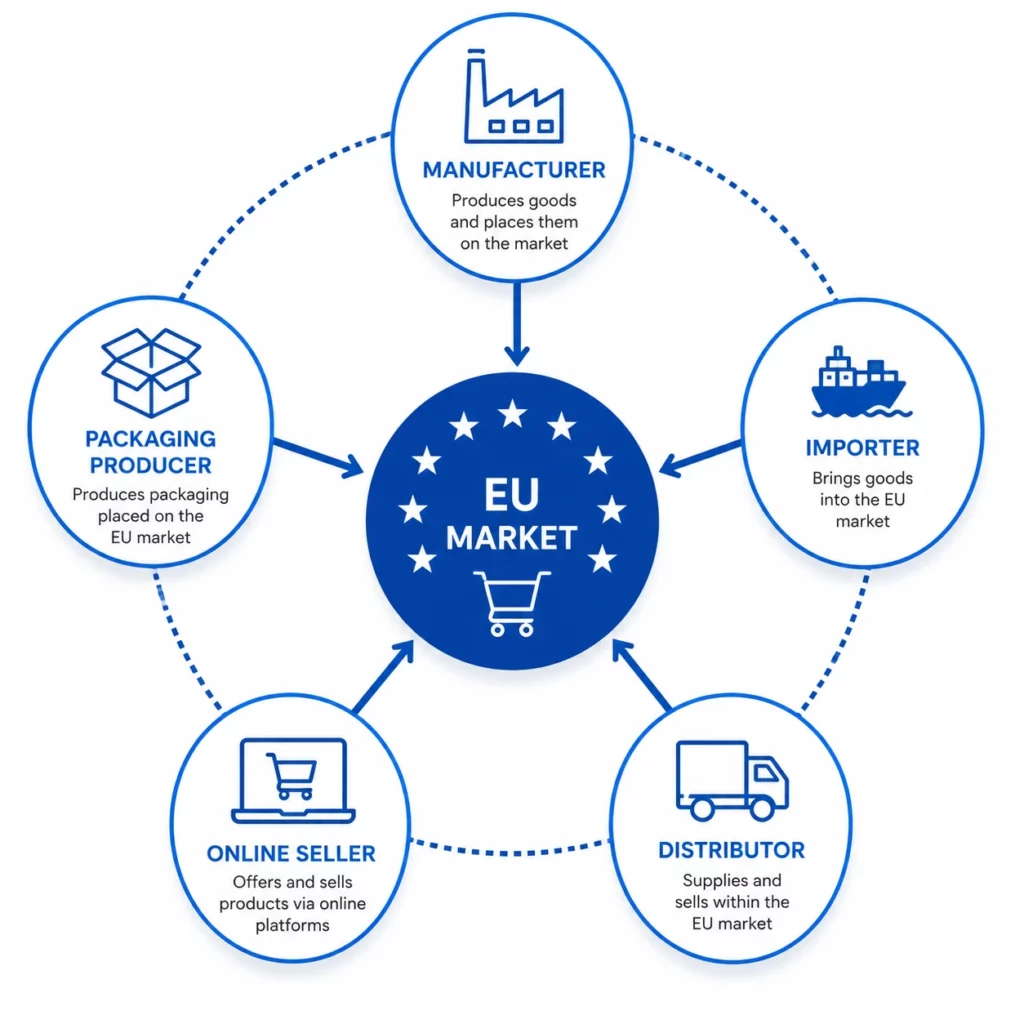
PPWR applies broadly. If your packaging touches the EU market directly or through a distributor the obligations likely apply to your business.
Read our “What Is PPWR?” blog to understand the Packaging and Packaging Waste Regulation, key compliance requirements, recyclability rules, sustainability obligations, and how PPWR impacts packaging supply chains across the EU.
PPWR compliance rests on four interlocking obligations. Each is a gate you must pass before and while your packaging is on the EU market.
| # | Obligation | What it proves | Owner |
|---|---|---|---|
| 1 | Design Requirements | Packaging meets recyclability, minimization and recycled content rules | Product / Packaging Design |
| 2 | Conformity Assessment | Compliance has been technically verified and documented | Compliance / R&D |
| 3 | Declaration of Conformity | Producer formally declares legal compliance | Regulatory / Legal |
| 4 | Producer Registration | Producer is registered in member state EPR registers | EPR / Sustainability |
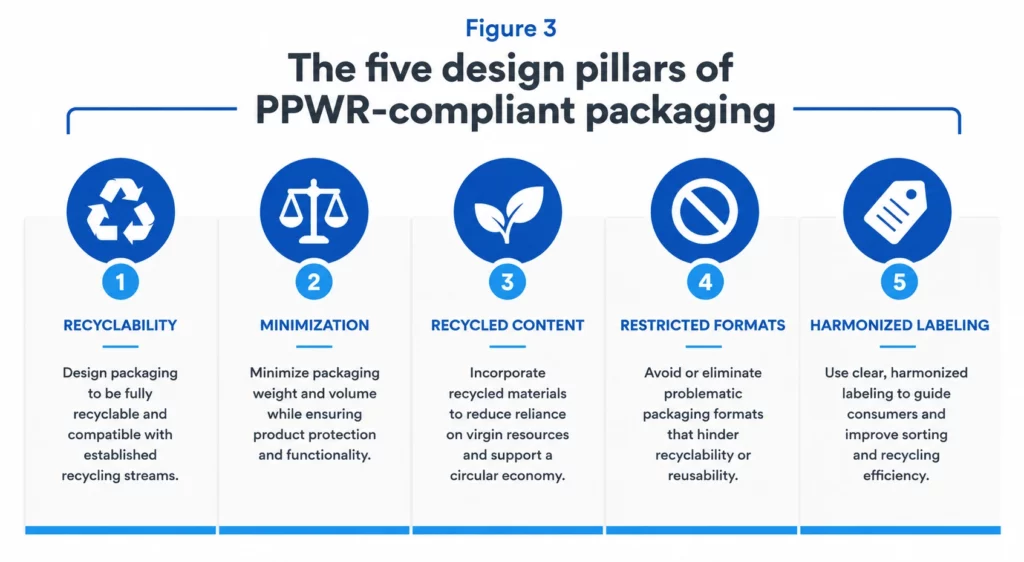
PPWR introduces mandatory design rules to align packaging with the EU’s circular economy objectives. Packaging that fails design requirements cannot lawfully be placed on the EU market.
Packaging must meet recyclability performance criteria across material composition, separability, sorting compatibility, and recycling-process compatibility. Materials that cannot be sorted or processed at scale will lose market access over time.
Producers must avoid unnecessary packaging volume and weight. Excess packaging empty space, redundant layers, oversized formats may be classified as non-compliant.
Certain plastic packaging categories will need to meet minimum recycled content thresholds, with claims substantiated by supplier evidence and chain-of-custody data.
Some single-use packaging formats may face restrictions or phase-outs. Producers should monitor the format-specific delegated acts as they are published.
Packaging may require harmonized labels covering material identification, disposal guidance, reuse instructions, and recyclability information replacing the patchwork of national symbols.
Design Checklist
Explore our PPWR Design Requirements blog to learn how the EU Packaging and Packaging Waste Regulation impacts packaging design, recyclability standards, material selection, reusable packaging systems, and compliance workflows.
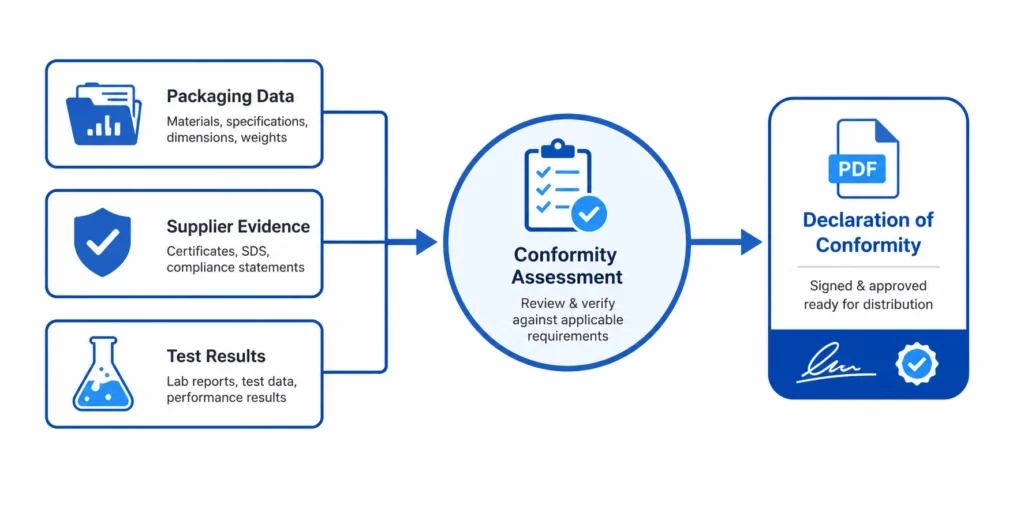
A conformity assessment is the structured process used to verify and document that packaging meets PPWR requirements. It is conceptually similar to other EU product-compliance frameworks such as CE marking but adapted to packaging.
Without a properly executed conformity assessment, packaging cannot legally enter the EU market. Customs and national authorities can block shipments, and EPR schemes can refuse registration.
Read our PPWR Conformity Assessment blog to understand how businesses can evaluate packaging compliance, meet EU regulatory requirements, manage technical documentation, and prepare for PPWR conformity verification workflows.
The Declaration of Conformity is the formal document where the producer legally declares that the packaging complies with PPWR. It is the public, accountable output of the conformity assessment process.
The DoC functions simultaneously as:
Operationally, this means companies must maintain structured packaging data, technical records, supplier documentation and traceability evidence — all aligned to the DoC.
Explore our Declaration of Conformity in PPWR blog to learn how businesses can prepare compliant packaging declarations, manage supporting documentation, and meet EU Packaging and Packaging Waste Regulation requirements.
PPWR strengthens Extended Producer Responsibility (EPR). Any company placing packaging on the EU market typically must register in each member state’s national producer responsibility register where its packaging ends up.
Manufacturers, importers, distributors, online sellers, and packaging producers placing packaging into a member state market.
Registration is the operational backbone of EPR it supports packaging waste reporting, EPR fee calculation, waste-management accountability, and enforcement oversight.
Consequences of Failing to Register
Read our Producer Registration in PPWR blog to understand registration requirements, producer obligations, compliance documentation, and how businesses can prepare for EU Packaging and Packaging Waste Regulation compliance.
PPWR moves packaging compliance from a back-office reporting task into a structured, evidence-based lifecycle system. The change is fundamental:
| Old World (Directive) | New World (PPWR) |
|---|---|
| Waste reporting after the fact | Lifecycle compliance from design forward |
| Fragmented national rules | Harmonized EU-wide regulation |
| Limited design requirements | Mandatory recyclability, minimization, recycled content |
| Light traceability expectations | Supplier and material traceability required |
| Paper-based records acceptable | Digital, audit-ready documentation expected |
To manage PPWR obligations sustainably not just survive the first audit companies increasingly need the following capabilities:
Under PPWR, packaging compliance is becoming a data and traceability challenge as much as a sustainability one. Companies that treat it as a data-management problem will move faster, cheaper, and with less risk than those treating it as paperwork.
Use this phased roadmap to operationalize PPWR without overwhelming your teams:
If your company places packaging on the EU market and you have not yet mapped your SKUs to PPWR obligations, start with two actions:
From there, the conformity assessment, Declaration of Conformity, and producer registration become structured workflows rather than reactive scrambles.
PPWR stands for Packaging and Packaging Waste Regulation. It is an EU regulation governing the design, market access, and end-of-life management of packaging placed on the EU market.
Any company placing packaging on the EU market manufacturers, importers, distributors, online sellers, and packaging producers must comply with PPWR, regardless of where the company itself is headquartered.
The four core obligations are: (1) packaging design requirements (recyclability, minimization, recycled content); (2) conformity assessment; (3) Declaration of Conformity; and (4) registration in member-state producer responsibility registers.
A Declaration of Conformity is a formal document in which the producer declares that the packaging complies with PPWR requirements. It references the conformity assessment, technical documentation, and supporting evidence.
A conformity assessment is the structured process used to verify and document that packaging meets PPWR design and performance requirements. It includes material review, recyclability evaluation, recycled content verification, and technical documentation.
Yes. PPWR introduces minimum recycled content thresholds for certain plastic packaging categories. Producers must substantiate recycled content claims with supplier evidence and chain-of-custody documentation.
PPWR is a regulation (directly applicable EU-wide), while the previous framework was a directive requiring national transposition. PPWR also introduces stricter design rules, mandatory recyclability, recycled content thresholds, and harmonized labeling.
Non-compliance can result in administrative fines, market access restrictions, inability to legally sell products in the EU, and reputational damage with retailers and customers.
Yes. Any non-EU company placing packaging on the EU market directly or through importers, distributors, or online channels is in scope of PPWR obligations.
Required documentation typically includes packaging technical specifications, recyclability evidence, recycled content verification, supplier declarations, the conformity assessment, and the signed Declaration of Conformity.