
Quick summary: Who are MSPOs under EUDR? Learn the criteria, compliance requirements, risks, and what micro and small primary operators mean for supply chains and due diligence.
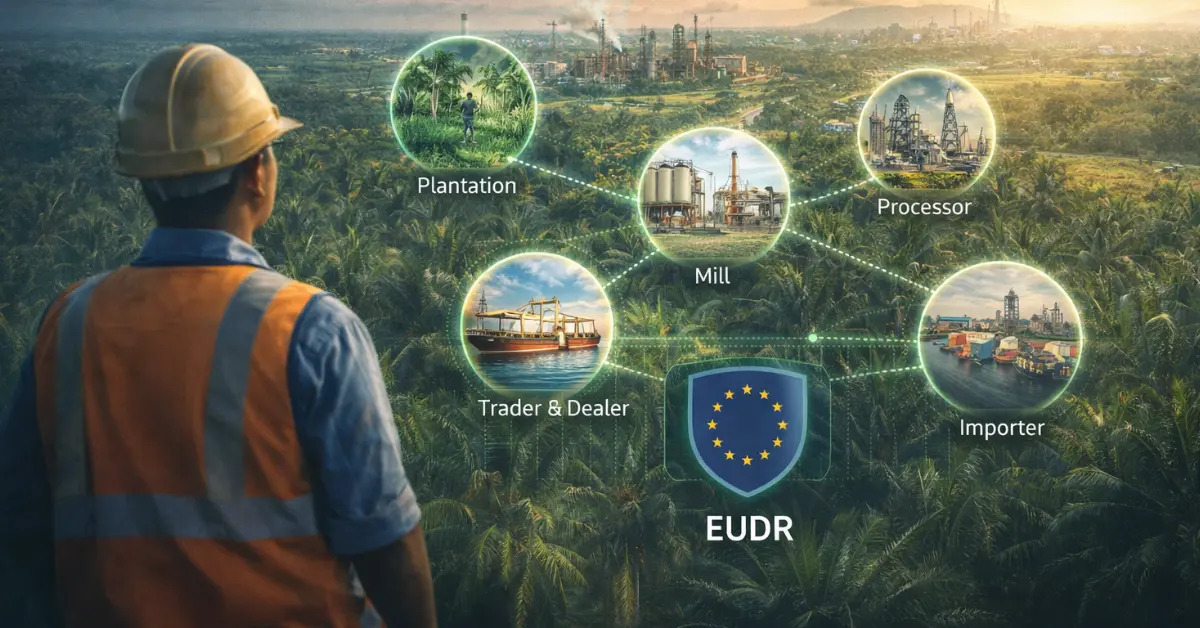
Your EU buyer just sent an email asking for your Due Diligence Statement. You’ve heard of EUDR. You know it’s about deforestation. But you’re not sure whether your business qualifies as an ‘operator,’ what data you’re legally required to collect, or what happens if that shipment arrives in Hamburg without a verified DDS. You’re not alone. Thousands of agri-food exporters, commodity processors, and supply chain managers across India, Southeast Asia, and Africa are in exactly this position somewhere between awareness and operational readiness. MSPO (Market Supply Process Operator) under EUDR is the practical term for operators embedded in the production-to-export supply chain, processors, exporters, aggregators, and commodity traders originating from producing countries like India, Indonesia, Brazil, Ivory Coast, or Vietnam. Their compliance deadline has already passed for large operators (December 30, 2025); SMEs face a revised deadline of June 30, 2026.
Under the EU Deforestation Regulation (EUDR), an ‘operator’ is any natural or legal person who places regulated commodities or derived products on the EU market or exports them. If your business supplies coffee, cocoa, palm oil, soy, rubber, cattle, timber, or derived products into the EU supply chain you are almost certainly an operator, regardless of where your company is headquartered.
This guide gives you a clear, actionable answer: who MSPOs are under EUDR, what their specific obligations are, where most compliance programs fail, and how to build a data pipeline that satisfies EU authorities and how TraceX Solutions help.
The European Commission estimates that over 140,000 companies worldwide are in scope for EUDR obligations. The regulation defines an operator as any person who, in the course of commercial activity, places relevant products on the EU market or exports them.
‘Placing on the market’ is the critical trigger phrase. It means making a product available for the first time on the EU market, whether through import, sale, distribution, or any commercial transfer. Importantly, this includes non-EU companies that export to EU-based buyers. If a coffee exporter in Vietnam ships green coffee beans to a roaster in Germany, that Vietnamese exporter is placing a product on the EU market.
This is where many emerging-market businesses miscalculate their exposure. They assume EUDR applies only to EU importers or EU retailers. It doesn’t. If your commodity ends up in the EU at any point in the chain someone must hold a valid Due Diligence Statement. And increasingly, EU buyers are contractually pushing that obligation upstream to their direct suppliers.
If all three apply, you have operator obligations regardless of company size, country of incorporation, or whether you’ve previously received requests from EU buyers.
Under EUDR Article 2(8), an ‘operator’ is defined as any natural or legal person who, in the course of a commercial activity, places relevant products on the market or exports them. This definition explicitly captures non-EU exporters whose commodities are destined for EU buyers a fact routinely overlooked by supply chain teams in producing countries. [CITE: EU Regulation 2023/1115, Official Journal of the EU, June 2023]
MSPO stands for Market Supply Process Operator. While not a term used verbatim in the EUDR legal text, it has become the practical shorthand for the class of operators most directly exposed to compliance risk: processors, aggregators, exporters, and commodity traders operating in producing countries who serve EU-bound supply chains.
Think of a Vietnamese coffee processor consolidating lots from 1,200 farmers across Dak Lak province, or a Ghanaian cocoa cooperative aggregating beans from 4,000 smallholder plots. Each of these entities is an MSPO a market-facing operator with direct obligations to verify deforestation-free sourcing, collect geolocation data from their supply base, and generate a compliant DDS before goods cross the EU border.
The European Commission estimates that supply chains for EUDR-listed commodities involve over 5 million smallholder farmers globally. In India alone, over 3.5 million farmers grow commodities covered by EUDR. Across Indonesia, Vietnam, and Ivory Coast, the number runs into the tens of millions.
For an MSPO managing a supply chain of 500-5,000 smallholder farmers, collecting GPS polygon coordinates for every plot a core EUDR requirement is not a legal problem. It’s an operational one. Paper-based collection methods fail at this scale. Manual data entry creates errors that invalidate DDS submissions. And the absence of plot-level data is the single most common reason EU buyers reject shipments from emerging market suppliers.
| Operator Category | Key Obligation / Deadline |
|---|---|
| Large Operators (non-SME) | Full DDS compliance – Deadline: December 30, 2026 |
| SME Operators | Full DDS compliance – Deadline: June 30, 2027 |
| Micro-enterprises | Simplified due diligence where downstream DDS exists |
| Traders (non-SME) | Collect and store DDS reference numbers; simplified declaration |
| Non-compliance penalty | Up to 4% of annual EU turnover; shipment confiscation; market ban |
The EUDR requires operators to provide the geolocation coordinates of all land parcels where relevant commodities were produced. For supply chains involving smallholder farmers, this means GPS data at plot level not village or district level. Failure to provide parcel-level coordinates is grounds for DDS rejection by EU customs. [CITE: EUDR Article 9, EU Regulation 2023/1115, 2023]
EUDR compliance for an MSPO is built on three pillars: due diligence, data collection, and documentation. Each has specific operational requirements that go well beyond ticking legal checkboxes.
Operators must establish a due diligence system capable of collecting information, assessing risk, and mitigating any identified risk of deforestation or illegality before placing products on the market. This system must be updated annually and made available to competent authorities on request.
This is where most MSPOs face their hardest challenge. EUDR Article 9 requires geolocation coordinates for all land where the commodity was produced. For smallholder supply chains, this means plot-level GPS polygons not addresses, not village names, not district boundaries.
For an exporter working with 2,000 farmers across fragmented geographies with limited connectivity and varying levels of digital literacy collecting verified polygon data requires mobile-first field tools, offline functionality, and agent-assisted data capture. The regulation doesn’t relax this requirement for smallholder supply chains. It just makes the operational challenge harder.
Before placing products on the EU market, the operator must submit a DDS to the EU’s TRACES system. The DDS is a formal declaration that due diligence has been conducted and that the risk of deforestation has been assessed as negligible. Once submitted, the DDS gets a reference number that must accompany the shipment throughout the EU supply chain.
A DDS is not a one-time document. Each new shipment, each new production season, each change in the supply base requires an updated or new DDS. For high-volume exporters, this means a systematic, automated approach to DDS generation not a manual, spreadsheet-based process.
EUDR guides written in Brussels often miss the realities on the ground in Coorg, Aceh, or Oromia. Here are the five compliance challenges MSPOs actually face and why each one threatens market access if left unresolved.
The GPS polygon requirement hits hardest in supply chains with 500+ smallholder farmers. Many farmers don’t own smartphones. Connectivity is unreliable. Plots are rarely formally surveyed. Collecting accurate, validated polygon data requires field agents with offline-capable mobile tools and a back-end that validates coordinates against deforestation risk layers like Hansen and JRC datasets.
See how TraceX enabled end-to-end cocoa traceability and EUDR compliance across Africa. Discover how blockchain, geospatial intelligence, and AI are transforming sustainable sourcing – explore the full case study.
Most MSPOs still manage supplier data across spreadsheets, physical registers, and local procurement software. The EUDR requires structured, traceable, exportable data none of which is possible when your supply chain lives in an Excel file and a stack of purchase orders. Data fragmentation is the single biggest driver of DDS rejections and delayed submissions.
Supply chains in commodity agriculture are not static. Farmers change. Plots change. Aggregators shift. A DDS submitted in October may be inaccurate by February if the supply base isn’t monitored continuously. MSPOs need real-time deforestation alerts not annual audits to maintain continuous DDS validity.
Supplier onboarding tools designed for European procurement teams fail in the field. Forms in English, requiring document uploads, assuming smartphone proficiency none of these work at the last mile of a cocoa or spice supply chain. Multilingual, offline-first, agent-assisted onboarding is a compliance requirement disguised as a UX problem.
Large MSPOs have existing ERP and procurement systems that hold partial supplier data. The challenge isn’t collecting data from scratch it’s integrating legacy systems with a new EUDR compliance layer that can pull, enrich, and validate that data without duplicating workflows. API-first integration architecture separates platforms that solve this from those that create more work.

| Commodity | Key Exporting Region | Risk Level / EU Import Volume |
|---|---|---|
| Soy | Brazil / Argentina | HIGH – 12.3B/yr |
| Palm Oil | Indonesia / Malaysia | HIGH – 7.1B/yr |
| Coffee | India / Vietnam | HIGH – 4.2B/yr |
| Cocoa | Ivory Coast / Ghana | HIGH – 3.8B/yr |
| Rubber | Thailand / Vietnam | MEDIUM – 1.9B/yr |
Source: European Commission EUDR Impact Assessment, 2023; EU Trade Statistics, 2024.
Submitting a compliant DDS isn’t just a form-filling exercise. It requires a complete data pipeline from farm to submission system. Here’s what that pipeline looks like in practice.
For MSPOs managing hundreds of suppliers across fragmented geographies, steps 2-4 represent the highest operational burden. EUDR Solutions from TraceX automate GPS collection via offline mobile apps, validate coordinates against JRC and Hansen datasets in real time, and generate audit-ready DDS documentation with one-click export to the TRACES system turning a 6-week manual process into a 72-hour automated workflow.
EUDR draws a critical distinction between operators and traders and your classification determines your compliance workload.
| Dimension | Operator (MSPO) | Trader |
|---|---|---|
| Definition | Places product on EU market for first time, or exports it | Supplies product already on the EU market to another actor |
| DDS Obligation | Must conduct full due diligence and submit DDS | Must collect and store DDS reference numbers from operators |
| Geolocation | Full GPS polygon data required | Can rely on operator’s DDS reference |
| Risk Assessment | Must independently assess deforestation risk | Simplified – relies on operator’s assessment |
| Penalties | Up to 4% of annual EU turnover | Up to 4% of annual EU turnover (same exposure) |
| Typical Actor | Exporter, processor, aggregator, commodity trader | EU importer, distributor, wholesaler buying already-placed goods |
If an EU importer purchases directly from a non-EU exporter (MSPO) and that’s the first entry point of the commodity into the EU market, the importer is the legal operator but they require the MSPO to provide all underlying geolocation and due diligence data. In practice, the data collection obligation falls on the MSPO even if the legal operator entity is the EU importer. Your EU buyer’s compliance depends on your data.
EUDR Article 2(15) defines a ‘trader’ as any person in the supply chain other than the operator who makes relevant products available on the market. Traders face simplified due diligence obligations but carry the same penalty exposure as operators for non-compliance. [CITE: EU Regulation 2023/1115, Article 2, June 2023]
The compliance challenge for MSPOs isn’t understanding EUDR. It’s building the data infrastructure to meet its requirements across supply chains that were never designed with regulatory traceability in mind.
TraceX’s Regulatory Compliance Platform is purpose-built for this exact problem specifically calibrated for emerging market supply chains where smallholder farmers are the production backbone.
Customers have used TraceX to build EUDR-ready supply chains across complex, high-volume commodity networks without increasing headcount or replacing existing procurement systems.
If you’re an agri-food exporter, commodity processor, or supply chain aggregator supplying EU-bound markets with coffee, cocoa, palm oil, soy, rubber, or timber, the question isn’t whether EUDR applies to you. It does. The question is whether your operational infrastructure can actually meet the data requirements that make compliance real.
MSPOs face the hardest version of this challenge not because the regulation is unclear, but because it requires farm-level data precision across supply chains that have historically operated on trust, paper, and good relationships. GPS polygons. Satellite validation. Continuous deforestation monitoring. AI-generated DDS at scale.
That’s the gap TraceX closes. Not just compliance as a checkbox compliance as a defensible, auditable, continuously maintained data infrastructure that your EU buyers can rely on and regulators can verify.
EUDR compliance is more than a checklist. Learn how to build a robust, audit-ready system that ensures market access and reduces risk.
Geolocation is at the core of EUDR. Discover how to capture and validate plot-level data for compliant sourcing.
Filing a Due Diligence Statement (DDS) can be complex. Learn the step-by-step process to ensure accurate and compliant submissions.
An operator is any entity that places regulated commodities on the EU market for the first time or exports them including non-EU exporters and processors. A trader is any subsequent supply chain actor who makes already-placed products available within the EU. Operators carry full DDS submission obligations; traders carry simplified obligations but face the same penalty exposure.
Yes. EUDR applies to any person placing regulated commodities on the EU market regardless of where their company is headquartered. A coffee exporter in Vietnam shipping to a German importer is placing a product on the EU market and is directly in scope for operator obligations, including DDS submission. Most EU buyers now contractually require non-EU suppliers to provide geolocation data and due diligence documentation.
EUDR covers seven primary commodities: cattle, cocoa, coffee, palm oil, soy, wood, and rubber plus over 30 derived products including chocolate, leather goods, furniture, paper, tires, and cosmetics. The full list is in EUDR Annex I. If your product contains any listed ingredient sourced from potentially forested land deforested after December 31, 2020, it’s in scope.
Failure to submit a compliant DDS can result in: shipment confiscation at EU borders, prohibition from placing products on the EU market, financial penalties of up to 4% of annual EU-wide turnover, and exclusion from public procurement. Penalties scale with the severity and duration of non-compliance.
Proof requires GPS polygon coordinates for every production plot, validated against satellite deforestation data layers (JRC Tropical Moist Forest, Hansen Global Forest Change). For smallholder supply chains, this requires field agent-assisted GPS capture using offline-capable mobile tools, plot-level risk scoring, and continuous satellite monitoring. Certification schemes like Rainforest Alliance or Fairtrade can support but do not replace EUDR due diligence requirements.