
Quick summary: Processing doesn't erase EUDR obligations. Learn how HS-code transformation shapes operator roles, DDS continuity, and compliance with 5 commodity examples.

HS-code transformation under EUDR determines whether your business is an upstream or downstream operator and whether your Due Diligence Statement (DDS) obligations continue, transfer, or end. Processing a regulated commodity rarely removes EUDR exposure; in most cases, the obligation simply moves down the chain. The operator role depends on first placement on the EU market and how the HS code shifts within Annex I not on the manufacturing activity itself.
A coffee roaster in Hamburg. A paper mill in Finland. A tyre manufacturer in Tamil Nadu shipping to Rotterdam. On paper, three different industries. Under EUDR, they share one question: does our HS-code transformation change our compliance obligation?
The EU Deforestation Regulation has quietly rewritten how companies assess exposure. It’s no longer enough to know which commodities you handle. You now have to know which HS chapter you enter the EU market under, which operator role that triggers, and whether DDS continuity survives the processing step.
This isn’t a customs question anymore. It’s a supply-chain governance question one that affects market access, supplier onboarding, and DDS architecture.
Key Takeaways
• Under EUDR, your operator role is decided by first placement on the EU market combined with HS-code interpretation under Annex I not by how much processing you do.
• Many companies wrongly assume that roasting, milling, compounding, or manufacturing a regulated commodity erases their DDS obligation. It usually doesn’t.
• Companies using digital traceability platforms from TraceX can map HS codes to operator roles, maintain DDS continuity across processing steps, and stay audit-ready before the next EU verification cycle.
According to the European Commission’s EUDR FAQ, the operator who first places a relevant product on the EU market carries the primary Due Diligence obligation. Everyone downstream still has obligations but the type of obligation shifts based on whether they’re an SME and whether the HS code changes meaningfully.
Upstream operator: the entity that imports or first places a regulated commodity on the EU market in its original Annex I form (e.g., green coffee beans, raw rubber, wood pulp). They generate the original DDS.
Downstream operator: any entity that processes, re-sells, or uses a product already placed on the EU market. Non-SME downstream operators must reference upstream DDS numbers, verify due diligence has been done, and submit their own DDS for derivative products that remain in Annex I scope.
Most published EUDR explainers treat ‘operator’ as a single role. In practice, large non-SME downstream operators carry near-identical reporting burdens to upstream operators they just inherit the geolocation and risk-assessment data instead of collecting it firsthand. This distinction drives 60–70% of compliance-tooling decisions we see across enterprise rollouts.
Key takeaway: Your role is decided by market placement + HS-code interpretation not by manufacturing activity.
| Dimension | Upstream Operator | Downstream Operator (non-SME) |
|---|---|---|
| First placement on EU market | Yes | No |
| Generates original DDS | Yes | No — references upstream DDS |
| Geolocation collection | Mandatory | Verifies upstream data |
| Risk assessment | Full | Confirms + monitors |
| Audit exposure | High | High (joint liability) |
| Typical example | Importer of green coffee | EU-based roaster, paper mill |
Source: Based on Regulation (EU) 2023/1115, Articles 4 & 5.
HS-code transformation is the shift in a product’s tariff classification when it’s processed. Under EUDR, the question isn’t whether the code changes it’s whether the new code still sits inside Annex I.
Annex I lists every HS chapter and subheading that triggers EUDR scope. If your product transforms from one Annex I code to another Annex I code (e.g., wood pulp HS 4703 → paper HS 4802), the obligation continues but the operator role often changes. If your product transforms to a code outside Annex I, you may exit scope entirely. The catch: very few ‘outside’ transformations actually exist for regulated commodities.
The Commission’s ‘ex’ HS-code designation is the trap most exporters miss. An ‘ex’ prefix (e.g., ‘ex 4001’) means only part of that subheading is regulated typically the natural-rubber portion, not synthetic. Misreading ‘ex’ codes is the single biggest source of misclassification we see in EUDR readiness audits.
Understand whether your products, HS codes, and supply chains fall under EUDR.
Explore our guide on EUDR scope to learn which commodities, derivatives, operators, traders, and downstream products are covered and where businesses often underestimate compliance exposure.
Interpretation logic to apply:
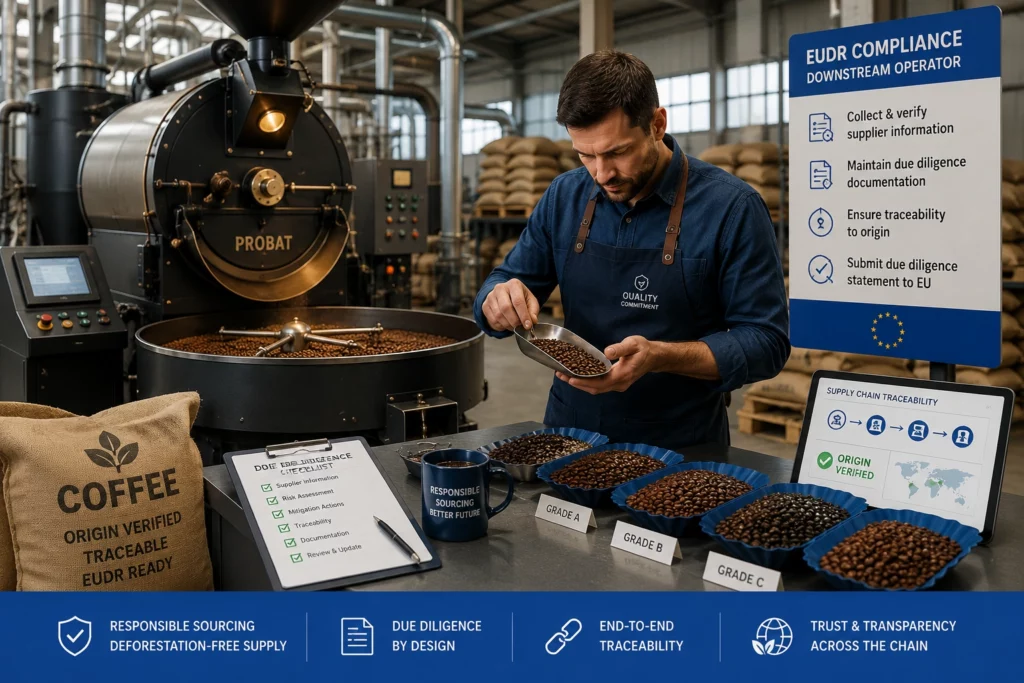
Scenario: Green coffee beans (HS 0901.11) are roasted into coffee (HS 0901.21).
Operator role: Downstream operator.
Green coffee enters the EU under HS 0901.11. An EU-based roaster transforms it into roasted coffee (HS 0901.21 or 0901.22). The Annex I chapter remains 0901 throughout meaning the regulated commodity is unchanged in EUDR’s eyes.
The roaster is a non-SME downstream operator. They must:
Key insight: Roasting changes the chemistry of the bean. It does not change the regulatory chapter. DDS continuity applies, traceability obligations remain active, and the roaster carries shared exposure with the importer.
Scenario: Wood pulp (HS Chapter 47) is transformed into paper and paperboard products (HS Chapter 48).
Operator role: Downstream operator with meaningful transformation.
Wood pulp enters the EU market as a Chapter 47 commodity. When it’s processed into paper, paperboard, and packaging, the HS code shifts to Chapter 48. Both chapters appear in Annex I paper is explicitly listed as a regulated wood-derivative under EUDR.
This transformation is meaningful but doesn’t remove scope. Paper manufacturers and packaging converters in the EU must:
Paper is one of the most underestimated EUDR commodities. Consumer-goods companies often discover during readiness audits that their packaging supply chain corrugated boxes, labels, sustainable cartons sits squarely inside EUDR. The exposure is sometimes larger than their primary commodity exposure.
Key insight: Some HS transformations fundamentally alter your role from upstream to downstream but they don’t erase your obligation. They restructure it.
Not sure whether your products or derivatives fall under EUDR?
Explore our guide on EUDR HS codes to understand which commodities, wood products, palm derivatives, furniture, rubber goods, cocoa products, and downstream materials are covered and where businesses often underestimate compliance exposure.
Scenario: Natural rubber latex (HS 4001) is compounded into rubber mixtures and ultimately used in tyres (HS 4011/4013).
Operator role: Depends on first market placement and ‘ex’ interpretation.
Natural rubber sits in Annex I under HS 4001 (with ‘ex’ designations for specific forms). Compounded rubber, vulcanised products, and tyres carry the natural-rubber commodity embedded inside them. EUDR uses the ‘ex’ prefix to scope only the natural-rubber portion synthetic rubber is outside scope.
This creates one of the most complex compliance situations under EUDR:
Key insight: Derivative manufacturing doesn’t eliminate EUDR exposure. The embedded commodity carries the obligation forward, even through multiple manufacturing steps.
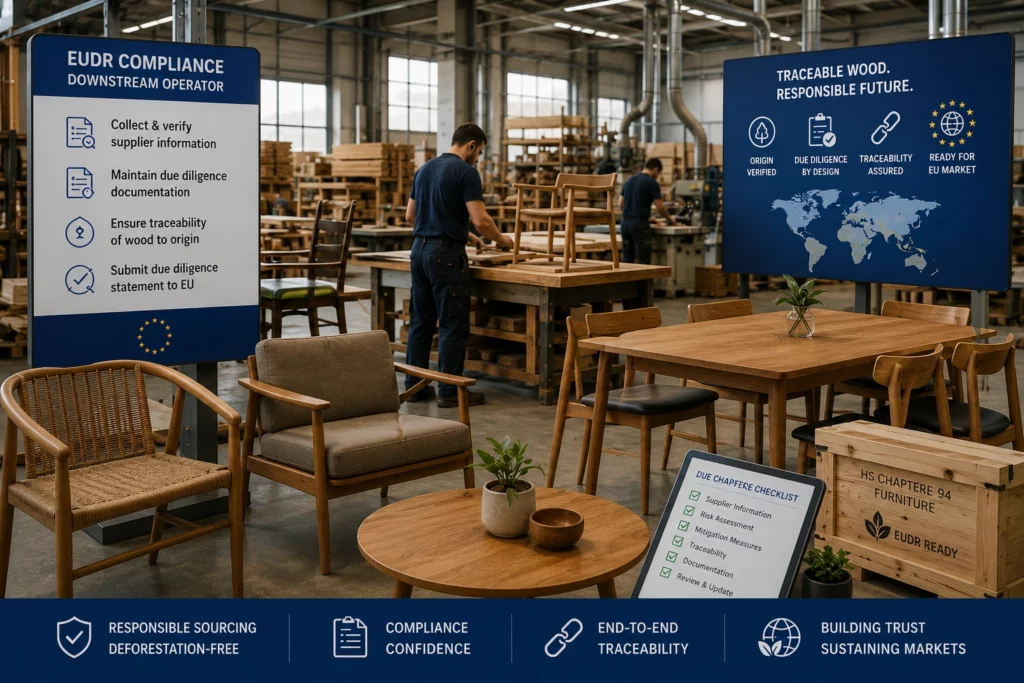
Scenario: Sawn timber (HS 4407) is manufactured into furniture (HS 9401–9403).
Operator role: Downstream operator.
Sawn timber and a wide range of wood products sit in Annex I. When transformed into furniture, the HS code jumps to Chapter 94 and Chapter 94 is also in Annex I scope for wooden furniture. EUDR explicitly lists wooden furniture as a regulated derivative.
Furniture manufacturers face an interesting compliance challenge: their inputs may come from multiple suppliers, multiple species, and multiple countries yet each batch needs traceability back to the forest plot of harvest.
A non-SME EU furniture maker must:
Key insight: High-value processing does not eliminate upstream traceability obligations. The further you move from the forest, the harder traceability becomes and the more critical structured DDS architecture is.
Scenario: Palm oil derivatives (palm kernel oil, palm fatty acid distillate) become surfactants, soaps, detergents, and oleochemicals.
Operator role: Downstream operator with embedded commodity exposure.
Palm oil is one of EUDR’s seven relevant commodities. The complexity is that palm derivatives flow into hundreds of downstream applications personal care, food, biofuels, industrial chemicals. Many of these end products carry HS codes outside the obvious ‘palm’ range but the regulated commodity is still embedded.
Annex I includes specific palm-derivative HS codes, including margarines, soaps, and certain oleochemicals. Companies producing surfactants or specialty chemicals must trace the palm content back to the plantation level even when the final product is two or three derivatives removed from the oil.
In TraceX engagements with EU buyers of palm-based ingredients, the most common failure point is ‘ghost commodity exposure’ derivatives sourced through trading houses where the palm content is real but the documentation chain breaks down two or three tiers upstream. This is where DDS continuity collapses without digital infrastructure.
Key insight: Indirect commodity dependency creates direct compliance risk. Hidden palm content in detergents, cosmetics, and industrial chemicals can trigger EUDR exposure that procurement teams didn’t know existed.
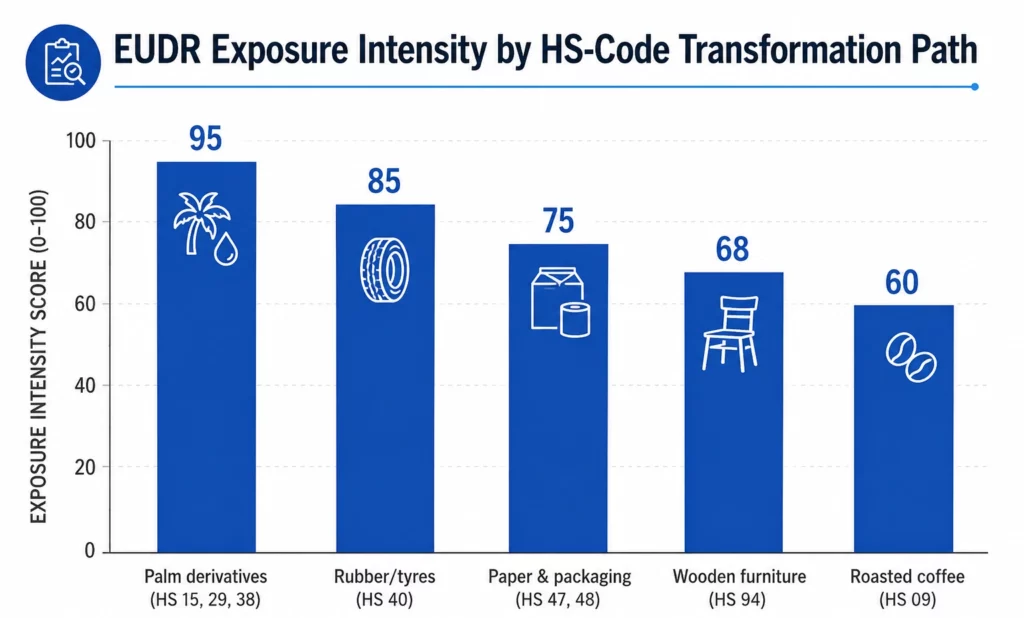
A 2024 EU Commission impact assessment estimated that EUDR-regulated commodities represent over €85 billion in annual EU imports. Of those, an estimated 60% involve at least one HS-code transformation before final consumption meaning the majority of EUDR exposure sits with downstream operators, not commodity importers.
HS-code transformation now affects:
Across EU-bound exporter readiness reviews, TraceX has observed that companies treating EUDR purely as a customs filing exercise hit a 40–50% rejection rate during initial DDS submission. Companies treating it as a cross-functional traceability project combining compliance, customs, procurement, legal, and sustainability clear submission on the first attempt at much higher rates.
This is why cross-functional alignment between compliance, customs, procurement, legal, sustainability, and operations isn’t optional it’s the architecture of EUDR readiness.
Confused about how to prepare and submit a Due Diligence Statement (DDS) under EUDR?
Read our step-by-step guide to understand DDS workflows, required geolocation data, supplier traceability, risk assessment obligations, and how to avoid common compliance errors before products enter the EU market.
Even well-resourced compliance teams stumble on the same five issues:
Avoid the most common EUDR compliance pitfalls before they disrupt your supply chain.
Read our guide on EUDR compliance mistakes to learn where companies struggle with geolocation data, supplier traceability, DDS workflows, HS-code assumptions, and audit readiness and how to proactively close those gaps.
Manual spreadsheets cannot solve HS-code transformation at scale. A 2,000-farmer coffee supply chain, a 50-supplier rubber compound flow, or a multi-tier palm derivative network needs digital infrastructure that handles operator-role logic, DDS continuity, and HS-code mapping in one system.
A mature EUDR traceability stack requires:
Explore how digital supplier onboarding, geolocation mapping, deforestation-risk monitoring, and automated compliance workflows helped strengthen traceability across complex soy supply chains.
TraceX’s Regulatory Compliance platform is built for EUDR readiness at scale. The Regulatory Compliance Platform handles:
This is why companies like Yokohama-ATG, Sunbeth Global Concepts, Interagro Commodities, WASIL use TraceX to manage operator-role complexity, supply-chain visibility, and EUDR readiness across thousands of suppliers.
Under EUDR, HS-code transformation is no longer just a customs decision. It is a traceability issue, a supply-chain governance issue, and a strategic compliance capability that directly affects whether your products reach the EU market.
The companies winning this are the ones who treat HS-code interpretation as a cross-functional architecture problem combining compliance, customs, procurement, sustainability, and operations on one digital platform. They map operator roles upfront. They maintain DDS continuity by design. And they stay audit-ready before the auditor arrives.
No. Under EUDR, processing a regulated commodity rarely removes the obligation. If the resulting HS code remains within Annex I, due diligence continues the operator role simply shifts from upstream to downstream. The European Commission has confirmed this for coffee, paper, rubber derivatives, and wooden furniture.
Annex I of Regulation (EU) 2023/1115 lists every HS chapter, heading, and subheading that triggers EUDR scope. It covers the seven relevant commodities cattle, cocoa, coffee, oil palm, rubber, soya, and wood plus their derivative products. The list uses standard HS codes plus ‘ex’ prefixes where only part of a subheading is regulated.
A downstream operator is any non-SME entity that processes, re-sells, or uses a relevant product that has already been placed on the EU market. They must reference upstream DDS numbers, verify that due diligence has been done, and submit their own DDS for derivative products that remain in Annex I scope.
Yes. Paper and paperboard products under HS Chapter 48 are explicitly covered as wood-derivative products in Annex I. Manufacturers, converters, and brand owners placing paper packaging on the EU market carry full DDS obligations, including forest-plot geolocation traceability.
Yes when those products contain a regulated commodity listed in Annex I. Soaps containing palm derivatives, tyres containing natural rubber, and detergents using palm-based surfactants all fall within EUDR scope. The ‘ex’ HS-code prefix indicates that only the regulated-commodity portion is in scope. Synthetic alternatives are typically excluded.