
Quick summary: Discover how sustainable fashion brands build traceable, compliant supply chains from fiber to finished product using digital traceability, ethical sourcing, and regulatory-ready systems.

The fashion industry is under unprecedented pressure. Regulatory mandates are tightening, buyers are demanding proof, not promises, and brands that can’t demonstrate fashion supply chain accountability face market exclusion, audit failures, and reputational damage that takes years to undo.
If you’re a sustainability lead, compliance manager, or sourcing director at a fashion or apparel brand, this page is for you. Below you’ll find an honest look at the challenges your peers are navigating right now, the data behind the urgency, and how TraceX enables end-to-end traceability from raw fiber to finished garment.
Sustainable fashion brands are moving beyond claims to proof-driven supply chains. By digitizing sourcing, enabling end-to-end traceability, and aligning with regulations and certifications, they can track materials from fiber to finished product. This ensures compliance, transparency, and ethical sourcing, while reducing risk and building consumer trust. The result: brands that invest in traceability today gain stronger market access, audit readiness, and long-term competitive advantage.
| 78% of consumers say sustainability is somewhat or very important when choosing a brand Blue Yonder Sustainability Survey, 2025 | 78% of consumers say sustainability is somewhat or very important when choosing a brand, Blue Yonder Sustainability Survey, 2025 |
| 50%+ of fashion decision-makers say traceability is a top-5 lever to reduce supply chain emissions Business of Fashion / TrusTrace Report | 50%+ of fashion decision-makers say traceability is a top-5 lever to reduce supply chain emissions, Business of Fashion / TrusTrace Report |
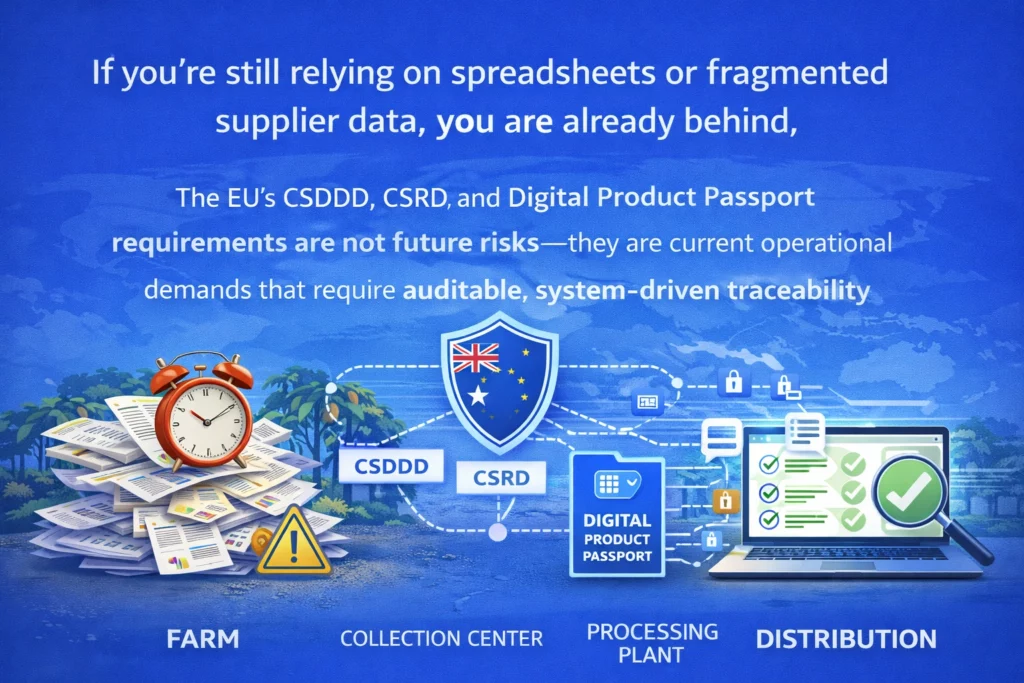
These are not abstract industry problems. They are the exact pain points we hear from sustainability managers, compliance officers, and sourcing teams every week.
| Challenge | Business Impact | TraceX Solution |
|---|---|---|
| No end-to-end visibility beyond Tier 1 suppliers | Cannot identify environmental or labor risks in Tier 2/3; fails CSDDD and CSRD requirements | Multi-tier digital traceability maps every supplier, farm, and processing facility in a single audit-ready system |
| Fragmented data across spreadsheets, emails, and portals | Audit prep takes weeks; compliance gaps go undetected until it’s too late | Centralized data platform that unifies ESG, certification, and operational data from all supply chain partners |
| Difficulty proving sustainability claims against greenwashing scrutiny | Regulatory fines, reputational damage, and buyer contract loss | Immutable, blockchain-verified chain-of-custody from fiber origin to finished product |
| EU Digital Product Passport (DPP) readiness gap | Brands risk market exclusion as DPP requirements enter phased implementation in 2025-2026 | Automated DPP generation with 100+ data points per product: certifications, materials, ESG metrics |
| Slow, expensive supplier onboarding and audit cycles | Compliance teams spend months collecting documents that go stale before the next audit | Digital supplier onboarding with automated document collection, validation alerts, and real-time status tracking |
| No single source of truth for ESG reporting (CSRD, GOTS, Fair Trade) | Reporting takes months; conflicting data across internal teams and tools | Single platform for ESG reporting: carbon, water, labor, certifications mapped to specific regulatory frameworks |
TraceX offers supply chain traceability and sustainability solutions built for fashion brands, textile manufacturers, and retailers who need to prove, not just claim, ethical sourcing and regulatory compliance.
Fiber-to-Fashion Traceability
Digitize and verify the complete journey of materials from the farm and spinning mill through manufacturing, finishing, and distribution. Every handoff is captured and timestamped.
Digital Product Passport (DPP)
Generate product-level digital passports that meet EU ESPR and textile strategy requirements. Each passport stores material origin, certifications, ESG scores, and lifecycle data in a scannable format.
Compliance and Audit Readiness
Built-in workflows for compliance. Compliance documentation is generated automatically, not assembled manually.
ESG Data Consolidation
Unify emissions, water usage, labor practices, and certification data into a single dashboard. Track supplier ESG performance over time and generate board-ready reports.
Blockchain-Verified Chain of Custody
Tamper-proof records for every material transaction. Verified data that regulators, investors, and buyers can trust, not marketing claims.
Supplier Collaboration Portal
Onboard suppliers digitally, collect certifications, and manage corrective action plans from a shared workspace. Reduce supplier data collection time from weeks to days.
Check our Sustainable Sourcing Solutions
Fashion brands operating globally are simultaneously navigating at least six major regulatory frameworks. Non-compliance is no longer a fine; it means losing market access.
| Regulation | What It Requires | Who It Affects |
|---|---|---|
| EU CSRD (2024-2026) | Due diligence on human rights and environmental impacts across the full supply chain | Large EU and non-EU companies selling in the EU |
| EU Digital Product Passport (ESPR) | Product-level transparency via scannable passports: materials, certifications, lifecycle data | Deforestation-free proof for leather, rubber, and wood-based materials |
| EU CSDDD | Textile and apparel brands entering the EU market | Large companies with EU operations or significant EU revenue |
| EU EUDR | Goods must be proven free of forced labor, with a rebuttable presumption at customs | Any brand using animal leather, natural rubber, or wood derivatives |
| California AB405 | Measure and disclose full lifecycle GHG emissions, set reduction targets | Fashion brands operating in California |
| US UFLPA (Forced Labor Act) | Goods must be proven free of forced labor, rebuttable presumption at customs | All importers into the US market |
TraceX maps your traceability data to specific regulatory frameworks, CSRD, DPP, CSDDD, EUDR in a single platform. Instead of managing five different compliance workflows, your team works from one source of truth that generates framework-specific documentation automatically.
Explore what supply chain compliance really means for your business. Learn how to meet regulatory requirements and build audit-ready supply chains.
TraceX Solutions is designed for the teams that actually carry compliance responsibility, not just C-suite visibility.
Pain: You’re responsible for CSRD reporting, but your ESG data lives in 12 spreadsheets, four supplier portals, and two inboxes.
With TraceX: Consolidate all supplier ESG performance, certification data, and emissions metrics into one dashboard. Generate CSRD-aligned reports directly from operational data, not manually assembled decks.
Pain: You need to verify supplier ethics and material origin, but Tier 2 and Tier 3 are invisible to you.
With TraceX, Multi-tier supplier mapping gives you verified visibility across every production stage. Onboard suppliers digitally, capture fiber origin and processing data, and flag non-compliance before it becomes an audit failure.
Pain: CSDDD and UFLPA require documented due diligence that you can defend to regulators and customs authorities, not just internal policies.
With TraceX: Blockchain-verified chain of custody and automated documentation workflows mean you always have audit-ready evidence, not last-minute scrambles.
Pain: EU Digital Product Passport requirements are rolling out, and your team has no infrastructure to capture or publish product-level sustainability data at scale.
With TraceX: Automated DPP generation with material origin, certification status, and lifecycle data, QR-code ready, and EU ESPR compliant. Start with a pilot SKU set and scale across the catalog.
Explore how Digital Product Passports are transforming the textile industry. Learn how DPP enables traceability, transparency, and compliance from fiber to finished product.
Digitize your supply chain. Onboard Tier 1, 2, and 3 suppliers through a guided portal. Collect certifications, material declarations, and facility data automatically.
Track materials from source (farm, mill, recycler). Verify raw material certifications (GOTS, BCI, Recycled Content) with timestamped digital records.
Every production handoff is recorded: spinning, dyeing, cut-and-sew, finishing, and logistics. Blockchain immutability ensures the record can’t be altered retroactively.
Pull environmental metrics (water, carbon, chemicals), social data (labor audits, wage records), and governance information into a unified ESG dashboard.
Your data is automatically mapped to applicable frameworks: CSRD, DPP, CSDDD, EUDR, GOTS, and Fair Trade. Gaps are flagged before audits, not during them.
Generate audit-ready compliance reports, board-level ESG summaries, and product-level Digital Product Passports, all from the same data set.
Explore solutions for the textiles and apparel industry. Discover how to build traceable, compliant, and sustainable supply chains.
If you sell to or through major retailers in the EU, UK, or US, these are the requirements arriving in your inbox:
According to a 2023 KPMG study, companies with mature ESG data governance are nearly twice as likely to feel prepared for regulatory disclosure requirements and significantly more likely to retain buyer contracts. Traceability is not just risk mitigation. It is a sourcing qualification requirement for major buyers in 2026.
TraceX works with fashion brands at every stage of their traceability journey, from initial supplier mapping to full Digital Product Passport deployment. Whether you’re facing your first CSRD disclosure cycle or preparing for EU DPP enforcement, the right time to build your traceability infrastructure is before the audit deadline, not after.
Sustainable fashion is no longer defined by intent; it is defined by proof. As regulations tighten and consumer expectations rise, brands must move beyond fragmented sourcing and embrace end-to-end traceability that connects fiber to finished product. By integrating supply chain digitization, verified data, and compliance-ready systems, fashion companies can not only meet regulatory requirements but also build resilient, transparent, and future-ready operations. Ultimately, those who invest in traceability today will lead tomorrow’s fashion industry, where sustainability, accountability, and trust are non-negotiable.
Fashion supply chain traceability is the ability to track a garment’s journey from raw fiber sourcing through every production stage to the end consumer with verified, auditable data. It matters now because regulatory frameworks, including the EU CSRD, CSDDD, and Digital Product Passport, mandate this level of visibility. Brands that cannot demonstrate traceability face legal sanctions, market exclusion from EU retail channels, and increasing reputational risk.
A Digital Product Passport is a product-level digital record that stores sustainability, material origin, compliance, and lifecycle information accessible via a QR code or similar interface. The EU’s ESPR (Ecodesign for Sustainable Products Regulation) makes DPPs mandatory for textiles entering the EU market. TraceX automates DPP generation from your existing traceability data, capturing 100+ data points per product including certifications, material sourcing, and ESG metrics.
Most brands have visibility into their direct (Tier 1) suppliers but lose track of the supply chain at Tier 2 (fabric mills, dye houses) and Tier 3 (fiber farms, yarn spinners). TraceX uses a digital supplier collaboration model, each production partner inputs their own data into the platform, creating a connected chain of custody that extends from fiber origin through finished product. This is the foundation for CSDDD compliance, which explicitly requires due diligence beyond first-tier suppliers.
Implementation timeline depends on supply chain complexity and existing data infrastructure. Most brands begin with a Tier 1 supplier pilot which can be operational within 4 to 8 weeks and expand to multi-tier traceability over a 3 to 6 month rollout. TraceX solution includes guided supplier onboarding to reduce friction during the supplier adoption phase.
Yes. UFLPA requires importers to demonstrate that goods are free from forced labor, the burden of proof lies with the brand, not customs. TraceX provides documented, blockchain-verified chain of custody from raw material origin through production, which is precisely the evidence required to rebut UFLPA detention at the US border.
Traditional audits are point-in-time snapshots that become outdated the moment an auditor leaves the facility. TraceX provides continuous, real-time traceability: supplier data is updated throughout production cycles, certifications are monitored for expiry, and compliance gaps are flagged automatically. The result is a living audit trail rather than a static report.