
Quick summary: Wondering if the EU Deforestation Regulation (EUDR) applies to your business? Learn about the commodities covered, affected industries, and compliance requirements to ensure your supply chain remains deforestation-free and EU market-ready.

Your sustainability certification arrived years ago. Your ethical sourcing policy is in the company handbook. Your suppliers are on speed dial. None of that is enough for the EU Deforestation Regulation (EUDR). EUDR product scope defines which commodities and derived goods fall under regulation, making it critical to assess your exposure and act now to ensure full supply chain compliance.
If your business touches cocoa, coffee, palm oil, rubber, soy, timber, or cattle, and you sell into, import from, or trade within the EU, you now need something far more specific: geo-mapped farm data, deforestation-free verification, and a formally filed Due Diligence Statement (DDS) for every single shipment.
Miss one data point. Get one polygon wrong. Skip a supplier’s farm record. Your shipment gets blocked.
According to the World Resources Institute, nearly 90% of global forest loss is driven by agricultural expansion tied to the very commodities EUDR now regulates. The EU has decided it will no longer passively consume deforestation. And companies that can’t prove otherwise will be shut out of the market regardless of size, history, or intent.
Key takeaways: EUDR product scope covers key commodities (cattle, cocoa, coffee, palm oil, soy, rubber, wood) and their derivatives. If your products fall within scope, you must ensure traceability, collect geolocation data, assess risk, and submit a Due Diligence Statement (DDS). Compliance is not optional; start preparing now to avoid disruption.
Key takeaways: EUDR product scope covers key commodities (cattle, cocoa, coffee, palm oil, soy, rubber, wood) and their derivatives. If your products fall within scope, you must ensure traceability, collect geolocation data, assess risk, and submit a Due Diligence Statement (DDS). Compliance is not optional; start preparing now to avoid disruption.
| 7 | How long must you retain all traceability data, risk assessments, and DDS documentation |
| Dec 31, 2020 | All shipments must be accompanied by a filed DDS proving deforestation-free, legal sourcing no exceptions |
| 5 Years | The hard cut-off date is any deforestation after this date on the land from which your products come, making you non-compliant |
| 100% | All shipments must be accompanied by a filed DDS proving deforestation-free, legal sourcing, no exceptions |
Forget wading through 60 pages of regulation. If your business does any of the following, EUDR applies to you:
Responsibility level: HIGHEST – you must collect all supplier data, verify deforestation-free origin, and file the DDS.
Responsibility level: HIGH – you must verify operator compliance and maintain your own records.
There is no EUDR certification. No badge. No logo. Compliance is proven through data, plot-level geolocation, deforestation risk checks, legal documentation, and a valid DDS. If the proof isn’t there, the product cannot enter the EU market.
EUDR covers seven commodity families. The regulation doesn’t stop at raw materials; it extends to derived products at every stage of processing.
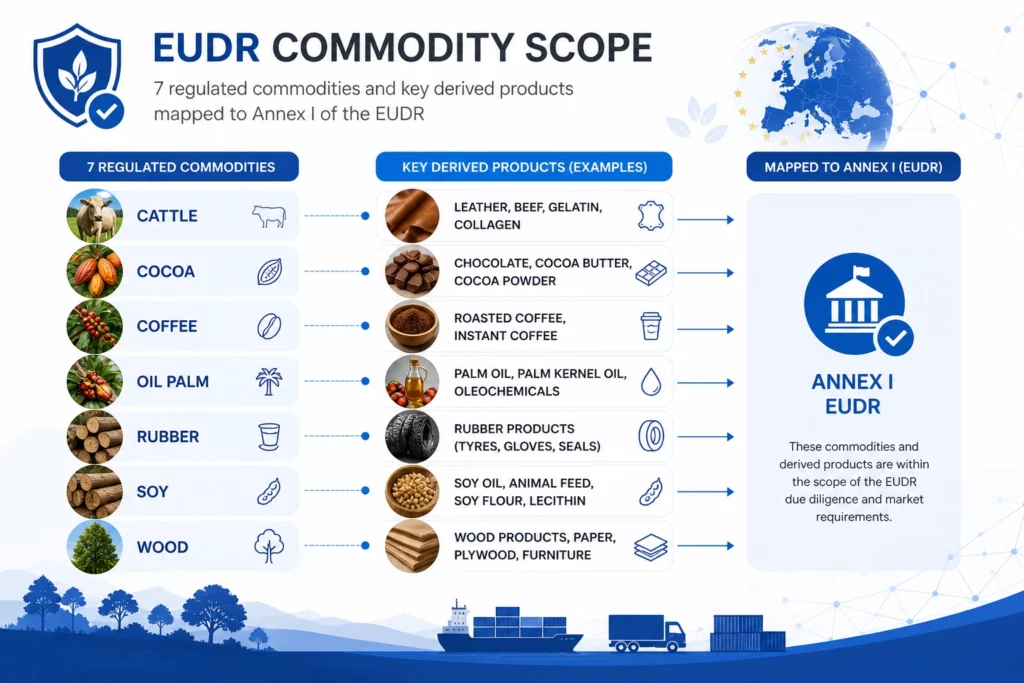
Read the blog to learn how EUDR HSN codes work, identify where your products fall, and avoid costly classification errors.
Pain
Cocoa supply chains span millions of smallholder farms across West Africa, most without GPS data or legal land documentation.
Feature
TraceX’s polygon-mapping tool enables cooperative agents to capture GeoJSON boundaries for every contributing farm, even offline.
Benefit
Every cocoa batch is traceable to its exact origin plot, giving operators the verified data they need for a compliant DDS.
See how a Nigerian trading firm leveraged TraceX to digitize supplier data, enable farm-level traceability, and streamline DDS submissions for full EUDR compliance. Read the case study.
A mid-size chocolatier in the Netherlands processes 800 tonnes of cocoa annually from Cote d’Ivoire cooperatives. When they attempt to file a DDS for a Q1 shipment, they discover they have village-level GPS points, not the polygon coordinates required by regulators. Their supply chain has 12 intermediary layers, and they can’t access plot-level data.
How TraceX Helps: TraceX deploys a structured supplier onboarding workflow with multilingual field data collection, automatically aggregating and validating polygon data from cooperative level down to plot level. The platform flags gaps before submission, not at the EU border.
Pain
Palm oil has been one of the biggest drivers of tropical deforestation, making it the highest-scrutiny commodity under EUDR. Traceability from plantation to finished product across complex multi-tier supply chains is extremely difficult without digital infrastructure.
Feature
TraceX maps the full palm oil supply chain from plantation GPS coordinates through mill processing to final product batch with automated deforestation risk scoring using satellite data.
Benefit
Operators can demonstrate a verified, deforestation-free chain of custody for every palm oil batch with risk scores generated before shipment, not after customs inspection.
Pain
Coffee is sourced from some of the world’s most remote growing regions. Low digital literacy among farmers, fragmented cooperative structures, and a lack of formal land documentation create compliance gaps.
Feature
TraceX’s mobile offline-capable data collection app enables field agents to register farm boundaries, farmer IDs, and harvest data without internet connectivity, syncing when back in range.
Benefit
Coffee exporters maintain a continuously updated, audit-ready supply chain record ready for DDS submission at any time.
Pain
Timber supply chains often involve multiple processing stages, such as sawmills, drying, treatment, and manufacturing, each one adding complexity to the chain of custody. Illegal logging is a persistent risk, and legal documentation of land use varies significantly by country.
Feature
TraceX captures full chain-of-custody documentation at each processing stage, cross-referencing against legal land-use records and country-specific legality requirements.
Benefit
Timber importers and furniture manufacturers can verify that every batch of wood product traces back to a legally harvested, deforestation-free plot, meeting both EUDR and country-of-origin legality standards.
A furniture company in Northern Italy sources oak and walnut from Poland, Romania, and Ukraine. They assume their existing FSC certification covers EUDR requirements. When enforcement begins, they discover FSC certification is insufficient on its own, EUDR requires plot-level geolocation of harvest sites and legal documentation tied to specific batches.
How TraceX Helps: TraceX integrates with existing FSC and PEFC certification workflows while adding the plot-level geolocation layer that EUDR mandates. The platform also generates country-specific legality documentation templates, reducing the compliance gap to a single onboarding process.
Pain
Soy’s indirect role in deforestation is often underestimated. A beef producer whose cattle eat soy-based feed is affected by EUDR requirements on soy, creating a cascading compliance chain that many businesses are not prepared for.
Feature
TraceX maps multi-commodity supply chains, tracking both direct and indirect commodity links, including soy used in animal feed chains tied to cattle products.
Benefit
Beef and pork producers can demonstrate compliance not just for their primary product, but for feed ingredient sourcing, avoiding a critical and often-overlooked compliance gap.
Pain
Rubber plantation expansion has historically contributed to deforestation in Southeast Asia. EUDR requires full traceability for natural rubber used in any product, including complex manufactured goods like tires, back to the original plantation.
Feature
TraceX’s deforestation risk assessment module uses satellite monitoring and risk scoring to verify that rubber plantation polygons show no land-clearing events after December 31, 2020.
Benefit
Rubber importers and manufacturers have on-demand, satellite-verified evidence of deforestation-free status, meeting the standard that regulators will check during audits.
Discover how a leading tire company transformed its supply chain to achieve plantation-level traceability, validate geolocation data, and streamline EUDR Due Diligence Statements. Read the case study.
Pain
Cattle ranching is the single largest driver of global deforestation. Under EUDR, any product using beef or leather must demonstrate that the land on which the cattle were raised was not deforested after December 2020, requiring traceability back to individual ranches.
Feature
TraceX connects slaughterhouse, tannery, and brand-level operators to individual ranch geolocation data, creating an unbroken chain of custody from pasture to finished product.
Benefit
Leather goods brands, beef processors, and dairy exporters can respond to regulatory requests with a verified, plot-level supply chain record rather than relying on self-declared supplier statements.
Certifications, supplier declarations, and good intentions will not satisfy EUDR enforcement. Here is exactly what regulators will look for:
Every batch of product must be traced to its origin land plot, not a village, not a district, not a general region. Regulators use satellite data to verify deforestation status against the coordinates you provide.
Read the blog to learn how to meet EUDR geolocation requirements with confidence and avoid costly errors.
The product must not be associated with land that was deforested after December 31, 2020, regardless of how long your supplier has been in business or what certifications they hold.
Products must be legally produced in the country of origin compliant with local land use, labor, and environmental laws. EUDR fuses environmental protection with legal traceability in a way no previous regulation has.
Every shipment must be accompanied by a formally submitted DDS through the EU’s centralized TRACES system before market entry. A missing, incorrect, or unvalidated DDS means the shipment is blocked.
Read the blog to understand how to file your DDS efficiently and avoid common compliance pitfalls.
The EUDR Delegated Act was not a minor update. It closes loopholes, adds new product categories, removes others, and introduces ‘ex’ HS code prefixes that completely change how classification works.
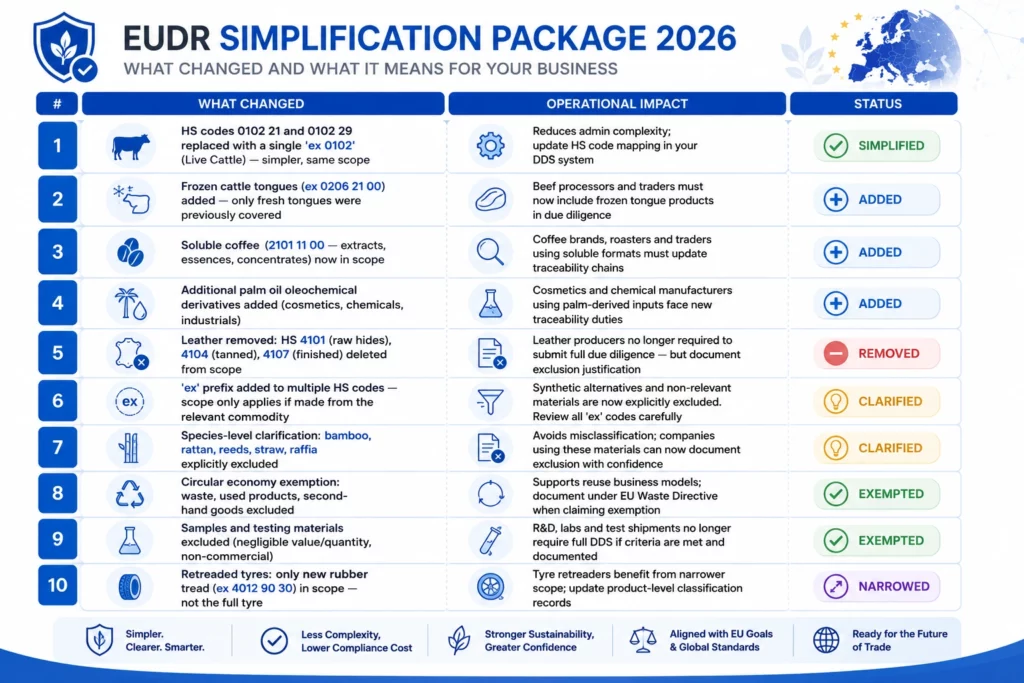
Two grey areas that confused the original text have been resolved in the Delegated Act:
The Delegated Act doesn’t affect every supply chain equally. Here’s how the changes break down by commodity sector and what compliance teams need to prioritise.
New Risk: Soluble coffee (extracts, concentrates, essences) is now in scope. If you source coffee for instant coffee production, you need full traceability to the farm plot level, not just to the bean.
Action required: Map your soluble coffee supply chain to plot-level geolocation. Identify suppliers using HS 2101 11 00 and initiate due diligence statements.
New Risk: The oleochemical loophole is now closed. If your product contains palm-derived fatty acids, glycerides, esters or surfactants, regardless of the application, traceability obligations now apply.
Action required: Audit your ingredient lists and supplier declarations. Many cosmetics and cleaning product manufacturers assumed palm derivatives were outside the scope. That assumption is no longer valid.
Scope Simplified and Expanded: The switch to ‘ex 0102’ simplifies classification. But frozen tongue products being added means processors with mixed fresh/frozen lines now have a new documentation requirement.
Action required: Confirm your product list covers both fresh and frozen formats. Update DDS entries for frozen cattle tongue lines (ex 0206 21 00).
Scope Narrowed – Positive for Remanufacturers: Retreaded tyres as a whole are no longer in scope, only the new rubber tread component. This aligns with EU circular economy goals and reduces the compliance burden for tyre retreaders.
Action required: Update product-level classification records. Document that retreaded tyre products rely on ex 4012 90 30 and claim the circular economy provision where applicable.
Partially Removed – But Document Your Exclusion: Raw hides, tanned leather and finished leather have been removed from the scope. However, compliance teams should maintain documentation justifying exclusion; auditors may still request it, especially for mixed supply chains.
Action required: Do not delete existing supplier records. Archive with a documented exclusion rationale. If your supply chain overlaps with cattle (e.g., beef and leather from the same animal), maintain clear product segregation in your DDS.
Many supply chain teams are attempting EUDR compliance with spreadsheets, email threads, and PDF declarations. This approach will fail, and here’s precisely why:
| Feature | Manual / Spreadsheet Approach | TraceX Digital Compliance Platform |
|---|---|---|
| Audit Readiness | Lacks built-in trails; version control issues during inspections. | Immutable Audit Trail: Every data point is logged and timestamped. |
| Mapping and Geospatial | Polygon data for hundreds of farms is unmanageable in rows/columns. | GeoJSON Integration: Native collection and validation of farm polygons. |
| DDS Accuracy | Errors often undetected until customs rejects the shipment. | Pre-validation: DDS checked before TRACES submission to catch errors early. |
| Risk Monitoring | No integration with satellite deforestation monitoring. | Real-time Satellite Scoring: Automated deforestation risk scoring per plot. |
| Scalability | System collapses as networks grow beyond 50 farms. | High Scalability: Built to handle from 50 up to 50,000 supplier farms. |
TraceX’s EUDR Solutions are built specifically for agricultural and forest-risk commodities. Here is how each module maps directly to your EUDR obligations:
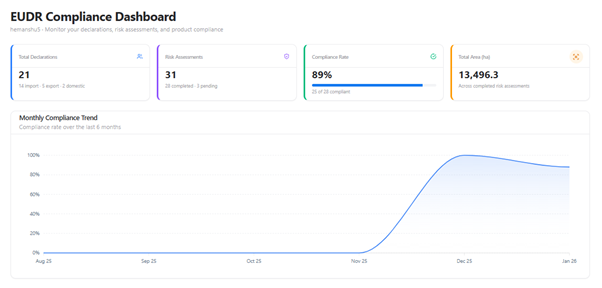
Getting farm-level data from hundreds or thousands of smallholder farmers is the hardest part of EUDR compliance. TraceX’s structured onboarding workflow allows cooperative field agents to collect data digitally using mobile devices with offline capability, and uploads automatically when connected.
TraceX captures GeoJSON polygon boundaries for every farm or plot in your supply chain. The platform validates polygon completeness and accuracy before you attempt DDS submission, flagging issues before they reach TRACES.
Using satellite monitoring, TraceX cross-references each plot’s polygon coordinates against deforestation databases to generate a risk score. High-risk areas are flagged for additional documentation before shipment, not after a regulatory inspection.
TraceX generates compliant Due Diligence Statements pre-formatted for EU TRACES submission. All required fields, GeoJSON files, supplier data, volume, product type, harvest dates, and risk assessment are populated automatically from the platform’s data records.
All compliance documentation is stored in a structured, tamper-evident record system. When regulators or trade partners request documentation, it’s retrievable in minutes, not buried in email threads.
TraceX has launched Agentic AI for EUDR, intelligent workflows that automate supplier data validation, cross-reference geolocation files against deforestation satellite data, and generate DDS submissions with significantly reduced manual effort. AI flags gaps in your compliance data before they reach customs.
Read the blog to explore how agentic AI solutions can streamline operations and unlock smarter, faster decision-making.
| Industry | Primary EUDR Challenge | TraceX Solution |
|---|---|---|
| Food and Beverage | Multi-origin cocoa, coffee, and soy sourcing across fragmented smallholder supply chains. | Farm-level onboarding, geo-mapping, and batch-level DDS generation. |
| Cosmetics and Personal Care | Palm oil in formulations often involves multi-tier chains with no visibility below Tier 2. | Supply chain mapping from plantation to mill to formulation batch. |
| Timber and Paper | Multi-commodity mapping, including indirect ingredient sourcing. | Country-specific legality templates plus multi-stage chain-of-custody tracking. |
| Animal Feed and Livestock | Indirect commodity exposure (soy in feed leading to cattle product) often overlooked. | Indirect commodity exposure (soy in feed leading to cattle product) is often overlooked. |
| Automotive and Industrial | Natural rubber traceability, complex and geographically dispersed plantation supply chains. | Plantation GPS mapping plus satellite deforestation risk scoring at scale. |
If you import, export, or trade commodities regulated under EUDR, compliance is not a future problem; it is a current operational requirement. Sustainability certifications, supplier declarations, and spreadsheet-based documentation will not satisfy EU regulators.
The companies that will retain EU market access are the ones building verifiable, data-backed supply chain traceability now, before customs block their next shipment. TraceX is built for exactly this. Farm-to-port data capture. Geo-polygon mapping. Automated deforestation risk scoring. DDS generation. Five-year audit-ready records. All in one platform.
Don’t let a missing data point cost you EU market access.
No. Voluntary certification schemes like FSC and Rainforest Alliance demonstrate sustainable sourcing intent, but EUDR requires verifiable, product-specific evidence: geo-polygon coordinates, deforestation-free verification via satellite data, and file DDS. Certifications can support your compliance process, but cannot substitute for EUDR’s mandatory data requirements.
A rejected DDS means your shipment cannot enter the EU market. Depending on the nature of the rejection, missing data, incorrect coordinates, or unverifiable deforestation status, you may face shipment delays, resubmission requirements, or, for repeated violations, fines and market access suspension. Catching errors before submission (as TraceX’s pre-validation does) is significantly less costly than catching them at customs.
This is one of the most common challenges for cocoa, coffee, and rubber supply chains. TraceX’s mobile offline-capable field app allows cooperative agents and extension workers to capture farm boundary polygons directly using smartphones, even in areas with no connectivity. Data syncs automatically when the device reconnects.
The critical date is December 31, 2020, not the enforcement date. Any deforestation that occurred on land associated with your product after that date makes the product non-compliant, regardless of when it was manufactured. You must be able to verify the deforestation-free status of your supply chain back to that baseline date.
It depends on the size and complexity of your supply chain. For operators with existing supplier relationships and partial data, TraceX has helped companies establish EUDR-ready compliance workflows in 30-90 days. For first-time implementers with large smallholder networks, implementation timelines vary, but early action significantly reduces risk. Book a free assessment call to get a realistic timeline for your supply chain.