
Quick summary: Stay ahead of the latest EUDR delay and understand what it means for your supply chain. Learn how businesses can use the extra time to strengthen traceability, improve risk assessments, and prepare for full EUDR compliance before enforcement begins.

The European Union Deforestation Regulation (EUDR) has been the central topic of boardroom anxieties, supply chain stress tests, and frantic data gathering for the better part of two years. As deadlines loom and implementation dates draw near, the collective focus of the global commodities market has been singular: Get Compliant.
Companies are scrambling to map plots, collect geolocation points, and secure due diligence statements. It is a massive undertaking, akin to preparing for a moon landing. The energy, resources, and capital expenditure are all focused on that one moment of “lift-off” the moment the regulation goes live and trade must continue uninterrupted.
But here is the uncomfortable truth that few are discussing loud enough: Getting compliant is the easy part. Staying compliant is the real challenge.
The EUDR is not a one-time audit or a certification you hang on the wall. It is a dynamic, ongoing operational requirement that demands a fundamental restructuring of how supply chain data is managed. If “getting compliant” is a sprint to the starting line, “staying compliant” is an ultramarathon run on shifting terrain.
In this deep dive, we will explore why the post-implementation phase of EUDR poses the greatest risk to businesses, the hidden pitfalls of static data, and how forward-thinking companies are pivoting from “compliance survival” to “data resilience.”
Key Takeaways for Business Leaders:
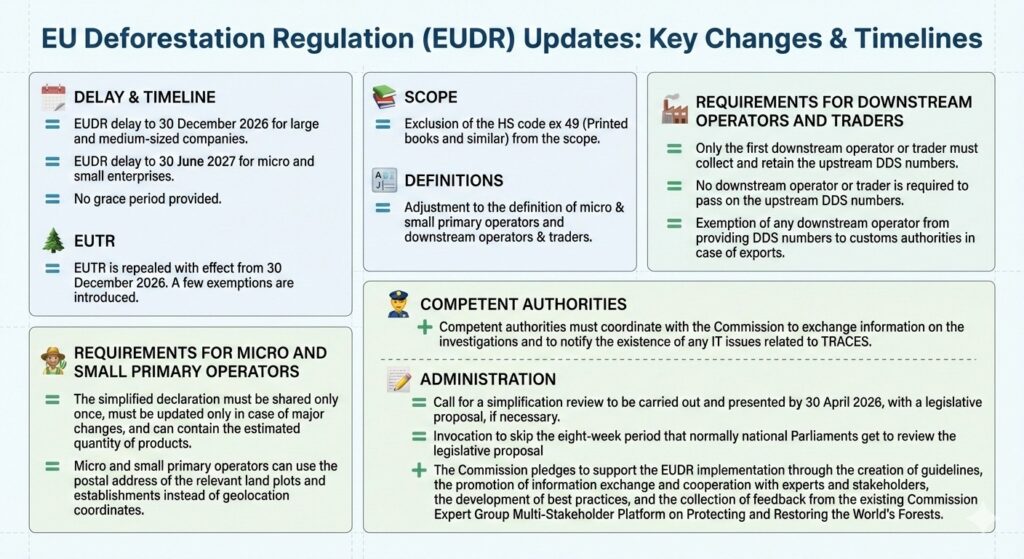
The EU has officially approved a strategic delay for the EU Deforestation Regulation (EUDR), pushing the enforcement deadline to December 30, 2026, for large/medium companies and June 30, 2027, for micro and small enterprises. Beyond the timeline shift, the updates introduce significant administrative relief: printed books are now excluded from the scope, and data obligations have been streamlined so that only the first downstream trader is required to retain upstream Due Diligence Statement (DDS) numbers. Furthermore, micro and small primary operators gain substantial flexibility, including the ability to provide postal addresses instead of precise geolocation coordinates and the use of simplified, one-time declarations.
The “Day One” Illusion- Snapshot Compliance
To understand the future challenge, we must first look at the current state of the industry.
Right now, thousands of companies trading in coffee, cocoa, soy, palm oil, cattle, rubber, and wood are in “project mode.” They have assembled task forces, hired consultants, and engaged third-party tech providers to gather the necessary data to pass the initial regulatory hurdles.
The goal is binary: Pass or Fail. Can we ship our goods into the EU on the implementation date without them being seized at customs?
This mindset leads to what experts call “snapshot compliance.” Companies are taking a snapshot of their supply chain as it exists today. They are mapping farms, verifying legal land use, and storing that data in a repository.
Supply chains are not static; they are living, breathing organisms.
If you treat EUDR compliance as a one-time data collection exercise, your compliance status begins to degrade the moment you finish collecting the data. By the time your second or third shipment leaves the port, the “snapshot” you took six months ago may no longer reflect the reality on the ground.
When a container arrives in Rotterdam or Hamburg six months post-implementation, customs authorities won’t care that you were compliant on Day One. They care if the specific batch in that container matches the due diligence statement attached to it now.
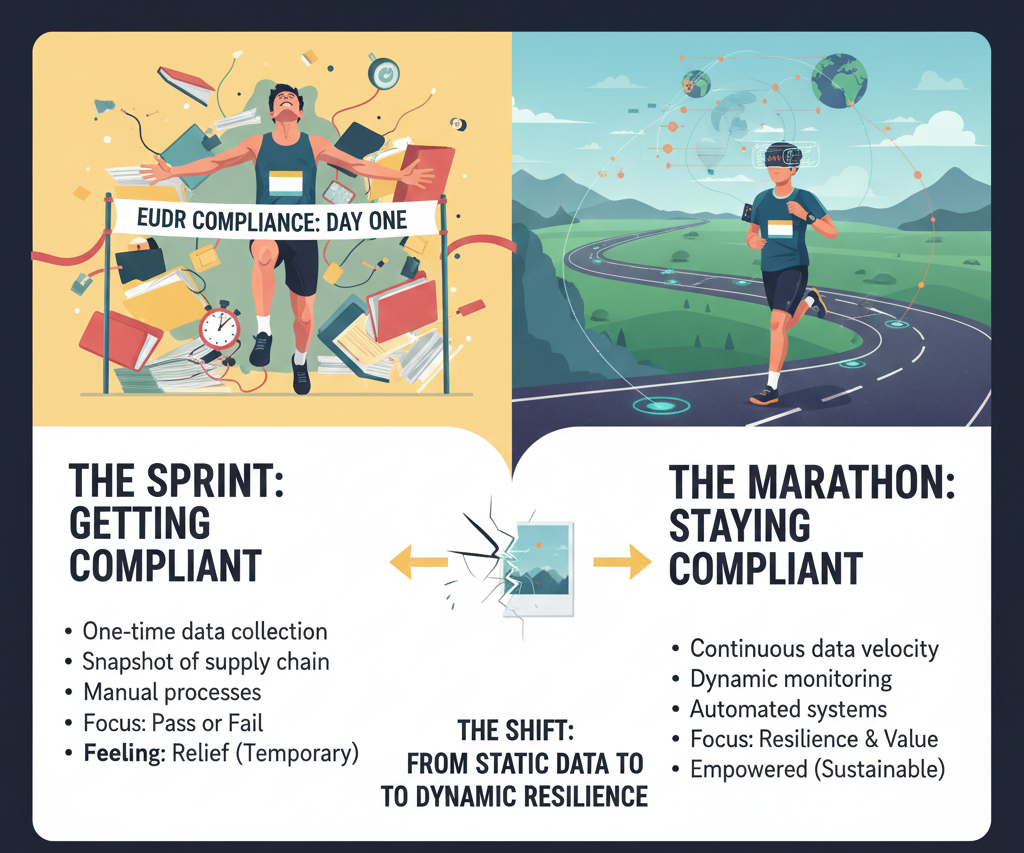
Moving from a snapshot model to a continuous compliance model requires a shift in strategy. Staying compliant relies on three pillars: Data Velocity, Supplier Engagement, and Audit Readiness.
Under the EUDR, the connection between the physical commodity and the digital data must be unbreakable. This requires high “data velocity” the speed at which data moves from the farm to the final exporter.
In many current setups, data collection is manual. Field agents go out with GPS devices, record coordinates, come back to the office, upload them to a spreadsheet, and eventually, that spreadsheet makes its way to a compliance officer. This process is slow, prone to error, and creates massive lag times.
To stay compliant, companies must automate the flow of data.
Technology often dominates the EUDR conversation, but the human element is where compliance lives or dies.
Getting a supplier to agree to share data once is difficult. Getting them to maintain that data, update it, and remain transparent year after year is a relationship challenge.
The Fatigue Factor: Suppliers, especially in the Global South, are facing “audit fatigue.” They are being asked for the same data by multiple buyers, in different formats, for different certifications. If the process of maintaining EUDR data is burdensome, suppliers will eventually disengage or cut corners.
Staying compliant requires reciprocity. Buyers cannot just extract data; they must provide value. This could mean:
If the supplier sees EUDR compliance as purely a cost centre with no benefit, the quality of data will degrade over time.
In the past, audits were scheduled events. You knew they were coming, and you spent a month preparing the paperwork.
The EUDR changes the game. Customs checks can happen at any time. Competent Authorities in EU member states will use sophisticated satellite tools and risk algorithms to spot-check shipments.
“Staying compliant” means being “audit-ready” 24/7/365. It means that if a customs official questions a specific container of cocoa beans, you can trace it back to the exact plots of land within hours, not weeks.
This requires a move away from disparate spreadsheets and emails to a centralized system of record. This “Single Source of Truth” must hold not just the geolocation data, but the chain of custody evidence, the risk assessments, and the mitigation plans.
What happens if you focus only on getting compliant and ignore the maintenance? The risks are not just regulatory; they are commercial and reputational.
Imagine a scenario: You are a coffee importer. You successfully navigated the first six months of EUDR. You have your due diligence statements. But unknown to you, one of your cooperatives added 50 new farmers to their roster without updating the polygon maps in your system.
Your shipment arrives in Belgium. The authorities run a check. The volume of coffee in the container exceeds the production capacity of the mapped land in your due diligence statement. The math doesn’t add up.
The shipment is held. You are scrambling to find the missing data. The beans are sitting at the port, accruing demurrage charges. Your customer is waiting. The reputational damage is instant.
Companies that struggle to stay compliant will eventually shrink their supply base. It is easier to manage compliance for 10 large plantations than 10,000 smallholders.
If businesses do not invest in systems that make ongoing compliance efficient, they will naturally drift toward larger, more organized suppliers, cutting smallholders out of the market. This unintended consequence undermines the very spirit of sustainable development. Staying compliant involves building systems that allow you to keep working with the smallholders who need market access the most.
A common trap is thinking, “We bought the software, so we are safe.”
Software is a tool. It is the engine, but it is not the driver. To stay compliant, organizations need to build internal Data Governance capabilities.
We are seeing the emergence of new roles within commodity trading firms. The “Traceability Manager” or “Data Governance Lead” is becoming as critical as the logistics manager.
This person’s job is not just to run the software, but to ensure data hygiene. They are responsible for:
For the industry to stay compliant without collapsing under administrative weight, systems must talk to each other.
If a cooperative in Vietnam uses one system to map farms, and a trader in Switzerland uses another, and a roaster in Germany uses a third, the friction of moving data between these silos creates risk. Data gets lost, corrupted, or duplicated.
Staying compliant requires a commitment to standardization. Whether it is using standard APIs or agreeing on common data formats (like the ones being developed by various industry associations), the industry must move toward a seamless flow of information.
This is where the right platform makes the difference.
The challenge isn’t just housing the data; it’s making the Traceability Manager’s job possible. Our TraceX EUDR Solution is specifically built to handle the complexities above automating supplier onboarding, managing polygon updates, and ensuring real-time interoperability with your existing ERP. It’s the engine designed for your new Data Governance strategy.
It is easy to view EUDR as a burden a tax on trade. But there is a flip side. Companies that master the art of staying compliant will build a massive competitive moat.
The data required for EUDR knowing exactly where your product comes from and how it was produced is the same data required to manage climate risk.
If you know the geolocation of every farm you buy from, you can model climate impacts. You can see which farms are at risk of drought or flooding. You can predict yield fluctuations with greater accuracy.
Banks and investors are increasingly looking at ESG risks. A company that can demonstrate a robust, “always-on” compliance system is a lower risk borrower. Access to green finance and lower interest rates may well depend on the quality of your traceability data.
Consumers are cynical. They are tired of greenwashing. A QR code on a package that leads to a static, generic marketing page is no longer impressive.
But a brand that can say, “We monitor our supply chain in real-time, and we can prove that this specific chocolate bar contributed to zero deforestation,” wins trust. Real-time data backs up brand promises with hard evidence.
The implementation of the EUDR is not a finish line; it is a gateway into a new era of global trade.
In this new era, opacity is a liability and data is an asset.
The companies that treat EUDR as a checklist to be completed will struggle. They will face constant fire drills, shipment delays, and rising costs as they try to patch holes in their data.
The companies that win will be those that accept this new reality. They will invest in dynamic systems, build deep relationships with suppliers based on data exchange, and view compliance not as a burden, but as the operational backbone of a modern, sustainable business.
The challenge is not getting to Day One. The challenge is thriving on Day Two, Day Three, and every day after.
Are you ready for the long haul?
The EUDR delay stems from ongoing implementation challenges, including data readiness, traceability gaps, and the need for clearer guidance for operators and smallholders. The delay aims to give businesses and authorities more time to adapt without compromising the regulation’s goals.
No. Despite the delay, companies are strongly encouraged to continue preparing. Building robust traceability systems, gathering geolocation data, and conducting due diligence take time. Early movers will be better positioned when enforcement begins.
Businesses should use the additional time to close data gaps, align supplier communication, test compliance workflows, and implement digital traceability tools. Treat the delay as an opportunity to refine systems rather than postpone action.