Quick summary: TraceX helps rubber part companies in UK meet EUDR requirements with automated Due Diligence Statement (DDS) generation, farm-level traceability, and deforestation risk verification.
EUDR DDS for Rubber Parts Supply Chain in UK requires UK manufacturers, importers, and distributors handling natural rubber or rubber-derived components to ensure all materials are deforestation-free, legally sourced, and fully traceable to plantation origin. Although the UK is not in the EU, any company exporting rubber parts into the EU must generate an EUDR-compliant Due Diligence Statement (DDS). This includes collecting geolocation polygons, legality documents, and risk assessments for all HS 4001–4017 products. Robust digital traceability and automated DDS workflows are now essential for UK suppliers to maintain seamless access to EU automotive, industrial, and engineering markets.
The EU Deforestation Regulation (EUDR) introduces strict traceability and legality requirements for natural rubber and rubber-derived products entering the EU market. Although the UK is no longer part of the EU, any UK company exporting rubber parts, components, or raw materials to the EU must fully comply with EUDR. This means UK importers, manufacturers, distributors, and re-exporters must ensure all rubber inputs are deforestation-free, legally produced, and traceable back to their plantation of origin.
The UK is a major centre for automotive parts manufacturing, aerospace components, industrial machinery, rail systems, construction equipment, and engineered rubber goods. Many of these products contain natural rubber traced under EUDR’s key HS codes:
These categories include raw rubber, processed inputs, and finished components that UK exporters must verify under EUDR before shipping to the EU.
The UK serves as a high-value manufacturing hub within Europe’s rubber engineering ecosystem, with strong export flows to EU automotive OEMs, industrial suppliers, medical manufacturers, machinery producers, and precision engineering companies. Any UK business exporting rubber goods (HS 4001–4017) into the EU must provide:
Failure to comply may result in EU border rejection, supply-chain delays, or penalties for downstream EU buyers.
While the regulation is enforced on the EU side, UK exporters must provide compliant data to avoid disruption in EU trade flows.
For UK companies, EUDR compliance affects the full lifecycle of rubber-based components from plantations in Asia, Africa, and Latin America, through UK ports and processing sites, to EU distribution channels. UK exporters must:
Meeting EUDR requirements is now essential to preserve seamless EU market access and safeguard the UK’s competitiveness across automotive, aerospace, industrial engineering, and rubber manufacturing sectors.
Master the step-by-step process of submitting Due Diligence Statements under the new EUDR rules.
Read the blog on filing DDS for EUDR compliance
Explore how rubber parts importers can achieve traceability, transparency, and compliance under EUDR.
Read the full blog on EUDR Rubber Compliance
Even though the UK is no longer part of the EU, any UK manufacturer or distributor exporting rubber parts to EU customers must comply with EUDR. This external compliance creates unique operational, traceability, and documentation challenges for UK firms across automotive, aerospace, machinery, construction, manufacturing, and industrial supply chains.
UK companies fall outside the EU regulatory environment, meaning:
Most natural rubber used in UK manufacturing originates from Thailand, Indonesia, Malaysia, Vietnam, Côte d’Ivoire, Liberia, and other high-risk regions.
Challenges include:
For UK companies dependent on multi-country sourcing, full upstream visibility is extremely difficult.
A significant share of global natural rubber comes from smallholder farms.
UK companies must:
Smallholder onboarding is one of the largest compliance bottlenecks.
A complete DDS requires:
Most UK manufacturers rely on:
These manual workflows lack:
This significantly increases the risk of EU customs delays or rejections.
Rubber parts supply chains are among the most complex industrial networks globally. UK companies often import:
And they frequently come from:
This fragmentation makes compliance extremely challenging because one incorrect link can invalidate an entire DDS.
EUDR requires proof that no deforestation occurred after 31 December 2020.
UK companies struggle with:
Without automated AI or satellite tools, companies cannot maintain continuous monitoring, as required by EUDR.
Non-compliance may lead to:
Given the UK’s heavy reliance on EU customers for rubber parts, the business stakes are extremely high.
Most UK firms must now:
This requires:
For SMEs, which compose the majority of UK rubber parts manufacturers, this is a material challenge.
UK rubber parts companies face a uniquely complex compliance environment:
➡ They must meet EUDR standards without being part of the EU,
➡ Rely on global, multi-tier rubber supply chains, and
➡ Carry the burden of plantation-level traceability and risk monitoring.
As a result, only digitized, automated, end-to-end traceability systems can handle the scale and complexity required for EUDR compliance in UK rubber supply chains.
The EU Deforestation Regulation (EUDR) requires every shipment of natural rubber and rubber-derived components placed on the EU market, whether imported directly or re-exported from the UK to be legally sourced, deforestation-free, and fully traceable to its plantation of origin. Although the UK is no longer in the EU, UK manufacturers, importers, processors, and distributors supplying rubber components to EU partners must meet EUDR requirements to avoid border delays or rejection. For the UK’s automotive suppliers, engineering firms, construction manufacturers, and industrial OEMs, manual EUDR compliance is no longer feasible.
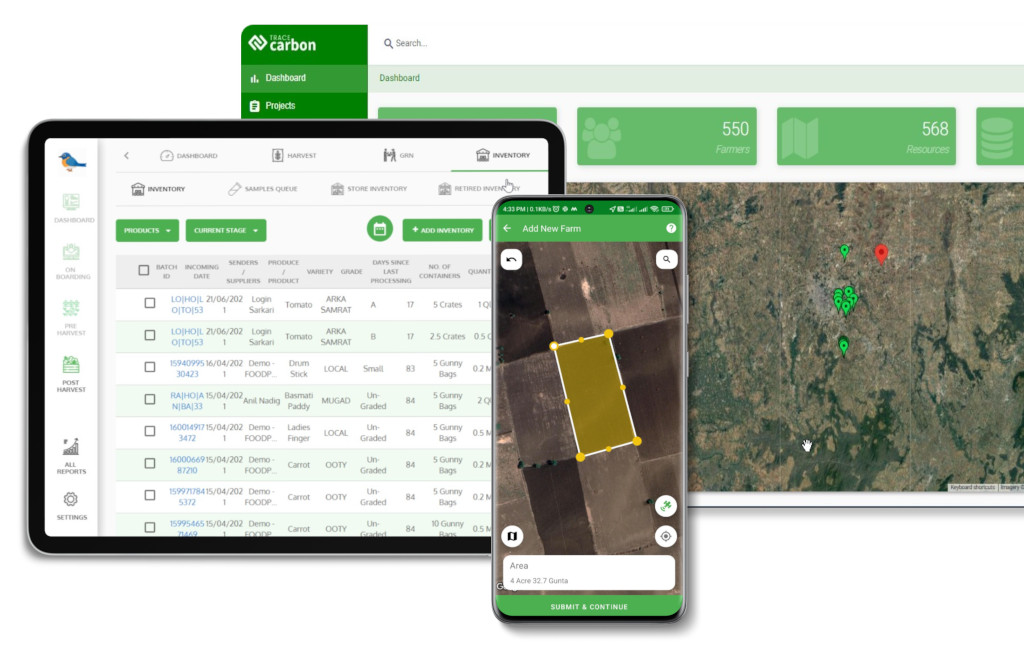
The TraceX EUDR Compliance Platform offers an end-to-end digital solution that automates Due Diligence Statements (DDS) and ensures EU-ready compliance across the full HS 4001–4017 rubber parts supply chain.
TraceX automatically generates EUDR-compliant DDS filings for natural rubber, compounded rubber, hoses, belts, gaskets, seals, vibration-control parts, and other HS 4016/4017 components destined for EU customers. The platform consolidates geolocation polygons, legality documentation, supplier declarations, and risk insights eliminating manual data collection and ensuring UK exporters submit accurate, audit-ready DDS files.
Every movement from plantation to processor to UK manufacturer or distributor is logged on TraceX’s immutable blockchain ledger. Each batch is tied to validated plantation polygons, giving UK suppliers verifiable evidence of legal and deforestation-free sourcing critical for EU importers and regulatory checks.
Using mobile-enabled onboarding tools, upstream plantations, cooperatives, processors, and traders across Asia, Africa, and Latin America can upload legality documents and capture GPS polygons directly in the field. UK companies often responsible for verifying compliance across thousands of upstream actors gain full visibility over even fragmented, smallholder-driven supply chains.
TraceX provides UK operators with real-time dashboards showing deforestation alerts, land-use change indicators, supplier compliance scoring, and documentation gaps. Automated risk classification helps UK exporters and manufacturers proactively mitigate risk and maintain audit-ready DDS documentation ahead of the 2025/2026 EU deadlines.
A leading UK automotive rubber parts manufacturer sourcing rubber from Southeast Asia and West Africa can use TraceX to map plantations, validate legality records, and auto-generate DDS filings for every EU-bound shipment. Within weeks, the company can achieve full traceability, reduce manual compliance workload by 60%, and secure uninterrupted access to its EU customer base.
By combining blockchain-based traceability, AI-driven risk scoring, and automated DDS workflows, TraceX converts EUDR compliance into a competitive advantage for UK exporters. Companies benefit from operational efficiency, stronger documentation integrity, resilient supply chains, and stronger sustainability credentials across EU-facing markets.

EUDR compliance is mission-critical for the UK rubber parts sector because the EU remains one of its largest export destinations for automotive components, engineering parts, seals, hoses, gaskets, belts, vibration-control items, and industrial rubber products. Even though the UK is no longer part of the EU, any UK manufacturer, trader, distributor, or re-exporter supplying rubber goods into EU markets must meet EUDR rules or risk having shipments delayed, rejected, or penalized at EU borders.
The regulation also raises the bar for supply-chain integrity: UK companies must demonstrate that all rubber inputs whether raw, compounded, or embedded in finished parts are legally sourced, deforestation-free, and traceable to plantation-level geolocation. This is especially challenging given the UK’s dependence on imports from high-risk regions in Asia and West Africa, where smallholder sourcing, intermediaries, and fragmented documentation can obscure origin information.
Failing to comply puts UK businesses at risk of:
• Lost access to EU automotive and industrial markets, harming revenue and supply continuity
• Reputational damage if buyers shift to compliant suppliers
• Increased audit scrutiny from EU partners and OEMs demanding transparent traceability
• Contract losses for Tier-1 and Tier-2 suppliers unable to meet OEM sustainability thresholds
On the opportunity side, companies that invest early in digital traceability, polygon-based geolocation, and automated DDS workflows can secure long-term EU contracts, improve supply-chain reliability, strengthen ESG commitments, and position themselves as leaders in sustainable rubber manufacturing.
EUDR is not just a compliance requirement it is a competitive differentiator. UK rubber parts companies that adapt quickly will benefit from greater market access, stronger customer trust, and future-proofed global supply chains.
EUDR DDS compliance is now a defining factor in the competitiveness and continuity of the UK rubber parts sector. As the EU tightens scrutiny on natural rubber sourcing, UK manufacturers, importers, and distributors must implement robust digital traceability, plantation-level geolocation validation, and automated DDS workflows to maintain seamless access to EU markets. By adopting modern compliance platforms and strengthening upstream visibility, UK companies can reduce regulatory risk, build trust with EU buyers, and position themselves as resilient, sustainable partners in the global rubber ecosystem. The businesses that act now will lead the next era of compliant, transparent, and deforestation-free rubber supply chains.
Understand the key components of EUDR compliance and how to streamline your DDS process efficiently.
Read the blog on EUDR Due Diligence
Learn how AI-driven automation and intelligent workflows simplify data collection, verification, and reporting.
Explore the blog on Agentic AI for EUDR
Unpack the biggest hurdles faced by importers under EUDR and how technology can turn compliance into a competitive edge.
Read blog on Challenges for EU Importers
The EUDR is an EU regulation requiring companies to prove that natural rubber and rubber-derived components used in UK manufacturing are deforestation-free, legally sourced, and fully traceable to plantation level. It applies to raw rubber (HS 4001), intermediates, and finished rubber parts used in UK’s automotive, engineering, and industrial sectors.
A DDS is a mandatory declaration submitted by UK operators confirming that all rubber inputs raw, compounded, or integrated into rubber parts comply with EUDR. It must include farm-level geolocation data, legality documentation, supply-chain mapping, and a risk assessment proving no post-2020 deforestation.
All manufacturers, Tier-1/Tier-2 automotive suppliers, importers, distributors, and traders placing rubber components on the EU market must comply. This spans gaskets, seals, hoses, belts, bushings, moulded components, and other rubber parts falling under HS 4001–4017.
UK rubber parts manufacturers face major EUDR challenges such as tracing natural rubber back to verified plantation polygons, collecting accurate GeoJSON coordinates from thousands of smallholders, and validating legality documentation across multi-tier, global supply chains. The complexity increases as many components pass through processors, compounders, and intermediaries before reaching UK, making manual DDS preparation slow, inconsistent, and high-risk. Ensuring deforestation-free sourcing, maintaining audit-ready documentation, and coordinating data across diverse suppliers remain the biggest operational hurdles under the EUDR.
TraceX digitizes supplier onboarding, collects verified geolocation and legality data, integrates satellite-based deforestation alerts, and automatically generates EUDR-compliant DDS files. The platform eliminates manual consolidation, reduces compliance time, and ensures exporters and UK automotive suppliers maintain audit-ready, tamper-proof records.
Yes. TraceX’s mobile-based tools allow smallholders, cooperatives, and processors to upload documents, GPS coordinates, and traceability data even in remote regions. This ensures full upstream transparency, enabling UK rubber parts makers to meet EUDR requirements even when sourcing from diverse and decentralized supply networks.