
Quick summary: Learn how EUDR Due Diligence (DDS) affects Belgium’s gloves supply chain. Understand traceability, risk assessment, origin verification, and compliance requirements for importers.
EUDR DDS for Gloves Supply Chain in Belgium requires companies to implement robust due diligence systems that verify raw material origin, ensure deforestation-free sourcing, and maintain complete traceability across manufacturing and import processes. Belgium-based glove suppliers must collect geolocation data for natural-rubber inputs, assess legality and environmental compliance risks, and maintain digital audit-ready documentation. Under EUDR, importers are accountable for demonstrating transparent, risk-mitigated supply chains, making end-to-end traceability and verified supplier data essential for compliance and continued access to EU markets.
Belgium is a major entry, distribution, and re-export hub for medical, industrial, and disposable gloves within the EU. Belgian importers source latex, rubber, and nitrile gloves primarily from Southeast Asia, Malaysia, Thailand, Vietnam, Indonesia, and China as well as natural rubber inputs originating from West Africa and ASEAN regions. These source countries operate under diverse land-use regulations and forest-governance systems, resulting in inconsistent origin verification and documentation quality.
Belgium’s imports of surgical and protective rubber gloves (HS 401511 & 401519) represent a significant share of EU demand, but the upstream supply chain remains highly fragmented. Natural rubber often flows through multi-tier networks of smallholders, aggregators, processors, and exporters, where plot-level geolocation, legality documentation, and deforestation-free records are frequently incomplete or unavailable. Commingling of latex and limited mapping of plantation boundaries further hinder traceability.
Under EUDR, Belgian glove importers must submit a fully compliant Due Diligence Statement (DDS) that includes precise plantation coordinates, legality and risk assessments, and verified chain-of-custody documentation. Given the fragmented upstream ecosystem, these requirements present a high risk of non-compliance, shipment delays, or blocked EU market entry. Digital traceability, supplier verification, and geospatial mapping are now essential for Belgium’s gloves sector to meet EUDR enforcement standards and maintain uninterrupted market access.
Belgium’s glove industry supports:
Industry Concentration
Key players include:
Upstream / Midstream / Downstream Stakeholders
Upstream:
Midstream:
Downstream:
• EU: Germany, France, Netherlands, Spain, Italy, Nordics
• Global: U.K., Middle East, North Africa
Belgium functions as one of the EU’s most efficient redistribution nodes for PPE and medical consumables.
Under EUDR, Belgium must ensure full DDS compliance for natural-rubber–based gloves. Importers must provide:
• Precise plantation geolocation (plot-level)
• Proof of deforestation-free production
• Verified legality and land-use evidence
• Digital chain-of-custody from plantation → processor → exporter → Belgium
This is complex due to multi-tier sourcing and fragmented smallholder landscapes.
Belgium bears regulatory responsibility for gloves distributed across the EU.
This raises compliance risk because incomplete upstream data—especially from Southeast Asian rubber supply chains—can lead to:
• Border delays
• Non-compliance penalties
• Rejected shipments
• Loss of buyer confidence
Gloves often use commingled latex from hundreds of plantations.
This creates major challenges:
• Missing geolocation data
• Unverified land-use documentation
• Difficulty proving deforestation-free sourcing
• Limited transparency in pre-processing stages
EUDR requires full chain documentation even when origin is mixed or processed at scale.
Belgian companies that digitize upstream data and adopt traceability platforms can:
• Prevent port delays and shipment holdbacks
• Ensure uninterrupted EU-wide distribution
• Strengthen relationships with hospitals, medical distributors, and regulators
• Gain a strategic edge as compliant PPE suppliers
EUDR will reward proactive importers and penalize reactive ones.
As one of the EU’s most influential PPE distribution hubs, Belgium sits at the forefront of EUDR enforcement in the gloves sector. Companies investing in plantation-level mapping, supplier onboarding, traceability technology, and DDS workflows will protect trade continuity and secure long-term competitiveness in the European medical and industrial glove market.
Although gloves themselves are not explicitly listed among EUDR-regulated commodities, the natural rubber used in many medical and disposable gloves falls under EUDR jurisdiction. As one of Europe’s major PPE import and redistribution hubs, Belgium faces high regulatory exposure in the glove market.
These risks increase the possibility of delays, shipment rejections, penalties, or even loss of access to the European market.
For Belgium a central logistics and PPE distribution hub EUDR DDS readiness is no longer optional. It has become a crucial strategic requirement to future-proof the gloves supply chain, protect market access, and build trust with increasingly stringent global buyers.
Master the step-by-step process of submitting Due Diligence Statements under the new EUDR rules.
Read the blog on filing DDS for EUDR compliance
Stay Ahead of EUDR in Healthcare Supply Chains
Germany’s medical and PPE sector is entering a new era of transparency. Don’t wait for regulatory audits or shipment blocks – learn how healthcare manufacturers and importers can streamline EUDR DDS, secure supplier data, and protect market access.
Read the full guide on EUDR compliance for the healthcare sector
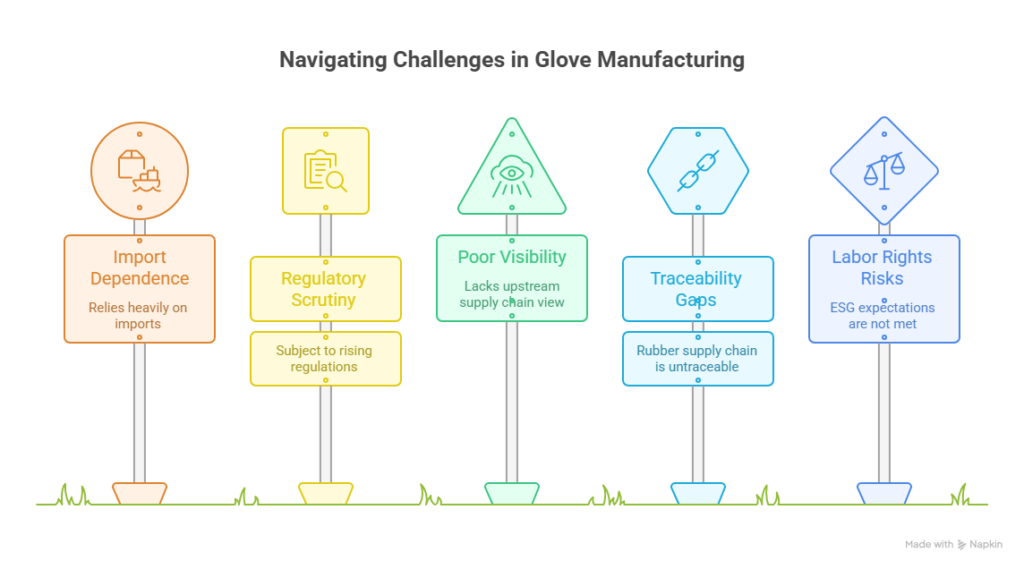
Belgium’s gloves sector spanning medical, industrial, and food-grade applications faces growing operational and regulatory pressure as natural rubber becomes fully regulated under the EU Deforestation Regulation (EUDR). Since much of the world’s rubber supply originates from high-risk regions with weak land-use governance, Belgian importers must address several structural and compliance-related challenges:
Belgian importers often rely on multi-tiered supply chains:
At the upstream smallholder level, key data is often missing:
Belgian companies rarely receive farm-level data, creating immediate EUDR compliance gaps.
Natural rubber is frequently pooled and blended during:
This commingling makes it difficult to identify which plantation contributed to a batch—creating a major risk for EUDR origin traceability.
Many rubber-producing countries have:
Belgian importers must now verify data quality and legality across jurisdictions with vastly different governance standards.
To export natural-rubber–based gloves into the EU, Belgian importers need to submit a Due Diligence Statement (DDS) containing:
Most glove manufacturers are not yet ready to supply this level of documentation.
Overseas glove factories and rubber processors may:
Belgian importers must invest in supplier onboarding, training, and capacity-building—often across multiple countries.
Costs will rise due to:
Compliance timelines are tight, adding pressure to modernize sourcing practices quickly.
Without verifiable farm-level traceability, Belgian importers risk:
For manufacturers importing natural rubber to produce gloves domestically, the same risks apply.
EU buyers including hospitals, procurement agencies, and retailers are tightening sustainability expectations. The absence of traceable, deforestation-free rubber exposes companies to:
The EUDR introduces a new era of transparency for the natural rubber and gloves supply chain in Belgium. Importers and manufacturers must address deep upstream visibility gaps, improve documentation standards, digitize traceability, and invest in supplier compliance readiness.
Companies that act early will safeguard market access and gain competitive advantage. Those that delay face escalating risks across compliance, logistics, and commercial performance.
TraceX provides an end-to-end digital compliance infrastructure that enables Belgian glove importers, manufacturers, distributors, and re-export hubs to meet stringent EUDR-aligned due diligence requirements for natural-rubber-based gloves. Belgium home to major logistics corridors such as Antwerp and Zeebrugge relies heavily on imported gloves from Southeast Asia and Africa, where rubber traceability gaps are common. The TraceX EUDR Compliance Platform digitizes plantation geolocation, supplier data, processing records, and risk intelligence, allowing Belgian companies to generate accurate, audit-ready Due Diligence Statements (DDS) with minimal operational disruption.
Natural rubber used in Belgian glove supply chains typically originates from fragmented smallholder networks. TraceX enables suppliers to upload:
This provides Belgian importers with verified origin data required for legality and sustainability compliance under EUDR.
TraceX platform creates a continuous digital chain-of-custody across:
plantation → latex collection → processing (RSS, TSR, cup lumps) → compounders → glove manufacturers → exporters → Belgian importers.
Each batch is assigned a traceable digital identity, eliminating blind spots caused by commingling or multi-tier sourcing and enabling defensible deforestation-free sourcing.
The platform automates collection of critical EUDR-required records:
Smart validation flags missing or inconsistent data before shipment reducing compliance risk at Belgian customs.
Using GIS and satellite analytics, TraceX platform provides real-time monitoring of:
Each batch receives an automated EUDR-aligned risk score, supporting Belgian importers’ mandatory risk assessment and mitigation steps.
TraceX platform compiles geolocation, legality documents, and risk assessments into a complete, EUDR-compliant DDS. This helps ensure glove shipments entering Belgian ports remain fully compliant, reducing the risk of border delays or market access issues.
Multilingual mobile tools help onboard glove manufacturers and rubber processors across Malaysia, Thailand, Indonesia, Vietnam, and West Africa quickly aligning them with Belgian buyers’ EUDR compliance needs, including smallholder integration.
All traceability records are anchored on blockchain, providing tamper-proof data for:
Belgian importers gain unified visibility into:
This enables proactive corrective action before gloves arrive in Belgium.
TraceX platform connects with SAP, Oracle, Microsoft Dynamics, and logistics platforms commonly used across Belgium’s PPE distribution networks, enabling compliance workflows to run alongside procurement and warehousing operations.
EUDR DDS for Gloves Supply Chain in Belgium is now a strategic necessity, not a procedural formality. As Belgium remains a major entry, storage, and redistribution hub for rubber-based gloves, importers and manufacturers must ensure full origin verification, geolocation accuracy, and deforestation-free documentation for every shipment. Digital traceability platforms such as TraceX enable Belgian companies to operationalize compliance, eliminate documentation gaps, and build a resilient, audit-ready supply chain. By investing in robust EUDR-aligned systems today, Belgium’s gloves sector can secure uninterrupted EU market access and strengthen its competitive edge in the global PPE landscape.
Understand the key components of EUDR compliance and how to streamline your DDS process efficiently.
Read the blog on EUDR Due Diligence
Learn how AI-driven automation and intelligent workflows simplify data collection, verification, and reporting.
Explore the blog on Agentic AI for EUDR
Unpack the biggest hurdles faced by importers under EUDR and how technology can turn compliance into a competitive edge.
Read blog on Challenges for EU Importers
Gloves made from natural rubber fall under EUDR because rubber is a regulated commodity. Belgian glove importers must prove deforestation-free, legally sourced rubber.
Importers must collect plot-level geolocation of rubber farms, verify legal harvesting, assess deforestation risk, and submit a Digital Due Diligence Statement before placing gloves on the EU market.
Most natural rubber comes from smallholder farmers in Southeast Asia and Africa, where limited mapping, informal trade, and supply commingling create traceability gaps.
Manufacturers must ensure full traceability for rubber used in surgical, household, and industrial gloves. Non-compliance risks shipment delays, fines, and market restrictions.
They must provide farm geolocation, legality records, land-use rights, supply chain traceability documents, and proof of deforestation-free sourcing.
Yes. Platforms like TraceX automate origin mapping, supplier data collection, risk scoring, and DDS generation, reducing manual compliance efforts and ensuring audit-ready records.