
Quick summary: Explore real-world EUDR coffee supply chain examples and learn how your business can navigate compliance, traceability, and due diligence to stay competitive in the EU market.
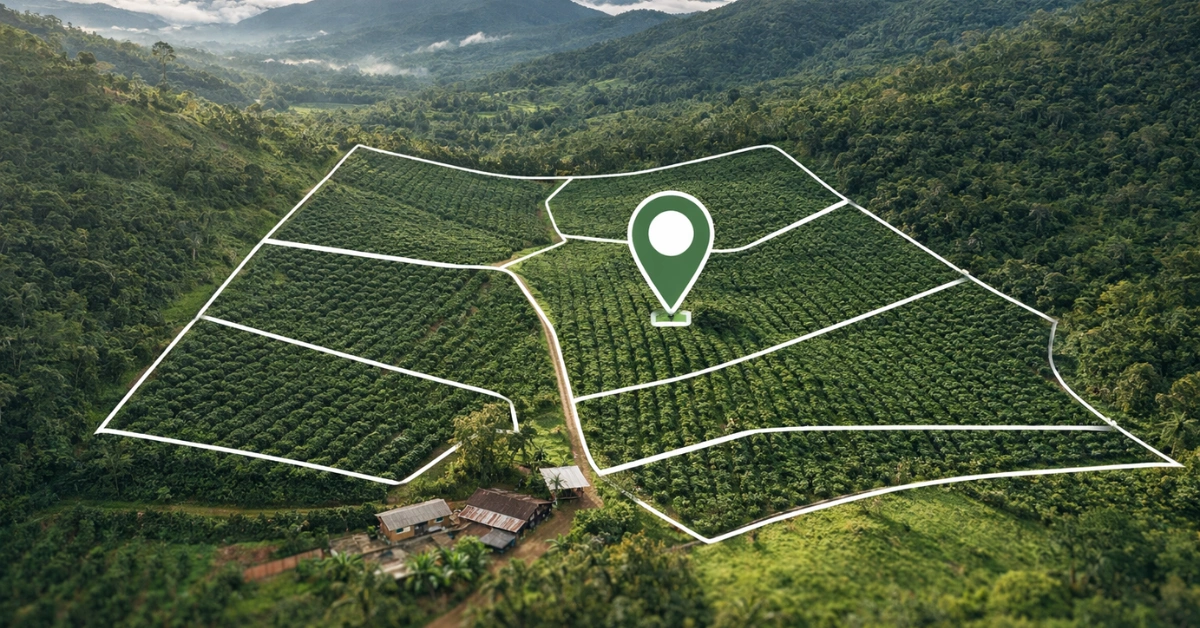
Picture this: Your premium Colombian coffee shipment arrives at Hamburg Port. Months of effort. Relationships built across dozens of farms.
Then customs flags it.
“Where is the geolocation proof that this coffee wasn’t grown on deforested land?”
Shipment halted. Contract at risk. EU market access: denied.
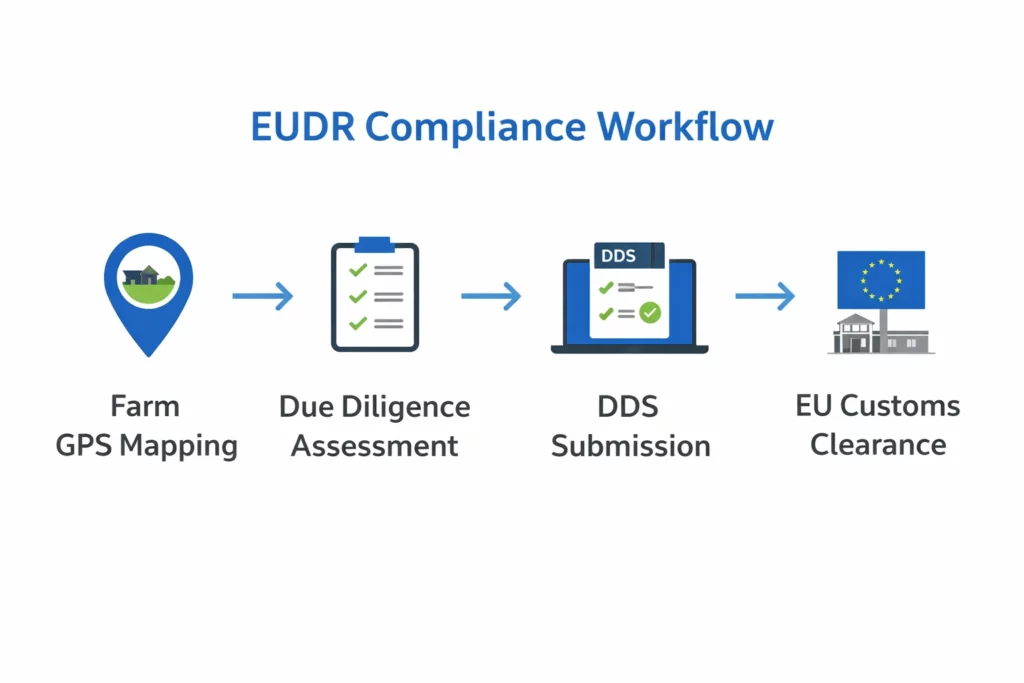
This isn’t hypothetical. It’s happening right now and it will happen at scale after December 30, 2026 when the EU Deforestation Regulation (EUDR) enters full enforcement for large operators.
The EU Deforestation Regulation (EUDR) requires every coffee batch entering the EU after December 30, 2026 to be proven deforestation-free with GPS-level farm data and a Due Diligence Statement (DDS). Non-compliance means shipment seizures, market bans, and fines up to 4% of annual EU turnover. This guide walks through real-world EUDR coffee examples from Latin America, Africa, and Asia and shows exactly how blockchain traceability and digital supply chain tools protect your market access.
Real EUDR coffee supply chain scenarios from Colombia, Ethiopia, Brazil, and Vietnam. The exact traceability, geolocation, and DDS requirements. Step-by-step compliance frameworks. How digital tools and blockchain platforms like TraceX eliminate the guesswork.
| 4% Max fine of EU annual turnover for non-compliance | Dec 30, 2026 EUDR enforcement deadline for large operators | 60% of global coffee grown by smallholder farmers (<0.5ha plots) |
The EU Regulation on Deforestation-Free Products (Regulation (EU) 2023/1115) entered into force on June 29, 2023. It targets seven commodities whose EU-market demand is directly linked to forest loss: cattle, palm oil, soy, wood, cocoa, coffee, and rubber.
Coffee earns particular scrutiny for a stark reason.
| 7% Coffee’s share of EU-driven agricultural deforestation | 30–40% EU’s share of coffee-related global ’embodied deforestation’ | 10M ha Forest lost globally each year — coffee expansion is a key driver |
Under the EUDR, any coffee placed on the EU market or exported from the EU must:
| KEY ENFORCEMENT DATES December 30, 2026 — Large operators and traders June 30, 2027 — Small and micro enterprises Note: The EU Parliament proposed a further one-year delay in November 2025, but this is not yet legally binding. Do not plan around it. |
This is not a paperwork exercise. The penalties are business-ending for unprepared companies.
| Consequence | Detail |
|---|---|
| Fines | Up to 4% of total EU annual turnover — for large multinationals, this can mean tens to hundreds of millions of euros |
| Shipment confiscation | EU authorities can seize and destroy non-compliant goods at port |
| Market ban | Repeat violators face temporary or permanent exclusion from EU markets |
| Reputational damage | 56% of EU consumers consider sustainability in purchases; violations become public record |
| Contract loss | EU buyers increasingly require pre-verified EUDR-compliant sourcing before signing |
And the compliance cost? According to ClientEarth analysis of a large EU coffee company, EUDR compliance runs approximately 0.03–0.07% of annual revenue with a consumer price impact of just 0.018% per cup. The cost of compliance is a rounding error. The cost of non-compliance is not.
What does EUDR compliance and non-compliance actually look like on the ground? Here are four scenarios drawn from real challenges facing exporters across origin countries.
| SCENARIO A premium coffee exporter from Colombia secures a lucrative contract with a European retailer. Just before shipment, a compliance check surfaces a critical gap: the supplier lacks geolocation proof that the coffee wasn’t grown on deforested land. Result: shipment halted, contract at risk, EU market access denied. |
The Pain Points:
The EUDR-Compliant Fix:

| SCENARIO Ethiopia is Africa’s largest Arabica producer with over 5 million smallholder farmers across regions like Sidama, Yirgacheffe, Guji, and Harar. The challenge: farms are often sub-0.5 hectare plots in dense agroforestry systems, without formal land titles or internet connectivity. |
Ethiopia’s 2025/26 season is forecast to produce a record 11.56 million 60-kg bags (approximately 694,000 metric tons). Without farm-level traceability, a significant portion of this volume risks exclusion from the EU market.
The Pain Points:
The EUDR-Compliant Fix:
See how a leading tire company achieved EUDR compliance with polygon mapping →
| SCENARIO Brazil is one of the world’s largest coffee exporters and is considered ‘well prepared’ for EUDR by industry analysts. The Brazilian Coffee Exporters Council (Cecafé) is leading development of georeferencing technology capable of pinpointing farm locations with up to 50 centimeters of accuracy. |
For Brazilian operators who invest now, EUDR compliance becomes a competitive moat not just a regulatory box to check. EU buyers are pre-qualifying suppliers based on compliance readiness, and compliant Brazilian lots are being contracted at premiums.
What Compliance-Ready Brazilian Operators Are Doing:
| SCENARIO Vietnam is a major robusta producer facing EUDR compliance pressure at scale. The Vietnamese government has partnered with private sector players to build a national farm mapping system that identifies at-risk areas and creates a compliance framework specifically for smallholders. |
This public-private model demonstrates that national EUDR readiness is achievable and that exporters who align with government traceability infrastructure gain streamlined compliance at reduced per-unit cost.
Key Lesson for Exporters from Any Origin:
Regardless of your origin country or company size, EUDR compliance for coffee follows a consistent structure. Here is the end-to-end framework.
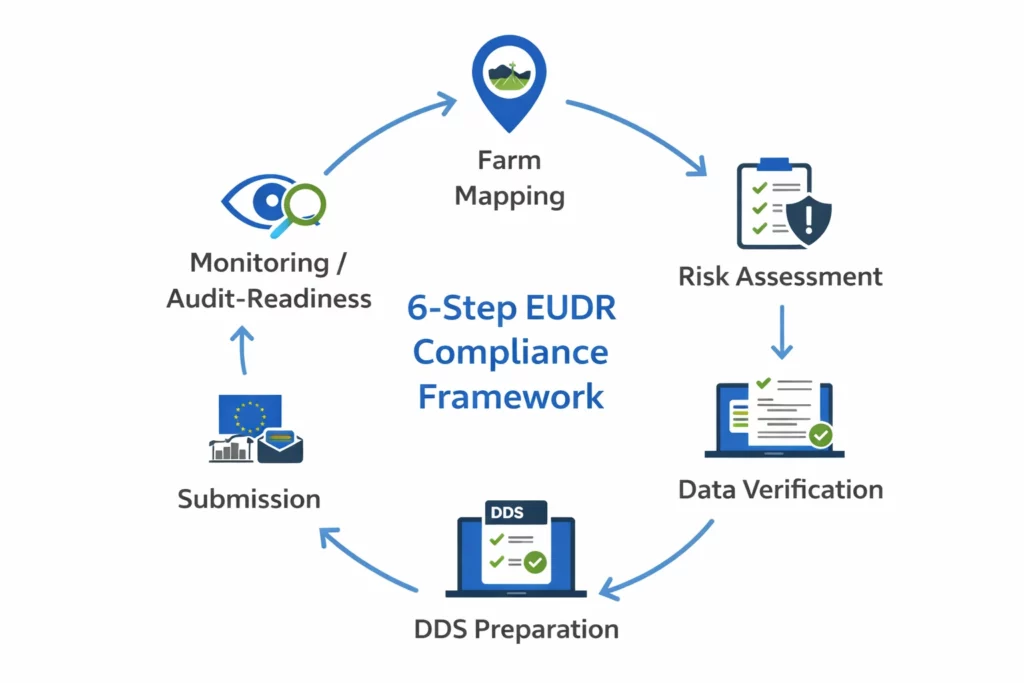
Every farm supplying your EU-bound coffee must be GPS-mapped to either a point coordinate or a polygon boundary. Polygons are preferred and may be required for high-risk origins as they confirm no deforestation occurred within the specific plot. Approximately 12% of submitted farm polygons contain errors (overlapping boundaries, wrong coordinates) that cause instant DDS rejection. Use validated mapping tools and quality-check all geo-data before submission.
Using satellite imagery and reference datasets (including EU’s Copernicus Land Monitoring Service), assess whether any mapped plot shows deforestation activity after December 31, 2020. This is not a one-time check ongoing satellite monitoring is recommended as farms continue operating.

Beyond deforestation-free status, EUDR requires that coffee was produced in compliance with local laws including land tenure, labor rights, and environmental regulations. For origins with fragmented land records (like Ethiopia), this typically requires working through cooperative structures that hold collective documentation.
The chain of custody from farm to EU border must be digitally documented with no breaks. This means tracking: farm → washing station / wet mill → dry mill → export warehouse → shipping lot. Aggregation is common in coffee but dangerous under EUDR: once farm identity is mixed without documented lot separation, compliance cannot be proven.
The DDS is the legal declaration submitted to the EU Information System before goods enter the EU market. It must include: operator details, product description, quantity, country of production, geolocation data of all source plots, and a certification that due diligence confirms deforestation-free and legal sourcing.
EUDR-compliant companies must retain all supporting documentation (geo-data, risk assessments, supplier declarations, DDS confirmations) for a minimum of five years. Authorities can audit any shipment maintaining cloud-based, searchable records means you can respond to an audit request in hours, not weeks.
| Aggregation Is the #1 Compliance Failure Point In Germany and other major EU import hubs, most DDS rejections trace back to aggregation coffee from multiple farms mixed without maintained identity. Once the link between farm → plot → volume → shipment is broken, EUDR compliance cannot be proven retroactively. Build segregation into your supply chain architecture from the first mile. |
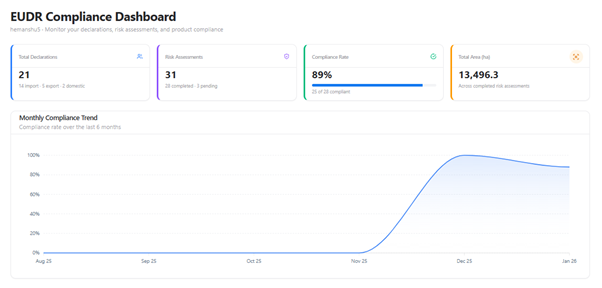
Manual recordkeeping, paper-based systems, and spreadsheet chain-of-custody processes cannot meet EUDR requirements at scale. The regulation demands digital, structured, verifiable data and the volume of farms involved in most coffee supply chains makes analog approaches unworkable.
| Capability | EUDR Requirement It Solves |
|---|---|
| GPS farm plot mapping (polygon & point) | Plot-level traceability for all sourced farms |
| Blockchain-immutable lot tracking | Tamper-proof chain of custody from farm to export |
| AI satellite deforestation monitoring | Ongoing deforestation-free verification post farm mapping |
| Automated DDS generation | Structured EU Information System-ready submissions |
| Offline mobile data capture | Smallholder farmer onboarding in low-connectivity regions |
| Multi-stakeholder data sharing | Exporters, cooperatives, EU importers, and regulators on one platform |
| 5-year audit-ready recordkeeping | Compliance with EUDR document retention requirements |
| Risk classification dashboards | Country risk-tiered due diligence calibration |
TraceX’s EUDR Compliance Solutions integrates all of these capabilities into a single supply chain hub enabling coffee operators at every tier, from smallholder cooperative to large EU importer, to meet EUDR requirements without rebuilding their supply chain from scratch.
The EU’s EUDR benchmarking system classifies origin countries as low, standard, or high deforestation risk. This classification directly affects the level of due diligence required and the scrutiny your DDS submissions will face.
| Origin | EUDR Readiness Level | Key Challenges | Recommended Action |
|---|---|---|---|
| Brazil | High | Scale of farm count; blending risks at mills | Leverage Cecafé georeferencing systems; implement mill-level lot segregation |
| Colombia | Medium | Fragmented smallholder supply chains; cooperative data gaps | Prioritize cooperative-level GPS onboarding; digital chain of custody from farm gate |
| Ethiopia | Medium-High | 5M+ smallholders; remote areas; no formal land titles | Mobile-first farmer mapping; cooperative data aggregation; TraceX platform deployment |
| Vietnam | Medium | Large robusta volumes; national mapping system still maturing | Align with government EUDR mapping initiative; integrate with national compliance framework |
| Indonesia | High | Complex land tenure; overlapping forest concessions | Third-party forest boundary verification; legal land-use documentation for each plot |
| Honduras / Guatemala | Medium | Cooperative fragmentation; altitude and remote access | Cooperative-level digital onboarding; aggregation with identity preservation |
December 30, 2026 is the enforcement date for large operators. June 30, 2027 for SMEs. That sounds like time until you map out what needs to happen:
| Timeline | Action Required |
|---|---|
| Now | Audit your supply chain identify farms without GPS mapping, data gaps in chain of custody |
| 3–6 months out | Deploy farm mapping at cooperative/supplier level; begin supplier data standardization |
| 2–3 months before deadline | Run test DDS submissions through the EU Information System; resolve polygon errors |
| 1 month before deadline | Complete all DDS pre-filing for in-transit and forward-contracted lots |
| Ongoing post-deadline | Maintain satellite deforestation monitoring; update supplier records seasonally |
The companies waiting for more delays are betting their EU market access on regulatory uncertainty. The EUDR cannot be amended until mid-2028. The window to build compliant infrastructure is now.
Turning Real-World Coffee Traceability into EUDR Readiness
Real-world examples from coffee supply chains show that achieving EUDR compliance is not just about meeting regulatory requirementsit is about transforming how sourcing, traceability, and risk management are handled at scale. From mapping thousands of smallholder farms to implementing satellite-based deforestation screening and digital due diligence workflows, leading companies a re moving toward data-driven compliance models. These examples demonstrate that even highly fragmented coffee supply chains can become transparent, traceable, and audit-ready with the right systems in place. As enforcement timelines approach, companies that learn from these real-world implementations will be better positioned to reduce risk, strengthen supplier relationships, and maintain uninterrupted access to EU markets.
What are your EUDR obligations? Find out here →
Run an EUDR gap analysis for your supply chain →
How do you prepare a Due Diligence Statement? Read here →
Both. EUDR applies to all coffee products placed on or exported from the EU market, including green beans, roasted coffee, coffee extracts, and soluble coffee. If coffee is an ingredient in a product, the finished product is also in scope.
Coffee is considered deforestation-free if it was produced on land that was not converted from forest use after December 31, 2020. This cut-off date is fixed earlier deforestation is not covered. Note: agroforestry coffee planted before 2021 can still meet EUDR requirements as long as verified geo-data confirms no protected forest was cleared.
Errors in polygon boundaries such as overlapping with neighboring plots or incorrect coordinates cause DDS submissions to fail automatically. Approximately 12% of submitted polygons contain these errors. Always validate geo-data using a qualified traceability platform before submission. Rejected DDS submissions require re-submission, which can delay shipments.
No. Existing sustainability certifications do not satisfy EUDR requirements. The EUDR demands specific plot-level geolocation data, legal sourcing verification, and a formal DDS submission through the EU’s Information System these are additional requirements beyond any existing certification.
The ‘operator’ who first places the coffee on the EU market carries the highest legal responsibility. For most supply chains, this is the EU-based importer or roaster. However, upstream exporters, traders, and cooperatives whose data is incomplete or inaccurate can cause operators to fail compliance making data quality a shared responsibility across the entire supply chain.