
Quick summary: Which industries face the highest EUDR risk? From coffee to cattle, discover the 10 sectors most affected and how to get compliant before the deadline.
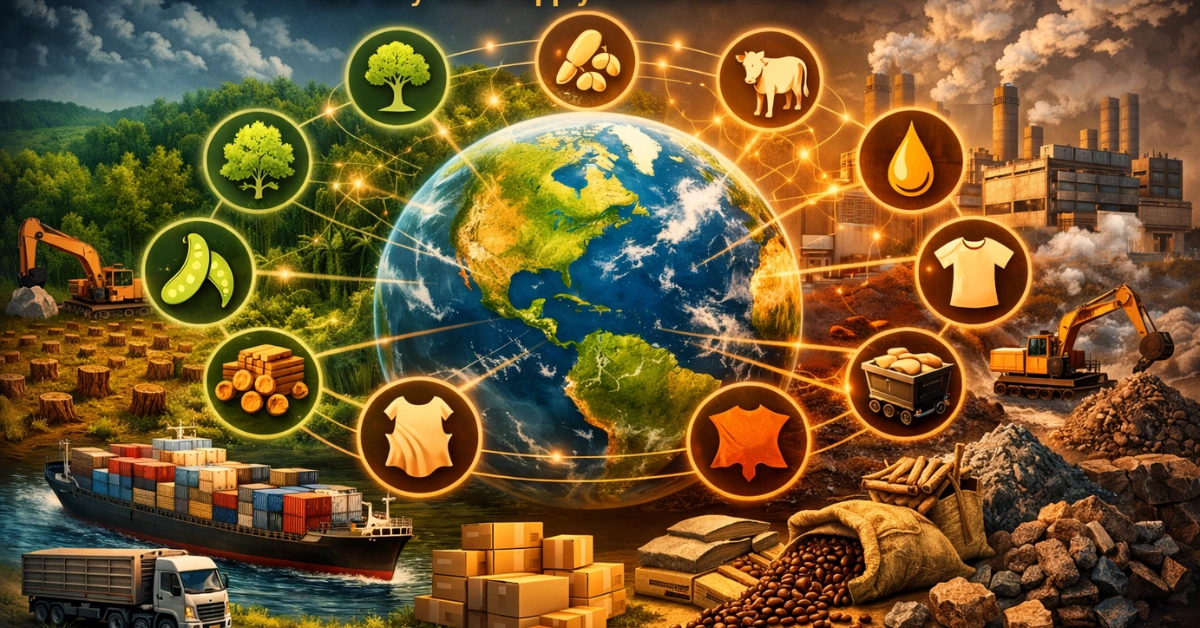
The EU Deforestation Regulation (EUDR) doesn’t just target timber companies. It reaches into the supply chains of coffee roasters in Kerala, cocoa traders in Cote d’Ivoire, and cattle processors in Brazil, and it demands verifiable, GPS-level proof of deforestation-free sourcing. If your business touches any of the seven regulated commodities, you’re in scope. This article maps the 10 industries most exposed to the EUDR sector by sector, with data on commodity volumes, compliance complexity, and what it actually takes to get audit-ready.
If you’re a sustainability officer, trade compliance manager, or procurement lead, this is the briefing you need. In December 2026, large operators faced their compliance deadline. SMEs now have until June 2027. Yet a 2025 European Commission survey found that fewer than 30% of businesses in scope had a compliant due diligence system in place, leaving the vast majority at risk of shipment seizure, fines up to 4% of annual EU turnover, and permanent exclusion from EU markets.
EUDR affects 10+ major commodity sectors, not just timber. Coffee, cocoa, soy, palm oil, rubber, cattle, and more are all in scope.
The June 2026 SME deadline means smaller agri-food exporters must act now. Large operators faced the December 2024 cut-off.
EUDR compliance requires GPS geo-mapping, Due Diligence Statements (DDS), and real-time satellite deforestation alerts, not spreadsheets.
2.4 Trillion Euros
Annual value of EU agri-food imports potentially in scope of EUDR (Source: European Commission, 2024)
The EU Deforestation Regulation (Regulation 2023/1115) prohibits the import, export, or sale within the EU of products linked to deforestation or forest degradation occurring after December 31, 2020. It applies to operators and traders who place the following commodities and their derived products on the EU market:
Compliance requires operators to submit a Due Diligence Statement (DDS) for every relevant product batch, including GPS polygon coordinates for every plot of land in the supply chain, validated against JRC satellite datasets and Hansen Global Forest Change data.
The regulation applies to any company selling into EU markets, regardless of where they are headquartered. Indian coffee exporters, Indonesian palm oil processors, and Brazilian cattle ranchers are all directly in scope if their products reach European buyers.
The table below summarises the compliance exposure, key risk factors, and urgency level for each of the 10 most impacted industries.
| # | Industry | Key Commodity | Primary EUDR Risk | Urgency |
|---|---|---|---|---|
| 1 | Coffee | Green coffee beans, roasted coffee | Smallholder sourcing from fragmented plots – geo-mapping at scale | CRITICAL |
| 2 | Cocoa and Chocolate | Cocoa beans, cocoa butter, chocolate | Cote d’Ivoire and Ghana sourcing – high deforestation risk zones | CRITICAL |
| 3 | Palm Oil | Crude and refined palm oil, derivatives | Indonesia/Malaysia sourcing – satellite monitoring essential | CRITICAL |
| 4 | Soy | Soybeans, soy meal, soy oil | Brazil/Argentina sourcing – Cerrado and Amazon overlap | HIGH |
| 5 | Cattle and Leather | Beef, hides, leather goods | Brazilian cattle traceability gaps – plot-level mapping required | HIGH |
| 6 | Rubber and Tyres | Natural rubber, tyres, gloves | Southeast Asia sourcing – smallholder data gaps | HIGH |
| 7 | Timber and Wood Products | Logs, sawnwood, paper, furniture | Complex multi-country supply chains – longest compliance history | HIGH |
| 8 | Chocolate and Confectionery | Chocolate bars, cocoa spreads, filled products | Brand-level deforestation claims – full cocoa traceability required | HIGH |
| 9 | Leather Goods and Footwear | Shoes, handbags, belts, upholstery leather | Cattle hides traceable to farm of birth – luxury and fashion sector in scope | MEDIUM |
| 10 | Paper, Pulp and Packaging | Cardboard, kraft paper, tissue, printed packaging | Wood derivative – FMCG secondary packaging compliance blind spot | MEDIUM |
Coffee is EUDR’s most immediate test case and the most technically complex.
The EU absorbs roughly 60% of global coffee exports, making it the world’s largest coffee-consuming bloc. That market power also means the EU’s EUDR requirements function as a de facto global standard for every coffee-producing nation.
The compliance challenge is acute: the vast majority of the world’s coffee is grown by smallholder farmers, often on plots smaller than 2 hectares, in remote areas with poor connectivity, and with no tradition of formal land documentation. According to World Coffee Research, over 12 million smallholder coffee farmers globally, each farming on less than five hectares, are responsible for producing 60% of the world’s coffee. Collecting GPS polygon data from 12.5 million smallholder coffee farmers is not a spreadsheet problem. It requires offline-capable mobile applications, multilingual field agent tools, and satellite validation at scale.
Key compliance requirements for coffee exporters: GPS polygon coordinates for every farm plot in the supply chain, validated against JRC Tropical Moist Forest layer (post-Dec 2020 deforestation check), a Due Diligence Statement (DDS) submitted to the EU TRACES system for each product batch, and real-time deforestation risk alerts are not a one-time assessment.
TraceX powers coffee supply chain compliance for exporters in India, Ethiopia, and Southeast Asia with offline-first mobile apps, agentic AI for DDS generation, and direct TRACES integration.
Côte d’Ivoire and Ghana produce 65% of the world’s cocoa. Both are deforestation high-risk zones under EUDR.
The cocoa industry faces the harshest EUDR scrutiny and for good reason. According to Nature, cocoa cultivation is an underlying driver of over 37% of forest loss in protected areas in Côte d’Ivoire and over 13% in Ghana, and official reports substantially underestimate the planted area (up to 40% in Ghana). For EU buyers of chocolate, cocoa butter, and cocoa powder, this makes deforestation-free proof a non-negotiable sourcing condition.
Major chocolate brands, including Nestle, Barry Callebaut, and Olam, have publicly committed to deforestation-free sourcing by 2025. But the traceability gap between farm-level reality and brand-level claims remains enormous. Many cocoa supply chains involve three to five intermediary traders before reaching the processor, each link a potential data gap.
What EUDR demands from cocoa traders: farm-level GPS mapping, not just co-operative level aggregation, deforestation risk scores per plot using Sentinel-2 satellite imagery, supplier KYC documentation automatically parsed under EUDR’s agentic AI requirements, and batch-level DDS submissions linked to specific farm coordinates.
Exporting coffee to the EU? Discover the best EUDR compliance tools built for coffee supply chains.
Simplify cocoa exports under EUDR – explore tools designed for seamless compliance and traceability.
Palm oil is in approximately 50% of packaged consumer goods, which means EUDR reaches deep into FMCG supply chains.
Indonesia and Malaysia together produce over 85% of the world’s palm oil, and both countries contain significant areas of tropical forest classified as high-risk under EUDR’s deforestation monitoring framework. The regulation requires operators to prove that palm oil and all its derivatives (including palm kernel oil, palm olein, and over 200 ingredient names used in food labelling) originate from plots that were not deforested after December 31, 2020.
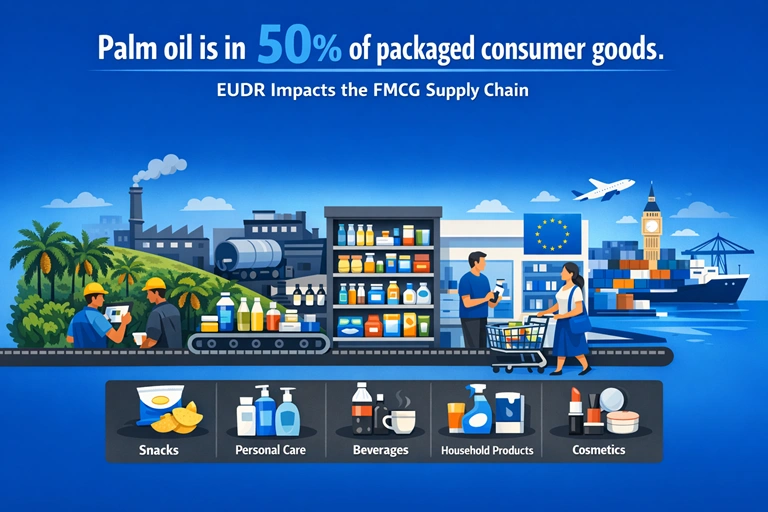
FMCG manufacturers face a compounded compliance problem: palm oil is a hidden ingredient in thousands of product lines, often sourced through complex, multi-tier supply chains. Many brands’ direct suppliers are processors, not growers, creating a traceability gap that EUDR requires them to close all the way back to the plantation level.
According to WWF, Indonesia and Malaysia make up over 85% of the global supply, but there are 42 other countries that also produce palm oil.
Soy is rarely the final product. But as an ingredient in animal feed, cooking oil, and plant protein, it’s everywhere.
Brazil is the world’s largest soy producer, contributing over 38% of global soy exports. The Brazilian Cerrado, the world’s most biodiverse savannah, has experienced dramatic agricultural expansion, with soy farming identified as a primary driver. EUDR’s deforestation cut-off date of December 31, 2020, captures the peak of this expansion.
European livestock producers, food manufacturers, and aquaculture businesses that import soy-based feed even indirectly face EUDR obligations. The compliance challenge is particularly acute for businesses that source soy derivatives (soy lecithin, soy protein isolate, soy flour) through European commodity traders rather than directly from the origin.
Cattle are not stationary. Tracking deforestation exposure across an animal’s lifetime grazing history is EUDR’s hardest technical problem.
Brazil exports approximately $8 billion in beef and leather to the EU annually. According to research on Amazon deforestation, cattle ranching is the biggest single cause of deforestation in the Amazon rainforest, accounting for about 80% of the Amazon’s deforestation as forests are cleared for farmers to raise herds of cattle, primarily for exporting beef.
EUDR requires that cattle products be traceable back to the specific plots of land where animals grazed, which may span multiple farms across multiple states over the animal’s lifetime. This creates a data problem that no manual system can solve. The leather industry faces a further complication: cattle hides are a by-product of beef processing, meaning compliance obligations flow from the abattoir back through the entire livestock production chain, often across 3-4 farm transitions.
Natural rubber is EUDR-regulated. Many tyre manufacturers and medical glove producers haven’t realised they’re in scope.
Thailand, Indonesia, and Vietnam are the world’s dominant natural rubber producers, collectively supplying over 70% of global output. Rubber plantations have been linked to forest conversion across Southeast Asia, including in areas that qualify as forests under EUDR’s definition.
The regulation captures rubber in its natural form and across derived products, including pneumatic tyres, rubber gloves, and conveyor belts. Major automotive manufacturers sourcing tyres from Tier 1 suppliers may have EUDR obligations they have not yet assessed. The automotive and healthcare supply chains are two sectors where EUDR awareness remains critically low.
According to ANRPC, Thailand leads the world in natural rubber production, accounting for 36% of the global supply in 2025. While Southeast Asia dominates, African nations like the Ivory Coast are emerging as growth hubs.
Timber was EUDR’s original focus. The sector has the most compliance history but also the most complex multi-country supply chains.
Timber and wood products, including sawnwood, plywood, paper, cardboard, and wooden furniture, have been subject to EU deforestation regulations since the EU Timber Regulation (EUTR) of 2013. EUDR supersedes EUTR with significantly stricter standards, including GPS-level plot mapping (vs. EUTR’s country-of-origin requirements) and mandatory DDS submission.
The sector’s complexity lies in the multi-country processing chain: logs are often harvested in Russia, Brazil, or Southeast Asia, processed in China or Vietnam, and exported as finished furniture to the EU. Each transformation step requires traceability back to the original harvest plot.
The EU confectionery market is worth over 40 billion euros annually. Every gram of cocoa in it is now EUDR-regulated.
Chocolate is perhaps EUDR’s most visible derived-product battleground. Unlike raw cocoa beans, where the compliance burden sits with trading companies, chocolate and cocoa-derived confectionery products are typically manufactured and branded in Europe. This means the compliance obligation lands squarely on household-name FMCG companies: Nestle, Ferrero, Mondelez, and Lindt.
The technical challenge for confectionery manufacturers is the multi-origin blending problem. Industrial chocolate production typically blends cocoa from multiple origins, Cote d’Ivoire, Ghana, Ecuador, and Peru, in a single production run. EUDR requires that each origin be individually verified as deforestation-free. That means mass-balance traceability approaches that were acceptable under older sustainability schemes no longer satisfy the regulation’s plot-level geo-mapping requirement.
58% of Global Imports: EU chocolate imports annually – the world’s largest cocoa derivative trade flow subject to EUDR (Source: CBI Report)
What this means in practice: confectionery manufacturers must either source exclusively from verified deforestation-free origins with GPS-mapped supply chains, or implement lot-level batch segregation that links each product SKU to its specific cocoa origin plots. Brands that cannot demonstrate this face potential withdrawal from EU shelves and the reputational damage of a public enforcement action.
A Hermes handbag. A pair of Church’s brogues. A BMW interior. All carry EUDR obligations that trace back to a cattle farm in Brazil.
Leather goods and footwear represent one of EUDR’s most commercially sensitive derived-product sectors. The EU is the world’s largest market for luxury leather goods, and Brazilian cattle hides supply the global leather industry’s premium tier. Under EUDR, every leather product placed on the EU market must be traceable back to the specific farm plots where the source cattle grazed.
This creates an unprecedented traceability demand for an industry that has historically relied on country-of-origin declarations and third-party tannery certifications. The cattle hide supply chain typically involves four to six actors between the farm and the finished product: the farm, the slaughterhouse, the wet blue processor, the finished leather tannery, the component manufacturer, and the brand. EUDR’s obligations travel across every link.
Key compliance requirements for leather goods manufacturers: GPS polygon mapping traceable to each animal’s farm of birth and all grazing locations; chain of custody documentation from slaughterhouse through tannery to finished goods; Due Diligence Statement for every product batch entering the EU market; and risk assessment covering all sourcing geographies, not just Brazil.
The luxury sector faces an additional commercial dimension: ‘deforestation-free leather’ is rapidly becoming a procurement condition for major European retailers and brand groups. Companies that can demonstrate GPS-verified, satellite-validated cattle sourcing will command a supplier premium, while those that cannot risk de-listing.
The cardboard box your product ships in. The tissue paper in the gift wrap. The Kraft sleeve on the coffee cup. All wood derivatives. All EUDR-regulated.
Paper, pulp, and packaging is EUDR’s largest-volume derived product sector by weight and arguably its most underappreciated compliance challenge. Every FMCG manufacturer, e-commerce retailer, food service brand, and publishing house that sources cardboard, paper, or wood-based packaging for the EU market is a regulated operator under EUDR Annex I.
The compliance challenge is structural: the paper and pulp supply chain is among the most geographically fragmented of any commodity sector. Wood fibre sourced in Canada, Brazil, Indonesia, and Russia is pulped in Scandinavia or China, converted to paper in Germany, and used in packaging manufactured in Poland. EUDR requires that the deforestation-free status of the original harvest plot be documented and verified through every stage of this transformation chain.
405 Million Tonnes Annual global paper and pulp production – a significant portion sourced from deforestation-risk geographies (Source: WWF)
For FMCG companies, the compliance blind spot is secondary and tertiary packaging: many brands have invested in primary pack sustainability (recycled content, FSC certification) but have not assessed whether their secondary packaging suppliers have the EUDR documentation chain in place. A product that is EUDR-compliant in its primary commodity ingredients can still fail compliance if its outer cardboard cannot be traced to a deforestation-free forest plot.
Unlike FSC certification (a standard), EUDR is a legal requirement. FSC-certified paper does not automatically satisfy EUDR – operators must still conduct due diligence and submit a DDS. This distinction is widely misunderstood across the packaging sector.
The single biggest compliance bottleneck is the inability to collect GPS polygon data from hundreds or thousands of smallholder farmers. Field agents using paper forms and basic GPS devices cannot deliver the accuracy, coverage, or verification speed that EUDR requires. Offline-capable mobile apps with automated satellite cross-checking are not optional; they’re the only scalable solution.

A Due Diligence Statement is not a form; it’s a structured data object that must reference verified geo-coordinates, validated satellite assessments, supplier KYC data, and product batch identifiers. Companies attempting to compile DDS documents manually in Word or Excel are generating documents that will fail automated EU TRACES system validation.

EUDR compliance requires a connected data trail from farm to shipment. Most food companies hold geo-data in one system, procurement data in another, and food safety records in a third. Without API integration between these systems, there is no single source of truth and no defensible audit trail.
For any business in the 10 industries covered in this article, a compliant EUDR programme requires:
TraceX’s EUDR Regulatory Compliance Platform delivers all of the above with agentic AI that automatically extracts supplier data from emails and documents, offline field apps for remote farmer onboarding, and direct TRACES integration for DDS submission.
The companies gaining EUDR compliance advantage in 2026 are not waiting for further regulatory clarity. They are:
Explore what food and agri companies are doing
June 30, 2027, EUDR compliance deadline for SME operators – the final major deadline in the regulation’s rollout (Source: European Commission, 2024)
The EU Deforestation Regulation is the most structurally significant trade regulation to hit the agri-food sector in a generation. It doesn’t ask businesses to report on their supply chains. It asks them to prove with verifiable, geo-referenced data that every product they sell into the EU is deforestation-free.
For the 10 industries covered in this article, from coffee and cocoa to rubber and paper, that means building end-to-end supply chain visibility that most businesses currently do not have. The companies that treat EUDR as a compliance cost will struggle. The companies that treat it as a supply chain upgrade with the right digital infrastructure will gain a durable competitive advantage in EU markets.
TraceX exists to make that transition possible. Built for the realities of emerging market supply chains, smallholder farmers, offline connectivity, multilingual field operations, the TraceX platform delivers the geo-mapping, DDS automation, and AI-powered supplier onboarding that EUDR compliance demands.
Understand where you stand – explore our guide to EUDR compliance and key requirements.
Not sure if you’re ready? Discover how an EUDR gap analysis can uncover hidden risks.
From requirements to readiness – learn how to achieve EUDR compliance step by step.
EUDR regulates seven commodity groups: cattle, cocoa, coffee, palm oil, soy, wood, and rubber plus all derived products including chocolate, leather, furniture, tyres, and paper. Any business placing these products on the EU market must submit a Due Diligence Statement (DDS) proving deforestation-free sourcing.
No. EUDR applies to any business regardless of where it is headquartered that places regulated commodities or products on the EU market or exports them from it. Indian coffee exporters, Indonesian palm oil processors, and Brazilian cattle farmers all have EUDR obligations if their products reach EU buyers.
A DDS is a structured compliance declaration that must include GPS polygon coordinates for every farm plot in the supply chain, validated against satellite datasets, along with supplier KYC information and product batch identifiers. It must be submitted to the EU TRACES system for each relevant product shipment.
Large operators faced a December 30, 2025 compliance deadline. Micro and small enterprises (SMEs) have until June 30, 2026. However, SMEs supplying large operators must be compliant on the large operator’s timeline meaning most SMEs in agri-food supply chains need to be ready now.
TraceX’s EUDR Regulatory Compliance Platform provides GPS geo-mapping for smallholder farmers, AI-powered DDS generation with automated TRACES submission, real-time deforestation alerts via GRC and Hansen data, and ERP integration for full chain-of-custody traceability.