
Quick summary: EU Timber Regulation (EUTR) vs EUDR explained: learn what has changed for timber supply chains, new deforestation-free requirements, expanded liability, mandatory geolocation data, and what timber companies must do to stay compliant under EUDR.
For years, timber companies relied on the EU Timber Regulation (EUTR) to manage compliance risk. If you could prove your wood was legally harvested and had the right paperwork in place, you were considered compliant. That era is over. The EU Deforestation Regulation (EUDR) fundamentally changes the rules. It goes beyond legality and asks a much harder question: Can you prove your timber is deforestation-free, right down to the forest plot where it was harvested? For many timber supply chains built around documents, supplier declarations, and Tier-1 checks, the answer today is no.
This is the core pain point facing the sector: systems designed for EUTR compliance are no longer sufficient under EUDR. What once passed audits can now block market access.
This article explains what changed from EUTR to EUDR, why it matters for timber supply chains, and what timber companies must do now to protect EU market access and remain compliant in a zero-deforestation regulatory environment.
Key Takeaways
The EU Timber Regulation (EUTR) is a European Union law designed to prevent illegally harvested timber and timber products from being placed on the EU market. In force since 2013, it requires companies to exercise due diligence to ensure that wood entering the EU is harvested in accordance with the laws of the country of origin.
EUTR was created to combat illegal logging, reduce associated environmental and social harm, and promote legal timber trade by closing EU markets to illegally sourced wood.
EUTR applies to a wide range of timber and timber products, including logs, sawn wood, panels, pulp, paper, and certain finished wood products. The regulation focuses on legality, not sustainability or deforestation outcomes.
Under EUTR, compliance relied heavily on documentation, risk assessment, and supplier declarations an approach that laid the groundwork for timber regulation, but ultimately proved insufficient to address deforestation risks, leading to its replacement by EUDR.
Explore the Timber Value Chain: Understand how wood moves from forest to finished product and where compliance risks emerge at each stage.
Understand Illegal Logging Risks: Learn how illegal timber enters global supply chains and how regulations are closing those loopholes.
Under the EU Timber Regulation (EUTR), timber compliance was built around a legality-based due diligence model. The core question companies had to answer was simple: Was this timber harvested legally under the laws of the country of origin?
Operators placing timber on the EU market were required to establish a due diligence system that collected information about the timber’s origin, species, quantity, supplier, and compliance with local harvesting laws. The emphasis was on proving legality, not environmental impact.
Once information was collected, operators had to assess the risk that the timber was illegally harvested. If risk was identified, they were expected to apply mitigation measures such as requesting additional documentation, third-party certifications, or supplier assurances before placing the timber on the market.
EUTR targeted illegal logging, meaning timber harvested in violation of local laws. Timber could still be compliant even if it came from deforested land, as long as the deforestation itself was legal. This distinction is one of the key gaps EUDR later addressed.
Compliance under EUTR relied heavily on paperwork: permits, licenses, transport documents, and supplier declarations. Physical traceability and geospatial verification were not required, making it possible for illegal or high-risk timber to be “laundered” through complex supply chains.
This system worked reasonably well for identifying obvious illegality but lacked the depth, data integrity, and traceability needed to prevent deforestation ultimately prompting the shift from EUTR to the more stringent EUDR.
While the EU Timber Regulation (EUTR) was a critical first step in regulating timber imports, its limitations became increasingly clear over time. Despite years of enforcement, deforestation and forest degradation continued, revealing gaps that legality-based controls alone could not address.
EUTR focused narrowly on whether timber was harvested in accordance with local laws. In practice, this meant timber could still enter the EU market even if it contributed to deforestation as long as the deforestation itself was legal under national law. This legal-but-unsustainable pathway undermined the EU’s broader climate and biodiversity goals.
Global deforestation rates remained high, particularly in regions supplying forest-risk commodities. Investigations showed that legality checks and paperwork were not sufficient to prevent forest loss or the laundering of high-risk timber through complex supply chains.
EUTR compliance systems rarely traced timber beyond immediate suppliers. Origin data was often lost during aggregation, processing, and cross-border trade, making it difficult to verify where timber actually came from or how it was harvested.
Enforcement of EUTR varied widely across EU countries. Differences in interpretation, inspection intensity, and penalties created uneven compliance expectations and regulatory blind spots that could be exploited by non-compliant actors.
In response, the EU introduced the EU Deforestation Regulation (EUDR) to close these gaps. EUDR moves beyond legality and requires companies to prove that products placed on the EU market are both legally produced and deforestation-free, supported by verifiable data, geolocation, and risk-based due diligence.
In short, EUTR was about stopping illegal timber. EUDR is about stopping deforestation-linked supply chains a far more ambitious and data-driven approach aligned with the EU’s climate and sustainability commitments.
| Feature | EU Timber Regulation (EUTR) | EU Deforestation Regulation (EUDR) |
| Core Mandate | Legality only: Prohibits placing illegally harvested timber on the EU market. | Legality + Sustainability: Prohibits timber that is illegal OR linked to deforestation/degradation after Dec 31, 2020. |
| Product Scope | Timber and primary wood products (limited Annex). | Expanded timber products (charcoal, printed paper) + 6 other commodities (Cocoa, Coffee, etc.). |
| Data Granularity | General country/region of origin and species documentation. | Plot-level Geolocation: Mandatory coordinates/polygons for the exact harvest location. |
| Traceability | One-step-back focus: Emphasis on the immediate supplier’s legality. | Full Supply Chain: Direct link from the specific forest plot to the final finished product. |
| Risk Assessment | Operator-driven: Individual companies define and mitigate their own risks. | Country Benchmarking: Three-tier risk system (Low/Standard/High) set by the EU Commission. |
| Enforcement | Member State level; penalties vary widely. | Minimum 4% Global Turnover Fine: Standardized penalties, product seizures, and market bans. |
The EU Deforestation Regulation (EUDR) significantly expands and clarifies product coverage compared to the EU Timber Regulation (EUTR), bringing a much wider range of timber and wood-based products under strict deforestation-free requirements.
EUDR applies to raw timber, including logs and roundwood, regardless of whether they are imported directly from producing countries or traded within the EU. Operators must prove that the timber originates from forest plots that have not been deforested after 31 December 2020 and that harvesting was legal.
Processed timber products such as sawn wood, plywood, veneer, particleboard, fibreboard, pulp, and paper are explicitly covered. This means compliance obligations now extend beyond forest operators and importers to include sawmills, panel manufacturers, paper producers, and downstream processors.
Finished and semi-finished goods such as furniture, flooring, joinery, and other wood-based products are also within scope. Companies placing these products on the EU market must be able to trace the wood back to its forest origin, even when materials pass through multiple processing stages and countries.
While EUTR also covered many timber and timber products, enforcement focused primarily on illegal harvesting and was often limited to early stages of the supply chain. EUDR goes further by requiring deforestation-free proof and geolocation data across both raw materials and finished products, closing loopholes that previously allowed high-risk wood to enter the market through processing or re-export.
In practice, this means far more timber products and far more companies are now directly responsible for compliance under EUDR than under EUTR.
The EU Deforestation Regulation (EUDR) significantly reshapes legal responsibility across timber supply chains, going well beyond the structure established under the EU Timber Regulation (EUTR).
Under EUDR, the first operator of the company that first places timber or timber products on the EU market carries primary legal responsibility. This includes submitting the Due Diligence Statement (DDS) and ensuring the product is both legally harvested and deforestation-free.
Downstream operators do not submit a new DDS if one already exists, but they must retain DDS references, preserve traceability, and make records available for audits.
Traders become legally exposed when they:
In these cases, traders effectively become first operators, inheriting full EUDR liability.
Under EUTR, liability was largely confined to legality checks and documentation, with traders facing limited obligations. EUDR expands liability by requiring verifiable proof of deforestation-free origin, geolocation data, and continuous risk assessment raising both legal and operational exposure across the value chain.
EUDR is data-driven. Simply passing supplier declarations, certificates, or contracts downstream is no longer sufficient. If data is incomplete, unverifiable, or inconsistent, liability remains with the operator placing the product on the market, regardless of how many documents were exchanged.
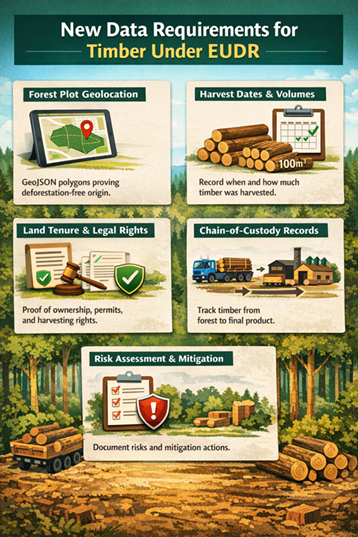
EUDR replaces document-heavy compliance with verifiable, plot-level data requirements that apply across the timber value chain.
Many timber companies underestimate how different EUDR is from EUTR, leading to avoidable compliance risks.
A successful transition requires rethinking compliance as operational infrastructure, not paperwork.
In short, transitioning from EUTR to EUDR means building systems that prove deforestation-free origin continuously not retroactively.
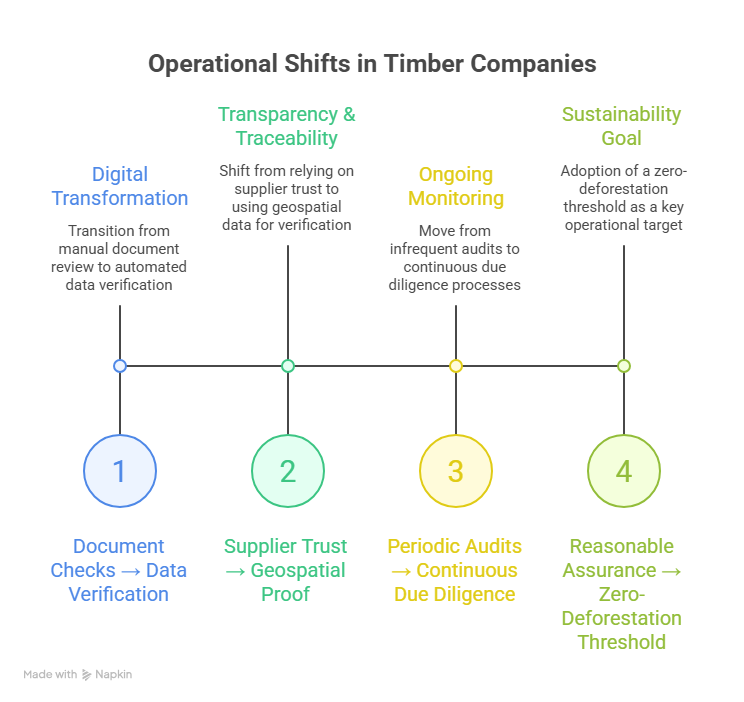
The shift from EUTR to EUDR turns traceability from a compliance “support function” into core operating infrastructure. Manual, document-based systems that worked under EUTR simply cannot meet EUDR’s data, verification, and audit demands at scale.
EUDR requires plot-level geolocation, continuous risk assessment, and verifiable chain-of-custody records. Spreadsheets, PDFs, and email-based supplier declarations break down quickly when managing multiple forests, processing steps, and cross-border flows. They introduce delays, errors, and gaps that can invalidate a Due Diligence Statement (DDS).
Digital traceability platforms integrate satellite imagery to verify whether forest plots linked to timber have experienced deforestation after 31 December 2020. This enables ongoing monitoring rather than one-time checks critical for detecting risk before products are placed on the EU market.
Blockchain technology provides a tamper-resistant ledger that records each transaction and transformation from forest harvest to processing and trade. This creates a verifiable, auditable chain-of-custody that preserves origin data even when timber passes through aggregation and multiple operators.
AI enhances compliance by automatically screening supplier data, geolocation accuracy, harvest volumes, and transaction patterns. Anomalies such as volume mismatches, inconsistent coordinates, or high-risk sourcing regions are flagged early, allowing companies to mitigate risk before enforcement or audits.
TraceX brings these capabilities together in a single, purpose-built platform for timber supply chains. It enables:
In the post-EUTR era, digital traceability is no longer optional. EUDR Compliance Solutions from TraceX allow timber companies to move from reactive, document-heavy compliance to proactive, data-driven EUDR readiness protecting EU market access while reducing operational and regulatory risk.
The transition from the EU Timber Regulation (EUTR) to the EU Deforestation Regulation (EUDR) marks a fundamental shift in how timber supply chains are regulated. Compliance has moved beyond proving legality to proving that timber is deforestation-free, supported by plot-level geolocation, verifiable data, and continuous due diligence. For timber companies, this means document-based systems are no longer enough. Those that invest in digital traceability, geospatial validation, and structured supplier data will protect EU market access and reduce enforcement risk while those that don’t risk delays, penalties, and blocked sales. EUDR compliance is now core infrastructure, not a compliance add-on.
Understand EUDR Geolocation Requirements: Learn why plot-level GeoJSON polygons are mandatory and how to avoid common geolocation errors.
Explore EUDR Timber Compliance: See how deforestation-free rules are reshaping timber supply chains and operator responsibilities.
Explore our EUDR due diligence guide to understand the exact steps companies must follow to place products on the EU market.
EUTR is being replaced by EUDR. While EUTR principles informed the new regulation, timber compliance going forward is governed by the EU Deforestation Regulation, which introduces stricter, deforestation-free requirements.
The biggest change is the shift from legality-only checks to mandatory proof that timber is deforestation-free, supported by plot-level geolocation (GeoJSON polygons) and verifiable supply-chain data.
No. Systems designed for EUTR focused on documents and supplier declarations do not meet EUDR’s geospatial, traceability, and risk-monitoring requirements.
The first operator placing timber or timber products on the EU market bears primary responsibility. Downstream operators must retain DDS references and traceability, and can become liable if data is missing or invalid.
Companies should conduct a gap analysis, restructure supplier data, implement geolocation capture and validation, deploy digital traceability systems, and prepare for audits and enforcement under EUDR.