
Quick summary: Learn what operators must register in the EUDR Information System, including DDS submission, geolocation data, and compliance requirements for EU market access.
Your shipment is ready. Your supplier says everything is compliant. But without a valid Due Diligence Statement (DDS) reference number from the EU Information System TRACES NT, your goods are legally blocked at customs. No exceptions.
That’s the reality operators, traders, and downstream businesses face right now under EU Regulation 2023/1115 (EUDR). The regulation doesn’t just ask you to source deforestation-free products. It requires you to prove it digitally, verifiably, and before goods cross the border by interacting with a specific information system that most compliance teams are still figuring out.
If you’re struggling with any of the following, this guide was written for you:
The EU EUDR Information System, officially TRACES NT (Trade Control and Expert System New Technology), is the European Commission’s centralized digital platform where all compliance actions under EUDR are recorded and validated.
Think of it as the regulatory passport system for every commodity shipment touching the EU market. Without an active record in this system, you do not have legal market access. It is not optional, and it cannot be substituted by internal certifications, FSC labels, or supplier declarations alone.
The system has four primary user types, each with distinct roles:
| Must Interact with TRACES | Access the System for Oversight |
|---|---|
| Operators: submit full DDS per shipment before placing products on the EU market. Traders: must pass DDS reference identifiers downstream; no new DDS required. Downstream Operators (NEW, 2025): register in the system and maintain traceability records | Operators: submit full DDS per shipment before placing products on the EU market. Traders: must pass DDS reference identifiers downstream; no new DDS requiredDownstream Operators (NEW, 2025): register in the system and maintain traceability records |
An amending regulation published in December 2025 extended the DDS deadline: large/medium operators now have until December 30, 2026; small and micro operators until June 30, 2027. However, core obligations, geolocation data, risk assessment, and TRACES submission remain fully intact. Use this window to build audit-ready systems now.
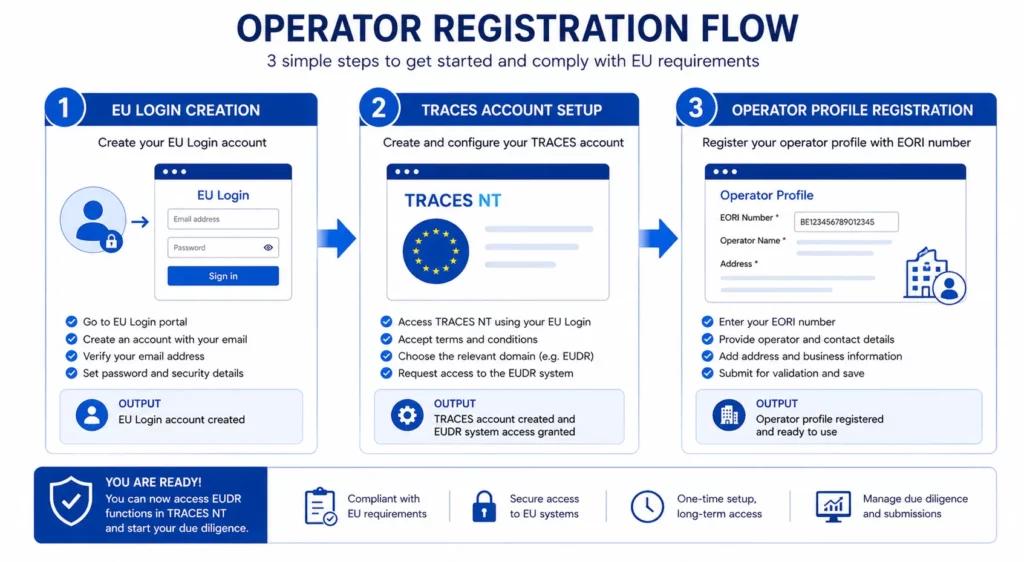
Before you can submit a single DDS, you must be registered as an operator in TRACES NT. This is not a one-time check: registration creates your legal identity within the system, and every DDS you file will be tied to it.
Every operator, trader, and downstream entity must create an EU Login account (formerly ECAS). This is the single sign-on gateway for all EU Commission systems, including TRACES. Teams managing multi-entity or multi-country compliance can use delegation features, allowing EU-based representatives to file on behalf of non-EU exporters under a single account.
Within TRACES, you register your operator profile, including:
Under the October 2025 amendment, a new category, Downstream Operators, must now register in the system. These are manufacturers and retailers placing products on the EU market that are made from commodities already covered by an upstream DDS. While they don’t file a full DDS, their registration creates the traceability link that competent authorities can audit.
Many operators report that EORI validation and TRACES account setup take 1-3 weeks. Without pre-registration, you cannot submit DDS even if all your supplier data is ready. Start registration immediately, don’t wait for compliance deadlines.
Understand the role of downstream operators under EUDR. Read the blog to learn your responsibilities and compliance requirements.

The DDS is your legal declaration, the official proof that every product you’re placing on the EU market is deforestation-free and legally sourced. It is not a form you fill in manually. At scale, it must be generated from verified, validated data. Here’s exactly what goes into it.
Learn how to submit your DDS through EU TRACES step by step. Read the blog to ensure an accurate, compliant submission without delays.
EUDR mandates plot-level geolocation data for every plot of land where regulated commodities were produced. This is the requirement most operators struggle with the most and the one most likely to block your DDS submission.
Acceptable formats include GeoJSON polygons (preferred) or GPS point data. The data must confirm that the plot did not contribute to deforestation after December 31, 2020.
The challenge here is severe:
TraceX’s mobile-first field app supports GPS-enabled polygon and point mapping, offline data capture, and multilingual onboarding specifically designed for smallholder farmer networks. AI validates and corrects polygon geometries before DDS submission, eliminating the rejection risk at source.
Invalid GeoJSON Can Block Your Shipment. Validate Now – Check polygons, fix errors, and ensure your data meets EUDR requirements before submission.
The EUDR benchmarking system classifies every country of production as low, standard, or high risk. Your uploaded DDS must include evidence of a risk assessment proportional to the country classification:
A rejected DDS means your shipment cannot enter the EU market. Common rejection reasons: invalid GeoJSON polygons, incorrect HS codes, missing supplier information, and batch traceability gaps. Each rejection means delayed shipments, customs holds, and mounting operational costs before you’ve sold a single unit.
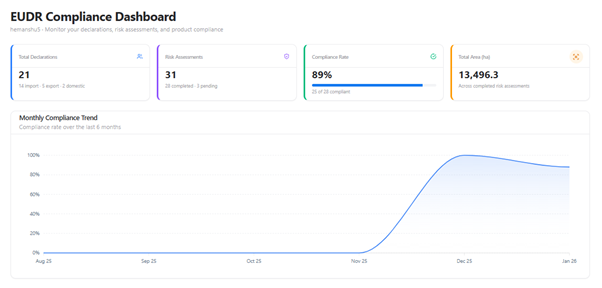
Submitting a DDS is not the end of your compliance obligation; it’s the beginning of an ongoing tracking and record-keeping requirement. Here’s what operators must maintain after submission.
Every approved DDS generates a unique reference number in TRACES. This number must:
All DDS filings and supporting documentation, geolocation data, supplier KYC, risk assessments, and legal compliance evidence must be retained for five years and made available on demand to competent authorities during regulatory inspection.
The most common pain point here: ERP systems, traceability platforms, and TRACES hold fragmented pieces of this data. When they don’t integrate, compliance teams spend hours re-entering data and risk creating audit gaps.
EUDR compliance is not a point-in-time check. The deforestation cut-off date is December 31, 2020, but operators must continue monitoring their supply chains for emerging deforestation risk. If a previously compliant supplier’s plots are flagged for post-2020 deforestation, your next DDS submission for that supplier will fail.
Leading compliance platforms use real-time satellite datasets, GRC and Hansen, to continuously monitor forest cover across your supplier network, alerting teams to risk before it becomes a customs problem.
Under the 2025 amendment, if you are an upstream operator, you are required to pass your DDS reference number and declaration identifiers to every downstream operator, trader, and retailer in your chain. This is a new legal obligation, not a courtesy. Downstream operators must then maintain these identifiers in their own TRACES registration.
The EU’s first consolidated EUDR review will occur by June 30, 2030. That means every DDS you file, every supplier you onboard, and every geolocation dataset you upload between now and then needs to be audit-ready. Competent authorities can trigger inspections at any point and a fragmented, manually managed compliance record is the highest-risk posture you can have.
Explore EUDR solutions built for end-to-end compliance.
These aren’t edge cases. They’re the operational realities that compliance directors, procurement leads, and supply chain managers encounter every week and the ones most likely to result in blocked shipments or failed audits.
ERP systems hold procurement data. Traceability platforms hold farm data. TRACES holds compliance records. When these three don’t communicate, your team manually re-enters data across platforms, multiplying error risk and submission delay at exactly the moment when shipments are on the water.
Who feels it most: IT Directors, Procurement Leads, and CFOs managing compliance infrastructure costs.
A large percentage of tropical commodity supply chains run through smallholder farmers who lack GPS devices, formal land titles, or digital infrastructure. Onboarding thousands of smallholders with verified, plot-level polygon data is operationally complex. One gap in this data means your DDS cannot be submitted or will be rejected.
Who feels it most: Field Data Teams, Supplier Managers, Cooperative Coordinators.
See how a leading tire company achieved EUDR compliance at scale. Explore the case study to learn how large-scale polygon mapping enabled traceability and audit-ready supply chains.
Most operators lack automated workflows to create, update, and submit DDS for each consignment. Manually filling forms, cross-checking documents, and uploading to TRACES creates submission delays, errors, and audit exposure, especially for businesses managing hundreds of shipments per quarter.
Who feels it most: Compliance Officers, Operations Managers, Logistics Teams.
The EU benchmarking system continuously reassesses country risk levels. A sourcing region that is standard-risk today may become high-risk tomorrow, requiring immediate changes to due diligence depth, documentation requirements, and supplier verification workflows. Companies without dynamic monitoring systems are always reacting rather than anticipating.
Who feels it most: Chief Compliance Officers, Head of Sustainability, Legal Teams.
The 2025 amendment expanded EUDR obligations to downstream operators, manufacturers, and retailers who previously had no direct compliance role. These businesses now need to register in TRACES, maintain traceability records, and pass DDS reference identifiers through their supply chains. Many are only beginning to realize the scope of what this requires.
Who feels it most: Procurement Directors at Retailers, In-House Legal, and Sustainability Leads at Manufacturing Groups.
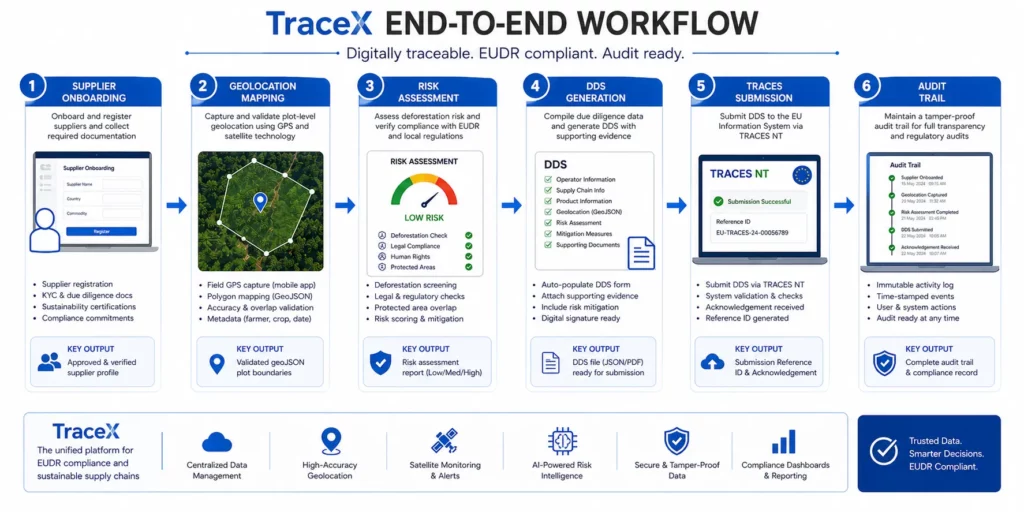
TraceX is built specifically to close the gap between your operational data and what the EUDR Information System requires. Here’s how it maps to the exact obligations outlined above.
Automated DDS Generation
TraceX pulls supplier data, geolocation inputs, and risk assessment scores directly from your connected systems and generates TRACES-ready DDS automatically, tied to procurement events, not manual triggers. Compliance happens before coffee is on the water, not at the border.
Plot-Level Geolocation with AI Validation
The platform supports polygon and point-based mapping validated against satellite imagery and official deforestation datasets. Built-in AI corrects polygon geometries and flags invalid data before submission, eliminating the most common DDS rejection trigger.
Direct TRACES Integration via API
TraceX connects directly to TRACES NT via API, eliminating manual re-entry of data between your internal systems and the EU platform. DDS submissions, amendments within the 72-hour window, and audit trail maintenance all happen inside the same workflow.
Continuous Satellite Monitoring
Real-time integration with GRC and Hansen datasets means your sourcing plots are continuously monitored for deforestation risk, not just checked once at onboarding. Emerging risks surface as alerts before they become compliance failures.
Downstream Operator Traceability
For operators passing DDS references downstream, TraceX manages the full chain of custody automatically, distributing reference identifiers to downstream operators and traders in your network, creating the documented traceability chain that EUDR requires.
The EU Information System is not a future obligation. TRACES NT is operational now. Competent authorities are beginning enforcement. And large operators who miss the December 30, 2026 deadline face shipment rejection, financial penalties, and loss of EU market access.
The operators who are building audit-ready systems today, automating DDS generation, validating geolocation at source, and integrating with TRACES directly, are not just meeting compliance. They are creating the operational infrastructure that will sustain EU market access for the next decade.
No. Under the 2025 amendment, downstream operators, manufacturers and retailers using products already covered by an upstream DDS, are exempt from filing a new DDS. However, they must register in the EU Information System and maintain traceability by passing reference identifiers and supplier data along the chain. Traceability responsibilities are mandatory; only full DDS filing is simplified.
A rejected DDS means your shipment cannot legally enter the EU market. Common rejection reasons include invalid GeoJSON polygons, incorrect HS codes, missing supplier information, and batch traceability gaps. You must correct the underlying data issue and resubmit before customs clearance is possible.
Non-EU exporters who choose to act as the operator (controlling DDS filings directly) will need an EU-based representative to access TRACES, respond to authority queries, and manage amendments within the 72-hour window. The regulation permits representatives to file DDS on behalf of exporters, while the operator retains full legal responsibility.
All DDS filings and supporting documentation must be retained for five years and available on demand for regulatory inspection. The EU’s first consolidated EUDR review is scheduled for June 30, 2030
Operators must align sourcing strategies with current country risk classifications and remain adaptive to reclassifications. A change from standard to high risk immediately increases the due diligence depth required for that sourcing region. Platforms like TraceX automatically update regulatory logic in sync with EU policy changes, so compliance requirements adjust without manual intervention.