
Quick summary: Learn how DPP interoperability enables seamless data exchange in ESPR Digital Product Passports. Explore GS1 standards, machine-readable data, APIs, and strategies to avoid silos for scalable, audit-ready compliance.

The Ecodesign for Sustainable Products Regulation (ESPR) is not just a law about better products; it is a mandate for a new digital infrastructure. At its heart lies the Digital Product Passport (DPP) a tool designed to make sustainability, repairability, and recyclability data accessible across the entire product lifecycle.
However, for a DPP to be effective, it must be interoperable. DPP Interoperability enables seamless data exchange across the entire supply chain, connecting manufacturers, suppliers, regulators, and consumers under ESPR Digital Product Passport requirements.
It relies on standardized data models, machine-readable formats, and API-based system integration to ensure product, material, and sustainability information flows accurately and in real time. GS1 identifiers such as GTIN and Digital Link link physical products to their digital records, eliminating ambiguity and supporting cross-system traceability. By establishing interoperable architectures, DPPs avoid data silos, maintain audit-ready records, and scale efficiently as delegated acts introduce new compliance and verification requirements.
If a recycler in Poland cannot read the data generated by a manufacturer in Vietnam, or if a consumer’s smartphone cannot open the “data file” of a jacket, the circular economy fails.
This guide explores the technical architecture and standards, such as GS1 Digital Link, JSON-LD, and Open API,s that allow the DPP to achieve seamless data exchange globally.
Key Takeaways
Interoperability is the ability of different digital systems and organizations to securely exchange information and use the information that has been exchanged. In the context of the ESPR, it means that a product’s “digital twin” must be readable by any authorized stakeholder, regardless of the software they use.
There are three primary dimensions of interoperability required for the DPP:
Deep dive into DPP Architecture: Learn how scalable, interoperable data models power ESPR-ready Digital Product Passports and prevent costly data silos.
Understand DPP Regulations: Get clarity on ESPR requirements, delegated acts, and what compliance really means for your products and supply chain.
DPP data models define how product, supplier, and sustainability data is structured, linked, and stored to meet ESPR Digital Product Passport requirements. They provide a blueprint for capturing, organizing, and exchanging information consistently across the supply chain.
DPP data models link each material and component to its supplier, creating a multi-tier map of the supply chain. This enables verification of sourcing claims, measurement of environmental and social metrics, and assessment of circularity. Integrating ESG indicators such as carbon footprint, chemical usage, or labor compliance directly into the data model ensures that sustainability reporting is automated and auditable.
Well-defined data models allow companies to maintain audit-ready records, reducing manual effort during inspections or regulatory reviews. They also provide a scalable architecture: as products, suppliers, or delegated acts evolve, new data points can be added without disrupting existing workflows, enabling compliance across thousands of SKUs and multi-supplier ecosystems.
In essence, DPP data models form the backbone of a compliant, transparent, and scalable ESPR Digital Product Passport system, ensuring accuracy, interoperability, and future-proof traceability.
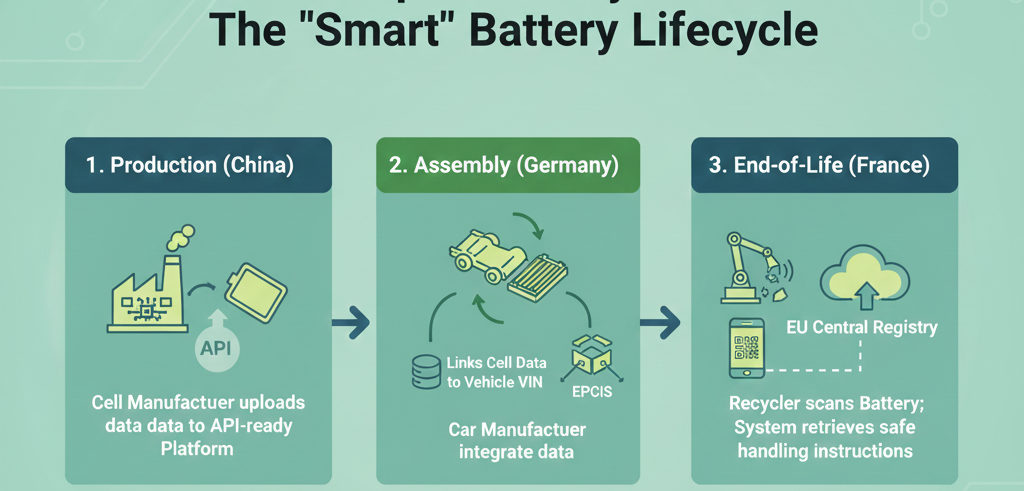
Unlike traditional government databases, the EU is not building a single “Central Cloud” to store all product data. Instead, the ESPR mandates a decentralized data architecture.
| Component | Responsibility | Role in Interoperability |
| Economic Operator (Brand) | Hosts the data on their own servers or via a service provider. | Acts as the “Source of Truth” for product-specific data. |
| EU Central Registry | Managed by the European Commission. | Stores only the “Metadata” (UPIs) to act as a directory. |
| Authorized Stakeholders | Recyclers, consumers, customs, and repairers. | Access data through standardized interfaces (APIs). |
In the world of sustainability, a story is only as strong as the data behind it. For many companies preparing for the ESPR Digital Product Passport (DPP), the biggest threat to compliance isn’t the regulation itself; it’s the internal data silo.
A data silo occurs when critical information is trapped within one department or system, inaccessible to the rest of the organization.1 In a DPP context, this means your “sustainability story” is fragmented across dozens of disconnected sources.
To avoid these pitfalls, forward-thinking brands are moving away from “point solutions” and toward Interoperable DPP Solutions.
Instead of creating a new silo, an interoperable platform acts as a Digital Glue. It uses APIs (Application Programming Interfaces) to pull data automatically from your existing ERP, PLM, and supplier portals.
| Feature | The Siloed Approach | The Interoperable Approach |
| Data Entry | Manual/CSV Uploads | Automated API Integration |
| Updates | Batch-processed (Slow) | Real-time (Dynamic) |
| Traceability | Limited to Tier 1 | Multi-tier (Deep Visibility) |
| Verification | Self-declared | Blockchain/Third-party Audited |
The Result:
A Single Source of Truth. When a regulator or consumer scans a QR code, they aren’t looking at a static PDF; they are accessing a live, verified data stream that reflects the actual journey of that specific product.
Multi-Stakeholder Data Flow: ESPR Digital Product Passports require data to flow seamlessly between multiple stakeholders regulators, suppliers, brands, distributors, and consumers. Regulators need access to verify compliance, suppliers must provide accurate product and material data, brands require transparency across the value chain, and consumers may access selected sustainability or circularity information. Interoperability ensures all these actors can interact with consistent, verified data without duplications or errors.
Standardized, Machine-Readable Data Formats: Interoperability is enabled through uniform data standards that define how product, material, and ESG information is structured. Machine-readable formats, such as XML or JSON aligned with GS1 Digital Link, allow systems to automatically interpret and validate data. Standardization eliminates discrepancies caused by local naming conventions, proprietary codes, or inconsistent reporting formats.
Real-Time System-to-System Data Exchange via APIs: APIs serve as the technical bridge between disparate systems, including ERP, PLM, traceability platforms, and regulatory portals. They enable real-time updates of product or batch-level data as changes occur in supply chain operations or compliance requirements evolve. This reduces manual intervention, prevents data silos, and supports continuous audit readiness.
Together, these elements ensure that DPP interoperability delivers reliable, scalable, and transparent data flows across the entire product lifecycle, transforming ESPR compliance into an efficient, future-proof process.
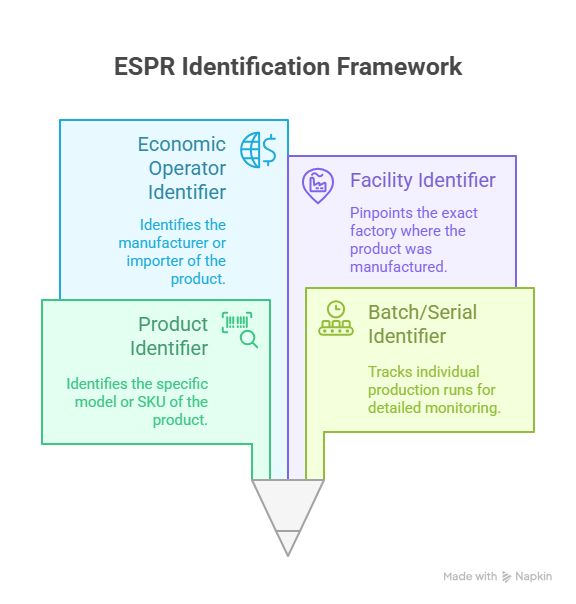
Role of GTIN and GS1 Digital Link: GS1 standards provide a globally recognized framework for identifying products and connecting them to digital information. The Global Trade Item Number (GTIN) uniquely identifies a product or SKU, while the GS1 Digital Link extends this identification by linking the physical product to a digital record. This connection ensures that every unit or batch of a product can be traced across the supply chain, forming the foundation for a compliant Digital Product Passport (DPP).
The GS1 Digital Link standard is emerging as the leading choice for the “data carrier.” Instead of a standard barcode that only contains a SKU, a Digital Link QR code is a web address that carries the product’s unique identity.
Ensuring Consistent Product Identification Across Supply Chains: By adopting GS1 identifiers, brands and suppliers eliminate ambiguity caused by internal SKUs, local codes, or proprietary numbering systems. Every stakeholder whether a manufacturer, distributor, or regulator can reference the same product consistently. This standardized identification ensures accurate data reporting, reduces errors, and enables interoperability across multiple systems.
Enabling Global Interoperability and Traceability at Scale: GS1 standards are already widely implemented in international trade, making them ideal for cross-border supply chains. When combined with DPP systems, GS1 identifiers allow seamless exchange of product, material, and sustainability data across ERP, PLM, and traceability platforms. They support batch-level traceability, audit readiness, and real-time compliance reporting, enabling companies to scale ESPR DPP implementation efficiently across thousands of SKUs and multi-tier supplier networks.
In essence, GS1 standards are the technical backbone of ESPR-compliant DPPs, enabling accurate, interoperable, and globally recognized product traceability.
To truly understand the Semantic Layer of a Digital Product Passport (DPP), you have to think beyond just “connecting” computers. Technical interoperability (the “plug”) is easy; semantic interoperability (the “meaning”) is the hard part.
Here is an explanation of the two components that make up this layer: JSON-LD and Common Ontologies.
Normally, data is just a list of keys and values. For example:
“cf”: 12.4
To a human, “cf” might mean “Carbon Footprint,” but to a computer in another country, it might mean “Correction Factor” or “Cash Flow.”
JSON-LD (JSON for Linked Data) solves this by adding a @context. It essentially says: “Every time you see the term ‘cf’ in this document, here is a link to the official EU definition of what that term means.”
An ontology is a formal way of naming and defining the types, properties, and interrelationships of the entities that exist in a particular domain. In simpler terms, It is a shared digital dictionary.
If every company creates its own “language” for sustainability, the Digital Product Passport fails. To prevent this, the EU has tasked three major standards bodies CEN, CENELEC, and ETSI, to build a unified dictionary for everyone to use.
Key Standards to Know:
Without the Semantic Layer, your data is a “Digital Island.” You might have the best sustainability data in the world, but if it isn’t mapped to these common ontologies:
| Term | Analogy | Purpose |
| JSON-LD | The Grammar | How we structure the sentence so it can be read. |
| Ontology | The Dictionary | Defining what the words in the sentence actually mean. |
| Interoperability | The Conversation | The ability for two different systems to have a meaningful exchange. |
Interoperability does not mean a “free-for-all” for data. The architecture must protect Intellectual Property and Trade Secrets.
The system uses Role-Based Access Control (RBAC) to filter information:
TraceX provides a robust, scalable platform to implement ESPR Digital Product Passports (DPPs) with full interoperability across complex supply chains.
Standards-Aligned Architecture: TraceX structures product, supplier, and sustainability data according to ESPR requirements and global best practices, ensuring consistent, machine-readable records across all supply chain tiers. This alignment reduces errors and supports automated compliance reporting.
GS1-Compatible Identifiers: By integrating GTINs and GS1 Digital Links, TraceX links every physical product or batch to its digital passport. This ensures consistent identification, traceability, and cross-system interoperability across manufacturers, suppliers, and regulators.
API-First Platform for Multi-Supplier Ecosystems: TraceX enables seamless system-to-system data exchange via APIs, connecting ERP, PLM, traceability, and regulatory systems. Multi-tier supplier data is captured, validated, and updated in real time, eliminating silos and manual reconciliation.
Compliance-by-Design, Future-Proofed for Delegated Acts: ESPR DPP requirements evolve over time. TraceX embeds compliance into workflows from the start, automating data capture, validation, and reporting. This approach ensures audit-ready records, minimizes compliance risk, and enables organizations to scale across products, suppliers, and regions without retrofitting systems.
By combining these capabilities, TraceX transforms DPP implementation from a regulatory obligation into a scalable, interoperable, and future-ready solution for global supply chains.
Success with ESPR Digital Product Passports (DPPs) begins with early architectural decisions. How you design your data models, link suppliers and materials, and structure product and batch-level information determines whether your compliance efforts are scalable, auditable, and efficient in the long term. Poor early design can create silos, duplicate work, and increase the risk of non-compliance.
Interoperable DPP Solutions are central to achieving circular economy goals. By enabling seamless, real-time data exchange across manufacturers, suppliers, regulators, and consumers, these platforms allow brands to track product lifecycle, resource use, and end-of-life management, supporting transparency and sustainability objectives.
Ultimately, DPP interoperability transforms a regulatory requirement into a strategic supply chain advantage. Companies gain operational visibility, strengthen buyer trust, reduce compliance costs, and position themselves as leaders in sustainability all while meeting evolving ESPR obligations efficiently.
DPP Guide: Get a practical, end-to-end understanding of Digital Product Passports from data requirements to implementation best practices.
ESPR Explained: Decode the regulation driving DPP adoption and what it means for your products and market access.
DPP Technology Stack: Explore the platforms, standards, and integrations needed to build scalable, interoperable DPPs.
DPP interoperability ensures that product, supplier, and sustainability data flows seamlessly across brands, suppliers, regulators, and consumers, enabling compliance and traceability under ESPR.
GS1 identifiers like GTIN and Digital Link link physical products to their digital passports, enabling standardized, cross-system data exchange and consistent product identification.
APIs, machine-readable data formats, and interoperable traceability platforms allow real-time system-to-system communication, prevent data silos, and support audit-ready compliance.