
Quick summary: DPP integration with PLMs explained: how Product Lifecycle Management systems connect with Digital Product Passports, what data is required, key challenges, and how companies can prepare for EU DPP compliance.
Digital Product Passports (DPPs) are no longer a future concept they are quickly becoming a regulatory and commercial reality. While many companies already manage product specifications, bills of materials, and lifecycle data in PLM systems, few have clarity on how this information connects to DPP requirements. As a result, product data often sits in silos, forcing teams into manual reporting, duplicated effort, and growing compliance risk. This blog explains DPP integration with PLMs how it works in practice, what data is required beyond PLMs, and how companies can prepare for scalable, compliance-ready Digital Product Passports.
Without clear integration, organizations risk treating DPPs as an add-on rather than an extension of existing product data infrastructure. PLMs were not designed to capture supplier-level traceability, sustainability attributes, or real-time updates required by DPP regulations. Understanding where PLMs end and where additional systems are needed is critical. This guide breaks down the practical steps for connecting PLMs with traceability and compliance systems, helping teams move from fragmented product data to a single, trusted source for DPP compliance.
Key Takeaways
DPP integration with PLMs refers to the process of connecting Product Lifecycle Management (PLM) systems with the Digital Product Passport (DPP) platform to ensure product data can be reused, enriched, and published in a compliance-ready format. A Digital Product Passport is a structured digital record that makes product information, such as materials, sourcing, sustainability, and compliance data, accessible across the value chain and to regulators or buyers when required.
PLM systems play a critical role by managing core product data, including product specifications, bills of materials (BOMs), design changes, and lifecycle status. However, PLMs were designed for internal product development and engineering workflows, not for regulatory transparency or value-chain data sharing.
Integration is therefore necessary, not optional. DPP regulations require data that extends beyond PLMs such as supplier-level traceability, origin, environmental impact, and real-time updates across the product lifecycle. Without integrating PLMs with traceability, compliance, and DPP layers, companies face fragmented data, manual reporting, and high non-compliance risk. DPP integration ensures PLM data becomes part of a single, trusted, continuously updated product record that meets regulatory and market expectations.
Not sure what data your Digital Product Passport must include?
Explore our guide to DPP data requirements and understand what regulators, buyers, and platforms expect.
DPPs don’t live in isolation.
Learn why DPP interoperability matters and how systems like PLM, ERP, and traceability must work together.
DPP integration with PLMs is becoming urgent as Digital Product Passports move from policy intent to enforceable regulation. Under the EU Ecodesign for Sustainable Products Regulation (ESPR), DPPs will be mandatory for multiple product categories, requiring companies to provide structured, product-level data throughout the lifecycle. Many of these requirements overlap with data already stored in PLMs but only partially and often in formats not suited for regulatory disclosure.
At the same time, product-level compliance obligations are expanding. Beyond basic safety or labelling, companies must now disclose material composition, sustainability attributes, repairability, recyclability, and in some cases, carbon and sourcing data. Without integrating PLMs into DPP workflows, this information must be recreated manually, increasing cost and error risk.
Buyer and regulator expectations have also shifted. Authorities expect consistent, verifiable product data, while buyers increasingly demand transparency to support their own compliance, ESG reporting, and due-diligence obligations. PLM data locked in internal systems is no longer sufficient.
Finally, the risk of siloed product data is growing. Disconnected PLM, supplier, and compliance systems lead to duplicated effort, inconsistent disclosures, and delayed DPP readiness. Integrating PLMs with DPP and traceability layers is now essential to create a single, reliable source of truth for product compliance and market access.
PLM systems already contain a significant portion of the core product data required for Digital Product Passports, making them a natural starting point for DPP implementation. However, this data is primarily design- and engineering-focused.
PLMs manage detailed product specifications, including part numbers, configurations, versions, and hierarchical BOMs. This information defines what a product is made of and how components relate to each other foundational data for any DPP.
PLMs store material types, grades, weights, and component attributes used during product design. This data supports DPP requirements related to material composition, recyclability, and in some cases restricted substances or safety considerations.
Design revisions, change histories, product lifecycle stages (development, production, phase-out), and version control are core PLM functions. These elements are critical for ensuring DPPs remain accurate over time as products evolve.
Many PLMs include compliance-related fields, such as RoHS or REACH status, approved materials, and internal sustainability flags. While useful, these attributes are often static and internally validated, requiring integration with external data sources to meet DPP expectations.
In summary, PLMs provide the structural backbone of product data for DPPs but they must be integrated with traceability, supplier, and impact data to deliver a complete, regulation-ready Digital Product Passport.
While PLM systems are essential for managing product design and structure, they do not capture many of the data elements required for Digital Product Passports. These gaps are critical and must be addressed through integration with traceability and supply-chain systems.
PLMs typically store approved supplier lists at a high level, but they lack visibility into tier-2, tier-3, and raw material suppliers. DPP regulations increasingly require disclosure beyond direct suppliers, including information on sourcing regions, upstream actors, and supplier compliance data that PLMs are not designed to manage.
PLMs do not track where materials and components are physically sourced, produced, or transformed. They cannot link products to farm, mine, factory, or processing locations, nor do they maintain batch- or lot-level traceability across supply-chain handoffs essential for DPP compliance.
Metrics such as carbon footprint, land-use impact, water use, labor conditions, or deforestation risk sit outside traditional PLM scope. This data is dynamic, supplier-dependent, and often requires external verification, making it unsuitable for static PLM fields.
PLMs are built for internal product development workflows, not continuous, real-world data updates. They cannot reflect changes in supplier status, compliance risks, or sustainability performance as products move through manufacturing, distribution, use, and end-of-life.
In short, PLMs define what a product is, but they cannot explain where it comes from, how it is produced, or its real-world impact. Bridging this gap is why DPP integration with traceability and compliance systems is essential.
DPP integration with PLMs works by connecting internal product data with external, verifiable supply-chain data, then structuring it into a Digital Product Passport that can be shared with regulators, buyers, and downstream partners. Each system plays a distinct role.
PLM systems act as the authoritative source for product identity and structure. They provide stable product identifiers, product hierarchies, Bills of Materials (BOMs), material specifications, design versions, and lifecycle status. This data defines what the product is and ensures consistency across all downstream systems. For DPPs, PLM data establishes the foundation on which additional compliance and sustainability information is layered.
Traceability and supply-chain systems extend PLM data by capturing where components come from and how they move through the value chain. These systems collect supplier and sub-supplier data, origin and geolocation information, batch and lot records, processing steps, and environmental or social impact data. This information is dynamic, supplier-driven, and continuously updated, filling the critical gaps PLMs cannot address.
The DPP layer sits on top of PLM and traceability systems to aggregate, validate, and structure data into a regulation-ready format. It aligns data fields with DPP requirements, applies access controls, and publishes the Digital Product Passport through QR codes, APIs, or portals. This layer ensures data is consistent, auditable, and accessible throughout the product lifecycle, enabling compliance without duplicating or manually reworking data.
Together, these integrated layers transform fragmented product and supply-chain data into a single, trusted Digital Product Passport that meets regulatory, buyer, and sustainability expectations.
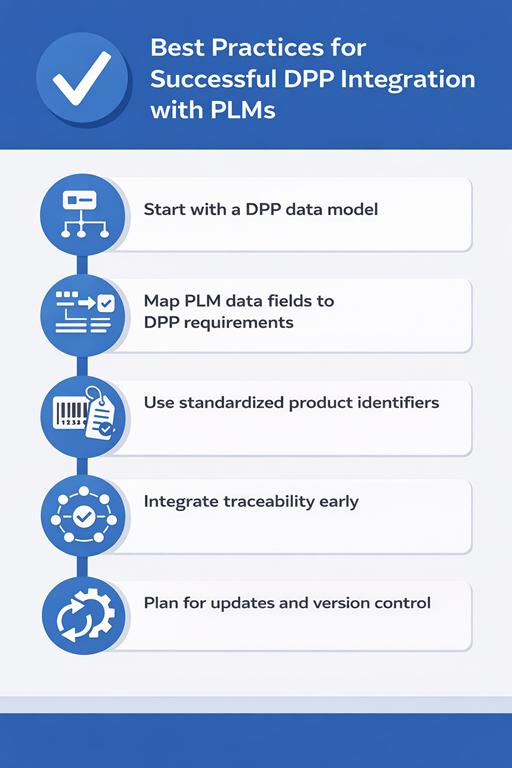
Despite the strategic value of DPP integration with PLMs, many organizations face practical challenges when attempting to connect product lifecycle data with Digital Product Passport requirements.
Product data is often spread across PLM, ERP, supplier portals, spreadsheets, and sustainability tools. Without integration, teams struggle to assemble a complete DPP, leading to duplicated work, inconsistent disclosures, and delayed compliance.
PLMs, supplier systems, and logistics platforms frequently use different product, part, or batch identifiers. These inconsistencies break data linkages, making it difficult to trace information across the product lifecycle or reliably populate DPP fields.
In the absence of automated integration, teams rely on manual exports, spreadsheets, and one-off data requests. This approach is time-consuming, error-prone, and unsustainable at scale especially as DPPs require ongoing updates rather than one-time reporting.
PLMs typically provide limited insight beyond tier-1 suppliers. However, DPP regulations often require upstream transparency, including origin, processing, and sustainability data from sub-suppliers. Without integrated traceability systems, these data gaps become a major compliance risk.
Addressing these challenges requires standardized identifiers, automated data flows, and traceability systems that extend beyond PLMs, enabling a single, trusted source of product truth for DPP compliance.
Traceability does not replace PLMs it extends them, ensuring product data meets the transparency and verification requirements of Digital Product Passports.
PLMs remain the system of record for product design, Bills of Materials (BOMs), material specifications, and lifecycle status. This data defines what a product is and provides consistency across engineering and manufacturing teams.
Traceability systems add the real-world context PLMs lack. They capture supplier and sub-supplier information, origin and geolocation data, batch and lot histories, and processing steps across the value chain. This ensures products can be linked to verified sourcing, handling, and impact data critical for DPP compliance.
The Digital Product Passport brings these data streams together into a structured, auditable record aligned with regulatory requirements. By combining PLM-defined product structure with traceability-driven supply-chain evidence, DPPs provide regulators, buyers, and downstream partners with reliable, up-to-date product information.
In practice, PLMs define the product, traceability proves where it comes from and how it is made, and DPPs make this information accessible and compliant creating a complete foundation for product transparency and regulatory readiness.
TraceX Regulatory Compliance Platform supports DPP integration with PLMs by acting as the connective layer between internal product data and external, verifiable supply-chain information without disrupting existing PLM workflows.
PLM systems are essential for managing product design, structure, and lifecycle changes but on their own, they are not enough to meet Digital Product Passport requirements. DPP regulations demand product data that goes beyond engineering specifications to include verified sourcing, origin, environmental impact, and real-world lifecycle events.
Turning PLM data into DPP-ready products requires integration, not duplication. Traceability systems must extend PLM data with supplier, batch, and origin information, while a dedicated DPP layer structures, validates, and publishes this data in a regulatory-compliant format. Together, these components create a single, trusted product record that stays current over time.
Companies that treat DPPs as an extension of their PLM ecosystem rather than a standalone reporting exercise are better positioned to meet regulatory deadlines, satisfy buyer expectations, and scale product transparency across their portfolios.
DPPs are only as strong as the data behind them.
Read how supply chain traceability enables Digital Product Passports and ensures verified, end-to-end product transparency.
Unsure how to structure DPP data across systems?
Learn how DPP data architecture works and how to design a scalable, interoperable foundation.
DPP compliance starts with suppliers.
Read how to engage suppliers effectively for Digital Product Passports without slowing operations.
DPP integration with PLMs is the process of connecting Product Lifecycle Management systems with Digital Product Passport platforms so product design data can be combined with supply-chain, sustainability, and compliance data in a single, regulation-ready product record.
No. PLM data covers product structure and specifications but does not include supplier traceability, origin, environmental or social impact data required for DPP compliance. Additional traceability and data management systems are essential.
DPP data must be kept current throughout the product lifecycle. Updates are required whenever there are changes in materials, suppliers, compliance status, or relevant lifecycle events such as repairs, recalls, or end-of-life processing.
DPP–PLM integration is typically shared across product, engineering, IT, sustainability, and compliance teams. Clear data ownership and governance are critical to ensure accuracy and accountability.
Companies should begin DPP integration as early as possible. Starting early allows time to map data, address gaps, and scale systems ahead of regulatory deadlines and market requirements.