
Quick summary: DPP Delegated Acts explained: what they are, how they make Digital Product Passports enforceable, key requirements, timelines, and what companies must do to stay compliant.

For many companies, the Digital Product Passport (DPP) still feels abstract, something coming later, once the rules are fully clear. That assumption is quickly becoming a risk. DPP is no longer just a policy framework under the ESPR. With delegated acts, it is moving decisively into enforcement territory. That’s why DPP delegated acts matter now: they mark the moment when Digital Product Passports stop being theoretical and start becoming unavoidable.
These acts are what turn high-level intent into product-specific, legally binding obligations defining exactly what data must be provided, for which products, and by when. Waiting for “final clarity” often means waiting until compliance is already late. Delegated acts are adopted on a rolling basis, enforcement timelines are tight, and companies without structured product and supplier data will struggle to respond at speed.
Organizations that treat delegated acts as a future problem risk scrambling again when DPP becomes a condition for EU market access. Those that act now can build the data foundations once and adapt as requirements evolve.
Key Takeaways
DPP delegated acts are legally binding measures adopted by the European Commission under EU law to define the detailed, product-specific requirements for Digital Product Passports.
Under the Ecodesign for Sustainable Products Regulation (ESPR), the main regulation sets out the overall framework and objectives for DPP, such as improving product sustainability, traceability, and transparency across the EU market. However, ESPR itself does not specify exactly which products, what data, or how that data must be provided. This is where delegated acts come in.
Delegated acts supplement the ESPR framework by translating high-level principles into operational rules. They specify, for each product group:
The key difference is scope and detail. ESPR defines the “what” and “why”, while DPP delegated acts define the “who,” “how,” and “when.” Once adopted, delegated acts are directly enforceable across the EU, making them the point at which DPP moves from policy intent to real compliance obligation.
In short, DPP delegated acts are what make Digital Product Passports legally actionable.
Understand which product categories are covered, how delegated acts define scope, and what this means for your business.
Read the blog: DPP Product Scope Explained
Get a clear breakdown of mandatory DPP data fields, verification expectations, and how requirements vary by product.
Read the blog: DPP Data Requirements Explained
DPP delegated acts are where Digital Product Passports become practical, enforceable, and product-specific. Rather than applying a one-size-fits-all rule, delegated acts define exactly how DPP works in real-world terms, varying by product category, risk profile, and policy objective.
Delegated acts determine which products must carry a Digital Product Passport. Coverage is introduced in phases, starting with priority product groups (such as batteries, electronics, textiles, or construction products). This ensures regulatory focus on products with the highest environmental, circularity, or market impact.
Each delegated act defines the exact data that must be included in the DPP for that product group. This may include product identifiers, material composition, substances of concern, environmental performance metrics, durability and repairability information, and traceability data. The scope and depth of data vary significantly by product type.
Delegated acts also specify how DPP data must be structured and accessed. This includes requirements for machine-readable formats, interoperability with other systems, and how data should be made available to authorities, economic operators, and in some cases consumers. These rules are critical for enforcement and market surveillance.
DPP data is not static. Delegated acts define how often information must be reviewed or updated and whether third-party verification or supporting documentation is required. This ensures that DPPs remain accurate throughout the product lifecycle, not just at the point of market entry.
DPP requirements vary because products differ widely in risk, complexity, and sustainability impact. For example:
Delegated acts allow regulators to tailor requirements to what is material and enforceable for each product group, rather than imposing unnecessary or impractical obligations.
As a result, DPP compliance is not about meeting a single standard it’s about understanding and adapting to product-specific delegated acts as they are introduced. This is why flexible data models and early preparation are essential for long-term DPP readiness.
Digital Product Passport requirements are not applied to all products at once. Instead, the European Commission introduces DPP obligations through product-specific delegated acts, prioritizing categories with the highest environmental impact, circularity potential, and regulatory urgency.
Batteries
Batteries are the most advanced DPP use case and already subject to detailed passport requirements under the EU Battery Regulation. Battery DPPs include extensive data on material composition, carbon footprint, performance, and end-of-life management, setting the benchmark for future product groups.
Electronics
Electronics and ICT products are expected to follow, driven by concerns around resource intensity, repairability, and electronic waste. DPPs for electronics will likely focus on product identification, component information, durability, repair instructions, and substances of concern.
Textiles
Textiles are a key focus area due to high environmental and social impact. Delegated acts for textiles are expected to require information on fiber composition, chemical use, recyclability, and sustainability attributes supporting circular economy objectives and transparency for consumers.
Construction Products
Construction products are also prioritized, given their long lifecycle and significant resource footprint. DPPs in this category are likely to emphasize material content, performance characteristics, durability, and lifecycle environmental data.
Rather than a single enforcement date, DPP delegated acts are rolled out in phases, with each product group governed by its own timeline and data requirements. This phased approach allows regulators to refine requirements while giving industries time to adapt, but it also means companies must track multiple timelines simultaneously.
Delegated acts are the legal instruments that activate the DPP product scope. While ESPR establishes the overall framework, it is the delegated acts that:
In practice, DPP product scope and delegated acts are inseparable, understanding one requires tracking the other.
DPP delegated acts define the mandatory data elements that must be included in a Digital Product Passport for each product group. These requirements are legally binding and tailored to what regulators consider material for sustainability, safety, and market surveillance.
Delegated acts require clear and consistent product identification to ensure traceability and enforcement. This typically includes unique product identifiers, model or batch numbers, manufacturer or importer details, and conformity references. Accurate identification is the foundation that links the physical product to its digital passport.
A core objective of DPP is to enable circular economy outcomes. Delegated acts specify environmental metrics such as durability, repairability, recyclability, energy or resource efficiency, and in some cases carbon-related indicators. These data points support sustainability claims and regulatory assessments across the product lifecycle.
Delegated acts require disclosure of material composition at an appropriate level of detail, including the presence of regulated or hazardous substances (such as those covered under REACH or SVHC lists). This improves chemical transparency, supports safer recycling, and enables compliance with broader EU chemical regulations.
DPPs must include traceability data that links products to production sites, batches, and key lifecycle stages. This enables authorities and downstream actors to verify origin, processing history, and compliance throughout the supply chain not just at the point of sale.
Delegated acts also define who must be able to access DPP data and how. Authorities require full access for enforcement and market surveillance, while economic operators and consumers may access defined subsets of information. Data must be machine-readable, interoperable, and accessible via digital carriers such as QR codes.
Together, these requirements ensure that DPPs function as a trusted, enforceable source of product truth, not just a static data repository.
DPP delegated acts are the mechanism that make Digital Product Passports enforceable in practice. Once a delegated act for a product category enters into force, DPP requirements are no longer guidance they become a legal condition for placing products on the EU market.
Delegated acts translate ESPR’s high-level objectives into clear, auditable compliance criteria. They define exactly what data must exist, how it must be structured, and when it must be accessible. This removes ambiguity for both companies and regulators and gives authorities a concrete basis to assess compliance.
Market surveillance authorities are responsible for checking products placed on or circulating within the EU market. With DPP in place, authorities can digitally access product data to:
DPP significantly increases the speed and depth of inspections by replacing manual document requests with digital verification.
What “non-compliance” looks like under DPP
Once delegated acts apply, non-compliance may include:
Even if a product meets technical standards, lack of compliant DPP data can still constitute a violation.
Penalties, product withdrawal, and market access risks
Enforcement actions may include administrative penalties, orders to correct non-compliance, temporary or permanent product withdrawal, and restrictions on placing products on the EU market. Repeated or serious breaches can result in significant financial and reputational damage.
In effect, DPP delegated acts turn Digital Product Passports into a market access requirement not meeting them can directly block products from the EU market.
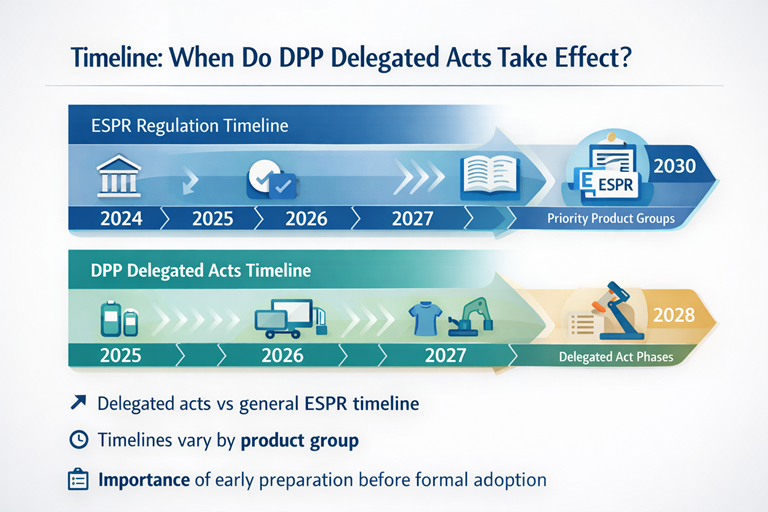
Digital Product Passport requirements do not follow a single, universal deadline. While the ESPR establishes the overarching regulatory framework, DPP obligations become enforceable only when product-specific delegated acts are adopted. These delegated acts are introduced in phases, with each product group assigned its own scope, data requirements, and compliance timeline. As a result, DPP enforcement may begin earlier for priority products such as batteries, electronics, or textiles, while other categories follow later. This staggered rollout means companies cannot wait for a single “go-live” date. Early preparation before delegated acts are formally adopted is critical, as building product data, supplier alignment, and digital systems takes significantly longer than the regulatory lead time allows.
As Digital Product Passports move closer to enforcement, several misconceptions continue to delay meaningful preparation. These assumptions create unnecessary risk especially for companies operating across complex, global supply chains.
“Delegated acts are optional” (false)
Delegated acts are legally binding EU measures. Once adopted for a product group, their requirements must be met to place products on the EU market. Treating delegated acts as guidance rather than law is a common mistake that can lead to non-compliance, enforcement actions, and market access restrictions.
“Only manufacturers are affected” (false)
While manufacturers generate much of the product data, DPP obligations extend across the value chain. Brands carry market-facing responsibility for claims and disclosures, and importers are legally accountable for ensuring compliant products enter the EU market. Delegated acts affect all economic operators involved—not just those producing the goods.
“We can wait until enforcement” (high risk)
Waiting for enforcement leaves little time to build the required data foundations, supplier alignment, and digital infrastructure. Delegated acts often provide limited transition periods, and DPP readiness cannot be achieved overnight. Companies that delay risk last-minute data gaps, operational disruption, and blocked market access.
Understanding and correcting these misconceptions is essential for turning DPP delegated acts from a compliance surprise into a manageable, strategic transition.
Preparing for DPP delegated acts requires shifting from passive monitoring to active readiness building. While product-specific requirements are finalized through delegated acts, the foundational work can and should start now.
Companies must actively track ESPR developments and delegated act consultations for relevant product groups. Early visibility into draft requirements allows teams to anticipate data needs, timelines, and scope changes before enforcement begins.
Because DPP requirements vary by product category, data systems must be adaptable. Flexible data models allow companies to add, update, or refine data fields as delegated acts evolve without rebuilding systems each time a new product group comes into scope.
Most DPP data originates upstream. Establishing clear supplier data standards, validation rules, and accountability models ensures data quality and consistency. Early supplier engagement also reduces friction when delegated-act-specific requirements become mandatory.
Manual tools and static systems cannot support DPP at scale. DPP-ready platforms provide structured data capture, interoperability, version control, and audit-ready records enabling companies to respond quickly as delegated acts take effect.
Together, these steps help companies move from regulatory uncertainty to operational readiness, reducing risk and avoiding last-minute compliance pressure.
TraceX helps companies prepare for DPP delegated acts by providing a regulation-aware digital platform built for evolving ESPR requirements. The platform enables structured supplier onboarding, product- and batch-level traceability, and flexible data models that adapt as delegated acts define new data fields and product scopes. With built-in data validation, version control, and audit-ready records, TraceX allows brands, manufacturers, and importers to manage DPP, EUDR, and CSRD requirements through a single compliance backbone reducing risk while preserving EU market access.
Digital Product Passports move from policy intent to real-world obligation through delegated acts. While ESPR sets the vision for sustainable, transparent products, it is delegated acts that define exactly what companies must do, for which products, and by when. This is the point at which DPP becomes enforceable and directly linked to market access.
Companies that act early gain a clear advantage. By preparing product data, supplier processes, and digital systems ahead of enforcement, early movers reduce compliance risk, avoid costly last-minute remediation, and spread implementation effort over time. Late adopters, by contrast, face compressed timelines, higher operational disruption, and increased exposure to enforcement action.
Most importantly, delegated acts should not be viewed as a series of compliance shocks. Treated strategically, they provide a roadmap for long-term readiness allowing organizations to build a scalable compliance foundation that evolves as new product groups and requirements are introduced.
Get a clear overview of DPP regulations under ESPR, enforcement timelines, and compliance obligations.
Read the blog: DPP Regulations Explained
Explore practical DPP use cases across industries—from compliance and traceability to sustainability and circularity.
Read the blog: Digital Product Passport Use Cases
Learn what Battery DPP requires, what data is mandatory, and how companies are preparing for enforcement.
Read the blog: Battery Digital Product Passport Explained
DPP delegated acts are legally binding EU measures adopted under the ESPR that define product-specific Digital Product Passport requirements, including data fields, scope, format, and timelines.
ESPR sets the overall framework and objectives for DPP, while delegated acts specify the detailed, enforceable rules for individual product categories.
Delegated acts take effect on a product-by-product basis, with timelines defined in each act. Enforcement begins once the delegated act enters into force for that product group.
Manufacturers, brands, and importers must all comply. Manufacturers provide most product data, while brands and importers carry market-facing and legal responsibility for compliance.
Non-compliance can lead to enforcement actions such as penalties, product withdrawal, and restricted access to the EU market, even if the product itself meets technical standards.