
Quick summary: Deforestation has become a critical supply chain and regulatory risk, driven largely by agricultural commodities like cattle, soy, palm oil, cocoa, coffee, timber, and rubber. With regulations such as the EU Deforestation Regulation now enforceable, businesses must demonstrate deforestation‑free sourcing through traceability, geolocation data, and documented due diligence to maintain market access.
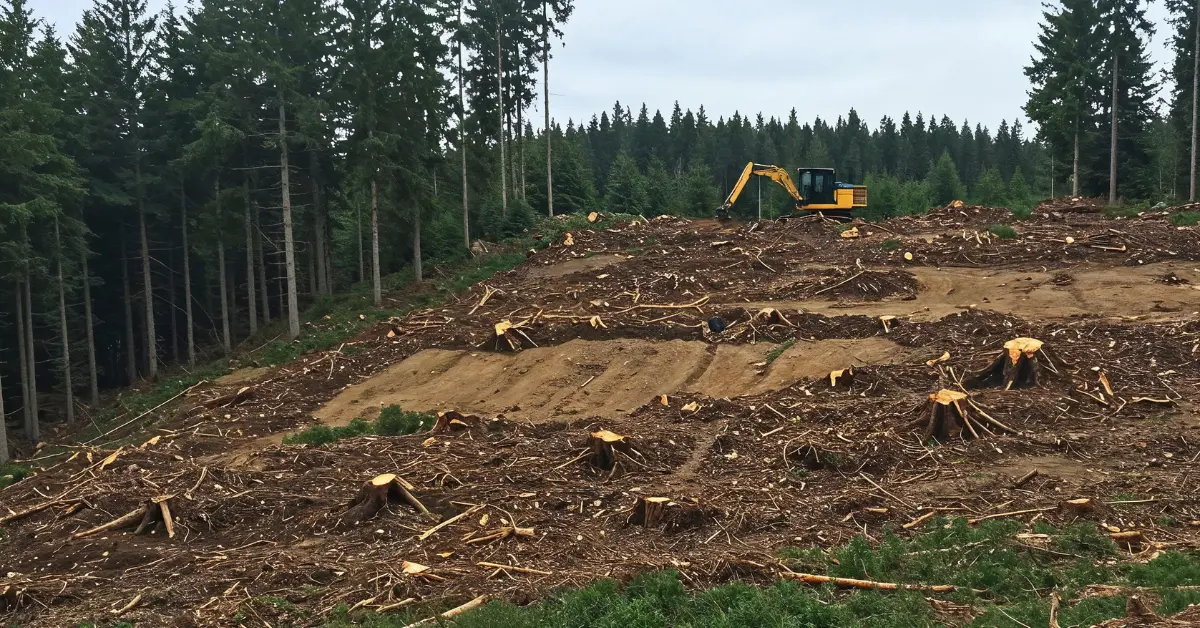
Global deforestation is no longer just an environmental issue; it is a supply chain, regulatory, financial, and reputational risk for businesses worldwide. This article provides a comprehensive, authority-level breakdown of the top 10 commodities that cause deforestation, why they matter, and how businesses can reduce risk in increasingly regulated markets.
According to global forest monitoring bodies, agricultural expansion remains the leading driver of forest loss. As consumer markets demand sustainability and governments introduce binding regulations like the EU Deforestation Regulation (EUDR), companies are being forced to examine their exposure to commodities linked to deforestation.
Key Takeaways
Deforestation is driven by a complex combination of economic demand, land-use pressures, governance gaps, and global trade dynamics. While the immediate cause is the clearing of forested land, the underlying drivers are structural and interconnected. Global deforestation averaged 10M hectares/year (1990-2020), slowing to 10.9M ha/year (2015-2025) from 17M ha (2000-2015), with 420M ha lost since 1990 (net loss 178M ha after 242M ha gain). Tropical regions account for 90%+ loss.
Deforestation contributes to approximately 15% of global greenhouse gas emissions, making it a significant driver of climate change.
The primary cause of deforestation globally is agricultural expansion. Forests are cleared to create pasture for cattle ranching or to grow commercial crops such as soy, palm oil, cocoa, coffee, and rubber. In tropical regions, forests are often burned or mechanically cleared to establish plantations or smallholder farms. Rising global demand for meat, dairy, processed foods, biofuels, and consumer goods fuels this expansion. As populations grow and diets shift toward higher meat consumption, land conversion accelerates. Agriculture drives 80% (small-scale 25%, commercial 75%), logging 15%, infrastructure/mining 10%, fires 5%, fuelwood 5%. Permanent agriculture caused 168M ha loss (2001-2024, 95% deforestation drivers).
| Cause | % Global Deforestation | Area (ha, 2001-2024) |
|---|---|---|
| Agriculture | 80% | 168M (permanent) |
| Logging | 15% | Included in 34% total deforest |
| Fires/Wildfires | 5-23% (temporary) | Record driver 2024 tropics |
Cattle ranching is the single largest driver of deforestation worldwide, especially in the Amazon Basin. Forest land is converted into grazing pasture, often as a low-cost way to claim and control land. Similarly, soy production contributes both directly (when forests are cleared for soy fields) and indirectly (when soy replaces cattle pasture, pushing ranching deeper into forest frontiers).
Commercial plantation agriculture, including palm oil and rubber, has caused widespread forest loss in Southeast Asia, parts of Africa, and Latin America. These large-scale monocultures often replace biodiverse ecosystems with uniform crop systems.
Beyond agriculture, logging, both legal and illegal, plays a major role. Timber extraction removes high-value trees and can degrade forest ecosystems even if the land is not completely cleared. Logging roads also open previously remote areas to further agricultural encroachment, multiplying deforestation impacts.
Infrastructure development is another major driver. Roads, dams, mining projects, and urban expansion fragment forests and make them accessible for settlement and farming. Mining operations, in particular, clear land directly and indirectly contribute to forest degradation through associated infrastructure and population influx.
Weak governance and unclear land tenure significantly exacerbate deforestation. In many regions, forests are cleared to assert land ownership, especially where legal land rights are poorly defined or enforced. Corruption, limited monitoring capacity, and inconsistent enforcement of environmental laws allow illegal clearing to persist.
Economic incentives and global supply chains amplify the problem. Many forest-risk commodities are traded internationally, meaning deforestation in one country is often driven by consumption in another. This disconnect between production and consumption has led to increasing regulatory intervention, such as mandatory due diligence laws.
Finally, climate change both contributes to and is worsened by deforestation. As changing weather patterns affect crop viability, farmers may expand into forested areas seeking more suitable land. Meanwhile, deforestation reduces carbon sequestration, accelerating global warming.
In summary, deforestation is not caused by a single activity but by a web of agricultural demand, industrial expansion, governance challenges, infrastructure growth, and global trade pressures. Addressing it requires coordinated action across governments, businesses, financial institutions, and consumers particularly within high-risk commodity supply chains.
The commodities most associated with global deforestation are:
Agriculture alone accounts for nearly 90% of global deforestation, with pasture expansion and large-scale plantations leading the way.
| Commodity | Est. Annual Forest Loss (Ha) | Primary Sourcing Hotspots | EUDR Status (as of 2026) |
|---|---|---|---|
| Cattle (Beef/Leather) | 2,100,000+ | Brazil (Amazon/Cerrado), Paraguay | In-Scope: Major driver of illegal land clearing. |
| Palm Oil | ~700,000 | Indonesia, Malaysia, Thailand | In-Scope: Traceability improving in SE Asia. |
| Soy | ~600,000 | Brazil, USA, Argentina, Bolivia | In-Scope: Primarily used for animal feed. |
| Timber and Wood | ~500,000 | SE Asia, Russia, Boreal forests | In-Scope: Includes pulp, paper, and furniture. |
| Cocoa | ~300,000 | Cote d’Ivoire, Ghana, Cameroon | In-Scope: High smallholder aggregation risk. |
| Rubber | ~250,000 | Thailand, Vietnam, Indonesia | In-Scope: Critical for automotive supply chains. |
| Coffee | ~150,000 | Brazil, Vietnam, Ethiopia, Colombia | In-Scope: Focus on “Traceability to Plot.” |
| Maize (Corn) | ~100,000 | Sub-Saharan Africa, Latin America | Under Review: Proposed for Annex I expansion. |
| Sugarcane | ~80,000 | Brazil, India, Thailand | Under Review: Often replaces former pasture land. |
| Mining Materials | Varies | DRC, Peru, Australia, Indonesia | Monitored: Labeled as “Hard Commodities.” |
Cattle ranching is widely recognized as the single largest contributor to tropical deforestation globally, particularly in the Amazon Basin.
Forests are cleared to create pastureland for grazing. In many regions, deforestation is driven by speculative land clearing forests are cut down to establish land ownership claims tied to cattle production.
Cattle-related deforestation impacts:
Retailers, fast-food chains, and automotive manufacturers face increasing scrutiny over leather sourcing and meat supply chains.
Soy expansion, especially in South America, has significantly contributed to deforestation. While soy is consumed directly in food products, most production is used for animal feed in poultry, pork, and dairy industries.
Companies may believe they are not sourcing high-risk commodities, yet meat and dairy inputs often contain soy feed linked to deforestation.
Key regions include:
Supply chain traceability in soy remains complex due to aggregation at silos and trading hubs.
Palm oil is found in:
Its efficiency per hectare makes it economically attractive, but expansion into tropical forests in Southeast Asia has led to significant biodiversity loss.
Palm oil has become a symbol of deforestation due to:
Although sustainability certifications exist, regulatory pressure now demands verifiable, geolocation-based traceability.
Cocoa production in West Africa particularly Cote d’Ivoire and Ghana has been linked to forest encroachment, often driven by smallholder farmers expanding plots into protected areas.
The chocolate and confectionery industry faces rising regulatory and consumer pressure. Traceability challenges stem from:
Cocoa is explicitly regulated under the EUDR framework.
Coffee cultivation, particularly in Latin America and parts of Africa, has historically expanded into forested areas. Climate change has also pushed coffee farming into higher-altitude forest zones.
Coffee supply chains are characterized by:
Under regulations like EUDR, coffee importers must provide farm-level geolocation data to prove deforestation-free production.
Timber has long been associated with deforestation and forest degradation. Logging can occur legally under national frameworks but illegal logging remains a major concern in tropical regions.
Timber-related deforestation affects:
Forest degradation from selective logging can be just as damaging as full land conversion.
Rubber expansion has gained less attention than palm oil or soy, yet natural rubber plantations have expanded significantly in Southeast Asia.
Rubber is critical to:
As electric vehicle production grows, rubber demand is increasing bringing fresh scrutiny to sourcing practices.
Rubber is also included under the EU Deforestation Regulation, signaling increased compliance expectations.
Maize is widely used in:
In certain regions, maize expansion contributes to forest conversion, particularly where demand for livestock feed rises.
While not always directly linked to primary tropical forest loss, maize-driven land-use change can contribute to broader ecosystem degradation.
Sugarcane expansion is tied to:
In some regions, forest and savannah ecosystems are converted into monoculture sugar plantations.
Biofuel mandates have historically driven sugarcane expansion in parts of Latin America and Southeast Asia.
Although agriculture leads deforestation statistics, mining activities including gold, bauxite, and iron ore extraction contribute to:
Mining-induced infrastructure often triggers secondary deforestation beyond the extraction site.
Governments are transitioning from voluntary sustainability standards to binding laws.
The EU Deforestation Regulation requires companies placing regulated commodities on the EU market to:
Other jurisdictions are exploring similar frameworks.
Institutional investors increasingly evaluate:
Non-compliance can affect capital access and valuation.
Consumers demand:
Brand reputation can erode rapidly when deforestation exposure becomes public.
Deforestation-linked commodities face:
Companies without traceability systems risk operational disruptions.
As regulations like the EU Deforestation Regulation move from policy to enforcement, deforestation-free sourcing is no longer optional it’s a legal requirement for accessing the EU market.
Read our complete guide to Deforestation-Free Sourcing with EUDR
Historically, companies relied on certifications and voluntary commitments to address deforestation.
Today, the landscape has shifted:
This marks a structural transformation in global commodity trade.
Identify:
Supply chain transparency is foundational.
Plot-level GPS coordinates allow satellite-based verification of forest cover history.
Evaluate:
Document findings thoroughly.
Adopt digital tools for:
Manual spreadsheets are insufficient at scale.
Provide training, onboarding tools, and structured data collection workflows to upstream suppliers.
Disclose:
Transparency builds trust with regulators and investors.
TraceX EUDR solutions help companies achieve compliance with global deforestation regulations including frameworks like the EU Deforestation Regulation by digitizing and automating key due diligence requirements across complex supply chains.
Here’s how TraceX supports regulatory readiness:
TraceX enables farm-level traceability by capturing GPS coordinates and polygon mapping data for production plots. This allows companies to verify that commodities are not sourced from land deforested after regulatory cut-off dates.
Integrated geospatial analytics and satellite monitoring tools validate land-use history, helping businesses demonstrate deforestation-free sourcing with objective evidence.
TraceX streamlines regulatory due diligence by assessing country risk, supplier performance, and geolocation data to generate structured, auditable risk profiles aligned with compliance requirements.
All compliance records geolocation data, supplier declarations, mitigation measures, and due diligence reports are stored in a secure, centralized system, ensuring audit readiness and faster response to regulatory inspections.
TraceX supports preparation and management of regulatory filings, helping companies compile the required data and documentation needed for submission in government compliance portals.
In short, TraceX transforms deforestation compliance from a manual, spreadsheet-driven process into a scalable, technology-enabled framework reducing risk, improving transparency, and protecting global market access.
The top 10 commodities that cause deforestation from cattle and soy to coffee and rubber are deeply embedded in global supply chains. For food producers, retailers, automotive manufacturers, and commodity traders, exposure is often indirect but substantial.
With binding regulations such as the EU Deforestation Regulation reshaping global trade, businesses must move beyond pledges and implement verifiable, technology-enabled compliance systems.
Deforestation risk is no longer a distant environmental issue. It is a measurable, auditable, and enforceable business risk and proactive companies will be best positioned to navigate the future of responsible commodity sourcing.
Agricultural expansion, particularly cattle ranching and soy production, is the leading cause of global deforestation.
Palm oil is a significant contributor in tropical regions, but cattle ranching accounts for the largest global share.
Modern regulations place due diligence obligations on companies to prevent forest-risk commodities from entering regulated markets.
Certifications can support sustainability goals but are often insufficient to meet mandatory legal requirements without geolocation-based verification.