
Quick summary: Learn how geo mapping for rubber exporters in Thailand enables EUDR compliance through GPS polygon mapping, traceability, and accurate supply chain data validation.
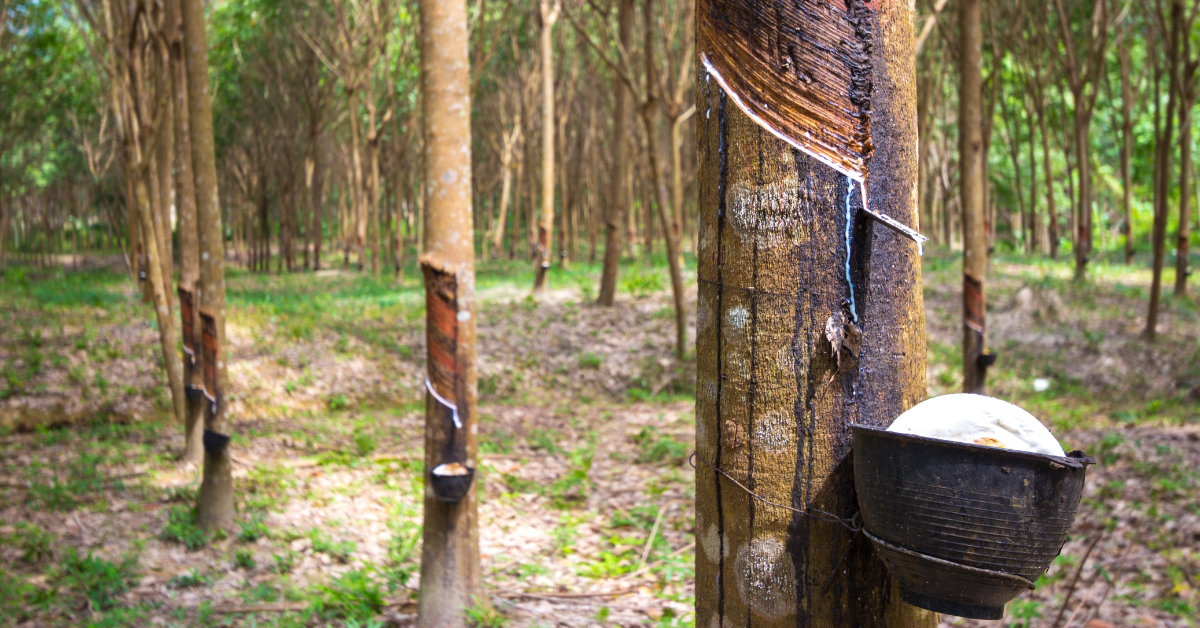
The EU Deforestation Regulation (EUDR), effective December 30, 2024, requires that all rubber and rubber-derived products entering the EU market be provably deforestation-free.
At the core of this requirement lies precise geolocation: GPS polygon mapping of every plot of land where the commodity was produced.
Geo mapping for rubber exporters in Thailand is becoming a critical capability, enabling accurate data capture, validation, and compliance at scale—particularly in a supply chain dominated by smallholders and regional processing networks.
This guide walks through each element of that process.
Regulation (EU) 2023/1115, commonly referred to as the EU Deforestation Regulation (EUDR), entered into force on June 29, 2023, with mandatory compliance deadlines beginning in late 2024.
It targets seven high-deforestation commodities:
Thailand one of the world’s largest rubber exporters—must ensure its supply chains meet strict traceability and deforestation-free sourcing requirements to maintain EU market access.
Operators and traders placing Thai rubber on the EU market must demonstrate three key conditions before export:
• No Deforestation
Rubber must not be sourced from land deforested after December 31, 2020.
• Legal Compliance
Production must comply with all relevant Thai laws, including:
• Due Diligence
A formal due diligence statement must be submitted through the EU information system, supported by verifiable and auditable data.
Article 9 of the EU Deforestation Regulation (EUDR) makes geolocation mandatory and non-negotiable.
For land-based commodities like rubber, exporters must provide precise geographic coordinates in the form of GPS polygons for every plot of land where the rubber was produced.
For Thailand, this requirement is especially significant due to:
To comply with EUDR, Thai rubber exporters must collect and submit:
Thailand remains the world’s largest natural rubber exporter, but the export profile is shifting toward higher-demand product forms and stronger dependence on China. In the first nine months of 2025, Thailand exported 1.993 million tons of natural rubber, down 8% year on year, but mixed-rubber exports rose 39% to 1.254 million tons, lifting total natural rubber plus mixed-rubber exports to 3.247 million tons, up 5.8%.
The latest 2025 figures show a clear product mix shift: standard rubber exports fell 20% to 1.116 million tons, while smoked sheet rubber rose 22% to 308,000 tons and latex rose 10% to 556,000 tons. By the first eight months of 2025, total natural rubber exports stood at 1.789 million tons, with China alone taking 696,000 tons, and mixed-rubber exports to China rising 44%. Broader industry summaries estimate Thailand produced about 4.7 million metric tons of natural rubber in 2023 and exported more than 85% of its output.
| Indicator | Time Period | Value |
|---|---|---|
| Natural Rubber Production (Total) | 2023 | 4.700 Million Metric Tons |
| Natural Rubber Exports (Volume) | Jan–Sep 2025 | 1.993 Million Tons |
| Mixed-Rubber Exports (Volume) | Jan–Sep 2025 | 1.254 Million Tons |
| Total (Natural + Mixed) Exports | Jan–Sep 2025 | 3.247 Million Tons |
| Natural Rubber Exports to China | Jan–Aug 2025 | 696,000 Tons |
Thailand’s export data shows a structural move away from standard rubber toward smoked sheet and latex, which generally command stronger or more stable demand. China remains the key buyer and price anchor, with some reports indicating Thailand shipped 1.34 million tons to China in the first half of 2025 and that China absorbed over 40% of exports historically. This concentration gives Thailand scale, but also exposes exporters to demand swings, freight disruptions, and pricing pressure tied to the Chinese market values.
The main story is not just volume growth; it is product upgrading and market concentration. Thailand is increasingly exporting more latex and smoked sheet rubber, which suggests buyers are favoring grades that better fit manufacturing and industrial demand. At the same time, sustainability and traceability requirements are becoming more important, especially for global buyers that want proof of legal origin and deforestation-free sourcing.
For exporters, Thailand’s advantage is its scale, logistics, and established processing base. The risk is that heavy dependence on China can compress margins when prices soften, while compliance costs rise for traceability and sustainability documentation. That makes the most resilient strategy one focused on higher-value grades, diversified markets, and verifiable sourcing systems.
Under the EU Deforestation Regulation (EUDR), GPS polygon mapping is not just a regulatory formality it is the technical backbone of deforestation verification.
For Thailand’s rubber sector characterized by millions of smallholder farms across the South and Northeast precise geolocation is essential to prove that rubber is sourced from deforestation-free land.
Without clearly defined farm boundaries, compliance cannot be verified, putting EU market access at risk.
EU authorities and third-party verifiers rely on satellite monitoring systems such as:
These tools assess forest cover changes at the parcel level, which is only possible when accurate polygon boundaries are provided.
In Thailand, where rubber farms are often:
…a single GPS point is insufficient and non-compliant.
Here’s why polygons are required:
For Thai exporters, relying on point data creates serious compliance risks under EUDR.
According to EUDR technical guidance:
Understand EUDR geolocation requirements in detail. Learn how to capture accurate GPS polygons and ensure compliance.
Avoid common GeoJSON errors in EUDR submissions. Learn how to validate and correct your geolocation data.
Thailand’s rubber supply chain presents structural and operational challenges that make compliance with the EU Deforestation Regulation (EUDR) more complex than plantation-driven systems in countries like Brazil.
Thailand is the world’s largest rubber exporter, with over 85% of production coming from smallholder farmers, many managing plots under 4 hectares.
Rubber cultivation is concentrated in:
Key challenges include:
Thailand’s rubber-growing regions present practical field challenges:
Thailand’s rubber industry relies on a network of:
This creates challenges such as:
These gaps make EUDR compliance and deforestation verification more complex.
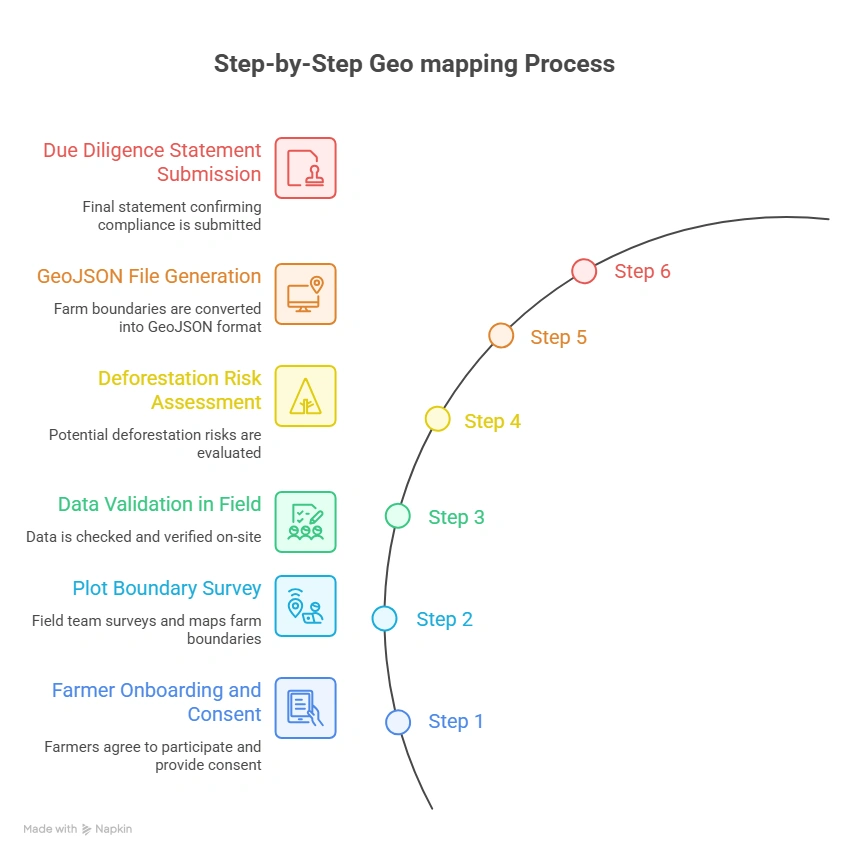
Below is a field-tested geo-mapping workflow tailored for Thailand’s rubber supply chain.
Before mapping begins, exporters must establish a legal and ethical data collection process:
Field agents use GPS-enabled smartphones or GNSS devices to capture polygon data.
Best practice protocol:
Validation must be completed immediately after mapping:
All mapped plots must be screened for compliance:
Validated data must be exported in GeoJSON format (RFC 7946 compliant):
| Specification | Value |
|---|---|
| Geometry type | Polygon (Feature) |
| Coordinate system | WGS 84 (EPSG:4326) mandatory |
| Coordinate order | Longitude first, then Latitude (per GeoJSON spec) |
| Winding order | Exterior ring: counter-clockwise |
| Properties | farmer_id, plot_id, area_ha, crop_type, country, region |
| Encoding | UTF-8 |
| Validation tool | geojsonlint.com, QGIS geometry validator, or Turf.js |
Final compliance step:
Geo mapping for Rubber Exporters in Thailand becomes seamless with TraceX EUDR solutions, enabling accurate GPS polygon capture, real-time validation, and end-to-end compliance management.
Data quality failures at the polygon level are the single most common reason EUDR submissions are flagged for review or rejected. Field teams and data managers should be trained to identify and fix the following errors:
| Error Type | Description | Impact | Fix |
|---|---|---|---|
| Self-Intersection | Polygon boundary crosses itself, creating a ‘bowtie’ shape. Occurs when field agent reverses direction while walking. | Fails GeoJSON validation; geometry engine cannot compute area. | Re-walk boundary; use QGIS Fix Geometries tool. |
| Unclosed Ring | First and last coordinate pair do not match. Polygon ring is not closed. | GeoJSON spec violation; most validators reject outright. | Append first coordinate to end of ring, or use auto-close in KoboToolbox. |
| Wrong CRS | Coordinates recorded in VN-2000 (Vietnam national projection) or UTM instead of WGS 84. | Coordinates displaced by hundreds of meters from true location. | Reproject to EPSG:4326 using QGIS or GeoPandas. |
| Reversed Winding Order | Exterior ring wound clockwise instead of counter-clockwise per RFC 7946. | Some parsers treat interior of polygon as exterior; area inversion. | Reverse coordinate array; QGIS ‘Rewind Polygons’ tool. |
| Coordinate Swap | Latitude and longitude values transposed (lat first, instead of GeoJSON spec’s lon first). | Plot placed in wrong hemisphere or ocean; immediate deforestation false-alarm. | Validate first coordinate: Vietnam lon ≈ 102–109°E; lat ≈ 8–23°N. |
| Spike Artefacts | One or more vertices are outliers caused by GNSS signal bounce under canopy. | Polygon area inflated; boundary bleeds into adjacent plots. | Remove outlier points; apply Douglas-Peucker simplification at 1m tolerance. |
| Duplicate Polygons | Same farm submitted twice with different farmer_id due to aggregator duplication. | Inflated area records; compliance review flags double-counting. | Spatial deduplication using PostGIS ST_Equals or Turf.js booleanEqual. |
| Overly Simplified Polygon | Only 3 or 4 vertices used for complex, irregularly shaped plots. | True boundary not captured; adjacent deforested land may be excluded or included. | Minimum 6–8 vertices for plots with non-linear edges; re-survey if needed. |
For Thailand’s rubber exporters, compliance with the EU Deforestation Regulation (EUDR) is not just a documentation exercise it represents a fundamental transformation of the supply chain.
At the core of this transformation is the GPS polygon requirement, which creates a verifiable link between:
Thailand’s challenges are real smallholder fragmentation, inconsistent land documentation, and geospatial data accuracy all pose significant hurdles.
However, the path forward is clear. Exporters who invest in robust geo mapping infrastructure combining mobile data collection, spatial data management, deforestation risk screening, and compliance platform integration will not only meet EUDR requirements but also gain a sustainable competitive advantage in global markets.
The clock is running. Geolocation is the foundation. Build it right.
Explore the tools you need for EUDR compliance → Discover how Thai rubber exporters are using digital solutions for geolocation, traceability, and DDS submission.
Understand EUDR compliance requirements for rubber supply chains → Learn what exporters must do to ensure deforestation-free sourcing.
Learn how rubber exporters in Thailand can meet EUDR requirements → Explore geolocation, traceability, and compliance workflows tailored to Thailand.
Geo mapping for rubber exporters in Thailand involves capturing GPS polygon coordinates of rubber farms to verify origin and ensure compliance with deforestation-free requirements under the EU Deforestation Regulation (EUDR).
Geo mapping is mandatory under EUDR because it enables authorities to verify that rubber is not sourced from land deforested after December 31, 2020, using satellite-based analysis.
Exporters must collect:
Geolocation data is typically captured using:
Key challenges include:
Digital solutions help overcome these challenges by enabling automated validation, risk scoring, and scalable traceability systems.