
Quick summary: Learn how packaging traceability for PPWR helps businesses manage packaging data, supplier compliance, recyclability requirements, PCR-content verification, and digital packaging transparency for EU market readiness.
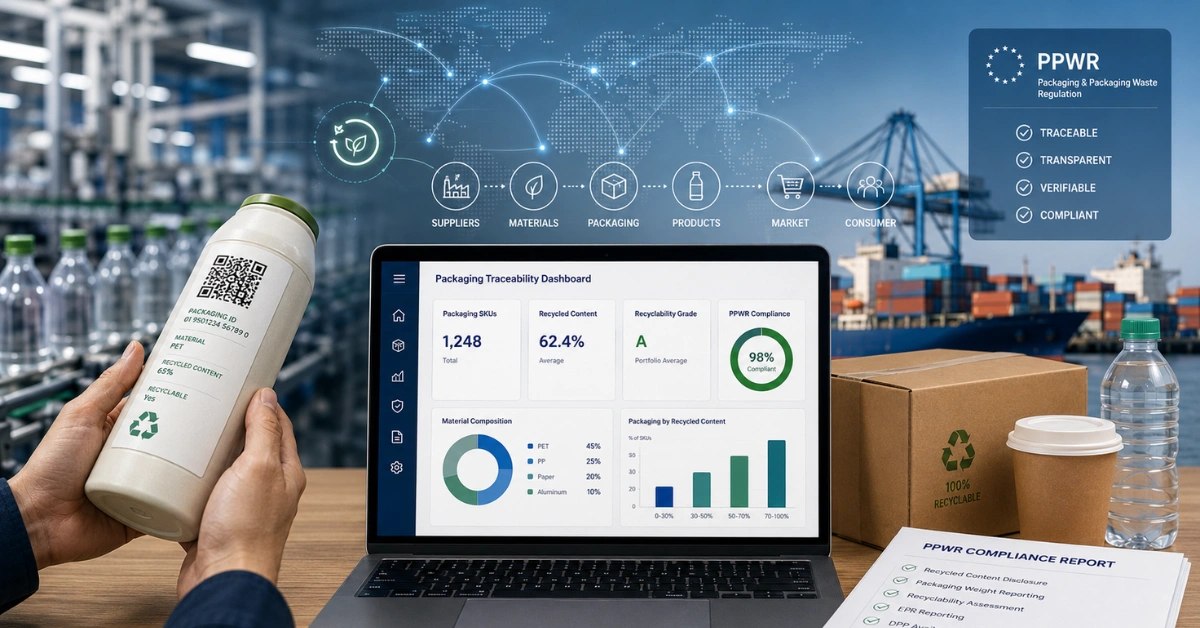
Packaging traceability for PPWR is the ability to track and verify the materials, origins, and environmental attributes of packaging from raw material sourcing to end-of-life disposal. Under the EU’s Packaging and Packaging Waste Regulation (PPWR), companies placing products on the EU market must collect and report granular data on recycled content, recyclability, and packaging weight per product unit or face market access restrictions from 2030 onward.
Imagine a regulatory auditor walks into your facility in 2028 and asks: ‘Show me the recycled content percentage for every packaging SKU you shipped to Germany last quarter.’ Can you answer that question accurately, in minutes, without calling three suppliers? Most food and consumer goods companies can’t. Not yet. But the EU’s Packaging and Packaging Waste Regulation (PPWR) is about to make that level of data granularity non-negotiable.
This guide explains what packaging traceability actually means, what the PPWR specifically requires you to track, and how forward-thinking companies are building the data infrastructure now before the deadline pressure hits.
| Key Takeaways Packaging traceability means digitally documenting every material, supplier, and environmental attribute across your packaging supply chain — not just your product supply chain. The EU’s PPWR (effective 2030–2035) mandates minimum recycled content, recyclability standards, and Digital Product Passport (DPP) data for all packaging entering EU markets. TraceX’s blockchain-backed compliance platform automates PPWR data collection, DPP generation, and audit-ready reporting so you’re not scrambling when deadlines hit. |
Packaging has always carried compliance obligations food safety labelling, country-of-origin rules, weight standards. But three forces are converging in 2025–2030 to make packaging traceability an urgent strategic priority, not a back-office concern.
| €800B+ | 40% | €7.4B |
|---|---|---|
| EU Packaging Market Value European Commission, 2024 | Recycled content mandated in plastic packaging by 2030 PPWR, Article 7 | Cost of EU packaging waste annually EEA, 2023 |
The EU Packaging and Packaging Waste Regulation replaces the 1994 Directive and introduces mandatory recycled content thresholds, recyclability standards, minimisation rules, and crucially Digital Product Passports (DPPs) that must carry traceable data for each packaging unit. Unlike voluntary sustainability reporting, this is market access legislation: non-compliant products can be blocked from EU sale.
Under EPR reforms being implemented across 27 EU member states, brands now bear financial responsibility for the end-of-life management of their packaging. That fee is calculated on packaging weight and material type per unit sold data that most companies don’t currently capture at SKU level.
Understand how Extended Producer Responsibility (EPR) is reshaping packaging and waste compliance globally. Explore our blog to learn how EPR impacts producers, importers, FMCG brands, and exporters through packaging accountability, recycling obligations, reporting requirements, and circular economy regulations.
76% of global consumers say they would change purchasing habits to reduce environmental impact (Nielsen, 2023). Major retailers including Carrefour, Lidl, and Tesco have introduced packaging scorecards for their suppliers and companies that can’t produce verified data are losing shelf space, not just ESG ratings.
The Packaging and Packaging Waste Regulation (PPWR) was formally adopted by the EU Council in November 2024 and will phase in requirements between 2030 and 2040. It applies to any company placing packaged goods on the EU market regardless of where the packaging is manufactured.
Key requirements at a glance:
| Requirement | What It Means | Deadline | Who It Affects |
|---|---|---|---|
| Recycled Content Mandates | Minimum % of recycled material in plastic packaging (30–65% depending on type) | 2030–2040 | All packaging producers & importers |
| Recyclability Standards | Packaging must meet EU recyclability criteria at design stage | 2030 | Packaging designers & brand owners |
| Packaging Minimisation | Restricts unnecessary packaging weight & empty space | 2030 | All packaged goods companies |
| Digital Product Passports (DPP) | Machine-readable data carrier (QR/RFID) with material composition, recycled content, and recyclability info | 2030 (phased) | B2B packaging, large-volume consumer goods |
| EPR Fee Reporting | Per-SKU data on packaging weight, material, and units placed on market | Ongoing (country-level) | All producers with EPR obligations |
| Reuse & Refill Targets | % of packaging offered in reusable format (e.g. 10% of takeaway drinks by 2030) | 2030 | Food service, e-commerce, beverage |
Preparing for PPWR compliance before the 2026 deadlines? Explore our blog to understand the key PPWR compliance requirements around recyclability, PCR content, packaging reduction, supplier-data management, labeling obligations, and digital packaging traceability for EU-bound products.
PPWR compliance isn’t just about having sustainable packaging; it’s about having verifiable, auditable data about that packaging at every tier of your supply chain.
Here’s the data you’ll need, broken down by packaging tier:
| Data Category | Specific Data Points Required | Where It Lives Today |
|---|---|---|
| Material Composition | % recycled content by polymer type; virgin vs. recycled split; bio-based content | Supplier COAs often PDF, undigitised |
| Packaging Weight & Dimensions | Weight per unit (grams), volume ratio, empty space % | ERP / product specs (often inconsistent) |
| Recyclability Classification | EU recyclability grade (A–E scale); end-of-life stream compatibility | Rarely tracked; lab certification needed |
| Supplier Chain Data | Tier-1 and Tier-2 supplier identity, location, material origin certificates | Fragmented across procurement teams |
| Batch / Lot Traceability | Link between packaging batch and product SKU placed on market | Often not connected to packaging data |
| DPP Data Elements | Unique identifier, material composition, instructions for consumers, QR/RFID link | Does not exist in most companies today |
| EPR Reporting Data | Units sold per SKU, weight per unit, by market / country | ERP data but rarely per packaging SKU |
| End-of-Life Documentation | Collection rates (where tracked), sorting & recycling pathway confirmation | Third-party waste operators disconnected |
The uncomfortable reality? For most mid-market food and consumer goods companies, 60–70% of this data either doesn’t exist in digital form or lives in supplier emails and PDF certificates not in any system that can be queried or reported on.
Trying to understand what PPWR requirements mean for your business and packaging operations? Explore our comprehensive guide on PPWR requirements to learn about recyclability mandates, PCR-content targets, packaging reduction rules, labeling obligations, supplier-data requirements, and digital compliance expectations for EU-bound products.
Packaging traceability isn’t a single system it’s a data architecture that connects your packaging supply chain to your product data and regulatory reporting. Here’s how it works end to end:
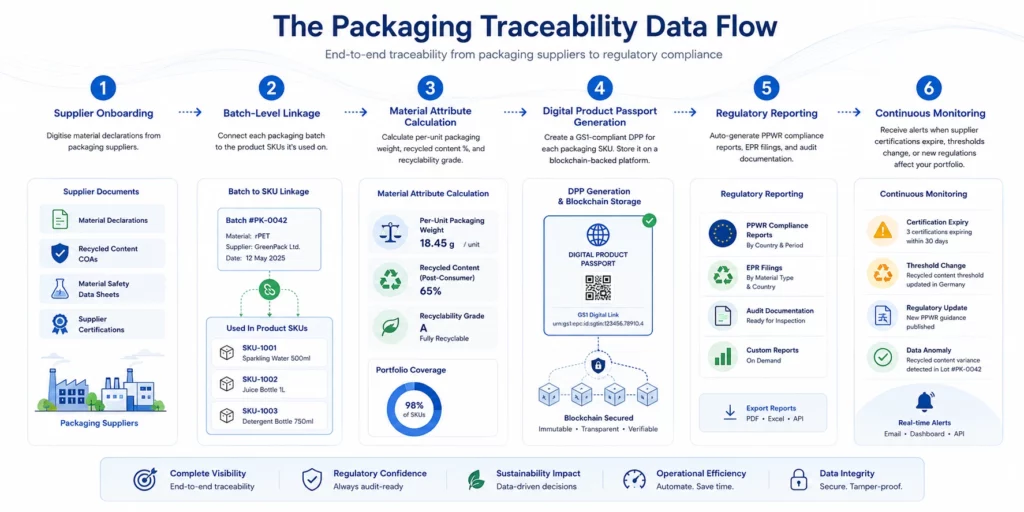
| The Packaging Traceability Data Flow STEP 1 — Supplier Onboarding: Digitise material declarations from packaging suppliers. Capture recycled content COAs, material safety data, and supplier certifications in a structured format. STEP 2 — Batch-Level Linkage: Connect each packaging batch (e.g. Lot #PK-0042) to the product SKUs it’s used on. This is the link that makes EPR reporting and DPP generation possible. STEP 3 — Material Attribute Calculation: Calculate per-unit packaging weight, recycled content %, and recyclability grade across your full product portfolio — automatically. STEP 4 — Digital Product Passport Generation: Create a GS1-compliant DPP for each packaging SKU. Store it on a blockchain-backed platform to ensure data integrity and prevent manipulation. STEP 5 — Regulatory Reporting: Auto-generate PPWR compliance reports, EPR filings, and audit documentation by country, material type, and reporting period. STEP 6 — Continuous Monitoring: Receive alerts when supplier certifications expire, recycled content thresholds change, or new regulatory updates affect your portfolio. |
Three technology layers make this work at scale:
Discover how ESPR and Digital Product Passports (DPP) are redefining product transparency in the EU.
Explore our blog to understand upcoming ESPR-DPP requirements, product traceability expectations, sustainability data mandates, and how businesses can prepare for connected digital compliance across global supply chains.
Packaging traceability isn’t theoretical it’s already being operationalised by leading agri-food and consumer goods companies preparing for PPWR. Here are three use cases that show what this looks like in practice.
| Use Case 1 — Food Manufacturer Automating Recycled Content Verification Company Type: Mid-market spice and condiment manufacturer, exporting to Germany and France Challenge: Five packaging suppliers across India and Turkey sending recycled content COAs as PDF emails. No single source of truth. Unable to calculate per-SKU recycled content % across 120+ product lines. Solution: TraceX can digitise all supplier COAs via AI document parsing. Each supplier’s material declarations were linked to product SKUs. Recycled content % is auto-calculated per unit for the full portfolio. Result: Company can now generate a PPWR-ready material composition report for any product in under 60 seconds. EPR fee calculations reduced from 3 weeks to 1 day per reporting cycle. |
| Use Case 2 — Specialty Coffee Brand Launching Digital Product Passports Company Type: Premium coffee brand with retail presence across 12 EU markets (similar profile to Blue Tokai Coffee) Challenge: Preparing for ESPR/PPWR Digital Product Passport requirements for flexible packaging (stand-up pouches). No existing system to generate DPP-compliant QR codes with blockchain-backed data. Solution: TraceX’s ESPR Digital Product Passport module — GS1-compliant, blockchain-backed. QR codes generated for each packaging run, carrying material composition, supplier data, and recyclability grade. Result: Consumer-facing DPP live 18 months before regulatory deadline. Retailer sustainability scorecards improved. Brand positioned as category leader on packaging transparency. |
| Use Case 3 — Agri-Commodity Exporter Managing Tier-2 Packaging Supplier Risk Company Type: Rice and spice exporter, 400+ product SKUs, selling to EU private-label buyers Challenge: EU buyers requiring PPWR-compliant packaging declarations as part of procurement qualification. Exporter had no visibility into Tier-2 packaging material suppliers (the companies supplying the packaging supplier). Solution: TraceX’s multi-tier supplier onboarding with offline-capable mobile data collection for smaller suppliers. GPS-tagged supplier profiles, material certifications stored with blockchain timestamps. Result: Full Tier-1 and Tier-2 packaging supplier data captured for 95% of SKUs. EU buyer procurement qualification passed in 6 weeks. Supply chain risk alerts now flag when any packaging supplier’s certification is within 90 days of expiry. |
TraceX’s Regulatory Compliance Platform is purpose-built for exactly the challenge PPWR creates: translating complex, multi-tier supply chain data into audit-ready regulatory documentation without building a team of compliance analysts.
Here’s how TraceX’s platform capabilities map to PPWR requirements:
| PPWR Requirement | TraceX Capability | How It Works |
|---|---|---|
| Recycled Content Tracking | AI Document Parsing + COA Digitisation | Automatically extracts recycled content data from supplier PDFs. No manual re-entry. |
| Digital Product Passports | ESPR DPP Module (GS1 + Blockchain) | Generates GS1-compliant DPPs with blockchain-backed data integrity. QR/RFID ready. |
| Supplier Data Management | Multi-Tier Supplier Onboarding | Offline-capable mobile onboarding for Tier-1 and Tier-2 packaging suppliers in any geography. |
| Audit-Ready Reporting | One-Click Export (PDF, XML, CSV) | PPWR compliance reports generated per product, per market, per reporting period. |
| EPR Fee Calculation | Per-SKU Packaging Weight Module | Links packaging batch data to product SKUs for accurate EPR unit reporting. |
| Regulatory Monitoring | Real-Time Compliance Alerts | Alerts when certifications expire, thresholds change, or new PPWR implementing acts are published. |
TraceX already supports EUDR, ESPR, and CSRD compliance for food and agri-commodity companies. PPWR packaging traceability uses the same blockchain infrastructure, purpose-adapted for packaging supply chains.
Discover how Digital Product Passports (DPPs) are transforming product transparency and compliance.
Explore our solutions to learn how DPPs enable traceability, sustainability data sharing, material disclosures, circularity tracking, and regulatory readiness across global supply chains.
Understanding when each requirement kicks in helps you prioritise your data collection roadmap:
| Year | PPWR Milestone | Data You Need Ready |
|---|---|---|
| 2025–2026 | PPWR enters into force; member state transposition begins | Start supplier data digitisation; COA capture programme |
| 2028 | DPP pilot programmes for select categories | Packaging material database; GS1 identifier assignment |
| 2030 | Mandatory recycled content minimums take effect (30% for contact-sensitive plastics) | Per-SKU recycled content tracking; recyclability grades assigned |
| 2030 | Packaging minimisation rules & unnecessary packaging restrictions | Packaging weight data by SKU; empty space ratio calculation |
| 2035 | Increased recycled content thresholds (50–65% for some plastic categories) | Full supplier COA chain; Tier-2 material origin data |
| 2040 | All packaging must meet ‘recyclable at scale’ standard | End-of-life data integration; collection rate reporting |
Source: EU PPWR Regulation Timeline, Official Journal, 2024; European Commission Implementation Roadmap
Having worked with food and agri-commodity businesses across the compliance journey, these are the five avoidable mistakes that consistently create last-minute scrambles:
Packaging traceability isn’t a sustainability nice-to-have. From 2030, it’s a market access requirement for every company placing goods on EU shelves. The companies that will navigate this smoothly aren’t the ones scrambling to collect COAs in 2029 they’re the ones digitising their packaging supply chains now, while they still have time to do it right.
The data you need exists. It lives in supplier emails, PDF certificates, and procurement spreadsheets. The question isn’t whether you need to capture it it’s whether you’ll have a system that makes capturing, verifying, and reporting it manageable at scale.
TraceX gives food and agri-commodity companies that system a blockchain-backed, AI-powered platform that turns fragmented packaging supplier data into PPWR-compliant, audit-ready reporting. The same infrastructure that handles EUDR, CSRD, and ESPR compliance for companies across India, Africa, and Southeast Asia.
Product traceability tracks what’s inside the package ingredients, batch numbers, farm origins. Packaging traceability tracks the package itself what material it’s made of, how much recycled content it contains, whether it’s recyclable, and who supplied it. PPWR specifically requires packaging traceability data, which is a separate data layer that most companies haven’t built yet.
PPWR applies to any company placing packaged goods on the EU market including importers of packaged products from outside the EU. If your products are sold in any of the 27 EU member states, PPWR applies to your packaging. This includes food manufacturers, agri-commodity exporters, FMCG brands, and e-commerce companies shipping directly to EU consumers.
A Digital Product Passport is a machine-readable data carrier typically a QR code, RFID tag, or DataMatrix attached to or printed on packaging. It links to a standardised data set that includes material composition, recycled content percentage, recyclability classification, and end-of-life instructions. Under PPWR and the ESPR framework, DPPs must meet GS1 standards and carry data that is verifiable and tamper-proof. TraceX generates GS1-compliant DPPs backed by blockchain for audit integrity.
Now. The first hard PPWR deadlines take effect in 2030 but building the data infrastructure (supplier onboarding, COA digitisation, packaging material database) typically takes 12–24 months for mid-to-large companies. Companies that start in 2025–2026 will have 2–3 years to test, verify, and refine their data before regulators start checking. Companies that wait until 2028 will be building under pressure, likely with inadequate data quality.
Yes. TraceX is a multi-regulation compliance platform built on a single blockchain-backed data infrastructure. The same supplier data captured for EUDR (farm/plot-level data, deforestation-free verification) can be extended to cover PPWR packaging supplier onboarding. CSRD Scope 3 reporting benefits from the same primary data layer. Running compliance on one integrated platform eliminates data duplication and audit gaps between different regulatory frameworks.