
Quick summary: Explore EUDR downstream operator examples and learn when full due diligence is required, including traceability, DDS verification, and risk-triggered compliance.

Under the EU Deforestation Regulation, downstream operators are not required to submit a Due Diligence Statement (DDS) or re-run full risk assessments for every transaction. Their obligations are tiered: maintain traceability records, verify that upstream due diligence has been completed, and act only when a substantiated concern arises. To understand how this works in practice, explore EUDR downstream operator examples from EU-based traders to distributors to see how responsibilities differ across roles in the supply chain.
The single most expensive mistake an EU commodity trader can make right now isn’t non-compliance. It’s over-compliance. Across procurement desks from Hamburg to Rotterdam, compliance teams are building parallel due diligence systems, re-running risk assessments, and filing duplicate DDS submissions for transactions that don’t require it. Meanwhile, they’re spending less time on what actually matters: verifying whether their upstream suppliers have credible, auditable data behind their DDS.
EUDR is a tiered system. Your role in the chain determines your obligation. And if you’re a downstream operator, your role is more targeted and far more manageable than most compliance briefings suggest.
Key Takeaways
EUDR creates a tiered compliance system upstream operators bear full due diligence and DDS submission duties, while downstream actors focus on traceability, record-keeping, and risk monitoring. Full due diligence becomes necessary only when ‘substantiated concerns’ surface (e.g., missing geolocation data, flagged suppliers). Duplicating upstream compliance is unnecessary and expensive.
For SME downstream traders, obligations are even lighter no requirement to verify the adequacy of upstream due diligence, only to hold the DDS reference number and maintain supply chain records.
The regulation’s design reflects a deliberate policy choice: compliance burden scales with proximity to the point of deforestation risk. Downstream actors in mature EU trading chains are given lighter obligations to avoid bureaucratic duplication a feature, not a loophole.
Not sure what applies to you as a downstream operator?
Read the blog to understand your exact responsibilities under EUDR.
Downstream actors aren’t off the hook entirely. There is a specific legal trigger: the substantiated concern.
EUDR defines a substantiated concern as credible evidence that a product may not meet the regulation’s requirements. This includes:
When any of these triggers appear, the downstream obligation escalates. The trader must investigate, potentially halt the shipment, and depending on the outcome run a full due diligence process or exclude the supplier.
This trigger-based model requires active monitoring, not passive record-holding. That’s where most downstream operators are currently under-invested.
Scenario: A Hamburg-based coffee importer sources from a Brazilian exporting cooperative. The exporter has conducted full due diligence, mapped all farm plots using GPS polygons, and submitted a valid DDS via EU TRACES NT before shipment.
What the importer must do:
Record the DDS reference number from the Brazilian exporter
Maintain supplier and customer records for 5 years
Verify (not re-audit) that a DDS was submitted
What the importer does NOT need to do:
Re-run geolocation verification
Conduct an independent risk assessment
Submit a second DDS
The DDS is valid. The polygon data checks out. No substantiated concern. The importer’s obligation ends at record-keeping and traceability maintenance.
Scenario: A Rotterdam-based rubber trader receives three shipments from a Southeast Asian supplier. Two arrive with complete documentation and valid GPS polygon data. The third arrives with point coordinates only no polygon boundary data and the DDS reference number doesn’t match the batch on the commercial invoice. What this creates: A substantiated concern.
What the trader must now do:
Place the third shipment on administrative hold immediately
Contact the upstream supplier to request corrected polygon data
Cross-reference the DDS reference against TRACES NT records
Document the investigation and outcome in full
If the data gap can’t be resolved: exclude the shipment or escalate
Under EUDR Article 24, downstream operators who proceed despite a known substantiated concern face penalties of up to 4% of EU annual turnover.
Polygon data gaps are the single most common substantiated concern trigger for rubber and timber downstream traders. Point coordinates alone are insufficient for commodities sourced from high-risk geographies, based on early EUDR implementation patterns.
One GeoJSON error can invalidate your DDS.
Read the blog to identify and fix common mistakes before submission.
Scenario: A Belgian palm oil distributor sources from certified sustainable suppliers in Malaysia. The upstream exporter has submitted a valid DDS for every shipment. No risk flags exist.
What the distributor decides to do anyway:
Build an internal due diligence team to replicate the upstream operator’s risk assessment
Re-verify all GPS polygon data independently
Submit additional DDS filings (not required)
Require all suppliers to complete a second documentation round
The result:
€180,000+ in annual compliance costs that weren’t required
Supplier friction and onboarding delays
No improvement in compliance outcome or deforestation risk reduction
EUDR’s tiered system is designed to prevent exactly this scenario. When downstream operators duplicate upstream obligations, they’re not safer they’re just more expensive.
Scenario: A Scandinavian timber trading company sources wood products from a supplier in Central Africa. They’ve held a valid DDS reference for 18 months. Then, Global Forest Watch publishes satellite data showing significant deforestation within the geographic boundary of the supplier’s declared sourcing plots. A European NGO formally notifies the company. What this creates: A substantiated concern, externally initiated.
What the importer must now do:
Pause all incoming shipments from that supplier immediately
Verify whether the deforestation alert overlaps with the supplier’s registered plots
Re-run geolocation validation against updated JRC and Hansen datasets
Request updated land tenure and certification documentation
If overlap is confirmed: exclude the supplier and document the decision
Notify the relevant EU competent authority if required under Article 10
Unlike Example 2 (data inconsistency trigger), this is triggered by external third-party intelligence. The reputational and regulatory urgency is significantly higher.
TraceX’s compliance platform monitors satellite deforestation alerts in real time and automatically flags supplier records when risk signals emerge from JRC, Hansen datasets. Rather than waiting for an NGO letter, companies get an internal alert first giving them time to investigate proactively before regulatory escalation.
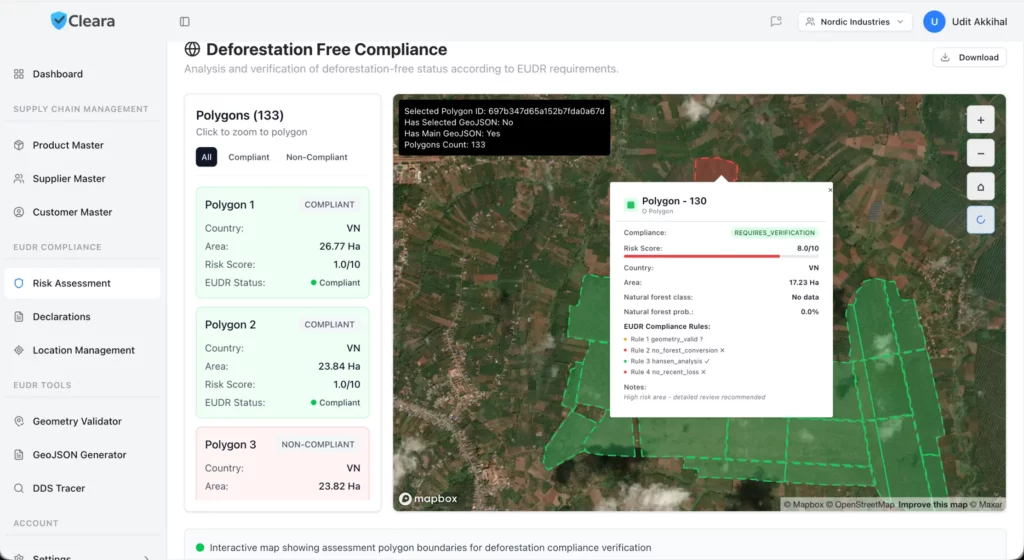
Scenario: A Belgian cocoa processor sources from 43 upstream operators across Ghana, Ivory Coast, and Ecuador. Each upstream operator submits their own DDS. Some are large certified cooperatives with robust digital traceability. Others are smaller exporters with inconsistent documentation quality.
What the processor must do:
Maintain DDS reference records for all 43 suppliers
Monitor for substantiated concerns across all incoming batches
Differentiate between high-risk and low-risk sourcing flows
Build escalation workflows that trigger investigation when risk signals appear
The challenge at scale: Manually tracking DDS references, monitoring deforestation alerts, and cross-referencing shipment data across 43 suppliers is operationally unsustainable in spreadsheets. Missing a single substantiated concern from a mid-tier supplier could expose the entire business to enforcement action even though the processor isn’t the upstream operator.
This is where the downstream obligation becomes strategically complex. The processor doesn’t need to replicate upstream due diligence. But they absolutely need intelligent monitoring infrastructure.
Companies managing 20+ upstream suppliers under EUDR are the highest-risk cohort for undetected substantiated concerns not because they’re non-compliant by intent, but because manual tracking at scale creates blind spots. The regulation’s trigger-based model requires continuous monitoring, not just onboarding documentation.
Upstream operators carry the highest compliance burden.
Learn exactly what you need to collect, validate, and submit.
The five examples above point to the same architectural conclusion: downstream EUDR compliance isn’t about doing less it’s about doing the right things.
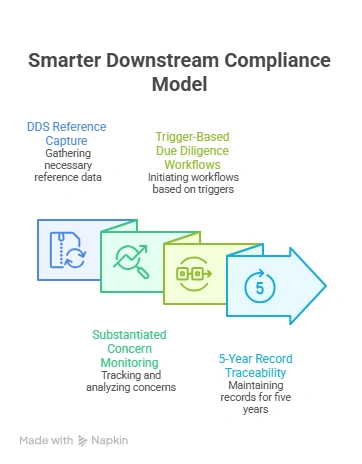
Every incoming shipment should be matched to a valid, retrievable DDS reference number. This should be automated, not manual discrepancies surface in seconds, not spreadsheet reviews.
Proactive monitoring for risk signals geolocation discrepancies, deforestation alerts, supplier flags is the core downstream obligation. Manual processes break down at scale above ~10 suppliers.
When a substantiated concern arises, operators need pre-defined escalation workflows: who investigates, what data is required, what the hold criteria are, and how the decision is documented.
Supplier and customer records, DDS references, investigation logs, and shipment decisions must be retrievable for five years. Audit-readiness isn’t optional it’s where penalties are determined.
| Obligation | Upstream Operator | Downstream Non-SME | Downstream SME |
|---|---|---|---|
| Full due diligence | ✅ Required | ⚠️ Only if substantiated concern | ⚠️ Only if substantiated concern |
| DDS submission (TRACES NT) | ✅ Required | ❌ Not required | ❌ Not required |
| DDS reference record | ✅ Must generate | ✅ Must collect & retain | ✅ Must collect & retain |
| Geolocation verification | ✅ Required | ⚠️ Only if concern | ❌ Not required |
| Supplier/customer records | ✅ 5 years | ✅ 5 years | ✅ 5 years |
| Risk monitoring | ✅ Continuous | ✅ Recommended | ✅ Recommended |
| Penalty exposure | High | High if concern ignored | Medium |
Source: European Commission EUDR Guidance Document, 2024; Regulation (EU) 2023/1115
Under the EU Deforestation Regulation, downstream operators are not expected to duplicate upstream due diligence they are expected to maintain traceability, verify DDS completion, and respond intelligently to risk. Full due diligence is only required when a substantiated concern arises, not as a default for every transaction.
The practical takeaway from these EUDR downstream operator examples is clear: compliance is tiered, not repetitive. Companies that build systems around verification, data integrity, and risk triggers rather than blanket duplication will be more efficient, audit-ready, and aligned with regulatory intent.
No. Only upstream operators those first place regulated commodities on the EU market are required to submit a DDS via EU TRACES NT. Downstream traders must collect and retain the DDS reference number from their upstream supplier, but are not required to submit an independent statement unless a substantiated concern arises. (Source: Regulation (EU) 2023/1115, Article 4-5)
A substantiated concern is credible evidence that a product may not meet EUDR requirements. Examples include missing or invalid GeoJSON polygon data, inconsistencies between a DDS reference and shipment documentation, suppliers flagged in deforestation monitoring databases (JRC, Global Forest Watch), or alerts from competent authorities or accredited NGOs. When any of these arise, full due diligence obligations are triggered.
No SMEs are not exempt, but their obligations are lighter. SME downstream traders must collect supplier and customer information and maintain records for 5 years. They are not required to verify the adequacy of upstream due diligence, only to confirm that a DDS exists. They face the same obligation to investigate substantiated concerns if these arise.
Under EUDR Article 24, operators who place non-compliant products on the EU market including downstream operators who knowingly proceed past a substantiated concern face penalties including fines of up to 4% of annual EU turnover, temporary exclusion from public procurement, and confiscation of goods and revenues. Downstream status does not provide immunity when a concern is known and ignored.
Manual tracking via spreadsheets becomes operationally unsustainable above ~10 upstream suppliers. Best-practice operators use dedicated compliance platforms like TraceX that automate DDS reference capture, flag discrepancies in real time, monitor deforestation risk signals continuously, and trigger investigation workflows when substantiated concerns are detected.