
Quick summary: EUDR compliance assigns different obligations to operators, traders, and retailers. Discover your role, your due diligence duties, and the penalties for non-compliance
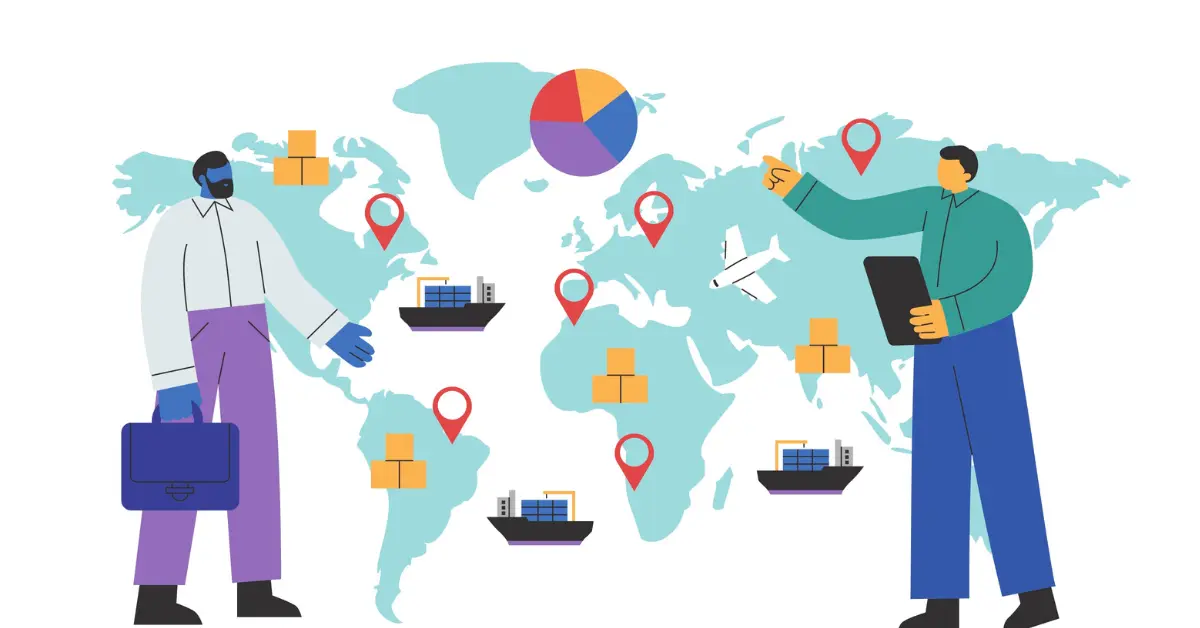
EUDR compliance for supply chain actors entails legally distinct compliance obligations for operators, traders, and retailers. Operators face the full due diligence burden, collecting geolocation data, performing risk assessments, and filing Due Diligence Statements (DDS) before placing goods on the EU market. Traders in the middle of the chain may use a simplified procedure, but only if their supplier has already filed a valid DDS. Retailers placing products directly on the EU market follow operator-level obligations. Non-compliance risks fines up to 4% of annual EU turnover, market bans, and confiscation of goods.
The EU Deforestation Regulation (EUDR) is not a future problem. It’s a present one. Large operators and traders are required to comply by December 30, 2025. SMEs follow by June 30, 2026. And yet, a significant share of supply chain teams still don’t know which category they fall into, let alone what their specific obligations are.
That ambiguity is expensive. Shipments blocked at EU ports. Contracts voided. Fines are calculated against the global annual revenue. Loss of EU market access potentially for years.
This guide maps EUDR compliance obligations by supply chain role. Whether you’re sourcing coffee from Ethiopia, palm oil from Indonesia, or cocoa from Ghana, here’s exactly what EUDR requires from you.
| 10M+ Hectares | €4.5 Trillion | 7 Commodities |
| Of forest lost globally per year — EUDR targets supply-chain-linked deforestation | EU-linked commodity trade covered by EUDR regulations (European Commission, 2023) | Coffee, cocoa, palm oil, soy, rubber, cattle, wood — plus derived products |
The EU Deforestation Regulation (EU 2023/1115) entered into force on June 29, 2023. It prohibits the placing or making available on the EU market of specific commodities and products if they were produced on land that was deforested or forest-degraded after December 31, 2020. It also prohibits the export of such products from the EU.
The seven in-scope commodities are: cattle, cocoa, coffee, palm oil, soya, wood, and rubber. Derived products, including leather, chocolate, furniture, paper, and printed products, are also covered. This means virtually every food exporter, commodity trader, or F&B brand sourcing from tropical regions is affected.
Unlike certifications such as Rainforest Alliance or UTZ, EUDR is a legal regulation with criminal liability, not a voluntary sustainability standard. Certification alone is not sufficient for EUDR compliance. You must still complete due diligence, geo-map your supply base, and file a DDS.
EUDR defines three categories of economic actors, and each has a different compliance obligation. Getting this wrong is the most common and most costly mistake companies make in early EUDR preparation.
| Role | Definition | Primary Obligation |
|---|---|---|
| Operator | Any person or entity that places in-scope products on the EU market for the first time, OR exports them from the EU. | Full due diligence: collect data, assess risk, mitigate risk, file DDS before market placement. |
| Trader | Any business in the supply chain that supplies, moves, or trades in-scope products without placing them on the EU market for the first time. | Simplified procedure: reference the operator’s DDS reference number. Must conduct own due diligence if DDS is absent or invalid. |
| Retailer | SMEs that make in-scope products available to end consumers. Large retailers placing products for the first time = treated as operators. | SME retailers: collect and keep DDS reference numbers from suppliers. Enterprise retailers placing stock first: full operator obligations apply. |
If you’re the first entity to introduce a covered commodity into the EU market, whether as a direct importer or an EU-based processor sourcing from non-EU suppliers, you are an operator. This is the highest burden under EUDR.
Operators must collect and maintain supply chain data (including GPS coordinates for plots over 4 hectares), conduct a formal risk assessment against the country and commodity risk benchmarks published by the European Commission, implement risk mitigation measures, and file a Due Diligence Statement (DDS) in the EU TRACES NT system before each shipment.
There is no pathway around the DDS. Every shipment must have one. And each DDS must contain verifiable geolocation data, not just certification references.
Miss one step in due diligence and your shipment is at risk. Explore what upstream operators must do to stay compliant.
Under the EU Deforestation Regulation, downstream operators (including many traders and retailers) are not required to conduct full due diligence or submit a Due Diligence Statement (DDS) for every transaction.
Their responsibilities are tiered and verification-focused:
In essence, downstream operators follow a ‘trust but verify’ model, ensuring compliance without duplicating upstream efforts.
Are you a downstream operator under EUDR? Understand your exact responsibilities – what to verify, what to store, and when to act.
The EUDR introduces a Micro and Small Primary Operator (MSPO) category to ensure small producers are not excluded due to complex compliance requirements.
MSPOs are:
To reduce administrative burden, MSPOs can:
However, this does not remove compliance requirements. Instead, the responsibility shifts to exporters, cooperatives, and operators, who must:
MSPOs enable inclusion of smallholders, while maintaining system-level accountability across the supply chain.
Are you a small producer under EUDR? Understand if you qualify as an MSPO and what simplified requirements apply.
Traders operating downstream from an operator can use a simplified compliance procedure, but only if a valid, complete DDS has already been submitted by the upstream operator. The trader references this DDS by its unique reference number and attaches it to their own shipment records.
Here’s where companies get caught out: if you cannot obtain the DDS reference from your supplier, or if the DDS is incomplete, you fall back to full operator-level obligations. Traders cannot simply claim ignorance of the upstream data gap.
Many traders in the middle of multi-tier supply chains don’t know whether their upstream supplier has filed a DDS. Auditors will check. If no DDS reference is present, the trader, not the missing upstream party, faces enforcement action from competent national authorities.
Small and medium-sized retailers (under 250 employees, under 50M euros annual turnover) were granted an extended deadline: June 30, 2027. However, this doesn’t mean they can ignore EUDR until mid-2027. SME retailers must request and retain DDS reference numbers from their suppliers and document this chain of custody.
Large retailers that place products on the EU market for the first time are treated as operators and face the December 30, 2026, deadline with full due diligence obligations.
Understand EUDR Compliance Requirements for SMEs. Learn what small and medium enterprises must do to meet EUDR obligations.
The EUDR responsibility structure is not flat; it flows upstream. The closer you are to the point of production (the farm, the forest, the herd), the more data you are expected to collect, verify, and hold.
| Farm / Origin | Processor | Exporter (Operator) | Importer / Trader | Brand / Buyer | Retailer |
|---|---|---|---|---|---|
| GPS plot data, land tenure records, deforestation-free proof | Batch traceability, ingredient sourcing data | Full DDS filing, TRACES submission, risk assessment | DDS reference number, supply chain transparency | Supplier DDS verification, ESG reporting | DDS reference retention (SMEs) or full operator obligations (large) |
| Highest Data Burden | High | Highest Legal Burden | Medium | Medium | Lower (SME) / High (Enterprise) |
The key insight: upstream actors (exporters, processors) accumulate the compliance infrastructure that downstream actors (traders, brands, retailers) rely on. If the upstream data is missing, broken, or unverifiable, the entire chain fails, and enforcement targets the party placing the goods on the EU market.
This is why a growing number of EU buyers are now contractually requiring their non-EU suppliers to provide EUDR-ready documentation as a condition of trade, even before formal enforcement begins.
Due diligence under EUDR is a three-step process defined in Article 8 of the regulation. Completing it correctly and documenting it is the difference between shipments clearing customs and shipments being seized.
Operators must collect specific data for each commodity lot placed on the EU market. The regulation specifies exactly what this data must include:
The 4-hectare threshold for polygon mapping is critical. Most exporters sourcing from smallholder networks have thousands of farmers with plots well under 4 hectares; EUDR allows a single GPS point for these. But for consolidation points, processing facilities, or larger estates, full polygon mapping is mandatory. This is the data gap most operators underestimate.
Validate your GeoJSON for Compliance.
Operators must assess whether the collected data contains any indication that the relevant products are non-compliant. The risk assessment must consider: the country-level deforestation risk classification published by the European Commission; the product type and commodity; and the operator’s own supply chain configuration.
The Commission’s country benchmarking system classifies countries as Standard Risk, Low Risk, or High Risk. Products from low-risk countries benefit from simplified due diligence, but operators must still verify that the classification applies and maintain documentation showing they verified it.
Understand EUDR Risk Assessment for Your Supply Chain. Learn how to identify, evaluate, and mitigate deforestation and compliance risks.
If any risk indicator is identified, operators must implement additional mitigation measures, including requesting additional information, undertaking independent surveys, or ceasing sourcing from a specific supplier. If risk is negligible or has been sufficiently mitigated, the operator files a Due Diligence Statement (DDS) in TRACES NT.
Each DDS has a unique reference number, which is the link that downstream traders rely on. A DDS must be filed before each and every shipment placed on the EU market, it cannot be used retrospectively.
| Due Diligence Requirement | Operator | SME Trader |
|---|---|---|
| GPS geolocation data per farm plot | Required | Reference only |
| Country-of-origin risk assessment | Required | Reference only |
| Supplier KYC documentation | Required | Request and retain |
| DDS filed in TRACES NT | Required (per shipment) | Reference upstream DDS |
| Land tenure legality records | Required | Request and retain |
| Deforestation-free satellite verification | Recommended | Upstream responsibility |
| Audit trail documentation (5-year retention) | Required | Required |
Learn How to File Your EUDR Due Diligence Statement Step by Step. Follow a clear process to prepare, validate, and submit your DDS accurately.
National competent authorities enforce EUDR in each EU member state. Penalties must be ‘effective, proportionate, and dissuasive.’ The regulation mandates minimum penalty levels; member states may go higher.
| Violation | Minimum Penalty | Additional Measures |
|---|---|---|
| Temporary prohibition on placing further products on the EU market | Up to 4% of annual EU-wide turnover | Product confiscation; ban from public procurement up to 12 months |
| Providing false or misleading information in DDS | Proportionate fine + criminal referral (member state discretion) | Potential criminal prosecution in certain EU jurisdictions |
| Failure to perform due diligence | Proportionate fine based on damage and market advantage gained | Temporary prohibition on placing further products on EU market |
| Repeat violations within 5 years | Enhanced fines; escalated enforcement | Temporary exclusion from EU market access |
| Failure to maintain documentation (5-year retention) | Fine proportionate to violation severity | Regulatory investigation triggers |
The 4% of annual turnover penalty is calculated against the company’s ENTIRE EU-wide annual revenue, not just the value of the shipment in question. For a company with 100M euros in EU turnover, a single compliance failure could result in a 4 million euro fine. This is not a cost-of-doing-business risk; it’s a material financial and reputational exposure.
Compliance isn’t a one-time project. It’s an operational system. Here’s how supply chain teams are building EUDR-ready infrastructure right now:
Start with your tier-1 suppliers and work backward. For each commodity, you need to know: which farms produced it, the GPS coordinates of those farms, and whether those coordinates fall inside or outside deforested areas as of December 31, 2020. This is the hardest part and where most compliance programs stall.
TraceX’s sustainable sourcing platform digitally onboards smallholder farmers at scale, capturing GPS plot polygons, land tenure documentation, and deforestation status in real time. Offline-first mobile apps allow field agents to collect data in remote, low-connectivity regions.
Understand EUDR Requirements for Producers and Smallholders. Learn how farm-level data and traceability impact compliance.
Once GPS data is collected, it must be cross-checked against authoritative satellite datasets, specifically the Joint Research Centre (JRC) Global Forest Cover data and the Hansen Global Forest Change dataset. Manual verification across thousands of plots is not operationally viable.
TraceX’s AI compliance engine automates this cross-referencing, flags plots with deforestation risk, and generates real-time alerts when satellite data shows new forest loss, allowing operators to respond before a DDS is filed.
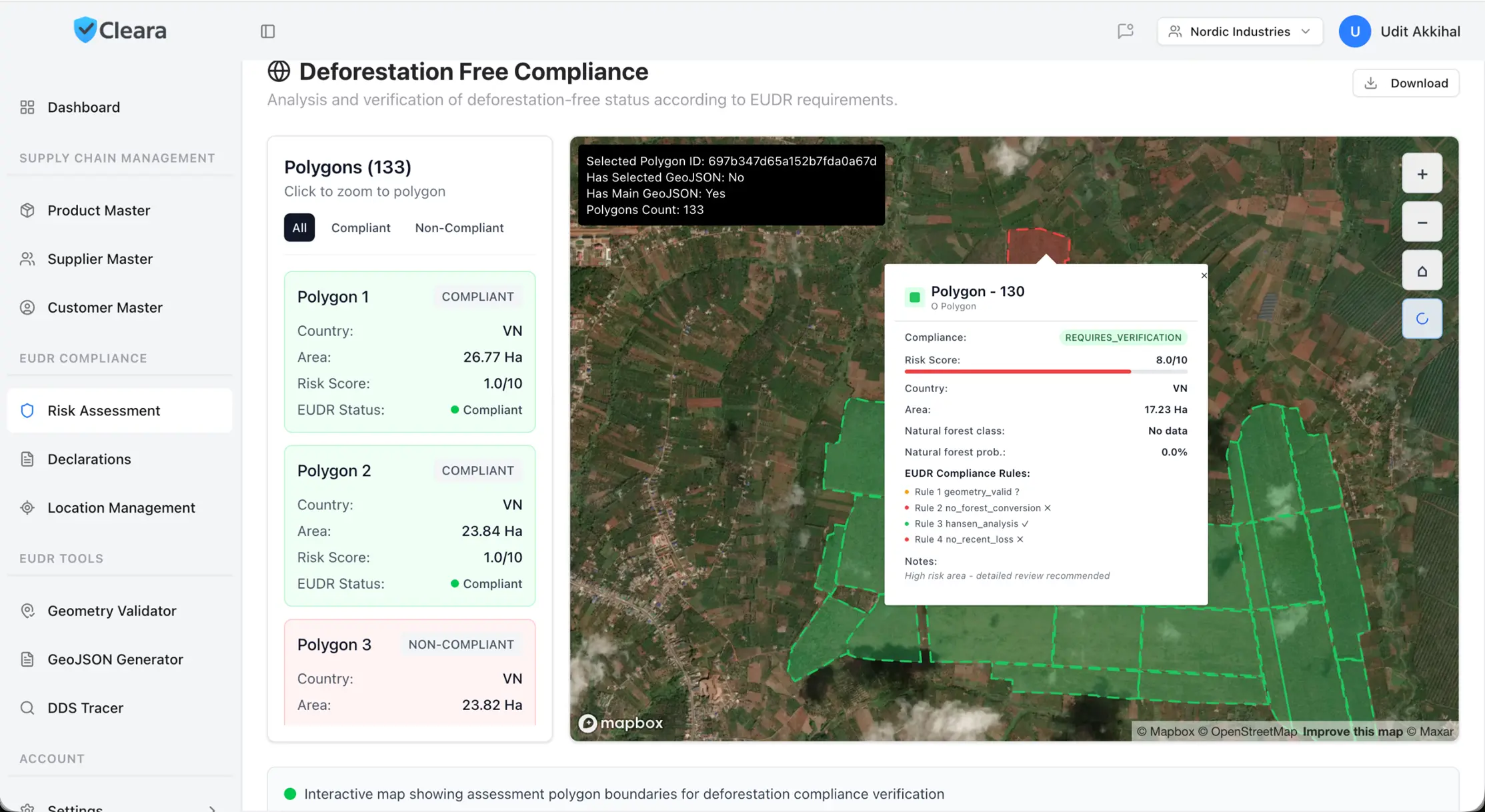
Collecting KYC documentation, land tenure records, and certifications from hundreds of suppliers via email is a compliance liability waiting to happen. Data gets lost, versions multiply, and audit trails disappear.
The most resilient EUDR programs use supplier portals, structured, role-based platforms where suppliers upload documentation once, and operators pull it as needed. TraceX’s agentic AI layer takes this further: it auto-parses uploaded supplier documents, extracts required fields, and populates DDS drafts automatically.

The DDS must be filed in TRACES NT for every shipment. Companies that are not already integrated with TRACES face a manual bottleneck at exactly the moment compliance pressure is highest. The best-in-class approach integrates DDS generation and TRACES submission directly into existing ERP and procurement workflows.
TraceX is TRACES-ready via API, enabling automated DDS submission that triggers at the point of shipment confirmation, no manual re-entry required.
Understand How EU TRACES Works for EUDR Compliance. Learn how to register, submit, and manage due diligence statements.
EUDR requires all due diligence records to be retained for a minimum of five years. Competent authorities can request access at any time. Companies that store compliance documentation in spreadsheets, email chains, or disconnected systems will struggle to produce a coherent audit trail under pressure.
A centralized, immutable compliance record with blockchain-backed data integrity is the gold standard. TraceX uses blockchain to ensure that once a record is written, it cannot be altered retroactively, providing regulators with a single, verifiable source of truth.
TraceX is a full-stack EUDR compliance platform designed specifically for agri-food exporters, commodity traders, and F&B brands sourcing from emerging market supply chains. Unlike point solutions that address one piece of the compliance puzzle, TraceX covers the entire workflow from farm-level data collection to DDS submission and audit reporting.
| TraceX Capability | What It Solves for EUDR |
|---|---|
| Agentic AI Document Parsing | Auto-extracts supplier KYC, land tenure, and certification data from emails and uploads, no manual data entry |
| GPS Polygon Mapping | Field agents capture farm plot polygons offline, synced in real time, covers smallholder networks at scale |
| Satellite Deforestation Alerts | Real-time verification against JRC and Hansen datasets, flags risk before DDS is filed |
| AI-Powered DDS Generation | Auto-generates complete DDS drafts from collected data, ready for operator review and TRACES submission |
| TRACES NT Integration | Direct API connection for DDS submission, integrates with your ERP or procurement system |
| Blockchain Audit Trail | Immutable 5-year compliance record provides tamper-proof documentation for regulatory inspections |
EUDR is not a compliance checkbox. It’s a fundamental restructuring of how agricultural supply chains prove their environmental credibility to access the EU market. The regulation is built to be enforced with penalties scaled to create real financial consequences for non-compliance.
The supply chain teams that will navigate this well are the ones who start with a clear understanding of their role, operator, trader, or retailer, and build data infrastructure that makes due diligence a systematic process rather than a last-minute scramble.
Yes. EUDR applies to any entity placing in-scope products on the EU market or exporting from it, regardless of its headquarters. Non-EU exporters who sell into the EU are operators under the regulation and must meet full due diligence requirements. EU buyers increasingly include EUDR compliance clauses in supply contracts with non-EU suppliers.
An operator is the first entity to place a covered commodity on the EU market or export from it, they bear the full due diligence burden, including DDS filing. A trader is any subsequent business in the supply chain that supplies or makes available the product; traders may use a simplified procedure that references an already-filed DDS, provided one exists and is valid.
If you are a trader and your upstream supplier has not filed a DDS, you cannot complete the simplified procedure. You default to full operator-level obligations: collect all required data yourself, perform a risk assessment, and file a DDS before placing the product on the EU market. This is why supply chain data transparency is critical; gaps upstream create compliance liability downstream.
No. Certifications such as Rainforest Alliance, Fairtrade, or RSPO are not a substitute for EUDR due diligence. The regulation requires plot-level geolocation data, a documented risk assessment, and a DDS filed per shipment. Certification evidence may be used as supporting documentation within a due diligence system, but it cannot replace it.
SMEs (under 250 employees and under 50M euros turnover) have until June 30, 2026. Large operators and non-SME traders must comply by December 30, 2025. However, SME retailers must begin collecting DDS reference numbers from their suppliers well before their own deadline, because if their suppliers haven’t filed DDS records, the SME faces their own compliance gap.