
Quick summary: The EU's 2026 EUDR simplification slashes compliance costs by approximately 75%. Here's what changed, who it affects, and how to get EUDR-ready before December 2026.

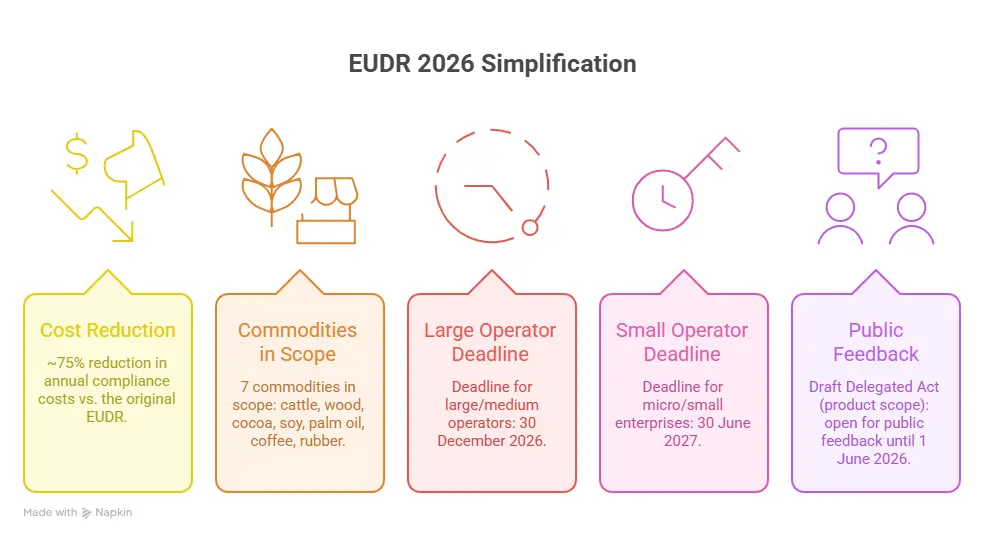
In May 2026, the European Commission published a simplification package for the EU Deforestation Regulation (EUDR), cutting annual compliance costs for affected companies by approximately 75% compared to the original regulation. The core deadlines remain: 30 December 2026 for large and medium operators, and 30 June 2027 for micro and small enterprises, but the path to compliance has just become meaningfully clearer.
Picture this: your EU buyer asks for proof that your coffee, cocoa, or palm oil didn’t drive a single tree out of a forest. Please provide your answer within six months with GPS coordinates, satellite-verified land records, and a legally compliant Due Diligence Statement submitted to the EU’s TRACES system. That’s the world the EU Deforestation Regulation (EUDR) was always designed to create.
The original regulation triggered serious alarm across agri-food supply chains, particularly among exporters from India, Southeast Asia, and Africa managing thousands of smallholder farmers. The compliance burden was real, the guidance was patchy, and the costs were eye-watering. So when the European Commission published its long-awaited simplification review in May 2026, the industry paid close attention.
Here’s what actually changed, what it means operationally, and what your business needs to do before the clock runs out.
The EU Deforestation Regulation entered into force in June 2023, covering seven high-risk commodities: cattle, wood, cocoa, soy, palm oil, coffee, and rubber, along with a wide range of derived products. Under the regulation, any operator or trader placing these goods on the EU market must prove they don’t originate from recently deforested land or contribute to forest degradation.
The regulation was ambitious and operationally punishing. Collecting GPS polygon data from hundreds of smallholder farmers across remote regions of India, Indonesia, or West Africa, while manually building Due Diligence Statements (DDS) and navigating a nascent IT system, proved far harder than regulators anticipated. Industry groups flagged disproportionate burdens, particularly for small and medium operators.
In December 2025, the European Parliament and Council adopted a revised text to provide legal stability. The May 2026 simplification package builds on that revision, delivering the concrete operational relief the sector had been waiting for.
The May 2026 package is a multi-part bundle. Here’s what it actually contains and what each piece means for your compliance workflow.
The Commission’s headline document describes the full body of simplification measures adopted since June 2023, alongside those introduced in this new package. Its most significant claim: combined, these measures are expected to reduce annual compliance costs by approximately 75% compared to the original regulation.
The report also introduces two practical trade facilitation tools: repositories of legislation from producing countries, and certification scheme repositories for EUDR commodities. These will help companies conduct faster, more defensible risk assessments, a direct response to the industry feedback that the original regulation left too much risk-assessment work to individual operators.
The updated guidance addresses the topics most frequently raised by stakeholders, with particular focus on the downstream supply chain and the simplified regime for micro and small primary operators. It provides clarity on e-commerce scenarios, geolocation modalities, and supply chain infographics illustrating various scenario types.
Crucially, this guidance has been ‘extensively discussed with Member States’ to ensure harmonised enforcement across the EU, which matters enormously for exporters who’ve been concerned about inconsistent inspections from one customs point to another.
This is arguably the most commercially significant piece for many operators. The draft delegated act proposes changes to which products fall inside and outside the EUDR’s scope.
If your product is affected by any of these additions or exclusions, a compliance scope review is urgent. The feedback window on the delegated act closes 1 June 2026.
Understanding what’s in scope, from raw commodities to derived and mixed products, is critical to avoiding compliance gaps and unexpected risks. Read the blog to get a clear breakdown of EUDR scope, covered commodities, HS codes, and real-world examples that help you assess your exposure with confidence.
The Commission is updating the EUDR Information System to reflect the revised regulation and improve usability. Key developments include:
The voluntary grouping feature is particularly significant for traders dealing with multiple operators and large commodity pools, as it should substantially reduce the administrative overhead of managing complex supply chains with many smallholder contributors.
Read the blog to learn how the EU Information System works, what data you need, and how to streamline your DDS submissions with confidence.
The regulation draws a sharp line between operator categories. Understanding which category applies to your business determines your compliance runway and your risk if you miss it.
| Category | Who It Covers | Compliance Deadline | Key Obligation |
|---|---|---|---|
| Large and Medium Operators | Exporters, processors, traders with more than 50 employees or more than 10M euros turnover | 30 December 2026 | Full DDS + geolocation + risk assessment |
| Micro and Small Enterprises (Timber sector) | SMEs in timber-related products | 30 December 2026 | Simplified DDS + geolocation |
| Other Micro and Small Enterprises | Distributors, retailers, importers reselling in the EU | 30 June 2027 | Simplified declaration form (new) |
| EU Traders (downstream) | Distributors, retailers, and importers reselling in the EU | Mirrors operator deadline | Due diligence or simplified reference to operator DDS |
With 30 December 2026 less than seven months away at the time of writing, any large or medium operator still relying on manual data collection from farmers is behind schedule. GPS polygon mapping, satellite verification, and DDS generation are not processes that can be stood up in weeks; they require supplier onboarding, data infrastructure, and testing.
The Commission’s claim that the simplification measures reduce annual compliance costs by roughly 75% compared to the original regulation deserves careful unpacking, because the original wasn’t cheap.
The bulk of the savings comes from three sources. First, simplified obligations for micro and small primary operators, who previously faced the same documentation requirements as large multinationals. Second, the introduction of certification scheme repositories and country legislation databases which eliminate hours of manual risk research per shipment. Third, the voluntary grouping feature, which allows traders to submit consolidated declarations for batches of commodities rather than individual shipments.
For a mid-size agri-food exporter shipping, say, 200 coffee lots per season through multiple smallholder cooperatives in India or Ethiopia, the administrative overhead under the original regulation could easily run to tens of thousands of euros annually in staff time alone, before factoring in external legal and compliance consulting. The simplification package attacks that cost directly.
Read the blog to learn how to file your DDS efficiently and stay fully compliant. Simplify your compliance process, start filing with confidence today.
Even before entering a formal application, the regulation is already producing structural change. The Commission’s own report acknowledges this: EUDR has prompted increased investment in supply chain traceability and greater transparency across commodity sourcing, a structural shift that’s expected to create long-term competitive advantages for producers of verified, deforestation-free goods.
This aligns with EUDR Solutions from TraceX across its customer base of agri-food companies, including major exporters and food brands sourcing from India, Southeast Asia, and Africa. Companies that have already digitised their farm-level data, GPS-mapped plots, geotagged transactions, and satellite-verified land use history are entering EU trade negotiations from a position of strength. Those that haven’t are being asked to prove compliance they can’t yet demonstrate.
The EUDR isn’t just a compliance box to tick. It’s becoming a market access credential, and buyers in Germany, the Netherlands, France, and across the EU are already factoring deforestation-free sourcing into procurement decisions.
Explore our Food and Agri solutions to see how you can streamline operations, ensure compliance, and drive sustainable growth.
The simplification package clarifies the path; it doesn’t eliminate the need to walk it. Here’s a practical response framework for operators and traders:
EUDR Solutions from TraceX are specifically engineered for this challenge: blockchain-backed data integrity, offline-first mobile apps for remote farmer onboarding, automatic geolocation validation against JRC and Hansen satellite datasets, and one-click DDS export in PDF, XML, or CSV, ready for TRACES submission. It’s not about adding another compliance tool; it’s about replacing a fragmented, manual process with a single source of truth.
Read the blog to learn how agentic AI solutions can streamline EUDR compliance and help you scale with confidence.
| Manual Compliance Approach | Automated Platform (e.g. TraceX) |
|---|---|
| GPS data collected manually via field visits | Automated Platform (e.g., TraceX) |
| DDS built from spreadsheets, error-prone | AI-generated DDS with auto-submission to TRACES |
| Risk assessment researched per shipment | Real-time satellite risk alerts (Sentinel-2, GLAD) |
| Supplier KYC via email and PDF attachments | Agentic AI auto-parses KYC from supplier docs |
| Audit trail in scattered files and folders | Immutable blockchain-backed single source of truth |
| Weeks to compile per reporting cycle | One-click export (PDF, XML, CSV) |
The May 2026 simplification package is a meaningful step. Compliance costs down 75%, clearer product scope, a workable IT system, and consistent enforcement guidance, these are real wins for operators who felt crushed by the original regulation’s weight.
But it doesn’t change the fundamental reality: to place cattle, coffee, cocoa, soy, palm oil, rubber, or timber products on the EU market from 30 December 2026, you must prove deforestation-free sourcing. Do not claim it. Prove it with data, coordinates, and a compliant DDS on file.
The companies that will navigate this with the least friction are the ones that started building their traceability infrastructure before the deadline pressure became extreme. The simplification package makes the journey easier. It doesn’t remove the destination.
The EU Commission’s May 2026 EUDR Simplification Review is a package of measures including a report to Parliament, updated guidance, a draft delegated act on product scope, and IT system upgrades. Together, they reduce annual compliance costs by approximately 75% compared to the original EUDR.
The EUDR covers seven core commodities: cattle, wood, cocoa, soy, palm oil, coffee, and rubber, plus a range of derived products. The May 2026 delegated act proposes adding soluble coffee and certain palm oil derivatives to the product scope, while excluding leather, retreaded tyres, product samples, and waste.
Large and medium operators must comply with the full EUDR by 30 December 2026. Micro and small enterprises (other than those in the timber sector) have until 30 June 2027. These deadlines were confirmed in the December 2025 revised regulation text and are not affected by the May 2026 simplification package.
A Due Diligence Statement is the core compliance document under EUDR. Operators must submit a DDS for each shipment, proving that the commodity doesn’t originate from recently deforested land or contribute to forest degradation. The DDS requires GPS geolocation data, risk assessment evidence, and must be submitted via the EU TRACES system.
TraceX’s Regulatory Compliance Platform automates the full EUDR compliance workflow: AI-powered DDS generation, GPS polygon mapping validated against JRC and Hansen satellite data, agentic document parsing for supplier KYC, real-time deforestation alerts, and one-click TRACES-ready export. It’s purpose-built for emerging market supply chains.