
Quick summary: Explore how Indonesia’s rubber mat exporters can achieve EUDR compliance through digital traceability, geolocation mapping, and blockchain verification. Learn how digital platforms can simplify Due Diligence Statement (DDS) creation, ensure deforestation-free sourcing, and future-proof rubber exports to the EU market.

EUDR Compliance for Rubber Parts Exporters in Vietnam requires full traceability of natural-rubber inputs used in automotive, industrial, and engineered rubber components shipped to the EU. Exporters must provide plantation-level geolocation (GeoJSON polygons), legality documentation, and proof of deforestation-free sourcing for all materials regulated under HS 4001-4017. Vietnam’s fragmented rubber supply chain driven by thousands of smallholders makes compliance complex, demanding digital traceability, supplier onboarding systems, and risk-assessment workflows. Strengthening data integrity, chain-of-custody tracking, and DDS accuracy is essential to maintain EU market access and meet EUDR deadlines.
Vietnam is a rapidly expanding exporter of automotive and industrial rubber components, supplying items such as hoses, belts, gaskets, engine mounts, bushings, seals, O-rings, and molded technical parts to major markets across the EU, Japan, South Korea, the United States, and ASEAN. With rubber product exports surpassing USD 2.5-3 billion annually, Vietnam has become an essential manufacturing hub for global automotive, electronics, and industrial supply chains.
Vietnam’s production ecosystem is anchored in industrial zones across Binh Duong, Dong Nai, Ho Chi Minh City, Long An, Hai Phong, and Bac Ninh, supported by a strong network of processors, compounders, and Tier-2 and Tier-3 suppliers. However, the majority of Vietnam’s natural rubber inputs originate from smallholder plantations representing over 70% of national output spread across the Central Highlands and Southeast regions. This creates significant traceability gaps in farm-level geolocation, legality verification, and chain-of-custody documentation, all of which are now mandatory under the EU Deforestation Regulation (EUDR).
Under EUDR, Vietnam’s exports of rubber parts and raw materials classified under HS 4001, 4002, 4005, 4006, 4008, 4010, 4011, 4016, and 4017 must be proven deforestation-free, legally sourced, and traceable to plantation polygons, including all upstream rubber used in compound formulations and finished components entering the EU.
With enforcement deadlines of 30 December 2025 for large and medium operators and 30 June 2026 for SMEs, Vietnam’s rubber parts manufacturers must rapidly strengthen compliance workflows. This requires adopting geospatial farm mapping (GeoJSON), blockchain-based origin verification, supplier onboarding systems, and AI-powered deforestation-risk monitoring to establish end-to-end visibility across multi-tier supply networks.
By digitizing traceability and ensuring EUDR compliance, Vietnam’s rubber component exporters can safeguard EU market access, enhance buyer confidence, and solidify their position as competitive, sustainability-aligned suppliers in the global automotive and engineered products ecosystem.
Vietnam’s rubber parts industry relies heavily on natural rubber sourced from smallholder-dominated plantations and complex multi-tier supply networks. Under the EUDR, exporters must prove that every gram of natural rubber used in hoses, belts, gaskets, vibration-control parts, seals, and engineered components is deforestation-free, legally sourced, and fully traceable to plantation polygons. This creates several significant challenges.
Over 70% of Vietnam’s natural rubber comes from hundreds of thousands of smallholders across the Central Highlands and Southeast. There is no standardized digital data, no GPS polygon mapping, smallholders are unaware of EUDR requirements, and multiple intermediary collectors break traceability. This makes linking raw rubber to final components extremely difficult.
EUDR requires polygon boundary coordinates, not pin-point GPS. Smallholders rarely have mapped plots, there is no centralized geospatial database, mapping formats across suppliers are inconsistent, and the cost of field mapping at scale is high. This poses a critical compliance bottleneck for manufacturers.
Vietnam’s rubber areas often involve informal land tenure, unclear documentation for old plantations, and mixed land-use histories. Exporters must now verify legality for every plantation, a task many suppliers are unprepared for.
Rubber typically moves through smallholder to collector to aggregator to processor to compounder to manufacturer. Each handoff increases the risk of data loss, lot mixing, inaccurate volume reconciliation, and unverifiable origins. This makes EU audit readiness complex.
Many suppliers still operate with paper invoices, WhatsApp records, manual logs, and unverified origin claims. Exporters must now maintain 5 years of digital records, which most upstream suppliers cannot currently provide.
Regions like Gia Lai, Dak Lak, and Binh Phuoc have a documented history of rubber-driven land-use change. Under EUDR, exporters must conduct risk assessments, monitor land-use changes post-2020, and provide evidence that no deforestation occurred. This requires satellite monitoring and AI-powered risk scoring that is not easily accessible to small suppliers.
Vietnamese exporters must submit a DDS for every regulated shipment, requiring polygon data, legality documents, supplier declarations, risk evaluation, and mitigation documentation. Compiling this for multi-tier supply networks is labor-intensive and error-prone.
EU automotive, machinery, and industrial buyers increasingly require real-time dashboards, plantation-level data, zero-deforestation proof, and audit-ready traceability. Vietnamese suppliers lacking digital systems risk losing contracts.
Large and medium manufacturers must comply by 30 December 2025 and SMEs must comply by 30 June 2026. Given the scale of supply chain complexity, the timeline is extremely challenging.
Vietnamese rubber parts exporters face a multi-dimensional challenge under EUDR: fragmented smallholder supply chains, missing polygon data, weak legality documents, multi-tier intermediaries, manual documentation practices, and growing EU buyer expectations. Without robust digital traceability, geospatial mapping, blockchain-secured chain-of-custody, and automated DDS workflows, compliance and EU market access will be at serious risk.
The EU Deforestation Regulation (EUDR) requires Vietnamese exporters of rubber parts such as hoses, belts, seals, gaskets, bushings, anti-vibration components, and engineered rubber assemblies to prove that all natural rubber used in manufacturing is deforestation-free, legally sourced, and traceable to the plantation of origin. Given Vietnam’s heavy dependence on smallholder rubber production, multi-tiered aggregators, and complex compound-processing networks, achieving end-to-end traceability manually is extremely difficult. The TraceX EUDR Compliance Platform provides a unified, digital-first solution that automates compliance workflows while enhancing Vietnam’s competitiveness in EU automotive and industrial markets.
TraceX links smallholder plantations, collectors, processors, compounders, and rubber parts manufacturers into one integrated digital ecosystem. Each batch of latex, block rubber, compound, or finished component is assigned a unique digital ID mapped to verified farm polygons, legality documentation, and processing histories, ensuring an unbroken chain of custody from plantation to export container.
Sourcing teams can digitally record polygon geolocations, land-use documents, supplier declarations, and compound batch data using mobile-based tools. TraceX platform then automatically compiles these inputs into a fully EUDR-compliant Due Diligence Statement (DDS) for each shipment, eliminating paper-based bottlenecks and enabling fast, accurate submission through the EU’s central DDS system.
Every transaction from latex tapping in Tay Nguyen to compound mixing in Binh Duong to final assembly in Bac Ninh is recorded on TraceX’s immutable blockchain ledger. This provides EU buyers and regulators with verifiable proof that all natural-rubber inputs are legal, traceable, and deforestation-free, greatly simplifying audits and border inspections.
Vietnam’s rubber sector depends on tens of thousands of smallholders across Tay Ninh, Gia Lai, Binh Phuoc, and Dak Lak. TraceX solution streamlines their onboarding with mobile-first digital KYC and polygon mapping tools, ensuring that even micro-suppliers become EUDR-visible and verifiable. Each farmer profile includes ownership details, production info, and compliance records.
Using satellite imagery and machine-learning analytics, TraceX platform monitors plantations for post-2020 land-use change, encroachment, and deforestation alerts. Automated risk scores allow exporters to identify and resolve issues before a shipment is flagged or rejected by EU authorities.
TraceX acts as a secure, collaborative data layer where manufacturers, processors, suppliers, auditors, logistics partners, and EU buyers can access verified documentation. This accelerates audit cycles, reduces compliance risk, and ensures uninterrupted movement of rubber parts across EU supply chains.
With blockchain-secured traceability, AI-driven risk analytics, supplier onboarding workflows, and automated DDS generation, TraceX empowers Vietnam’s rubber parts exporters to transform compliance from a challenge into a market differentiator. Exporters can build stronger buyer confidence, protect EU market access, and elevate Vietnam’s reputation as a trusted source of sustainable, EUDR-ready rubber components.
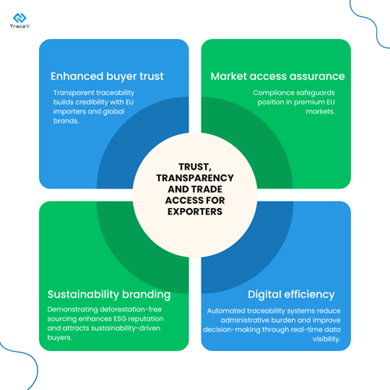
EUDR compliance is not just a regulatory obligation for Vietnam’s rubber parts exporters it is now a direct determinant of market access, buyer confidence, and long-term competitiveness in the EU. Because the EU is one of Vietnam’s largest destinations for automotive, engineering, and industrial rubber components, any non-compliance risks immediate shipment delays, customs rejection, financial penalties, or outright loss of European customers.
Vietnam’s rubber parts sector relies heavily on natural rubber sourced from smallholders across Tay Nguyen, Binh Phuoc, Dong Nai, and Gia Lai, regions where documented geolocation, legality records, and deforestation monitoring are still inconsistent. Under EUDR, every rubber-derived product (HS 4001-4017) must be traceable back to plantation polygons, proven deforestation-free post-2020, and supported by a fully verified Due Diligence Statement (DDS). Without this transparency, Vietnamese exporters face severe risk of losing access to premium EU markets.
EUDR compliance also matters for Vietnam’s position in global value chains. European automotive manufacturers, machinery producers, and industrial OEMs are increasingly prioritizing suppliers who can demonstrate transparent, low-risk, sustainable sourcing. Compliant Vietnamese exporters can secure long-term contracts, command better margins, and strengthen their ESG reputation, while non-compliant firms risk being phased out.
Ultimately, EUDR compliance enables Vietnam’s rubber parts industry to transition from cost-driven manufacturing to sustainability-driven market leadership, ensuring business continuity and reinforcing Vietnam’s role as a preferred global supplier of rubber components.
EUDR Compliance for Rubber Parts Exporters in Vietnam is no longer optional it is a strategic necessity for sustaining and expanding access to the EU market. As regulations tighten and buyers demand transparent, deforestation-free sourcing, Vietnamese exporters must adopt digital traceability, robust geolocation mapping, and automated DDS workflows to stay competitive. By modernizing compliance systems today, Vietnam’s rubber parts industry can ensure uninterrupted trade, build stronger trust with EU automotive and industrial buyers, and position itself as a future-ready, sustainable manufacturing hub in the global supply chain.
Understand the key components of EUDR compliance and how to streamline your DDS process efficiently. Read the blog on EUDR Due Diligence
Learn how AI-driven automation and intelligent workflows simplify data collection, verification, and reporting. Explore the blog on Agentic AI for EUDR
Discover how digital onboarding bridges the gap between smallholders and EUDR compliance. Read our blog: Smallholder Onboarding for EUDR Compliance
EUDR compliance requires Vietnamese rubber mat exporters to ensure that all mats are deforestation-free, legally sourced, and fully traceable to the plantation of origin before entering the EU market.
The EU is a key market for Vietnam’s rubber mats. Compliance guarantees continued access, strengthens buyer confidence, and positions exporters as leaders in sustainable and ethical trade.
Exporters must implement farm-level mapping, capture geolocation coordinates (GeoJSON), verify legality of plantations, and submit a Due Diligence Statement (DDS) via the EU portal for each shipment.
Challenges include fragmented smallholder networks, limited digital infrastructure, reliance on manual documentation, and the absence of standardized traceability frameworks across the supply chain.
Compliance enhances supply chain transparency, builds international buyer trust, strengthens ESG credentials, and opens access to premium European and global markets demanding sustainable, traceable rubber mats.