
Quick summary: UK Timber Regulation (UKTR): A complete guide for importers and exporters on due diligence requirements, risk assessment, supply chain traceability, and compliance with UK timber legality rules.
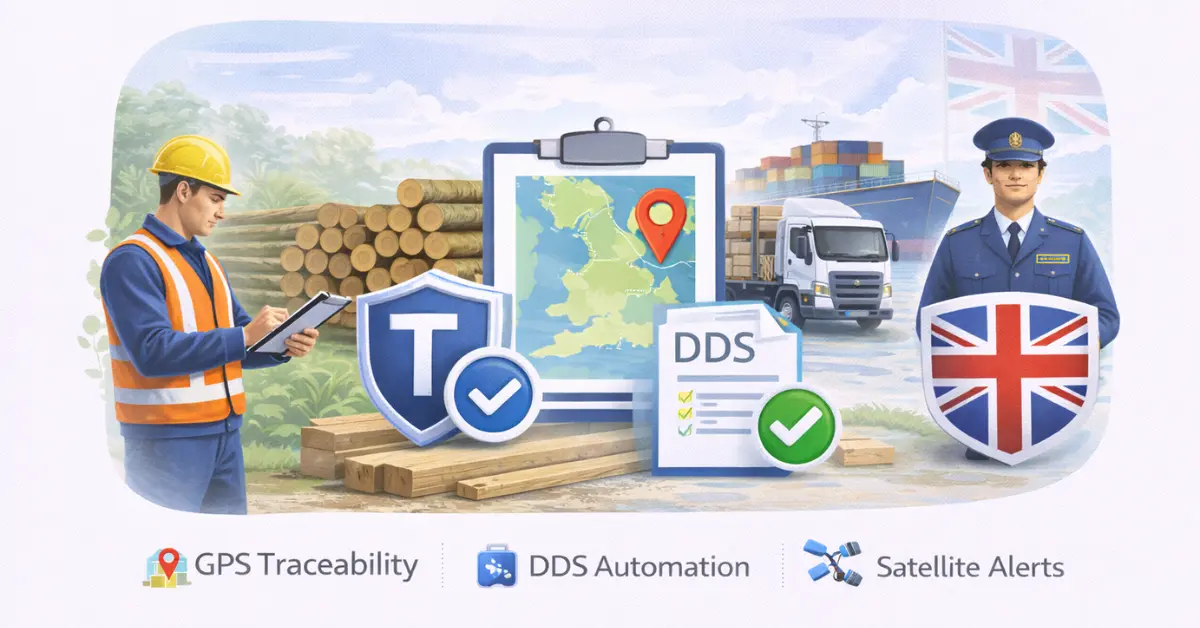
Your goods are sitting at the border. OPSS officers are reviewing your paperwork. You’re confident your supplier is reputable, but you’ve never formally documented why. You don’t have a written risk assessment. You don’t have sub-national harvest location data. You assumed a well-known brand name was proof enough. Under the UK Timber Regulation, however, operators must demonstrate due diligence with documented risk assessments and traceability data, not assumptions about supplier reputation.
It isn’t. And that’s exactly the situation that put Sunseeker International in Bournemouth Crown Court in November 2024, pleading guilty to 11 imports of teak from Myanmar. It’s what caused IKEA Supply AG to have 26,767 items seized, the first-ever Seizure Notice issued under the UK Timber Regulation. Both were established, well-resourced businesses. Neither intended to break the law.
This guide gives you a clear, jargon-free breakdown of exactly what the UKTR requires, who it applies to, and how to protect your business from enforcement. By the end, you’ll know whether you’re an operator or a trader, what a compliant Due Diligence System looks like, how FLEGT licences work, and what the new EU Deforestation Regulation means for your export customers.
The UK Timber Regulation (UKTR), in force since 1 January 2021, bans illegally harvested timber from the GB market. Operators must build a documented Due Diligence System; traders must keep traceability records for five years. Non-compliance means seizure, unlimited fines, and potential Crown Court prosecution, as two major businesses discovered in 2024 (OPSS, 2025).
Not sure if your current process would pass an OPSS inspection? Businesses that document their DDS before an inspection are significantly less likely to receive a Notice of Remedial Action.
The Timber and Timber Products (Placing on the Market) Regulations 2013, known as the UKTR, came into force on 1 January 2021, replacing the EU Timber Regulation (EUTR) in Great Britain (GOV.UK, 2025). If your business was EUTR-compliant before Brexit, you’re close but not automatically covered. The enforcement regime is now independently British, and OPSS has an active programme of inspections, checks, and prosecutions.
The regulation traces back to the 2003 EU FLEGT Action Plan a multilateral effort to keep illegally harvested timber out of consumer markets. Illegal logging drives deforestation, undercuts compliant businesses, and causes irreversible biodiversity harm. The UKTR is the UK’s primary legal lever to address that at the supply chain level.
The Office for Product Safety and Standards (OPSS), part of the Department for Business and Trade, enforces the UKTR on behalf of the Secretary of State. OPSS conducts routine checks, verifies FLEGT licences, and, as 2024 demonstrated, initiates criminal proceedings when required.
Northern Ireland: Because of the Windsor Framework, the EU Timber Regulation, not UKTR, continues to apply in Northern Ireland. Businesses moving timber between NI and GB need to track which regime applies to each leg of the journey.
Want to understand where timber risks enter global trade? Explore our guide to timber supply chains and learn how wood moves from forest to finished product.
Illegal logging remains one of the biggest threats to forest ecosystems. Read our blog on illegal logging and discover how companies can prevent illegal timber from entering their supply chains.
Your obligations under the UKTR are entirely determined by where you sit in the supply chain and the operator vs trader distinction is the single most misunderstood concept in the regulation (OPSS, 2025). Getting it wrong doesn’t just mean paperwork gaps. It means you may be operating without a mandatory Due Diligence System and not know it.
You are an operator if you are the first to place timber or timber products on the GB market. That means: importing timber from overseas into Great Britain or harvesting domestic timber and bringing it to market. There is no volume threshold. A single import makes you an operator, and operators must implement a full Due Diligence System for every product they place on the market.
You are a trader if you buy and sell timber already placed on the GB market by an operator. Wholesalers, distributors, and retailers sourcing domestically are usually traders. Your obligation is narrower: maintain records identifying your supplier and your customers for every product. Those records must be kept for at least five years and produced immediately on request from OPSS (GOV.UK, 2025).
Critical post-Brexit trap: Many UK businesses that previously imported from EU suppliers were traders under EUTR (because the EU importer was the operator). Post-Brexit, UK businesses importing from EU member states are now operators under UKTR, meaning they need a full DDS for the first time. This catches businesses off guard more than any other single change.
A common assumption is that UKTR only affects sawmills and raw timber importers. It doesn’t. The regulation covers a wide range of wood-derived products, and a furniture retailer or paper importer faces the same legal obligations as a timber merchant (GOV.UK, 2025).
Products in scope include:
Two important exclusions: recycled timber components within composites are not subject to assessment, and timber used purely as packaging (pallets protecting other goods) is also out of scope, provided the timber product is not itself the primary item being traded.
The practical implication: if you import flat-pack furniture with wood components, you’re an operator under UKTR, subject to the same DDS requirements as a sawmill bringing in raw logs. The product category doesn’t reduce the obligation; only recycled or excluded material does.
A Due Diligence System (DDS) is not a folder of supplier certificates. It is a mandatory three-stage framework that must be documented, repeatable, and applied to every product you place on the GB market (GOV.UK, 2025). OPSS inspectors know what they’re looking for, and an incomplete or undocumented DDS will trigger a Notice of Remedial Action at a minimum.
Collect and record: timber species, quantity, country of harvest, sub-national region (and concession where available), supplier details, and documentary evidence of legal harvest in the country of origin. For supply chains spanning multiple countries of transit or processing, every leg must be documented. This is the stage where most operators struggle with getting accurate sub-national location data from suppliers in high-risk countries, which requires proactive supplier engagement, not reactive chasing.
Use the information gathered to assess the likelihood of illegal harvest. OPSS provides a free due diligence tool on GOV.UK that mirrors their own internal assessment framework. The key variables: country risk (informed by the Corruption Perception Index and NGO reports), species risk, and supply chain complexity. If the overall risk is negligible, you may proceed to market. If not, Stage 3 is mandatory.
Where risk is non-negligible, you must take additional steps before placing the timber on the market. Options include: requesting further documentation from suppliers, commissioning third-party wood identification testing, or obtaining verification through a certified Monitoring Organisation (MO).
You can build your own DDS or subscribe to one run by an approved UK MO. There are five: Soil Association, Preferred by Nature, Control Union (UK) Ltd, BM Certification, and Envirosense. All are audited by OPSS every two years (OPSS UKTR Report, 2025).
Stage 1 is consistently the bottleneck. Getting accurate sub-national harvest location data from suppliers in high-risk countries is harder than it sounds. Building supplier contracts with explicit information-provision clauses early is far more effective than trying to retrofit them once an OPSS inquiry has started.
Manual DDS processes spreadsheets, emailed supplier declarations, and PDF certificates break down quickly at scale. Missed fields, outdated coordinates, and undocumented risk assessments are the most common reasons operators fail OPSS checks.
TraceX is a digital supply chain traceability platform built specifically for timber and agri-commodity compliance. For UKTR operators, it addresses each stage of the DDS directly:
The result is a DDS that’s audit-ready at any point not assembled under pressure when an OPSS inspector requests it. TraceX offers a free demo for operators who want to test the platform before committing.
In 2024-25, OPSS verified 4,824 FLEGT licences with just 7 ultimately rejected (OPSS FLEGT Report, 2025). That near-perfect acceptance rate reflects a robust system. It also means that if you’re importing timber from Indonesia, a valid FLEGT licence is the fastest, cleanest route to compliance removing your DDS obligation entirely.
A FLEGT licence is issued under a Voluntary Partnership Agreement (VPA) between the UK and a timber-producing country. Currently, Indonesia is the only country with an active VPA. Timber accompanied by a valid FLEGT licence is legally considered compliant; it represents a ‘green lane’ at the GB border that bypasses the need for due diligence.
The process: your Indonesian supplier obtains the licence at the origin. You submit it to OPSS for verification via email when the shipment is in transit. OPSS matches it against HMRC customs data at the National Clearance Hub before release. In 2024-25, 96% of licences were processed within OPSS service standards (OPSS Delivery Report, 2025), making this a genuinely streamlined route for compliant operators.
CITES permits work differently. Certain protected species, such as Brazilian mahogany and some rosewoods, require CITES documentation. Like FLEGT licences, valid CITES permits satisfy UKTR compliance for those species. But the two systems serve different purposes: CITES protects specific endangered species; FLEGT addresses the broader legality of harvesting practices across an entire country’s forestry sector.
Post-Brexit, the UK is a ‘third country’ in EU trade law, and your EU buyers are now subject to the EU Deforestation Regulation (EUDR), which means they’ll come to you for documentation you may not yet be collecting. Understanding what they need and what you’re already well-positioned to provide is a competitive advantage worth capturing.
The EUDR entered into force in June 2023 and applies from 30 December 2026 for large and medium operators, and 30 June 2027 for small enterprises (EU Council, 2025). It goes further than UKTR: products must not only be legally harvested, they must be demonstrably deforestation-free since 31 December 2020, with GPS coordinate data for the production plots.
The good news: in May 2025, the European Commission formally designated the UK as a low-risk country under the EUDR benchmarking system. UK-origin timber will face just 1% annual compliance checks at EU borders compared to up to 9% for high-risk countries. UK exporters also benefit from simplified annual due diligence statements rather than per-shipment filings.
The data you gather for UKTR Stage 1 (species, harvest country, sub-national region, supplier documentation) is almost identical to what EU buyers need for EUDR. Businesses that build a strong DDS for UKTR compliance will already hold most of the data needed to satisfy their EU customers, turning a compliance cost into a sales advantage.
Your EU customers operating under EUDR will need: polygon-level GPS coordinates for every production plot, satellite-verified deforestation-free status against the 31 December 2020 cut-off, and a Due Diligence Statement (DDS) submitted through the EU’s TRACES portal before shipment. For UK exporters supplying multiple EU buyers across multiple product lines, managing this manually is unrealistic.
TraceX’s EUDR compliance platform is purpose-built for this challenge. It captures farm and plot-level geolocation data (points or polygons), runs automated deforestation risk checks against satellite datasets including Hansen and Sentinel-2, and auto-generates fully formatted DDS documentation ready for direct upload to the EU TRACES system. For UK exporters, this means being able to respond to buyer due diligence requests in minutes rather than days a genuine competitive advantage as EUDR enforcement tightens in 2026 and 2027.
UK exporters can explore TraceX’s EUDR compliance suite.
| Obligation | UKTR (GB) | EUDR (EU) |
|---|---|---|
| Covers illegal logging only | Yes | Yes |
| Covers deforestation (legal or illegal) | No | Yes |
| Geolocation data required | No | Yes |
| Records kept for 5 years | Yes | Yes |
| UK classified as low risk | N/A | Yes (1% checks) |
| Enforced by | OPSS (UK) | EU Member States |
Source: GOV.UK UKTR Guidance; EU Commission EUDR, 2025
Most businesses assume enforcement starts with a warning letter and ends there. In most cases, it does, but the 2024 enforcement record shows OPSS is prepared to go all the way. The enforcement ladder is real, it escalates, and the consequences at the top are serious.
1. Informal guidance letters – for minor or first-time failures. No formal consequence, but creates a record.
2. Notices of Remedial Action (NRAs) – issued for incomplete DDS, missing risk assessments, or inadequate records. Operators have 28 days to comply.
3. Criminal prosecution – for deliberate violations, repeated failures, or non-compliance with NRAs. Penalties include unlimited fines. Imprisonment is available for the most serious cases.
4. Seizure – physical seizure and disposal of non-compliant timber products. This is the tool that was deployed against IKEA in 2024.
In November 2024, Sunseeker International Limited, a luxury yacht manufacturer, pleaded guilty at Bournemouth Crown Court to 11 separate imports of teak from Myanmar, a designated high-risk country. The business had continued importing without conducting adequate due diligence.
Separately, IKEA Supply AG self-reported non-compliance within its own supply chain. The result: 26,767 items of furniture seized under a formal Seizure Notice, the first ever issued under the UKTR. The seized goods were donated to Nadiya, a Ukraine-based charity. Self-reporting didn’t prevent seizure. But it did avoid criminal prosecution, which tells you something important about how OPSS weighs transparency.
For traders, penalties for record-keeping failures or obstruction of inspectors are applied on summary conviction. Recent convictions have typically resulted in fines of around £5,000 per offence, though the statutory cap was removed in 2015 and courts retain unlimited fining power (Forest Policy Group, 2025).
Could your current records withstand an OPSS inspection today? Operators who maintain a documented, three-stage DDS are significantly better positioned to resolve OPSS inquiries without escalation to prosecution.
The UK Timber Regulation is not a theoretical compliance risk. It’s an active enforcement regime with a dedicated inspectorate, a Crown Court track record, and the power to seize your products. Two of the world’s most recognisable brands discovered that in 2024, one in a criminal court, and one via a warehouse seizure.
The good news: compliance is entirely achievable. OPSS provides free tools. Approved Monitoring Organisations can run your DDS for you. And the documentation you build for UKTR compliance doubles as the supply chain data your EU customers will soon require under EUDR.
If you’re managing a complex, multi-supplier timber supply chain and need a digital platform that handles UKTR due diligence and EUDR traceability in one place, TraceX offers end-to-end compliance tools built specifically for timber operators and exporters. Get in touch with our experts.
Want to simplify forest regulation compliance? Explore our guide to Forest Compliance Tools and discover how digital platforms streamline due diligence and traceability.
Curious how responsible forestry certification works? Read our blog on FSC Certification and learn what it means for sustainable timber sourcing.
Struggling to track wood from forest to finished product? Discover how Timber Traceability systems improve supply chain transparency.
No. FSC is a useful risk mitigation tool but does not constitute a complete DDS. OPSS requires the full three-stage framework to be documented and operational. FSC is one input into your due diligence, not a substitute for it.
Yes. Both countries appear on OPSS’s risk-based targeting lists. Russia is classified as high risk. Country-level risk ratings for these regions should be reviewed regularly as the situation evolves.
Traders must record who supplied the timber and who they sold it to – for every product, regardless of species or origin. Records must be kept for at least five years and made available to OPSS on request.
UKTR targets illegal logging only. The EUDR goes further – products must be deforestation-free since 31 December 2020, and GPS coordinate data for production plots is mandatory. UK exporters to the EU must meet both.
Contact OPSS directly: [email protected] or call 0121 345 1201. OPSS treats self-reported non-compliance more favourably – as the IKEA case demonstrated.