
Quick summary: Build an ILPA-compliant digital due diligence system for Australia's 2025 illegal logging laws. Step-by-step guide + AI automation tools for timber importers.
60% of assessed importers were found non-compliant with due diligence obligations in audits conducted under the previous ILPA Regulation.
To build a digital due diligence system for ILPA in Australia, you need five components: a written system document, supply chain information gathering, risk assessment, risk mitigation, and record keeping. Under the Illegal Logging Prohibition Rules 2024 (in force since 3 March 2025), this system must be in writing and must be applied to every regulated timber import or raw log processing event or you face penalties up to AUD $165,000.
Understand global illegal logging laws and what they mean for your business. Download the ebook to navigate compliance requirements with confidence.
| ICP Segment | Buyer Persona / Job Title | Key Pain Trigger |
|---|---|---|
| Timber Importers (Primary) | Head of Compliance / Trade Operations | Penalty exposure up to AUD $165,000 or 5 yrs imprisonment under ILPA 2024 Amendment |
| Wood and Paper Processors (Primary) | Operations Director / Supply Chain Lead | Written due diligence system now mandatory under Rules 2024 (effective 3 March 2025) |
| Furniture and Building Products Retailers (Secondary) | Procurement Manager / ESG Lead | 25% of products tested by DAFF in 2024 were inconsistent with declared species/origin |
| Forestry Certification Bodies (Tertiary) | Program Director / Auditor | FSC/PEFC Chain of Custody certification alone is NO LONGER sufficient under Rules 2024 |
| Sustainability and Compliance Consultancies | Practice Lead / Principal Consultant | Serve regulated clients; seeking scalable digital tools to deploy across portfolios |
Since 3 March 2025, every business that imports regulated timber products into Australia or processes domestically grown raw logs is legally required to operate a written due diligence system under the Illegal Logging Prohibition Rules 2024 (DAFF, 2025). That’s not guidance. It’s a compliance obligation with criminal penalties attached. If you’re importing sawn wood, plywood, paper, furniture, or any of the dozens of regulated product categories and you don’t have a documented system in place, you’re already exposed.
The Illegal Logging Prohibition Act 2012 (ILPA) makes it a criminal offence to import or process timber products that have been illegally logged regardless of whether you knew the timber was illegally sourced. Intent doesn’t protect you. Negligence is enough to trigger liability.
The Act has been in place since 2012. But here’s what changed: the Illegal Logging Prohibition Amendment Act 2024 passed in September 2024 strengthened the enforcement architecture significantly. New powers include injunctions, enforceable undertakings, and the ability for the Department of Agriculture, Fisheries and Forestry (DAFF) to publicly name non-compliant businesses on its website. Reputational exposure is now a real consequence of non-compliance, not just fines.
The new Illegal Logging Prohibition Rules 2024, which replaced the old 2012 Regulation, came into force alongside the amended Act on 3 March 2025. These Rules specify exactly what your due diligence system must contain, how it must be applied, and what records you must keep. A six-month transition period ran until September 2025 that window has now closed.
The law applies to two distinct groups.
Timber importers – Any business that brings a regulated timber product into Australia. This covers a wide range of product categories, including sawn wood and timber boards, veneers and plywood, moulding, joinery, and flooring products, paper, pulp, and cardboard, furniture containing wood components, and engineered wood products (MDF, particleboard, LVL).
Raw log processors – Any business that processes Australian-grown raw logs into another product. Processors who are also the harvester of those raw logs qualify for an exemption under the Rules 2024 but if you’re purchasing logs from third-party suppliers, the full due diligence requirements apply.
One of the most commonly misunderstood aspects of ILPA is scope. Many furniture importers and paper product distributors assume the law only targets ‘timber companies.’ It doesn’t. If your product contains regulated wood content even as a secondary material you’re caught by the Act.
| Offence Type | Mental State / Trigger | Maximum Penalty |
|---|---|---|
| Criminal | Intentional or reckless import/processing of illegally logged timber. | 5 years imprisonment and/or $165,000 AUD |
| Civil | Negligent failure to comply with the prohibition of importing/processing. | $33,000 AUD |
| Strict Liability | Failure to comply with specific due diligence requirements (e.g., record-keeping). | $19,800 AUD |
Audits are conducted regularly. DAFF issues a Requirement to Give Information and Produce Documents notice and you must respond within the stated deadline. Across years of assessments under the previous Regulation, DAFF found that around 60% of importers assessed were non-compliant with some or all of their due diligence obligations (Parliamentary Digest, 2024). That’s not a fringe problem it’s a sector-wide exposure.
| Milestone | Date | Status |
|---|---|---|
| Original Act Commences | 2012 | Established the legal framework. |
| Due Diligence Activated | 2014 | Mandatory reporting requirements began. |
| Amendment Act 2024 Passed | September 2024 | Introduced modernized penalties and oversight. |
| ILPA Rules 2024 Finalized | December 2024 | Technical guidelines and definitions locked in. |
| New Laws Come into Force | 3 March 2025 | The 2024 amendments became legally binding. |
| Education Period Ends | September 2025 | Soft enforcement and warnings phase expired. |
| Full Enforcement | Ongoing (2026) | Strict auditing and statutory penalties in effect. |
Struggling to understand AILPA requirements? Discover how to structure your due diligence and avoid compliance gaps.
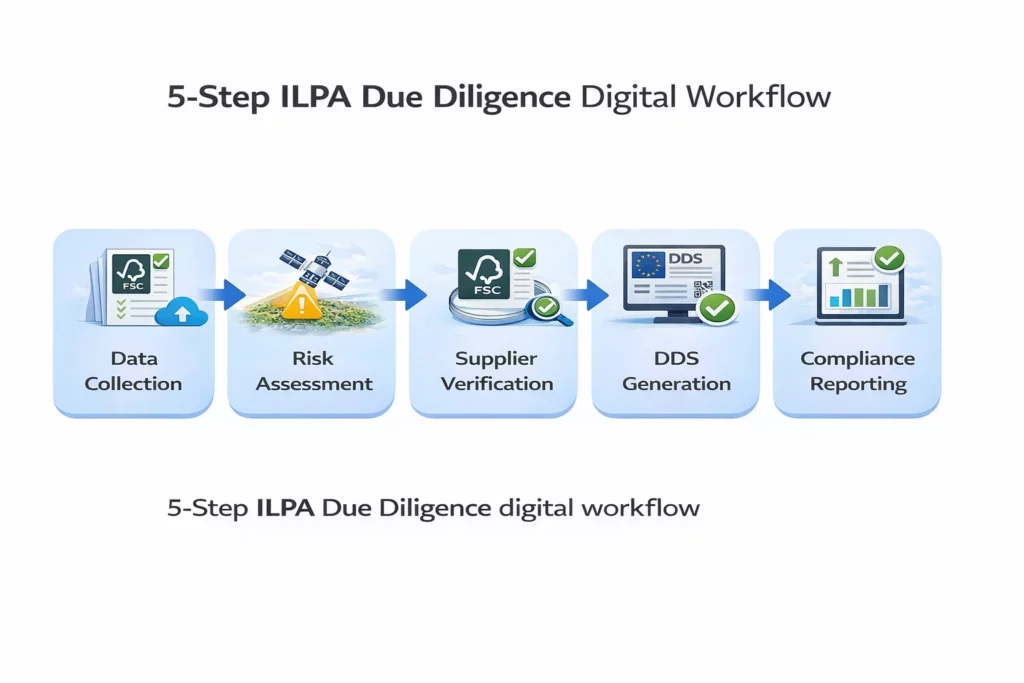
The updated Illegal Logging Prohibition Amendment Rules 2024 (ILPA) introduce a more structured and enforceable five-step due diligence framework for timber importers and processors in Australia. These requirements aim to ensure that all timber products are legally sourced and fully traceable.
Importers and processors must establish a documented due diligence system outlining how they comply with ILPA requirements. This document must include the system owner’s name and contact details (address, phone, email), business identifiers such as ABN/ACN, and a clearly defined process for meeting due diligence obligations. This forms the foundation of compliance and must be readily available for review.
Before importing or processing timber, businesses must collect detailed product and supply chain information, including product description, timber species, harvest country, region, and area, and quantity. For certified products, additional documentation is required, such as FSC or PEFC certification records and government-issued permits. This step ensures transparency and traceability at source.
Businesses must assess the likelihood that timber is illegally sourced. This includes evaluating country risk (based on DAFF risk classifications), species risk, supplier/operator risk, and certification credibility. The goal is to determine whether the risk is low, negligible, or requires mitigation.
If the assessed risk is not low or negligible, companies must take additional steps before proceeding, such as requesting further supplier documentation, conducting independent verification, or changing suppliers if risks remain high. Timber cannot be imported or processed until risk is reduced to an acceptable level.
All due diligence activities must be documented and retained, including information collected, risk assessments performed, and mitigation actions taken. These records must be maintained for audit purposes and provided to authorities (e.g., DAFF) upon request. Proper record keeping ensures audit readiness and legal compliance.
The ILPA 2024 framework shifts compliance from basic checks to a structured, evidence-based system where documentation, risk evaluation, and traceability are essential at every step.
| Due Diligence Requirement | ILPA Regulation 2012 (Old) | ILPA Rules 2024 (New – from 3 March 2025) |
|---|---|---|
| Written System Required? | Not explicitly mandated in writing | YES mandatory written documentation (Part 2 Sec 7) |
| Certified Timber Exemption | FSC/PEFC Chain of Custody manual could suffice | NO CoC manual alone is insufficient; must meet Rules obligations |
| Repeat Import Exemption | No formal exemption – full process each time | YES same supply chain/same product exempt within 12 months |
| Notice to DAFF | Via Community Protection Question (CPQ) at import declaration | New IT system (not yet live) CPQ method available during transition |
| Penalties for Non-Compliance | Limited enforcement history; first infringement notice in 2018 | Strict liability AUD $19,800 / Civil AUD $33,000 / Criminal AUD $165,000+ |
| Processor Exemption | No exemption for harvesters | NEW: Processors who are also the harvester are exempt from DD requirements |
Understand ILPA due diligence requirements for timber importers in Australia. Learn what you must do to stay compliant and avoid risks.
Despite increased awareness and regulatory updates, a significant number of timber importers in Australia are still struggling to meet compliance requirements under the updated Illegal Logging Prohibition Act (ILPA). The root cause? Over-reliance on manual due diligence systems.
Recent data highlights the scale of the problem. 60% of importers assessed under ILPA were found non-compliant with some or all due diligence obligations even after extensive awareness efforts (Parliamentary Digest, 2024). 25% of timber products tested in 2024 showed inconsistencies between declared and actual species or origin, exposing major gaps in supply chain transparency (DAFF, PwC, 2025). Earlier studies found that 40% of timber labels at retail level were inaccurate based on DNA testing (CIEL/EIA Report, 2023).
These are not minor errors they are systemic failures in verification and traceability.
Manual compliance processes fail across four critical dimensions.
Importers often manage hundreds of SKUs and shipments, making spreadsheet-based tracking error-prone and unscalable.
Multi-country supply chains require tracking data across different jurisdictions, risk levels, and documentation standards something manual systems struggle to standardize.
Validating supplier documents, certifications, and origin claims manually leaves room for fraud, outdated records, and unverifiable data.
Regulators such as DAFF can request records with tight deadlines. Manual systems slow down retrieval, increasing the risk of non-compliance during audits.
Under updated enforcement powers, authorities can now issue injunctions and enforceable undertakings, and publicly disclose non-compliance and company identities. Compliance is no longer just operational it’s reputational.
Manual due diligence systems are no longer sufficient. As regulatory scrutiny intensifies, importers must move toward scalable, verifiable, and audit-ready compliance systems to reduce risk and maintain market credibility.
Building a compliant due diligence system under Australia’s Illegal Logging Prohibition Act (ILPA) requires more than documentation it demands a digitized, scalable, and audit-ready workflow. Here’s how to implement it step by step.
Start by creating a formal written due diligence system document that outlines how your business meets ILPA requirements. This must include system owner details (name, address, contact information), business identifiers (ABN/ACN), and a clearly defined compliance process. This document must always be current and accessible, as regulators like DAFF can request it during audits.
Practical tip: Use digital solutions from TraceX to auto-generate, update, and version-control your due diligence system ensuring audit readiness at all times.
Next, centralize all supply chain data into a structured database. Key data points include timber species, harvest country, region, and area, supplier details, and quantity per shipment. This becomes complex in multi-origin supply chains, where data varies across suppliers and geographies.
Best practice: Implement geo-polygon mapping, capturing GPS coordinates of harvest plots and validating them against global datasets. This ensures accurate origin verification and reduces fraud risk.
Risk assessment must evaluate country risk (DAFF risk lists), species risk, supplier/operator risk, and certification credibility. Manual evaluation is slow and error-prone. Digital systems can use AI-powered risk scoring to ingest supplier documents (permits, land tenure, certifications), cross-check origin claims, and automatically classify risk levels.
Recent testing revealed undeclared high-risk origins in timber and paper products highlighting how origin obfuscation bypasses manual checks.
When risk is not low or negligible, action must be taken before import approval. This includes requesting additional supplier documentation, conducting third-party audits, and switching to certified or verified sources. A digital system ensures mandatory mitigation workflows are completed before progressing eliminating compliance gaps.
Every due diligence activity must be recorded and linked to specific shipments. This includes information collected, risk assessments performed, and mitigation actions taken. DAFF audits require both your written due diligence system and proof of how it was applied to each shipment. With upcoming digital notice submission systems, businesses must be ready to provide structured, exportable data.
ILPA Solutions from TraceX enable one-click export of audit-ready reports (PDF, XML, CSV), centralized record storage, and instant retrieval for audit requests.
A digital due diligence system transforms compliance from a manual burden into a structured, automated, and audit-ready process reducing risk, improving accuracy, and ensuring regulatory readiness at scale.
| Capability | Manual / Spreadsheet System | TraceX Digital Platform |
|---|---|---|
| Written System Documentation | Word doc / PDF version control risk | Auto-generated, versioned, audit-ready |
| Supply Chain Information Gathering | Manual email collection inconsistent | Digital supplier portal + automated data ingestion |
| Species and Origin Verification | Paper certificates forgery risk | GPS geo-polygon mapping + satellite cross-validation |
| Risk Assessment | Subjective, spreadsheet-based | AI-powered auto-scoring against DAFF country/species risk lists |
| Risk Mitigation Enforcement | Ad hoc email chains | Embedded workflow blocks import approval until mitigated |
| Record Keeping | File folders / cloud drives | Timestamped, blockchain-backed, exportable per DAFF format |
| DAFF Notice Submission | Manual CPQ during import declaration | API-ready integration with new DAFF IT system |
| Repeat Import Exemption Tracking | Manual calendar reminders | Auto-flags 12-month exemption window per supply chain |
| Audit Response Time | Days to compile high stress | One-click export of full due diligence record |
ILPA is Australia’s equivalent of the EU Timber Regulation (EUTR) / EUDR and the US Lacey Act all require due diligence on timber legality.
EUDR relevance: Australian businesses exporting to the EU must comply with EUDR (EU Deforestation Regulation) which requires deforestation-free supply chain proof for cattle, soy, palm oil, cocoa, coffee, rubber AND timber.
Convergence opportunity: Digital due diligence systems built for ILPA can be extended to meet EUDR requirements with minimal additional effort especially for GPS geo-mapping and blockchain-backed audit trails.
Australian businesses that build ILPA-compliant digital systems now will have a head start on EUDR readiness a significant competitive advantage for those supplying EU buyers.
Failing an ILPA compliance audit is no longer a minor operational issue it carries serious legal, financial, and reputational consequences.
If selected for audit, regulators issue a ‘Requirement to Give Information and Produce Documents’ notice. This requires businesses to submit due diligence records within a tight deadline and provide information in a prescribed format. Delays, incomplete data, or inconsistencies can trigger further enforcement.
DAFF auditors focus on whether your system is not just documented but applied. They will assess your written due diligence system document (must be current), records showing how the system was applied to the specific shipment under review, and evidence of risk assessment and mitigation actions. Missing links between documentation and actual shipments are a common failure point.
Under strengthened 2024-2025 regulations, authorities can now issue injunctions to stop business activities, require enforceable undertakings, and publicly name non-compliant companies on government websites. Compliance failures now carry reputational damage, not just fines.
Non-compliance can lead to civil penalties (fines), criminal liability in severe cases, and strict liability offences where intent is not required. A clear precedent exists 14 furniture importers were fined in March 2023 for failing due diligence under earlier regulations. With stricter laws now in place, enforcement is expected to increase.
ILPA audits don’t just test your documentation they test your ability to prove compliance under pressure. If your records aren’t audit-ready today, the risk is already building.
A due diligence system under Australia’s Illegal Logging Prohibition Act (ILPA) is a documented process used by importers and processors to ensure timber is legally sourced.
It includes five key steps:
It ensures businesses can demonstrate legality and traceability of timber products.
Under ILPA, timber importers and domestic processors in Australia are required to establish and maintain a due diligence system.
This includes:
The obligation applies before import or processing, and compliance must be demonstrated if audited.
No, FSC or PEFC certification alone is not sufficient to meet ILPA due diligence requirements.
While certifications can support risk assessment, businesses must still:
Certifications are supporting evidence not a substitute for due diligence.
For an ILPA audit, businesses must maintain records that show how due diligence was applied to each shipment.
This includes:
Records must be complete, accurate, and readily accessible for submission upon request.
Digital due diligence tools help automate and streamline compliance by:
Solutions from TraceX provide end-to-end compliance workflows, reducing manual effort and improving audit readiness.