
Quick summary: Learn how to conduct a traceability gap analysis for agri-food companies identify compliance gaps, improve supply chain visibility, and build an audit-ready traceability system step by step.
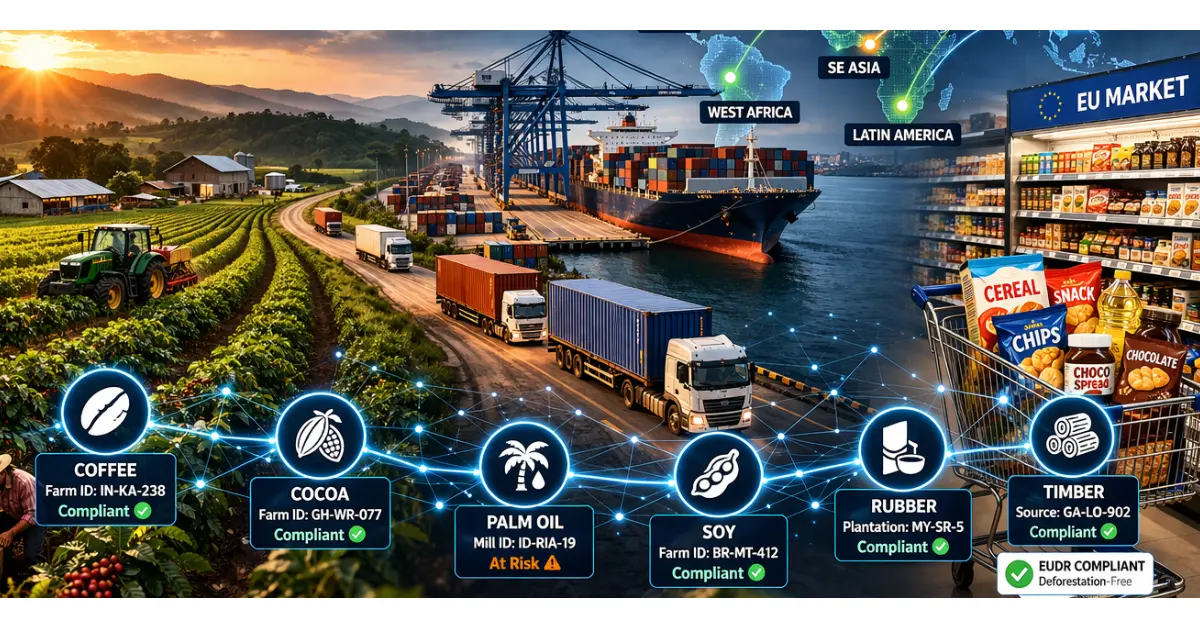
An EUDR shipment that cannot prove deforestation-free sourcing can be blocked at the EU border even if it is, in reality, compliant. The problem is almost never the actual sourcing practice. The problem is the data gap. A traceability gap analysis is the systematic process of identifying every point in your supply chain where data is missing, unreliable, digitally inaccessible, or non-compliant with regulatory requirements. It is the essential first step before any compliance programme, platform deployment, or certification audit.
This guide walks agri-food companies, sustainability teams, and supply chain managers through the exact methodology TraceX uses with their enterprise clients to map, score, and close their traceability gaps before a regulator or EU buyer does it for them.
Key Takeaways
A traceability gap is any break in the chain of evidence connecting a product at the point of consumption back to its origin. In an EUDR context, this means any inability to prove, with verifiable digital evidence, that the commodity was produced on land that was not subject to deforestation after December 31, 2020.
Discover how large-scale polygon mapping enabled EUDR compliance for a leading tire company.
Use this framework as a structured audit not a checklist. Each step builds on the previous, and the output feeds directly into your compliance action plan.
Before you can identify gaps, you must establish a complete map of your supply chain from Tier 0 (your company) through to Tier N (the farm or forest of origin). This is harder than it sounds for agri-food businesses sourcing through multiple trader intermediaries.
Key actions:
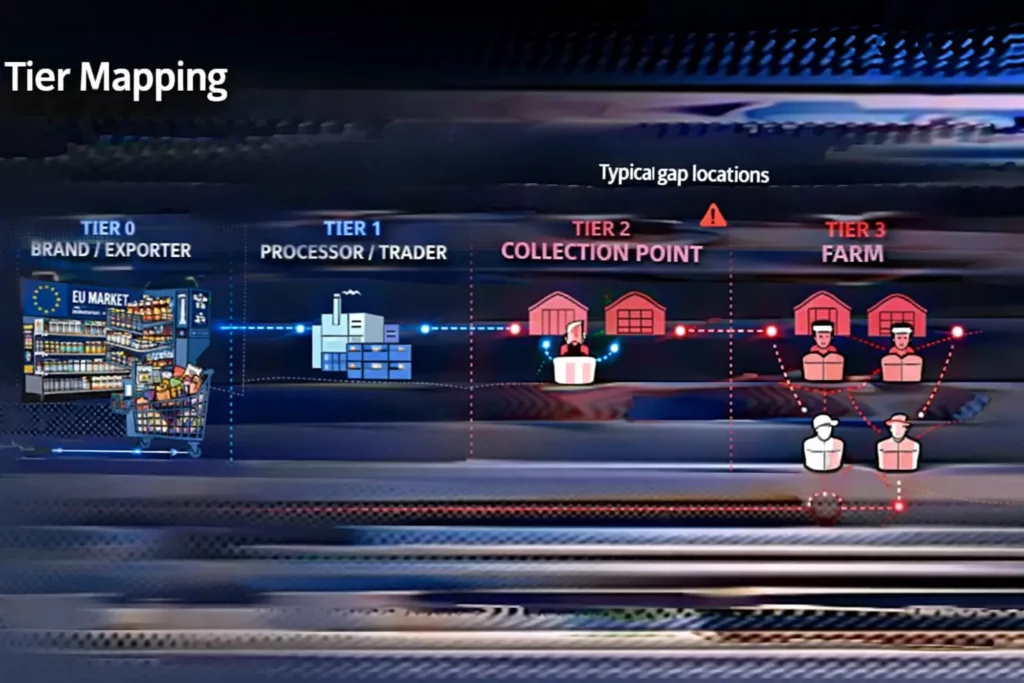
Conduct a structured audit of every data source your organisation currently holds. Map each data type against each supply chain tier to reveal where coverage exists and where it does not.
Not all gaps carry equal risk. Use a risk scoring matrix to prioritise remediation effort. Score each identified gap across two dimensions: regulatory consequence (what regulation does this gap violate?) and operational feasibility (how hard is this gap to close?).
Below is the TraceX Gap Risk Matrix a practical scoring tool used with enterprise agri-food clients:
| Gap Category | Risk Level | Regulatory Impact | TraceX Solution |
|---|---|---|---|
| Farmer GPS Data | High | EUDR non-compliance, DDS rejection | Offline mobile GPS capture + polygon mapping |
| Supplier Documentation | High | Audit failure, shipment block | Agentic AI auto-parses KYC & land docs |
| Scope 3 Emissions Data | Medium | CSRD reporting gaps | Primary supply chain emissions calculation |
| Batch-level Traceability | Medium | Food safety recall delays | Forward & reverse traceability engine |
| Deforestation Verification | High | EU market access revoked | JRC/Hansen satellite dataset validation |
For each high-risk gap identified in Step 3, validate your current state against the specific regulatory requirement it threatens. This step converts a general gap into a compliance deficit with a defined remediation standard.
EUDR – Requires GPS polygon data for every plot of land producing the listed commodity. Validation: cross-check supplier GPS coordinates against the JRC Tropical Moist Forests layer and Hansen Global Forest Watch dataset.
CSRD / Scope 3 – Requires primary supply chain emissions data (not industry averages). Validation: confirm you have actual farm-level input data (fertiliser, fuel, land-use change) for emissions calculation.
FSMA / FSSC / BRC – Requires batch-level forward and reverse traceability within defined timeframes. Validation: simulate a product recall. How many hours does it take to identify all affected batches and their distribution points?
The output of a traceability gap analysis is not a report it is a prioritised action plan. Structure your roadmap around three closure tracks:
Check how TraceX helps Food and Agri Players
A gap analysis can begin with a spreadsheet but it cannot end there. The data volumes involved in agri-food supply chains (hundreds of farmers, dozens of commodities, multiple regulatory frameworks) require purpose-built traceability infrastructure.
The EU Deforestation Regulation (EUDR) came into force in June 2023, with the compliance deadline for large operators originally set for December 30, 2024 subsequently extended to December 30, 2026. SMEs have until June 30, 2027.
Your EUDR gap analysis must confirm the following data elements are present and verifiable for every shipment:
Dec 30, 2026
EUDR compliance deadline for large operators exporting to the EU – missing it risks shipment rejection and market exclusion
European Commission EUDR Implementation Timeline, 2024
The most common failure point in any agri-food traceability gap analysis is Tier 3: the smallholder farmer. This is where data collection is hardest and where regulatory requirements are most demanding.
Consider the scale: A single cocoa exporter in Indonesia may source from 50,000 smallholder farmers across 300 villages. Each farmer may hold land in multiple fragmented plots. Many will have no formal land title only customary tenure recognised locally. The nearest mobile data signal may be 20 kilometres away.
Check our Traceability Solutions
Traditional traceability approaches paper collection, desktop data entry, Google Forms collapse at this scale. Effective gap closure at the smallholder level requires:
A leading agribusiness managing thousands of farmers struggled with manual data collection, fragmented farm records, and slow compliance processes – putting certifications like EUDR and organic standards at risk. By adopting TraceX’s KML Extracts and Excel Farm Import Solution, they digitized farm data at scale, streamlined compliance workflows, and achieved faster, more accurate traceability across their supply chain.
See how TraceX transformed farm data digitization and compliance for this agribusiness – explore the full case study.
EUDR compliance is the most urgent driver of traceability investment but it is not the only one. CSRD (Corporate Sustainability Reporting Directive) requires EU-listed companies and large non-EU companies with EU operations to report Scope 3 emissions from their value chains from 2024 onwards.
A Scope 3 gap analysis follows the same 5-step framework as an EUDR gap analysis but focuses on a different set of data requirements:
Companies that invest in traceability infrastructure for EUDR compliance typically find they have already collected 60-70% of the data required for Scope 3 reporting making dual compliance a question of data architecture, not double effort.
Strengthen compliance at the source – explore how effective farm management supports regulatory readiness.
From farm to market – learn how EUDR traceability ensures transparency across your supply chain.
Not sure where you stand? Start with an EUDR gap analysis to identify and fix compliance gaps.
For a mid-market agri-food company with 500-2,000 suppliers, a structured gap analysis typically takes 4-8 weeks when conducted manually. With a digital traceability solutions from TraceX, the data collection phase can be compressed to 2-3 weeks, with automated gap scoring and reporting generated in real time.
A traceability audit verifies that your existing system is working correctly. A gap analysis starts from scratch it identifies where your system has no coverage. Gap analysis comes first; audit comes after gaps are closed. For EUDR, you need both: a gap analysis to build compliance, and an audit to verify it before DDS submission.
No. Modern traceability solutions from TraceX are designed for field agents who collect data on behalf of farmers using rugged smartphones or tablets with offline capability. The farmer simply participates in a data collection visit; no personal smartphone is required. Farmer consent and data are recorded by the field agent.
If a DDS is incomplete, inaccurate, or cannot be verified against the JRC or Hansen satellite datasets, EU customs authorities can block the shipment. Repeated violations can result in fines up to 4% of total EU turnover. The DDS system has no grace period operators are legally responsible for the accuracy of every statement submitted.
Yes and this is the recommended approach. Data collected for EUDR compliance (GPS coordinates, land ownership records, deforestation verification) overlaps significantly with requirements for CSRD Scope 3 reporting, UEBT certification, and food safety standards (FSSC 22000, BRC). A well-designed gap analysis maps data requirements across all relevant frameworks, enabling parallel compliance rather than sequential effort.