
Quick summary: Stress-test your compliance before enforcement begins. This EUDR Gap Analysis Guide helps you identify traceability, geolocation, and due diligence gaps to avoid fines, shipment delays, and market exclusion.

If your company cannot prove within hours exactly where your commodities were produced, whether deforestation occurred after December 31, 2020, and how risk was mitigated, you are exposed. An effective EUDR Gap Analysis reveals whether your traceability infrastructure, risk classification framework, supplier data integrity, and audit response capability can withstand regulatory scrutiny before enforcement authorities conduct their own review.
The enforcement phase of the EU Deforestation Regulation (EUDR) is not a theoretical future risk. It is an operational reality. Authorities will not ask whether you intended to comply they will ask for verifiable geolocation data, documented risk assessments, and defensible due diligence statements.
And this is where most organizations are vulnerable.
Many companies believe they are “EUDR-ready” because they:
But EUDR is not a documentation exercise. It is a systems test.
The uncomfortable truth?
Most compliance programs break under stress.
A structured EUDR Gap Analysis does more than check compliance boxes. It stress-tests your entire due diligence ecosystem from farm-level coordinates to board-level accountability. In this guide, we’ll walk through how to identify critical compliance gaps, simulate regulatory scrutiny, and strengthen your EUDR framework before penalties, product seizures, or market exclusion become real business risks. We’ll also explore how TraceX Deforestation Regulation Solutions enable polygon-level traceability, automated risk assessment, and audit-ready due diligence workflows to help organizations move from reactive compliance to continuous regulatory readiness.
Key Takeaways
An EUDR gap analysis evaluates whether your systems, suppliers, traceability tools, and documentation meet the requirements of the EU Deforestation Regulation (EUDR). It identifies weaknesses in geolocation data, risk assessment workflows, supplier due diligence, and reporting processes before enforcement or audit exposure.
It goes beyond checking documents. It stress-tests your entire due diligence system.
Under EUDR, companies placing or exporting regulated commodities (such as soy, palm oil, cocoa, coffee, cattle, rubber, and wood) on the EU market must prove that their products are:
An EUDR Gap Analysis evaluates whether your current systems can actually deliver that proof on demand.
It checks whether you collect precise land plot coordinates (ideally polygon data, not just GPS points) and whether those plots can be verified against deforestation cut-off dates.
Questions it answers:
EUDR requires companies to assess and mitigate deforestation risk.
A gap analysis evaluates:
It reviews:
It identifies inconsistencies, missing files, and weak controls.
It assesses whether your systems can:
Many companies discover their traceability breaks at Tier-2 or Tier-3 suppliers.
EUDR enforcement authorities may request evidence quickly.
A gap analysis tests:
An EUDR Gap Analysis answers one critical question:
If regulators audited us tomorrow, could we confidently prove our products are deforestation-free and legally produced with complete, verifiable evidence?
If the answer is uncertain, a structured gap analysis is not optional it is essential.
Polygon mapping isn’t optional under EUDR, it’s foundational. If you’re unsure whether GPS points are sufficient, how to validate farm boundaries, or how to link geolocation to shipment batches, you may be exposed.
Read the Complete Guide to Geolocation Requirements Under EUDR
Submitting a Due Diligence Statement (DDS) without structured risk assessment and mitigation documentation can result in shipment delays or rejection.
Explore the Step-by-Step EUDR Due Diligence Guide
An EUDR Gap Analysis is not a theoretical exercise; it’s a defensive strategy. With enforcement approaching or already active, depending on company size, regulators are shifting from awareness to verification. That means your systems will be judged on evidence, not intent.
Here’s why stress-testing your EUDR solution is urgent:
EUDR is no longer a policy discussion it is enforceable law. Authorities can request:
If your compliance process hasn’t been tested under real audit conditions, you may discover gaps too late. Stress-testing ensures you can retrieve and defend required documentation immediately.
Under EUDR, penalties may include:
For global traders and manufacturers, market suspension can disrupt revenue, reputation, and investor confidence. A stress test identifies exposure before enforcement does.
Many organizations still rely on:
These systems may function with limited suppliers but EUDR requires plot-level traceability and structured risk mitigation across entire value chains. Manual processes collapse when volume increases or audit pressure intensifies.
Stress-testing reveals whether your model is scalable or fragile.
EUDR compliance depends heavily on supplier-provided data. Common weaknesses include:
If supplier data is inconsistent, your compliance is compromised even if your internal systems are strong. A stress test highlights where supplier onboarding, validation, or monitoring must be strengthened.
Many companies assume their existing ESG or sustainability software is sufficient. However, EUDR introduces new technical demands:
Traditional ESG platforms were not designed for regulatory-grade traceability. Without stress-testing, companies may discover critical capability gaps during enforcement.
Ready to Close Your Compliance Gaps Before Regulators Do?
Explore Our EUDR Compliance Solutions and see how you can strengthen your compliance posture before enforcement exposure becomes a business risk.
Even organizations that believe they are EUDR-ready often discover structural weaknesses when their systems are stress-tested. Here’s what typically breaks under regulatory scrutiny:
EUDR requires precise land plot coordinates ideally polygon-level mapping, not simple GPS points. Many companies rely on supplier-declared data without independent validation or historical deforestation verification (post-2020 cut-off).
If your geolocation data cannot be verified or linked directly to shipments, your compliance claim is vulnerable.
Validate your polygons in seconds
Country-level risk ratings are not enough. EUDR requires risk assessment at supplier and plot level.
If risk scoring is static, updated infrequently, or lacks mitigation tracking, your system may fail to demonstrate adequate due diligence.
Missing statements, inconsistent supplier declarations, or poorly structured audit files can derail compliance even if your traceability is strong.
Regulators will assess the completeness and accessibility of your documentation, not just its existence.
4️. No Real-Time Monitoring Capability
EUDR is not a one-time validation exercise. Ongoing monitoring is essential.
Without satellite monitoring, deforestation alerts, and continuous verification workflows, companies risk unknowingly placing non-compliant goods on the market.
Blind spots at Tier-2 and Tier-3 suppliers are common especially in aggregated or trader-heavy supply chains.
If compliant and non-compliant sources can mix without detection, your entire shipment may be exposed.
Compliance evidence must be centralized, secure, and retrievable quickly.
If documentation is scattered across teams or systems and ownership is unclear audit response times will suffer. EUDR requires defensible records, not internal confusion.
Many companies have never tested what happens if a shipment is flagged.
Can you produce plot-level evidence immediately?
Are workflows automated or manual?
Is escalation clearly defined?
Without stress-testing, enforcement becomes your first real test and that is a high-risk strategy.
A structured EUDR Gap Analysis follows a logical sequence from defining your regulatory exposure to stress-testing your audit readiness. Here’s how to approach it efficiently:
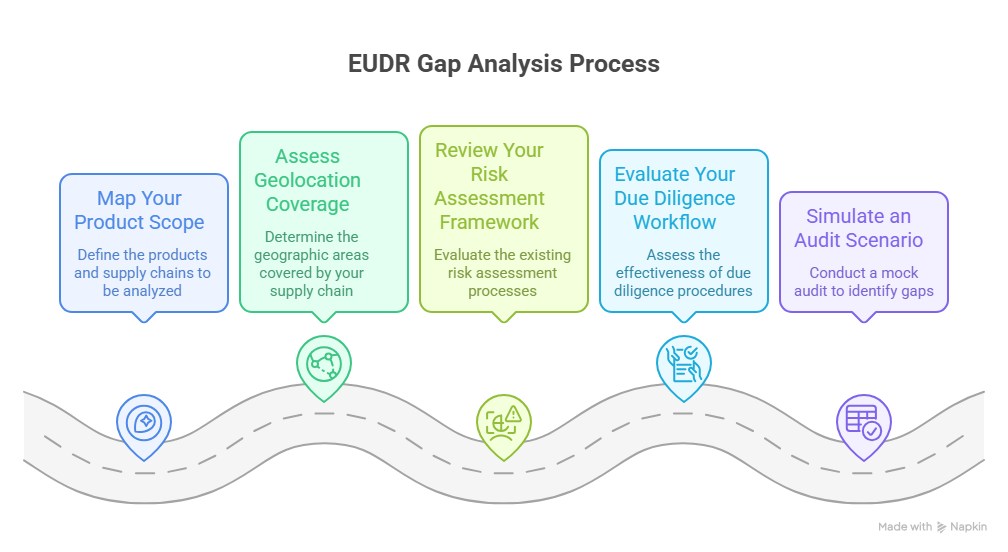
Start by identifying whether you place or export regulated commodities under EUDR including soy, palm oil, coffee, cocoa, rubber, cattle, and wood (and their derived products).
Then map:
This step defines the full scope of your exposure and clarifies accountability across the organization.
EUDR requires precise land plot coordinates for production areas.
Evaluate:
This step determines whether your traceability foundation is technically compliant.
EUDR requires documented risk evaluation and mitigation.
Assess:
The goal is to confirm that your risk model is dynamic, defensible, and aligned with regulatory expectations.
Compliance depends on process integrity.
Determine:
This step highlights process bottlenecks and documentation weaknesses.
This is the true stress test.
Ask yourself: If regulators requested documentation today, could you immediately retrieve:
If retrieval is slow, fragmented, or incomplete, you’ve identified actionable compliance gaps.
| Level | Maturity Stage | Description of Practices | Risk Exposure |
| Level 1 | Manual & Reactive | Reliance on siloed spreadsheets and paper certificates. Compliance is handled “lot-by-lot” just before shipment. No central database for farm coordinates. | High: Prone to “fat-finger” errors, missed cutoff dates, and high probability of border detention. |
| Level 2 | Partial Traceability | Digital storage of some supplier data. Basic GPS point collection exists, but lacks Polygon Mapping for larger plots. Inconsistent legal documentation. | Medium: Sufficient for “Low-Risk” regions, but fails the “Standard” or “High-Risk” scrutiny. Audit trails are disjointed. |
| Level 3 | Integrated Risk Scoring | Compliance is linked to the ERP. Automated screening against the EU Benchmarking System (Low/Standard/High). First-mile data is validated at the gate. | Moderate: Strong internal governance, but still relies on manual verification of satellite imagery and legal tenure. |
| Level 4 | Automated Monitoring | Real-time Satellite Monitoring is integrated. System auto-flags “Land-Use Change” (LUC) in farm polygons. Suppliers are onboarded via digital KYC portals. | Low: Minimal human intervention. The system provides “Near-Real-Time” alerts, allowing for proactive sourcing shifts. |
| Level 5 | Continuous Compliance Engine | Compliance is a “Digital Twin” of the product. APIs connect directly to the EU Information System (TRACES-NT). Full interoperability with Digital Product Passports (DPP). | Minimal: Compliance is a competitive edge. Zero-deforestation is guaranteed, and audit reports are generated instantly. |
A leading global tire manufacturing company successfully strengthened its EUDR readiness by digitizing its upstream natural rubber sourcing network across six key suppliers with TraceX EUDR Solutions. Through a structured farm-level traceability program, the company mapped approximately 37,000 individual plots covering nearly 160,000 hectares, ensuring precise geolocation and polygon-level verification aligned with the 31 December 2020 deforestation cut-off requirement. By consolidating fragmented supplier records into a unified digital system, validating land-use documentation, and linking volumes back to verified plots, the company transformed a complex, multi-tier supply chain into an audit-ready, defensible sourcing framework. This large-scale mapping initiative not only ensured regulatory compliance but also enhanced supplier transparency, risk visibility, and long-term EU market access.
Read the Case study
An EUDR Gap Analysis is not a paperwork exercise it is a stress test of your entire compliance infrastructure. When enforcement authorities request evidence, they will evaluate your geolocation accuracy, risk assessment logic, supplier due diligence, and audit trail integrity in real time.
Organizations that rely on fragmented systems, static risk models, or manual documentation workflows often discover their weaknesses only after shipments are flagged or penalties are imposed.
By proactively identifying gaps, simulating regulatory scrutiny, and strengthening your traceability and due diligence frameworks, you move from reactive damage control to defensible, audit-ready compliance.
Enforcement day should not be your first system test. It should be a validation of a framework you have already pressure-tested.
If your team is still chasing documents, validating coordinates manually, or updating static risk scores, you’re operating reactively.
Discover How Agentic AI Is Transforming EUDR Compliance
If you’re unsure whether your current framework meets enforcement standards:
Read the Complete Guide to EUDR Compliance
Explore step-by-step requirements, documentation workflows, geolocation standards, and practical implementation strategies.
If you cannot confidently answer how each supplier is classified, validated, and monitored:
Explore the EUDR Supplier Assessment Framework
Understand how to implement structured supplier onboarding, dynamic risk scoring, mitigation tracking, and defensible documentation.
An EUDR Gap Analysis evaluates whether your systems, suppliers, traceability tools, and documentation meet EU Deforestation Regulation requirements, identifying weaknesses before regulatory enforcement or audits occur.
Because penalties can include fines, product seizures, and EU market exclusion. A gap analysis ensures you can produce verifiable geolocation data, structured risk assessments, and audit-ready documentation on demand.
Common gaps include incomplete polygon-level geolocation data, overreliance on country risk benchmarks, manual due diligence workflows, fragmented supplier documentation, and lack of real-time deforestation monitoring.
At minimum, before enforcement deadlines and whenever significant supplier, commodity, or system changes occur. Many organizations conduct annual reviews with quarterly stress tests to ensure continuous compliance readiness.
Not necessarily. Many ESG platforms lack regulatory-grade geolocation validation, dynamic risk scoring, and automated due diligence statement generation required for defensible EUDR compliance.