
Quick summary: Traceability in seed oils is no longer optional. Learn how farm-to-refinery digital traceability protects contracts, reduces compliance risk, and ensures defensible origin proof in complex oilseed supply chains.
Your refinery may be fully compliant internally, but can you prove where every tonne of oilseed originated? Seed oil supply chains are among the most complex in agriculture. Thousands of smallholder farmers. Multi-layer aggregation. Cross-border trade. Bulk storage mixing. Refinery blending. Export documentation. Traceability in seed oils refers to the ability to track oilseeds and derived edible oils from farm-level production through aggregation, processing, refining, and final distribution
Seed oils power global food systems. From household cooking oils to processed foods, snacks, cosmetics, and biofuels, oils derived from soy, sunflower, palm, canola, mustard, and other oilseeds move through some of the most complex agricultural supply chains in the world. Millions of smallholder farmers grow oilseeds across continents. Aggregators consolidate volumes. Traders blend shipments. Refineries process and refine at industrial scale. Exporters distribute across borders.
Operationally, the system works. But under regulatory scrutiny and buyer transparency demands, it is increasingly fragile. Today, traceability in seed oils is no longer a value-added feature. It is a compliance requirement, a commercial safeguard, and a strategic differentiator.
If you cannot prove where your oilseeds were grown, how they were handled, and whether they meet sustainability and legality standards, you are exposed to audits, shipment delays, rejected contracts, reputational risk, and regulatory penalties.
This blog explores why seed oil traceability is shifting from optional to essential and what it takes to build end-to-end visibility from farm to refinery.
Key Takeaways
To understand why traceability is difficult, we must first understand the structure of oilseed supply chains.
Most edible oil supply chains share five characteristics:
Each step introduces traceability risk.
By the time oilseeds reach a refinery, origin data is often reduced to a supplier declaration not a verifiable, farm-level audit trail.
Palm oil supply chains are among the most complex and high-risk under global deforestation regulations. From smallholder sourcing to mill-level aggregation and refinery blending, traceability gaps can expose your business to serious compliance and reputational risk.
Read Our Deep Dive on Palm Oil Supply Chain Traceability
Even if your farms are mapped and suppliers are onboarded, uncontrolled aggregation can silently destroy traceability. Once compliant and non-compliant volumes mix, risk spreads across the entire batch.
Explore the Hidden Aggregation Risks in Seed Oil Supply Chains
Traceability in seed oils is the ability to:
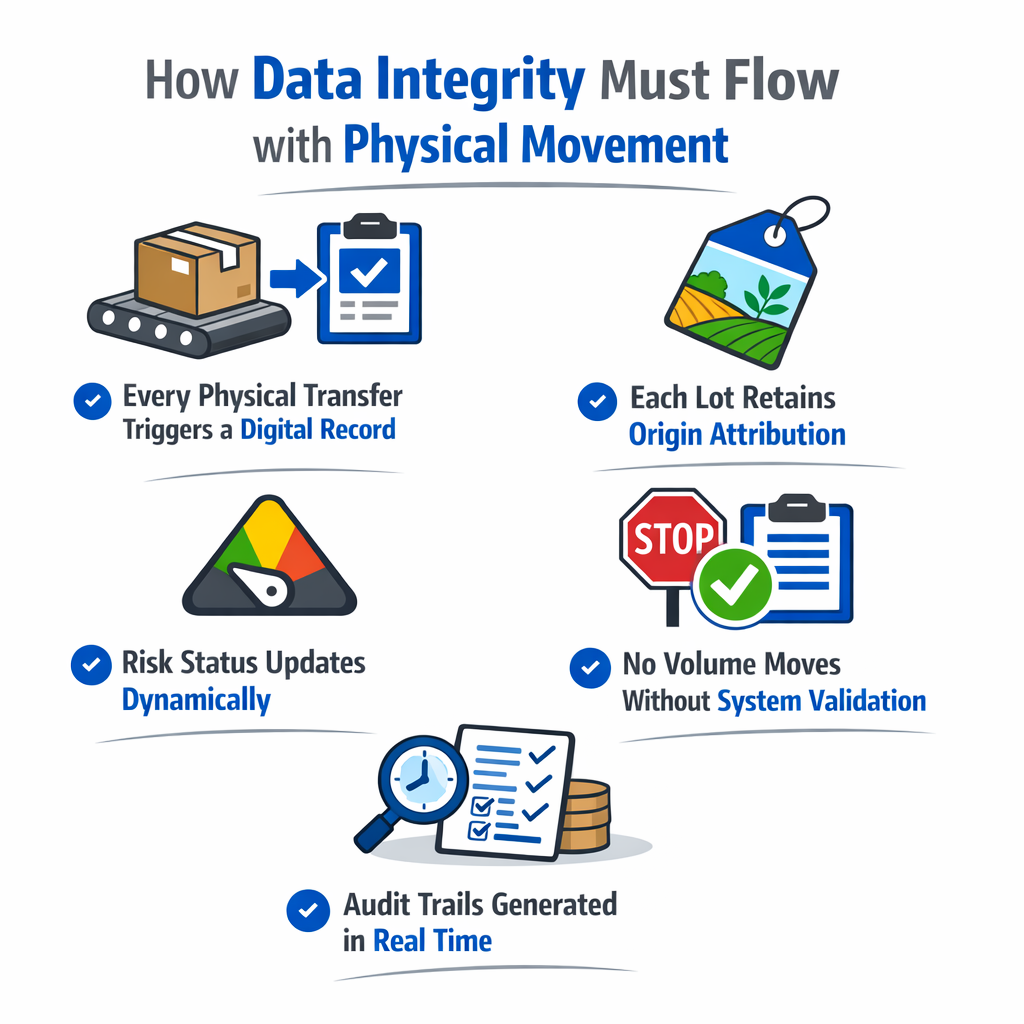
True traceability is not simply “knowing your supplier.” It is preserving data integrity across physical movement.
It means the origin story of a tonne of soy or sunflower does not disappear when it is mixed, transported, or processed.
Despite increasing awareness, traceability frequently collapses at predictable points.
Many oilseed supply chains still rely on:
Without structured farmer profiling and verified geolocation, origin cannot be defensibly proven.
Increasingly, regulations and buyers require polygon-level farm mapping, not just village-level identification. GPS points are often insufficient for deforestation checks or regulatory compliance.
When farm data is incomplete or unverifiable, the entire downstream chain inherits risk.
Aggregation is the most underestimated risk in seed oil traceability.
Oilseeds are often collected from hundreds of farmers at a single aggregation point. Without lot-level segregation and digital custody tracking:
Bulk consolidation may make logistical sense but without structured digital transaction capture, it breaks traceability.
A refinery may receive 5,000 tonnes of soy from a trusted trader yet be unable to prove which farm produced each tonne.
Under tightening regulations, this is no longer defensible.
Once oilseeds enter crushing and refining facilities:
Most refinery ERP systems focus on production efficiency and inventory control. They rarely preserve farm-level metadata through processing stages.
When refined oil is exported, documentation may rely on upstream declarations rather than structured traceability systems.
The result: a refinery that can track production metrics precisely but cannot reconstruct origin details under audit pressure.
Global markets are shifting rapidly.
Regulations such as the EU Deforestation Regulation (EUDR) require:
Buyers increasingly demand:
Customs authorities are scrutinizing documentation more closely. Rejected due diligence statements and delayed shipments are becoming more common.
If origin cannot be proven quickly and defensibly, contracts and revenue are at risk.
The shift toward mandatory traceability is being driven by three forces.
Soy and palm-based oils are directly exposed to deforestation-related regulations in key markets. Authorities require:
Regulations are becoming data-intensive. Narrative claims are insufficient.
Global food brands, retailers, and CPG companies are tightening sourcing policies.
They expect:
Suppliers that cannot meet transparency expectations risk losing preferred vendor status.
Seed oils are widely consumed and publicly scrutinized. Allegations of deforestation, labor violations, or adulteration can damage brand equity.
Digital traceability reduces the risk of reputational crises by strengthening documentation and audit defensibility.
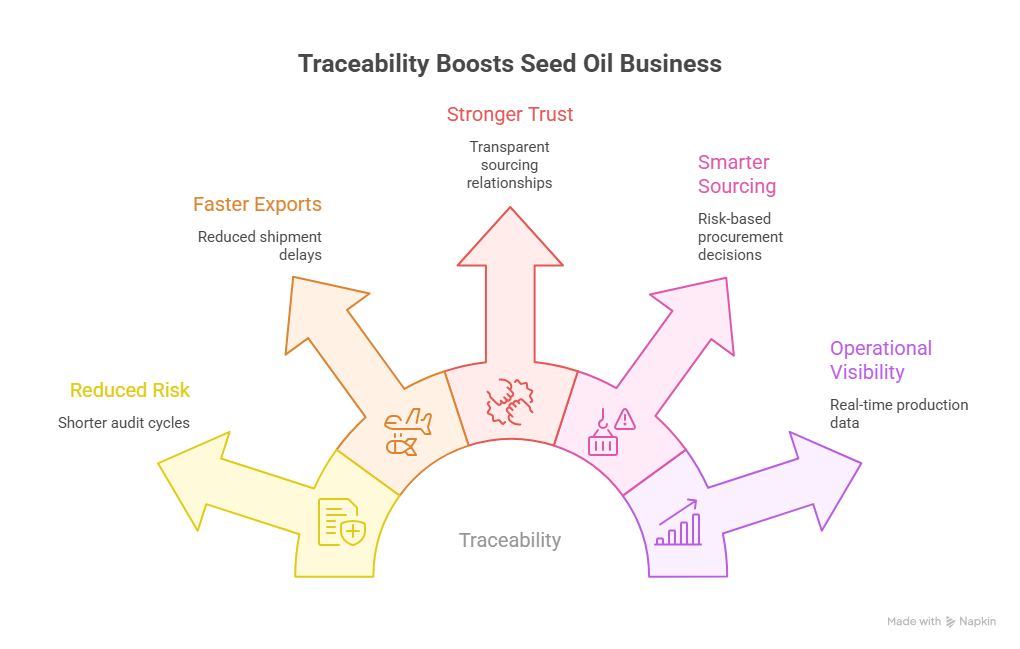
Achieving resilient traceability requires structural changes across the value chain.
Every supplier should be digitally onboarded with:
This builds a verified supplier base rather than a list of informal relationships.
Plot boundaries must be digitally mapped using polygon geolocation.
This enables:
Without polygon-level mapping, origin claims are increasingly vulnerable.
Digital scan-and-transfer workflows must capture:
Each movement should preserve lot identity and farmer attribution.
This prevents mixing risks and maintains traceability integrity.
Traceability systems must connect:
Raw material lots → Crushing batches → Refined oil tanks → Export consignments
Origin metadata must survive processing and blending.
Without system integration, traceability collapses at the refinery gate.
Manual document compilation is unsustainable.
Traceability platforms should generate:
Automation reduces human error and strengthens defensibility.
| Level | Maturity Stage | Practical Description | Risk Exposure |
| Level 1 | Paper-Based & Fragmented | Reliance on physical “Sustainability Certificates” and static PDF invoices. No digital link between a batch of oil and the farm coordinates. | High: Non-compliant under EUDR. Risk of 4% revenue fines and total market exclusion. |
| Level 2 | Partial Digitalization | Supplier lists are in an ERP (SAP/Oracle), but “Origin” is only tracked to the Mill or Collection Center, not the individual farm plot. | Medium: Fails the EUDR “Plot-Level” mandate. Batches are easily contaminated with non-compliant oil. |
| Level 3 | Digital Onboarding & Mapping | All supplying farmers are profiled. Small plots have GPS center-points; large plots (>4ha) have GeoJSON Polygons defining boundaries. | Moderate: Operationally compliant but requires heavy manual labor for risk assessment and satellite verification. |
| Level 4 | Lot-Level Aggregation Control | Digital “Chain of Custody” is active. Every truckload is digitally tagged at the farm gate, ensuring traceability is preserved through the refinery. | Low: Minimal risk of “batch mixing.” Highly defensible audit trail. Ideal for “Standard-Risk” sourcing regions. |
| Level 5 | Integrated Traceability Engine | Real-time Satellite Monitoring auto-flags deforestation in mapped plots. APIs instantly push Due Diligence Statements (DDS) to the EU TRACES-NT portal. | Minimal: Compliance is automated. Traceability data adds value to carbon credits and premium green-bond reporting. |
Traceability cannot be retrofitted during a regulatory investigation.
It must be designed into the system.
Aggregation is the most underestimated vulnerability in seed oil supply chains and the point where traceability most often collapses.
While companies invest in supplier onboarding and refinery systems, aggregation quietly erodes origin integrity. Oilseeds from hundreds, sometimes thousands of farmers are consolidated at collection centres, warehouses, or trader facilities. Without structured controls, this is where compliant and non-compliant volumes become indistinguishable.
Let’s break down why this matters.
At the farm level, traceability can be clear:
But once that harvest leaves the farm, it enters a pooled environment.
Aggregation introduces three core risks:
If aggregation is not digitally controlled, upstream compliance efforts lose downstream integrity.
In simple terms, aggregation disconnects origin from volume.
Consider this scenario:
At an aggregation center, both volumes are stored in the same silo. Once mixed:
Under regulations requiring plot-level proof (such as EUDR for soy), blended volumes without structured segregation can invalidate compliance claims.
Physical mixing without digital controls creates regulatory exposure.
Many companies assume that tracking volume at silo or warehouse level ensures traceability.
But silo-level tracking answers only one question:
“How much material do we have?”
It does not answer:
Silo tracking manages inventory not origin integrity.
Without lot-level attribution preserved during aggregation, compliance becomes assumption-based rather than evidence-based.
To protect traceability through aggregation, every movement must be recorded digitally.
This includes:
Digital scan-and-transfer workflows ensure:
Digital transaction capture transforms aggregation from a blind spot into a controlled checkpoint.
Instead of losing traceability at consolidation points, the system preserves origin metadata alongside physical movement.
Refineries often assume traceability can be managed internally.
But origin proof begins upstream.
If upstream data is incomplete:
Traceability must start at the farm not at the processing plant.
Farm → Collection Center → Aggregator → Processor → Refinery → Export
Seed oil traceability is not achieved at a single point. It is built through connected digital checkpoints that preserve data integrity at every physical handoff. If traceability breaks at even one stage, downstream compliance becomes fragile.
Here’s how a resilient digital framework works across the value chain.
Digital Checkpoints Must Include:
This is where traceability begins. Every farm must have a unique digital identity linked to mapped plots and recorded production volumes.
Without structured farm-level data, all downstream traceability rests on declarations not evidence.
Digital Checkpoints Must Include:
At this stage, physical crops change hands. If digital records are not created simultaneously, farm-level origin begins to weaken.
Data integrity must move with the crop not be reconstructed later.
Digital Checkpoints Must Include:
Aggregation is where compliant and non-compliant volumes can mix. If blending occurs without digital traceability controls, origin identity dissolves.
Every mixing event must be documented digitally to preserve proportional attribution and risk visibility.
Digital Checkpoints Must Include:
When oilseeds are crushed, traceability must transition from physical seed lots to processed oil and meal batches.
Origin metadata must remain attached to every production batch.
Digital Checkpoints Must Include:
Refineries often blend multiple batches to meet specifications. Traceability must survive blending through digital allocation models that preserve origin percentages.
Without this, refined oil cannot be traced confidently back to mapped farms.
Digital Checkpoints Must Include:
At the export stage, the question becomes:
“Can you prove this shipment’s origin under regulatory scrutiny?”
If digital traceability has been preserved upstream, export documentation becomes automated and defensible.
If not, teams scramble to reconstruct records manually, increasing the risk of delay or rejection.
Blending is common in seed oil supply chains at aggregation silos and refinery tanks.
The risk is not blending itself.
The risk is blending without digital proportional tracking.
When blending occurs without traceability logic:
When blending is digitally managed:
This ensures traceability survives consolidation instead of being erased by it.
TraceX Traceability Solutions enable end-to-end, farm-to-export visibility by transforming fragmented supply chain data into structured, verifiable intelligence. Through digital farmer onboarding, polygon-level geolocation mapping, lot-level aggregation controls, and batch-level processing traceability, TraceX ensures that origin data remains intact as commodities move across collection centers, aggregators, processors, and refineries. The platform integrates real-time transaction capture, risk scoring, and automated compliance reporting to support regulatory requirements such as deforestation-free sourcing and due diligence documentation. By embedding traceability directly into procurement and operational workflows, TraceX helps organizations reduce audit risk, protect market access, and build resilient, transparent supply chains at scale.
Seed oil supply chains were built for scale and efficiency, not transparency. But today’s regulatory scrutiny, buyer expectations, and export controls demand more than operational throughput. They require defensible proof of origin, structured due diligence, and data integrity that survives aggregation and blending. From fragmented farms to refinery tanks, every transfer must preserve traceability. In this environment, traceability in seed oils is no longer optional or aspirational it is foundational infrastructure. The companies that embed digital traceability from farm to refinery will protect contracts, reduce compliance exposure, and build resilient supply chains prepared for regulatory and commercial scrutiny.
Learn how to validate plantation polygons, manage mill aggregation risk, and submit audit-ready Due Diligence Statements.
Read the Complete Guide to EUDR Palm Oil Compliance
Sustainable soy sourcing goes beyond supplier declarations. It requires deforestation-free verification, farm-level traceability, dynamic risk scoring, and defensible origin proof especially for EU-bound shipments.
Explore Our Guide to Sustainable Soy Supply Chains
Learn how to preserve origin data through pooling, blending, and processing and prevent compliant volumes from becoming exposed.
Discover How Aggregated Traceability Impacts EUDR Compliance
Traceability ensures that oilseeds and derived oils can be tracked back to verified farms, enabling compliance with regulations, preventing adulteration, protecting contracts, and strengthening buyer trust.
Traceability most often breaks during aggregation and bulk blending, where compliant and non-compliant volumes can mix without structured digital transaction capture.
No. Silo-level tracking manages inventory but does not preserve farm-level origin attribution. Lot-level digital traceability is required to maintain defensible compliance.
Digital systems generate structured audit trails, automate due diligence documentation, and provide shipment-level origin proof, reducing customs delays and rejection risk.
End-to-end traceability requires farmer profiling, polygon-level mapping, lot-level aggregation controls, batch-level refinery integration, and automated compliance reporting that preserves origin data through every supply chain stage.