Quick summary: Learn how to choose the best digital traceability system for compliance, audits, and market access. Compare key features, risks, and platforms to build audit-ready, end-to-end traceability.
Most companies don’t realize their traceability system is broken until it’s too late. Everything looks fine until an audit fails, a shipment is held at the border, or a recall demands answers in hours, not weeks. That’s when spreadsheets collapse, ERPs hit their limits, and QR-only tools are exposed for what they are: surface-level tracking, not proof. Regulations don’t test intent; they test data at speed and at depth. Choosing the right digital traceability system is what separates teams that scramble under pressure from those that respond with confidence.
This guide is designed to help you avoid that moment not by comparing vendors or buzzwords, but by showing how to choose a traceability platform that actually holds up under audits, recalls, and regulatory scrutiny.
Key takeaways
A digital traceability system is an integrated technology platform that enables end-to-end tracking of products, materials, and data from source to final destination using structured, verifiable digital records. It captures and links information across every stage of the supply chain such as origin, processing, storage, transport, and export creating a continuous chain of custody that can be audited and verified at any time.
Unlike basic tracking, which often relies on spreadsheets, siloed ERP modules, or static QR codes, compliance-grade traceability is designed to withstand regulatory and buyer scrutiny. Basic systems may show where a product is today, but they cannot reliably prove where it came from, how it was handled, or whether it meets legal and sustainability requirements. A digital traceability system goes deeper by linking products to farm plots, suppliers, batches, geolocation data, timestamps, and supporting documentation, ensuring data integrity and consistency across the supply chain.
Digital traceability has become mandatory in regulated supply chains due to tightening global regulations and due-diligence requirements. Frameworks such as the EU Deforestation Regulation (EUDR), Digital Product Passports (DPP), food safety laws, and ESG disclosure standards require companies to provide verifiable, auditable proof not declarations of origin, legality, and sustainability. As audits become faster and more data-driven, only digital traceability systems can deliver the speed, accuracy, and transparency needed to maintain market access, reduce risk, and build trust with regulators and buyers.
Explore How Digital Traceability Transforms Food Supply Chains
Learn how end-to-end digital traceability improves food safety, quality control, and export readiness across complex supply chains. →
Building Compliance-Ready Supply Chains
See how leading food companies use digital traceability to meet evolving import, ESG, and due-diligence requirements. →
Choosing the right traceability platform is no longer an IT decision, it is a business-critical risk and compliance decision. As regulations tighten and buyers demand verifiable proof, digital traceability has become essential for protecting market access, revenue, and brand credibility.
Weak or incomplete traceability systems often fail at the moment they are needed most. During audits, recalls, or border inspections, companies with fragmented or manual systems struggle to produce accurate, consistent data. This leads to audit failures, delayed responses, and increased scrutiny from regulators and buyers.
Poor traceability also increases the risk of shipment rejections and border holds, especially in regulated markets where farm-level origin, legality, and chain-of-custody data are mandatory. Non-compliance can result in financial penalties, contract cancellations, and operational disruptions. Over time, repeated failures erode buyer confidence and brand trust, making it harder to secure long-term contracts or premium pricing.
Today’s buyers and regulators expect proof-based sourcing, not declarations or self-reported claims. This means companies must demonstrate exactly where products originated, how they were handled, and whether they meet legal and sustainability requirements.
Expectations have shifted toward farm- and supplier-level visibility, supported by geolocation data, batch-level tracking, and verified chain-of-custody records. Regulators and auditors increasingly reject static PDFs and spreadsheets, instead requiring audit-ready, digital datasets that can be validated quickly and consistently.
A robust digital traceability platform enables organizations to meet these expectations confidently delivering transparent, verifiable data that withstands audits, supports compliance, and strengthens trust across global supply chains.
Not all digital traceability systems are built for the same purpose. Understanding the strengths and limitations of each approach is critical to choosing a platform that can withstand regulatory scrutiny and real-world supply chain complexity.
ERP-based traceability systems work well for internal operations. They provide structured records for inventory management, production planning, and transactions within a company’s four walls. For manufacturers and processors, ERPs can track material movements between internal facilities and generate standardized reports for finance and operations.
ERPs struggle when traceability needs to extend beyond direct suppliers. They are not designed to capture farm-level data, smallholder inputs, or multi-tier supplier information. External data often enters ERPs through manual uploads or summaries, creating gaps and inconsistencies. This makes ERP-based systems poorly suited for regulatory requirements that demand plot-level origin, geolocation, and verified chain-of-custody across independent actors.
QR codes are often mistaken for traceability, but they are simply data access points, not traceability systems. A QR code can display information, but it does not guarantee that the underlying data is accurate, complete, or verifiable. Without a robust backend system, QR codes only show what someone chose to publish.
Many QR-only solutions rely on static URLs or manually updated content. This creates risks of outdated, inconsistent, or unverifiable information especially when data is changed after the fact. Regulators and buyers increasingly reject QR codes that are not backed by time-stamped, immutable records. Without a structured traceability platform behind them, QR codes offer transparency theatre, not compliance-grade traceability.
Blockchain adds value by ensuring data integrity and trust. Time-stamped, tamper-resistant records help prevent data manipulation, retroactive edits, and disputes over provenance. When combined with structured data capture, blockchain strengthens auditability and confidence in traceability records.
Blockchain is not a traceability solution on its own. Its value depends on what data is captured, how it is verified, and who can access it. When blockchain is layered onto a purpose-built traceability platform one that captures farm, batch, and supply chain events it enhances credibility and compliance. When used without strong data governance or field-level verification, it becomes a buzzword that adds cost without solving traceability gaps.
The most effective digital traceability systems combine field-level data capture, batch-level tracking, and secure data integrity mechanisms. Choosing the right architecture determines whether a system simply tracks transactions or delivers true, compliance-grade traceability.
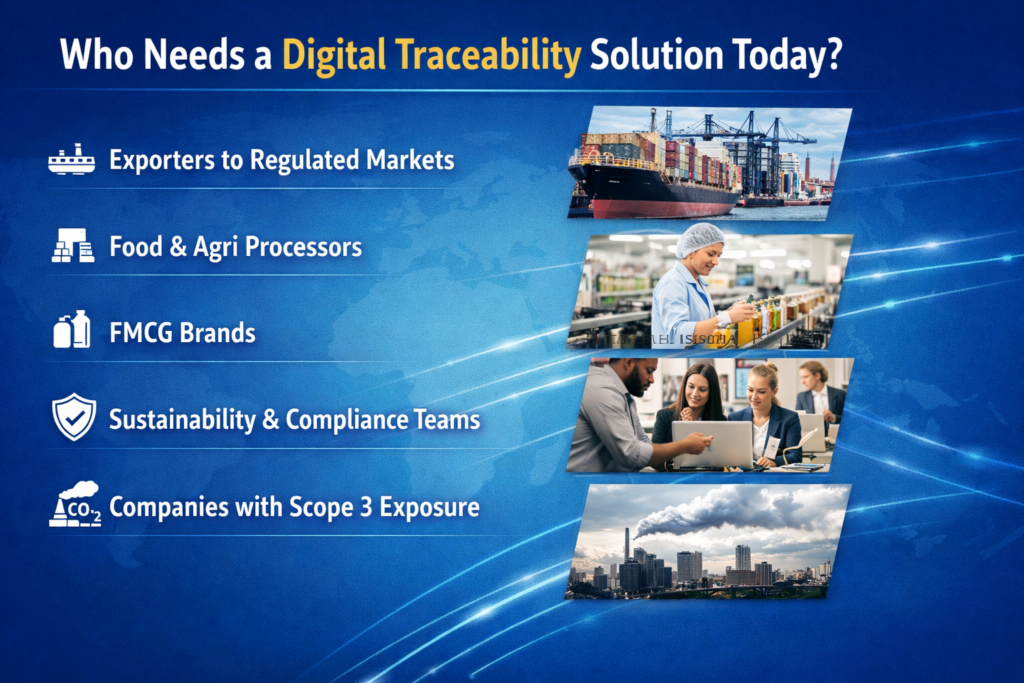
Choosing a digital traceability solution should be driven by regulatory readiness, operational reliability, and data credibility not surface-level visibility. The following features separate compliance-grade platforms from basic tracking tools.
A robust traceability solution must capture the entire product journey from farm or source, through aggregation and processing, to export and final buyer. This continuous chain-of-custody ensures that every handover is documented and verifiable. Without end-to-end coverage, traceability breaks at aggregation points, creating blind spots that regulators and buyers increasingly flag as high risk.
Effective traceability starts upstream. The platform should support digital onboarding of suppliers and farmers, capturing verified identities, geolocation data (GPS points or polygons), and supporting documentation such as land-use records or certifications. This creates a trusted upstream data foundation and enables farm- or supplier-level visibility required for due diligence, sustainability reporting, and deforestation-free claims.
See How Integrated KYC Transforms Farmer Onboarding
Discover how digital KYC validation strengthens farmer verification, reduces onboarding friction, and improves traceability at the source. →
Batch-level tracking is critical to prevent mixing, dilution, and misrepresentation. Each lot or batch should carry a unique digital ID that follows it through collection, storage, processing, and shipment. This allows companies to trace finished products back to specific origins, isolate issues quickly, and maintain integrity across complex, multi-supplier supply chains.
The best digital traceability platforms generate audit-ready outputs automatically. Instead of manually compiling spreadsheets or PDFs, users should be able to produce compliance reports, chain-of-custody records, and buyer-specific documentation with a single click. This dramatically reduces audit preparation time and ensures consistency across regulatory and buyer inspections.
Traceability data must be trustworthy and tamper-resistant. Platforms should ensure records are time-stamped, securely stored, and protected against retroactive edits. Strong data integrity often reinforced with blockchain or immutable logging builds confidence with regulators, buyers, and auditors that the information reflects real events, not post-hoc adjustments.
Together, these features enable digital traceability systems to move beyond basic tracking and deliver verifiable, compliance-grade transparency the standard now expected in regulated and high-risk supply chains.
Digital traceability has become a foundational requirement for companies operating in regulated and export-oriented supply chains. It enables organizations to move from claims-based compliance to proof-based compliance, reducing risk while protecting access to global markets.
Digital traceability systems are designed to meet the growing complexity of regulatory requirements by providing verifiable, structured, and audit-ready data.
Buyer Due Diligence & Risk Management
Beyond regulation, digital traceability directly strengthens commercial relationships by reducing buyer risk.
By aligning regulatory requirements with buyer expectations, digital traceability transforms compliance from a defensive exercise into a strategic advantage protecting market access, strengthening trust, and enabling sustainable growth in global supply chains.
Many companies mistake QR codes for traceability. QR is only a presentation layer. Without verified, structured data underneath farm records, batch IDs, timestamps, geolocation, and chain-of-custody a QR code simply exposes unverified claims. Compliance-grade traceability must be built on robust data capture and validation, not labels.
Traceability systems fail when suppliers can’t or won’t use them. Complex interfaces, high data entry burden, or lack of offline/mobile capability lead to incomplete or unreliable data. Successful platforms are designed for smallholders and tier-2/3 suppliers, not just corporate users.
Many teams assume they can “switch on” traceability when regulations take effect. In reality, onboarding suppliers, mapping farms, cleaning data, and running audits takes months. Late adoption increases the risk of shipment delays, non-compliance, and buyer penalties.
Traceability is often delegated to IT as a software purchase. In reality, it is core compliance and risk infrastructure that impacts sourcing, sustainability, legal, and commercial teams. Platforms must support governance, audits, and decision-making—not just system integration.
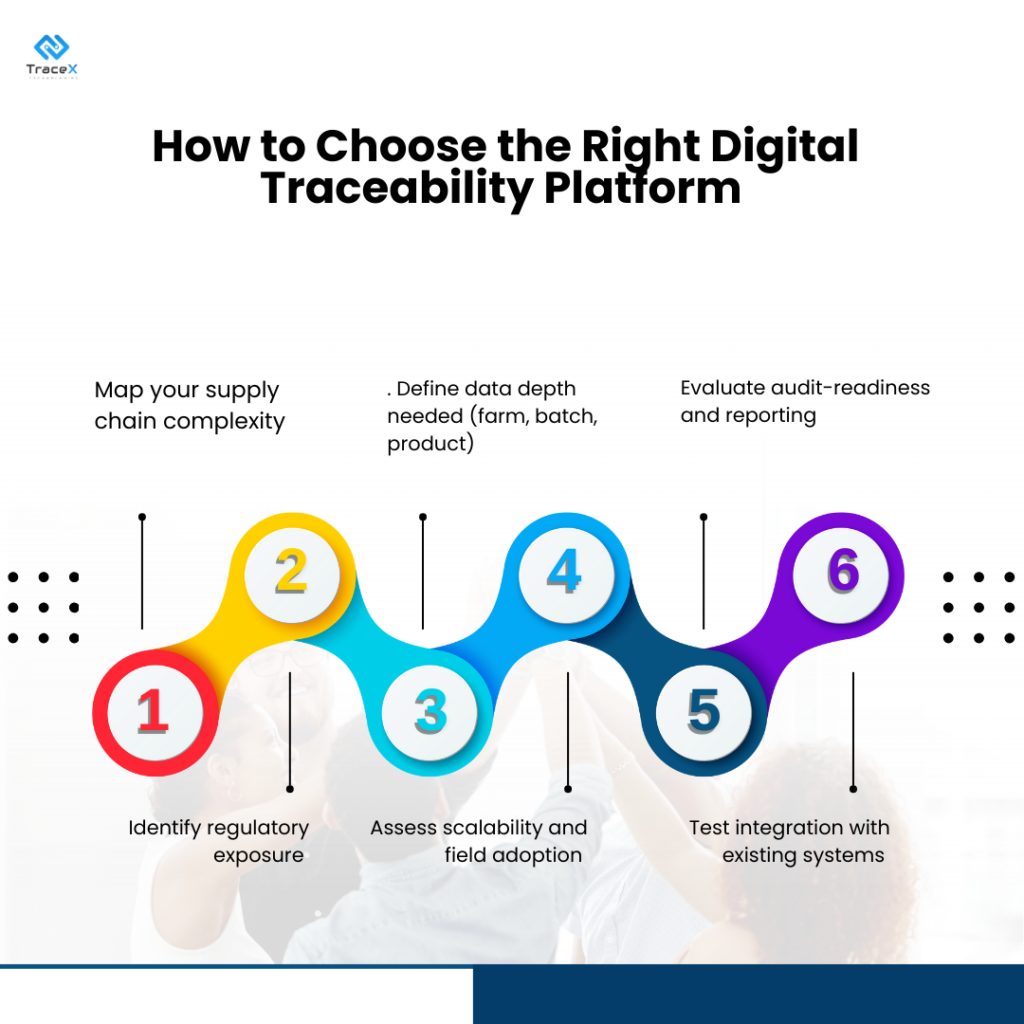
TraceX is purpose-built for compliance-grade, real-world traceability, not just product labelling. The platform delivers true farm-to-export visibility, capturing verified data from origin through aggregation, processing, and shipment. Every movement and transformation is linked through batch-level digital IDs, preventing mixing, misrepresentation, and data loss across complex supply chains.
To ensure trust and auditability, TraceX uses blockchain-backed data integrity, making all records time-stamped, tamper-resistant, and independently verifiable. On top of this, TraceX automatically generates compliance-ready reports aligned with regulations such as EUDR, DPP/ESPR, food safety laws, and ESG and Scope 3 disclosure requirements eliminating manual reporting and last-minute audit stress.
TraceX Traceability platform supports traceability across food and agriculture value chains, with deep applicability in wood, soy, cocoa, and coffee, where smallholder fragmentation and regulatory pressure are highest. Beyond trade compliance, the platform powers sustainability and ESG programs, enabling companies to prove deforestation-free sourcing, responsible land use, and verified supplier practices.
By connecting upstream data with downstream compliance needs, TraceX helps exporters, brands, and sustainability teams move from fragmented records to a single, trusted source of traceability truth at scale.
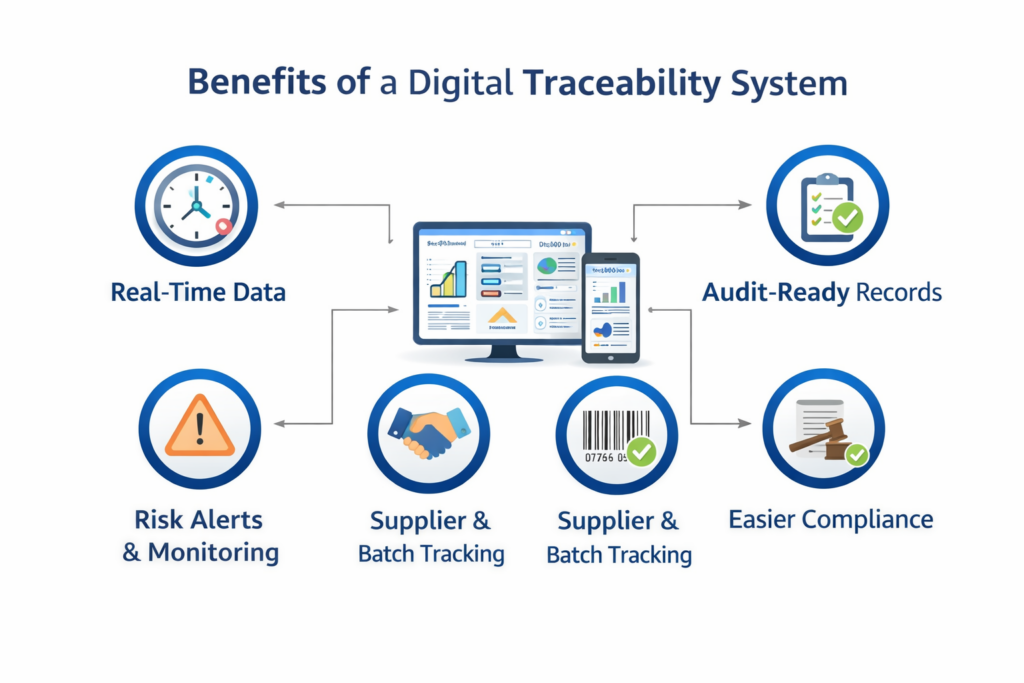
Traceability is no longer a tool you “add on” to operations it is core infrastructure that determines whether supply chains can survive increasing regulation, audits, and buyer scrutiny. The right traceability platform defines how reliably a company can prove origin, legality, sustainability, and compliance across years and markets. When built as infrastructure, traceability becomes a long-term competitive advantage, enabling faster audits, stronger buyer trust, and resilient market access. Companies that invest early in scalable, data-first traceability systems will not just meet today’s requirements they will be prepared for the next wave of regulations and expectations that will shape global trade.
Preparing for DPP? Start With Traceability
Understand what data, systems, and supplier visibility are required to meet upcoming DPP regulations. →
EUDR Compliance Starts at the Farm
See how farm-level traceability, geolocation, and chain-of-custody data enable deforestation-free sourcing under EUDR. →
Read the EUDR traceability guide
Food Safety Compliance Needs More Than Paper Records
Discover how digital traceability helps meet global food safety regulations and manage recalls, audits, and contamination risks. →
The best digital traceability solution provides end-to-end visibility from source to finished product, supports batch-level tracking, ensures data integrity (often via blockchain or immutable logs), and delivers audit-ready compliance reporting for regulations like EUDR, food safety laws, and ESG disclosures.
In many sectors and markets, yes. Regulations such as the EU Deforestation Regulation (EUDR), food safety laws, and product transparency frameworks increasingly require digital, verifiable traceability rather than manual or declarative records.
Yes. Modern digital traceability platforms are designed to integrate with ERPs, procurement systems, and logistics tools, extending visibility beyond Tier-1 suppliers to farms, processors, and external partners.
Implementation timelines vary by supply chain complexity but typically range from a few weeks for pilot deployments to a few months for full farm-to-export or multi-supplier rollouts.
Yes. Batch-level traceability enables rapid identification and isolation of affected lots, reducing the scale, cost, and reputational impact of recalls while improving response time and regulatory compliance.