
Quick summary: Traceability in the soy supply chain in Kenya ensures verified origin, quality control, and regulatory compliance, helping exporters meet global buyer standards and secure sustainable market access.

Traceability in the Soy Supply Chain in Kenya ensures full visibility of soybeans from farm to market, supporting compliance, quality assurance, and sustainability. In Kenya’s smallholder-driven soy sector, digital traceability captures farm-level data, including origin, land use, and production practices, enabling chain-of-custody verification and risk management. These systems enhance access to premium and regulated markets, support environmental and social compliance, and reduce post-harvest losses. By adopting farm mapping, batch-level digital IDs, and audit-ready reporting, Kenyan soy producers and exporters can meet rising global buyer expectations and strengthen competitiveness in increasingly regulated international and regional supply chains.
Kenya is an emerging soybean producer in East Africa, with cultivation concentrated in western and central regions, including Nyanza, Western, Rift Valley, and parts of Central Kenya. The sector is predominantly smallholder-driven, with soy grown on fragmented plots and traded through a multi-tiered structure: smallholder farmers → local collectors → district aggregators → processors → exporters. Kenya produces an estimated 200,000–250,000 metric tons of soybeans annually, supplying domestic processors and regional markets for animal feed, edible oil, and food ingredients.
Kenya’s soy export landscape is still very small and import-dependent: in 2023 the country exported only about $22,400 worth of soybeans (making it the 98th largest exporter globally), with export volumes around a few dozen tonnes and main destinations being Pakistan ($19,400), Sweden ($1,980), the Netherlands, Uganda, and Canada. Over the same year, Kenya imported $9.65 million of soybeans roughly 20,000–25,000 tonnes from Uganda ($9.33M), Tanzania ($282K), Malawi, Zambia, and India to cover crushing, feed, and food demand. Historically, exports fluctuated sharply (e.g., $425,000 in 2018 dropping to $56,000 in 2019, and 60 tonnes exported in 2019 vs 23,776 tonnes imported), with current wholesale prices around $0.33 per kg in 2025,
Kenya’s soy exports are expanding steadily, driven by rising regional demand and increasing interest from international buyers seeking non-GMO and sustainably sourced soy. However, the supply chain remains highly informal, with multiple aggregation points leading to mixed sourcing and limited traceability. Most farmers lack digital records, geolocation data, or formal land documentation, reducing visibility into farm practices, input use, and yields.
These gaps create significant traceability and compliance challenges, including weak chain-of-custody, inconsistent quality, and limited verification of environmental and social standards. As global and regional buyers increasingly require deforestation-free, legally sourced, and fully traceable soy, Kenya’s traditional manual systems are insufficient. To sustain export growth and strengthen competitiveness, Kenya’s soy sector must adopt digital traceability, farm mapping, and verifiable data systems that enable transparent, compliant, and market-ready soy supply chains.
From farm mapping to blockchain traceability, our Guide to Food Traceability breaks it all down. Read it now.
Explore how sustainability and traceability are transforming soy sourcing.
Read our blog on Sustainable Soy Supply Chains to learn how responsible sourcing, digital traceability, and compliance-ready practices help exporters reduce risk, meet global regulations, and build long-term buyer trust.
Kenya’s soy sector is growing but faces structural, operational, and sustainability challenges that limit productivity, traceability, and export competitiveness.
Kenya’s soy sector must address these challenges through digitized traceability, improved supply chain coordination, enhanced post-harvest practices, and inclusive farmer engagement to unlock export growth and long-term sustainability.
The TraceX Traceability Platform provides a scalable, digital foundation to bring transparency, compliance, and efficiency to Kenya’s soy value chain from farm to export.
TraceX platform connects farmers, collectors, cooperatives, aggregators, processors, and exporters into one integrated ecosystem, enabling:
This eliminates blind spots and ensures only verified soy enters regional and international markets.
TraceX platform captures precise GPS points or polygon boundaries for soy farms, enabling exporters to:
Mobile-first tools digitally register soy farmers with structured data, including:
This creates a verified digital farmer network and strengthens upstream visibility.
Each soy batch is assigned a unique digital ID that follows it through:
Exporters can trace shipments back to specific farms, seasons, and handling points with confidence.
All traceability records are secured on blockchain, ensuring data is:
This builds trust with buyers and supports premium market access.
Digitized data automatically generates:
This reduces manual effort, improves accuracy, and keeps Kenya’s soy exports market-ready.
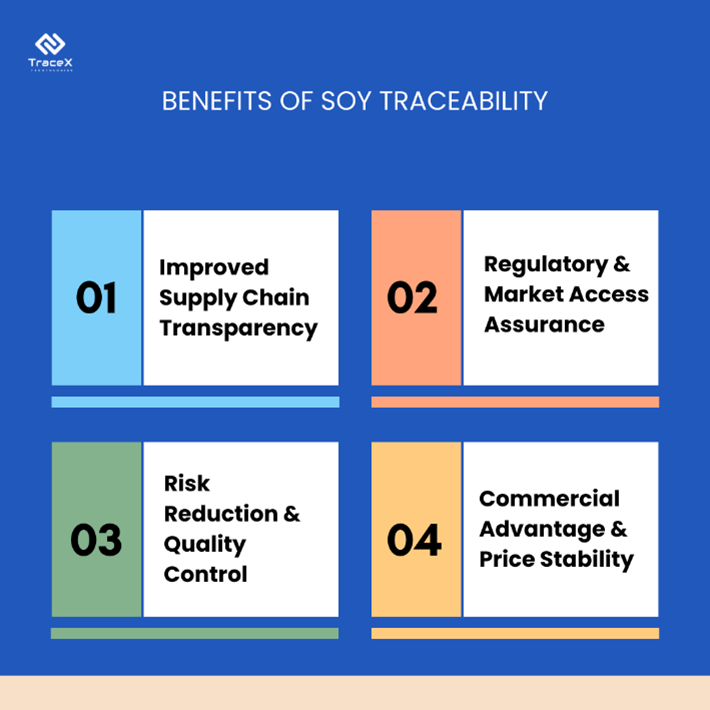
Kenya is an emerging soybean producer in East Africa, but global regulatory shifts and evolving buyer expectations are redefining how soy must be produced, documented, and exported. Market access is no longer driven by volume and price alone traceability, compliance, and verified sustainability are now decisive for competitiveness.
Key importing markets, including the EU, UK, and North America, are strengthening due-diligence requirements for agricultural commodities. Notable trends include:
For Kenyan soy exporters, batch-level traceability, farm GPS data, and digital audit trails are becoming mandatory. Without these, exporters risk shipment delays, rejections, buyer delisting, and restricted access to regulated markets.
Global processors, feed manufacturers, and food brands increasingly prioritize transparency and risk management. Buyers now expect:
Even price-sensitive markets demand traceable, consistent sourcing to reduce regulatory and reputational risk. Traceability is increasingly seen as supply-chain insurance.
Kenya’s soy sector still relies on paper-based records, informal aggregation, and multi-layered sourcing. These systems cannot:
As audits intensify, exporters using manual systems face higher compliance costs and increased risk of market exclusion.
Digitally traceable soy allows Kenyan exporters to:
Traceability enables competition based on verified origin, compliance, and reliability, not just volume.
At a national level, traceable soy supply chains:
Countries that digitize soy supply chains early will shape future global trade. For Kenya, traceability is no longer optional it is essential for long-term competitiveness, market access, and sustainable export growth.
Traceability in the soy supply chain in Kenya is critical for ensuring compliance with global regulations, meeting buyer expectations, and unlocking access to premium markets. By adopting digital farm mapping, batch-level tracking, and audit-ready reporting, Kenyan soy producers and exporters can improve supply chain transparency, strengthen quality control, and demonstrate responsible sourcing. Investing in traceability not only safeguards market access but also enhances smallholder inclusion, mitigates risks, and positions Kenya’s soy sector for sustainable growth and long-term competitiveness in regional and international markets.
Struggling with visibility gaps? Discover how traceability can fix them in our Supply Chain Traceability Blog.
Transform your food supply chain with digital tools—explore the Digital Traceability for Food Systems Blog.
See how blockchain improves trust, transparency, and auditability—start with our Blockchain Traceability Blog.
Traceability in the soy supply chain in Kenya is the ability to track soybeans from farm-level production through aggregation, processing, and export using digital records, batch IDs, and verified chain-of-custody systems.
Traceability enables Kenyan soy exporters to meet global buyer requirements, manage food safety and GMO risks, comply with sustainability and due-diligence regulations, and maintain access to regulated and premium markets.
Key challenges include fragmented smallholder production, informal aggregation networks, limited digital farm records, weak post-harvest documentation, and lack of standardized land and origin data.
Digital traceability supports GPS-based farm mapping, farmer onboarding, batch-level tracking, and automated compliance reporting improving transparency, efficiency, and audit readiness across the soy value chain.
Yes. Buyers increasingly prefer traceable soy for food, feed, and industrial use. Verified origin and compliance reduce rejection risk, improve buyer confidence, and enable access to long-term and higher-value contracts.