Product Transformation & Batch-Level Traceability for DPPs
Published
, 10 minute read
Share this article
Quick summary: Learn how Product Transformation & Batch-Level Traceability for DPPs ensures ESPR compliance, prevents data breaks, and provides end-to-end, auditable visibility across the supply chain.
Regulatory compliance under ESPR Digital Product Passports (DPPs) is no longer satisfied by simply knowing a product’s origin organizations must be able to prove how materials are transformed at every stage of production. Product Transformation & Batch-Level Traceability for DPPs enables Digital Product Passports to record how materials evolve from raw inputs to finished goods across the value chain.
From raw inputs to finished goods, each transformation changes a product’s composition, risk profile, and sustainability impact. The challenge is that many supply chains lack the visibility to track these changes consistently, leading to data breaks, unverifiable claims, and compliance risk. By linking transformation events to standardized product, batch, and location identifiers, DPPs provide auditable visibility into processes, inputs, and outputs. Batch-level traceability offers scalable compliance for high-volume and process-based industries, while serial-level tracking is used for higher-risk products.
Together, Product Transformation & Batch-Level Traceability for DPPs ensures data continuity, prevents traceability breaks, and supports ESPR compliance with verifiable, end-to-end product histories.This blog explores how DPPs track product transformations, when batch-level versus serial-level traceability is required, and how to prevent traceability gaps across the value chain.
Key Takeaways
Digital Product Passports (DPPs) enable end-to-end traceability by capturing product transformations across the value chain, linking raw materials to intermediates and finished goods through standardized identifiers and event-based records.
Organizations must choose between batch-level traceability for scalable, high-volume products and serial-level traceability for high-risk or regulated goods.
Common data breaks arise from inconsistent identifiers, manual handoffs, and system incompatibilities, which can be prevented through persistent identifiers and interoperable architectures.
Platforms from TraceXautomate batch traceability, ensuring continuous, auditable DPPs that meet ESPR compliance and maintain supply chain visibility.
DPP Explained → From Compliance to Competitive Edge
Unlock expert insights on Digital Product Passports, ESPR compliance, and leveraging traceability as a business advantage.
How DPPs Track Product Transformations Across the Value Chain
Digital Product Passports (DPPs) track product transformations by recording what changes, when it changes, where it happens, and who is responsible at every stage of the value chain. This approach moves beyond static product descriptions and creates a continuous, auditable record of material and process evolution, which is essential for ESPR compliance.
What Are Transformation Events in DPPs?
A transformation event captures the moment when one or more inputs are converted into a new output. Typical transformation stages include:
Raw material → intermediate product (e.g., cotton fiber spun into yarn)
Intermediate product → finished good (e.g., yarn woven and assembled into apparel)
Each event represents a material or structural change that affects the product’s composition, sustainability attributes, and regulatory profile.
Learn why source-level traceability is the foundation of Digital Product Passports →
Why ESPR Requires Recording Processes, Inputs, and Outputs
ESPR focuses on how products are made, not just where materials originate. This means DPPs must record:
Inputs: materials, components, and quantities used
Processes: manufacturing or processing steps applied
Outputs: resulting products, by-products, or waste
Without this information, sustainability claims (such as recycled content or low environmental impact) cannot be verified, and traceability becomes incomplete.
Linking Transformations to Traceable Identifiers
To ensure continuity and auditability, DPPs link every transformation event to standardized identifiers and metadata:
Product identifiers (GTINs) to identify inputs and outputs
Batch or lot numbers to group products produced under the same conditions
Time and location data to establish when and where the transformation occurred
Responsible party (supplier or facility) to assign accountability
These links create a connected chain of custody across the value chain.
Event-Based Traceability vs Static Product Records
Static records capture product attributes at a single point in time and quickly become outdated.
Event-based traceability records every transformation, shipment, and handoff as it happens, maintaining a live product history.
For ESPR DPPs, event-based traceability is essential to prevent data breaks, support audits, and enable real-time verification.
Choosing the correct level of traceability is a critical design decision for ESPR Digital Product Passports (DPPs). Both batch-level and serial-level traceability are valid under ESPR, but each serves different product types, risk profiles, and operational realities.
Batch-Level Traceability
Batch-level traceability groups products produced under the same conditions into a single identifiable batch or lot.
Suitable For
Commodities and process manufacturing, such as food ingredients, chemicals, textiles, and raw materials
High-volume, low-variability products where individual units are materially identical
See how custom batch IDs improved end-to-end crop traceability
Lower data volume, making it easier to manage and scale across large product volumes
Faster supplier onboarding and reduced integration complexity
Cost-effective compliance while still meeting ESPR traceability requirements
Typical ESPR Use Cases
Tracking material origin and sustainability attributes at batch level
Verifying recycled content or environmental characteristics for groups of products
Managing transformation events in continuous or process-based production environments
Batch-level traceability provides sufficient visibility for many ESPR use cases without introducing unnecessary complexity.
Serial-Level Traceability
Serial-level traceability assigns a unique identifier to each individual product unit.
Required For
Regulated, high-risk, or durable goods, such as electronics, batteries, medical devices, and long-life consumer products
Benefits
Unit-level visibility, enabling precise tracking throughout the product lifecycle
Accurate recalls and defect management, down to a single item
Lifecycle tracking, including repair, reuse, and end-of-life processes
Serial-level traceability supports deeper accountability and control where product risk, value, or regulatory scrutiny is higher.
How to Choose the Right Granularity for ESPR DPPs
Selecting the appropriate traceability level depends on several factors:
Regulatory requirements: Some product categories mandate unit-level traceability
Product risk and lifecycle: Higher risk or longer-lived products benefit from serial tracking
Operational feasibility: Data volume, system readiness, and supplier capabilities must be considered
Many organizations adopt a hybrid approach, using batch-level traceability for upstream materials and serial-level traceability for finished goods.
What Causes Data Breaks in DPP Traceability?
Data breaks occur when traceability information is lost, duplicated, or cannot be reliably connected across supply chain stages. In the context of Digital Product Passports (DPPs), these breaks undermine ESPR compliance by disrupting the continuous, auditable record required to prove product origin, transformations, and sustainability claims.
The most common causes include:
1. Inconsistent Identifiers
Different suppliers using internal SKUs instead of standardized product, batch, or location identifiers
Identifier changes across regions or systems that break data continuity
2. Manual Data Handoffs
Spreadsheets, emails, and PDFs introduce errors, delays, and version conflicts
Manual reconciliation leads to missing or duplicated records
3. Supplier System Incompatibility
Disconnected ERP, MES, and legacy systems that cannot exchange structured traceability data
Lack of interoperability across supply chain tiers
4. Region-Specific Data Silos
Country- or market-specific systems storing traceability data independently
Inability to aggregate a unified product history for DPPs
How Persistent Identifiers and Event-Based Models Prevent Data Breaks
Persistent identifiers (for products, batches, and locations) ensure that every event references the same entities across systems and regions.
Event-based traceability records each transformation, shipment, and handoff as it occurs, maintaining a continuous chain of custody rather than static snapshots.
Together, these approaches preserve data integrity as products move through complex, multi-tier supply chains.
Linking Upstream and Downstream Data Without Duplication
Effective DPP traceability requires upstream supplier data to flow seamlessly into downstream product and market records:
Each transformation or movement should reference existing identifiers rather than creating new records
This prevents duplication, supports auditability, and enables a single, trusted product history
Digital platforms from TraceX automate these linkages, ensuring consistency across the value chain.
Architecture Considerations for Transformation-Ready DPPs
A transformation-ready Digital Product Passport (DPP) requires a robust, modular architecture to ensure traceability, compliance, and interoperability across the value chain. This architecture is typically organized into three key layers:
1. Identity Layer
Purpose: Uniquely identifies every product, batch, and location.
Components:
Products: GTINs or serial numbers
Batches/Lots: Batch or lot numbers to link groups of products
Locations: GLNs to identify farms, factories, warehouses, and suppliers
Importance: Prevents duplicate records and ensures that each transformation event is linked to the correct entities, forming the backbone of traceability.
2. Data Layer
Purpose: Captures all events, transformations, and attributes associated with products.
Components:
Transformation events (e.g., raw material → intermediate → finished goods)
Shipment, storage, and handling events
Product attributes such as material composition, certifications, and sustainability claims
Importance: Supports event-based traceability, maintaining a live, auditable record rather than static snapshots, which is essential for ESPR compliance.
3. Access Layer
Purpose: Controls who can view, modify, and verify DPP data.
Users:
Regulators: Access audit-ready traceability records
Consumers: Verify sustainability and provenance via QR codes or Digital Link
Partners/Suppliers: Update and enrich upstream or downstream data
Importance: Ensures secure, role-based access while maintaining transparency and interoperability across the supply chain.
Interoperability and Standards Alignment
Adopting global standards such as GS1 identifiers ensures seamless data exchange between suppliers, partners, and regulatory systems.
Interoperability prevents data silos and allows DPPs to function across geographies, systems, and regulatory frameworks.
A standards-aligned architecture reduces future rework, supports compliance, and scales across multiple product lines.
How TraceX Helps in Batch Traceability for Digital Product Passports (DPPs)
TraceX provides a comprehensive digital traceability platform that ensures batch-level visibility across the entire supply chain, enabling organizations to meet ESPR and DPP compliance requirements. Here’s how it helps:
Persistent Batch Identification
Assigns unique batch IDs to raw materials, intermediates, and finished products.
Links each batch to its origin, supplier, and production site, ensuring upstream traceability.
Prevents duplication and inconsistencies by integrating with GS1-compliant identifiers like GTINs and GLNs.
Event-Based Traceability
Captures every transformation, movement, or storage event for each batch.
Records inputs, outputs, timestamps, locations, and responsible parties, creating a live, auditable chain of custody.
Ensuring End-to-End Traceability with Product Transformation & Batch-Level Tracking
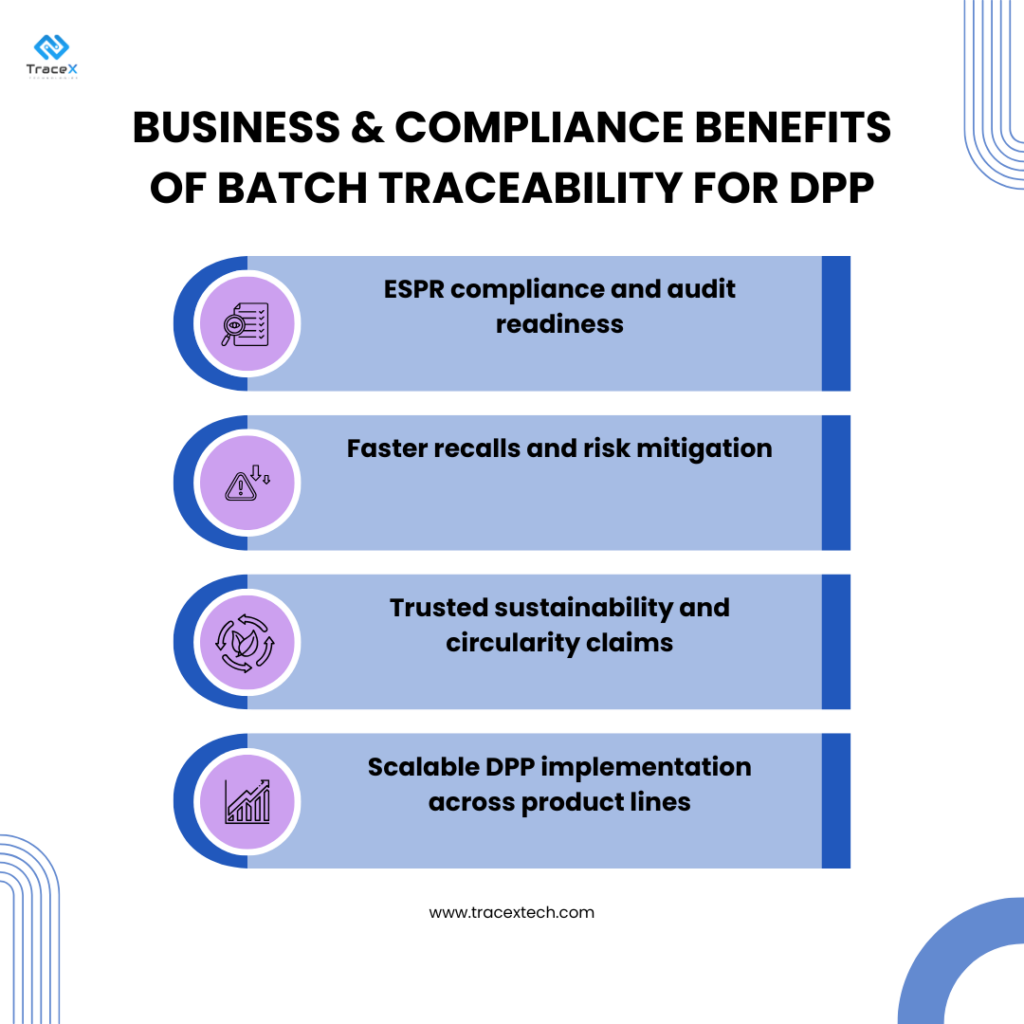
Product Transformation & Batch-Level Traceability for DPPs is essential for achieving ESPR compliance and building trusted, auditable Digital Product Passports. By linking transformation events to standardized product, batch, and location identifiers, organizations can track how raw materials evolve into finished goods across complex supply chains. Batch-level traceability offers scalable oversight for high-volume products, while serial-level tracking provides unit-level visibility for high-risk items. Implementing event-based traceability and leveraging digital platforms like TraceX prevents data breaks, ensures continuous compliance, and enables verifiable sustainability claims throughout the product lifecycle.
Learn how to choose the right traceability level—read our DPP architecture guide →
Explore the technology stack that powers modern Digital Product Passports
Frequently Asked Questions (FAQ’s)
What is batch-level traceability in DPPs?
Batch-level traceability tracks groups of products produced under the same conditions, linking raw materials, intermediate products, and finished goods for scalable, auditable oversight.
How do DPPs track product transformations?
DPPs record transformation events by linking inputs, processes, and outputs to standardized identifiers, capturing time, location, and responsible parties for complete traceability.
When should serial-level traceability be used instead of batch-level?
Serial-level traceability is required for high-risk, regulated, or durable goods where unit-level visibility, precise recall, and lifecycle tracking are essential.
Start using TraceX
Transparency, Trust, & Success for your Climate Journey.
We use cookies on our website to give you the most relevant experience by remembering your preferences and repeat visits. By clicking “Accept All”, you consent to the use of ALL the cookies. However, you may visit "Cookie Settings" to provide a controlled consent.
This website uses cookies to improve your experience while you navigate through the website. Out of these, the cookies that are categorized as necessary are stored on your browser as they are essential for the working of basic functionalities of the website. We also use third-party cookies that help us analyze and understand how you use this website. These cookies will be stored in your browser only with your consent. You also have the option to opt-out of these cookies. But opting out of some of these cookies may affect your browsing experience.
Necessary cookies are absolutely essential for the website to function properly. These cookies ensure basic functionalities and security features of the website, anonymously.
Cookie
Duration
Description
cookielawinfo-checkbox-analytics
11 months
This cookie is set by GDPR Cookie Consent plugin. The cookie is used to store the user consent for the cookies in the category "Analytics".
cookielawinfo-checkbox-functional
11 months
The cookie is set by GDPR cookie consent to record the user consent for the cookies in the category "Functional".
cookielawinfo-checkbox-necessary
11 months
This cookie is set by GDPR Cookie Consent plugin. The cookies is used to store the user consent for the cookies in the category "Necessary".
cookielawinfo-checkbox-others
11 months
This cookie is set by GDPR Cookie Consent plugin. The cookie is used to store the user consent for the cookies in the category "Other.
cookielawinfo-checkbox-performance
11 months
This cookie is set by GDPR Cookie Consent plugin. The cookie is used to store the user consent for the cookies in the category "Performance".
viewed_cookie_policy
11 months
The cookie is set by the GDPR Cookie Consent plugin and is used to store whether or not user has consented to the use of cookies. It does not store any personal data.
Functional cookies help to perform certain functionalities like sharing the content of the website on social media platforms, collect feedbacks, and other third-party features.
Performance cookies are used to understand and analyze the key performance indexes of the website which helps in delivering a better user experience for the visitors.
Analytical cookies are used to understand how visitors interact with the website. These cookies help provide information on metrics the number of visitors, bounce rate, traffic source, etc.
Advertisement cookies are used to provide visitors with relevant ads and marketing campaigns. These cookies track visitors across websites and collect information to provide customized ads.