Quick summary: Decoding GS1 identifiers for end-to-end traceability learn how GTINs, GLNs, SSCCs, and Digital Link enable compliant, interoperable supply chains.
Traceability fails when everyone speaks a different language. Modern supply chains are expected to answer simple questions instantly: Where did this product come from? What is it made of? Is it safe? Is it compliant? Yet many organizations still use internal SKUs, spreadsheets, or partner-specific codes. The result? Confusion, data gaps, failed audits, and broken traceability. Traceability only works when everyone speaks the same identification language and that language is GS1. GS1 Identifiers are globally standardized codes such as GTINs for products, GLNs for locations, and SSCCs for logistics units that uniquely identify items, facilities, and shipments across supply chains.
They enable end-to-end traceability by linking physical products to consistent, machine-readable digital records at farm, factory, warehouse, and market levels. By eliminating fragmented SKUs and manual reconciliation, GS1 Identifiers ensure interoperable data exchange, auditability, and real-time visibility. They form the foundation for regulatory compliance, recalls, sustainability reporting, and Digital Product Passports across complex, multi-supplier value chains.
Traceability is not just about collecting data it’s about connecting data.
Without a common identification language, supply chains fragment. With GS1 identifiers, they align. That’s why GS1 identifiers are widely considered the language of traceability spoken by products, understood by systems, and trusted by regulators worldwide.
Key Takeaways
GS1 is a global, neutral, non-profit standards organization that develops and maintains the most widely used identification and data-sharing standards in the world. Its mission is simple but critical: enable different organizations, systems, and countries to identify, capture, and share information about products, locations, and assets in a consistent way.
GS1 operates in more than 100 countries and underpins everyday supply chain operations across industries such as:
When a product scans at checkout, moves through a warehouse, crosses a border, or appears in a regulatory database, it is very often using a GS1 identifier. This global acceptance makes GS1 the foundation of modern supply chain interoperability.
At the core of GS1 traceability standards is the principle of global uniqueness.
GS1 assigns companies a GS1 Company Prefix, which they use to create identifiers that are guaranteed to be unique worldwide. These identifiers follow standardized structures and rules so that any system, anywhere, can interpret them correctly.

For example:
Because these identifiers follow GS1 traceability standards, they allow supply chain events production, transformation, shipping, receiving, and sale to be linked together reliably.
Explore our deep dive into GS1 standards and how they power modern traceability
Go deeper on GS1 traceability, and how to make it work in practice
| Feature | Internal SKU (Stock Keeping Unit) | GS1 Identifier (e.g., GTIN / GLN) |
| Primary Purpose | Internal inventory and accounting. | Cross-border trade and regulatory compliance. |
| Scope of Meaning | Private (only your company understands it). | Universal (recognized by every scanner in the world). |
| Uniqueness | Local. Another company could use the same code. | Global. Guaranteed to be unique to your product. |
| Structure | Alphanumeric and flexible (often human-readable). | Numeric-only and standardized (machine-optimized). |
| Persistence | Can be changed if your warehouse logic changes. | Permanent. It stays with the product forever. |
| DPP Compliance | Non-compliant. Cannot be used for the DPP link. | Mandatory. The “backbone” of the DPP data carrier. |
| Interoperability | Zero. Systems outside your company cannot “read” it. | High. Enables seamless data exchange with recyclers. |
GS1 traceability standards rely on one foundational idea: you cannot trace what you cannot uniquely identify.
By using GS1 identifiers:
GS1 identifiers transform traceability from isolated tracking into a connected, end-to-end data ecosystem.
GS1 identifiers form the backbone of traceability by uniquely identifying what the product is, where it is, and how it moves through the supply chain. Each identifier serves a specific role, and together they create a complete, auditable traceability system.
The GTIN uniquely identifies a product at the item or SKU level anywhere in the world.
What it identifies
Each product configuration size, packaging, formulation receives its own GTIN.
Where it is used
The GTIN is the foundation of product-level traceability. When combined with batch/lot or serial numbers, it enables:
Without a GTIN, product data cannot be consistently linked across organizations.
The GLN uniquely identifies locations and legal entities within a supply chain.
What it identifies
A GLN can represent both physical locations and legal entities.
Where it is used
GLNs play a key role in regulations and sustainability frameworks, including:
By standardizing location identification, GLNs remove ambiguity from compliance and audit processes.
The SSCC uniquely identifies logistics units such as pallets, cartons, and containers.
What it identifies
An SSCC identifies the unit being shipped, not the individual products inside it.
Where it is used
SSCCs enable:
By linking SSCCs to the GTINs they contain, organizations gain full visibility from shipment → pallet → product.
GRAI (Global Returnable Asset Identifier) and GIAI (Global Individual Asset Identifier) identify assets, not products.
What they identify
Where they are used
As supply chains move toward reuse and circularity, asset identification becomes essential. GRAI and GIAI support:
These identifiers are increasingly important in circular economy and sustainability initiatives.
True traceability happens when GS1 identifiers are combined:
Together, they form a connected traceability framework that is interoperable, auditable, and globally trusted.
GS1 Digital Link is a GS1 standard that connects a physical product’s GS1 identifier (such as a GTIN) to live, web-based digital information using a QR code or other scannable data carrier.
In simple terms:
GS1 Digital Link turns a barcode into a web link that points to trusted, up-to-date product data.
Instead of encoding only a static number, the GS1 Digital Link encodes a URL structure that systems, regulators, and consumers can all interpret consistently.
Traditional barcodes only tell systems what a product is. GS1 Digital Link goes further by enabling access to everything known about that product.
Here’s how it works:
The same QR code can deliver:
This is the foundation of GS1 QR code traceability one code, many trusted data destinations.
GS1 Digital Link is a critical enabler of Digital Product Passports (DPPs) and modern transparency requirements.
Digital Link allows a product’s GS1 identifier to act as the primary key for its DPP, ensuring:
With a simple smartphone scan, consumers can access:
Because the data is linked dynamically, it can be updated without changing the packaging.
In recall situations, GS1 Digital Link enables:
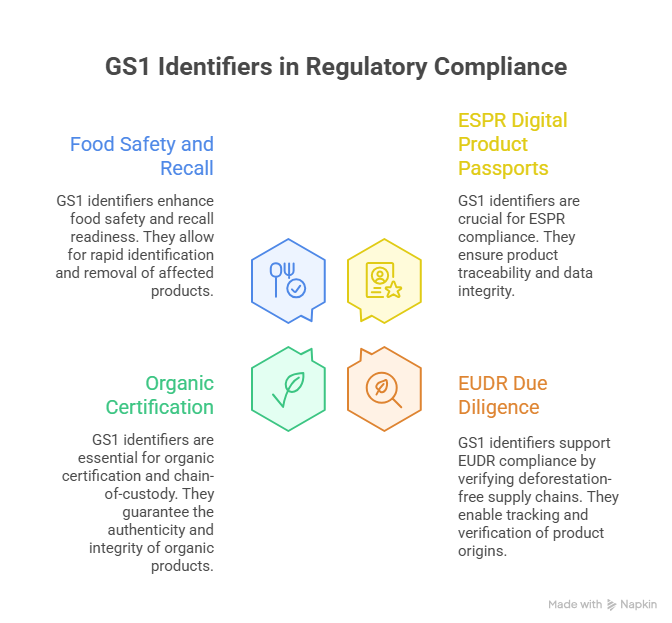
The Ecodesign for Sustainable Products Regulation (ESPR) and related EU initiatives require products to be connected to standardized, interoperable digital data.
GS1 Digital Link is central to this because it:
By separating identity (GS1 identifier) from data storage (digital endpoints), Digital Link ensures that DPPs remain flexible, future-proof, and interoperable.
This makes GS1 Digital Link a natural fit for regulatory-driven traceability and sustainability frameworks.
GS1 Digital Link transforms QR codes from marketing tools into trust anchors for traceability.
It enables:
End-to-end traceability means being able to answer quickly and with evidence where a product came from, what happened to it, and where it went. GS1 identifiers make this possible by providing a shared, globally understood identification framework that links every step of the supply chain.
Linking farm → batch → product → shipment → market
GS1 identifiers create a connected chain of identity across supply chain events.
Because each step uses GS1 identifiers, data from different parties can be linked without ambiguity. This creates a continuous digital trail from origin to consumer.
Modern supply chains involve many independent actors farmers, processors, manufacturers, logistics providers, retailers each using different IT systems.
GS1 identifiers act as a common reference layer that ensures:
Instead of mapping dozens of internal codes, systems align on GS1 identifiers as the single source of identity, enabling interoperability across ERP, WMS, blockchain, IoT, and regulatory platforms.
GS1 identifiers support multiple levels of traceability, depending on regulatory and business needs.
Because these identifiers are standardized, companies can scale from basic compliance to advanced traceability without redesigning their data model.
GS1 identifiers are often adopted to “check a box” for labelling or retail requirements. When that happens, companies miss their real value as a data foundation for end-to-end traceability. The result is fragmented systems, audit fatigue, and growing compliance risk.
Many organizations view GS1 purely as a packaging or labelling requirement something owned by the packaging or retail team. GTINs are printed on products but not used in backend systems. Traceability data lives separately from GS1 identifiers. Barcodes exist without meaningful digital linkage
Treat GS1 identifiers as master data keys that link operational, regulatory, and sustainability data across the organization.
Inconsistent use across suppliers and regions
GS1 identifiers are used correctly in some regions or business units, but not others. Suppliers may use different identifier formats, Local codes instead of GS1 IDs and Incomplete or incorrect GS1 data. What goes wrong is traceability breaks at supplier handoffs, data cannot be aggregated globally and manual mapping and reconciliation increase. Traceability is only as strong as its weakest link. Inconsistent GS1 usage prevents organizations from achieving end-to-end visibility, especially in global or multi-tier supply chains.
Define clear GS1 governance
Not linking GS1 IDs to sustainability and compliance data
GS1 identifiers are used for logistics and inventory but are not connected to certifications, ESG metrics, origin and deforestation data and Digital Product Passports. Sustainability data cannot be verified at product level, compliance evidence must be recreated for every audit and reporting becomes manual and error-prone. Regulations increasingly require proof, not just claims. Without GS1 identifiers as the linking key, sustainability and compliance data remain siloed and unverifiable.
When these mistakes compound, organizations experience:
TraceX solutions natively supports GS1 identifiers as first-class data objects, not add-ons.
This ensures that every traceability event origin, processing, transformation, shipment is anchored to globally unique GS1 identities.
TraceX is designed to be GS1 Digital Link–ready by default.
This architecture makes TraceX a natural backbone for:
Traceability breaks when suppliers don’t speak the same data language. TraceX solves this by using GS1 standards as the onboarding baseline.
This allows TraceX to scale traceability beyond tier-1, reaching upstream origins where most compliance risk lives.
TraceX embeds GS1 identifiers directly into compliance workflows so compliance is designed in, not bolted on.
Because all compliance data is anchored to GS1 identifiers, it is:
GS1 is often seen at the checkout scanner, but its real power lies far beyond the barcode. By providing a shared, globally trusted identity for products, locations, and shipments, GS1 makes traceability possible at scale. It is the invisible backbone that connects data across suppliers, systems, and borders turning fragmented records into a single, verifiable story. In an era of rising regulation, digital product passports, and consumer demand for transparency, GS1 is not optional infrastructure; it is the foundation on which compliant, intelligent, and trustworthy supply chains are built.
Go deeper into product traceability and how to implement it →
Learn how QR codes enable real-time, digital traceability →
Explore the architecture behind compliant Digital Product Passports →
GS1 identifiers are globally unique, standardized codes (such as GTINs and GLNs) used to identify products, locations, and shipments. They are essential for traceability because they ensure that data from different suppliers and systems refers to the same item or location, enabling accurate tracking, audits, and recalls.
GS1 identifiers link every stage of a product’s journey from origin and batch to shipment and market using a common identification language. This allows data to flow seamlessly across organizations, eliminates manual reconciliation, and supports batch-, product-, and location-level traceability.
While not always explicitly mandated, GS1 identifiers are increasingly a de facto requirement for compliance with regulations such as EUDR and ESPR. They also serve as the foundation for Digital Product Passports by providing a consistent, interoperable product identity that connects physical goods to verified digital data.