
Quick summary: Traceability in the Shea Supply Chain in Kenya is essential for global market access. Learn how digital tools enable transparent, compliant, and premium cashew exports.

Traceability in the Shea Supply Chain in Kenya is critical for ensuring ethical sourcing, quality, and compliance with global standards. Shea production is concentrated in arid and semi-arid regions such as Kitui, Garissa, and Isiolo, where women smallholders harvest nuts from naturally occurring parklands. The supply chain is multi-tiered—collectors, local aggregators, cooperatives, processors, and exporters—leading to challenges in tracking farm-level origins, verifying land use, and ensuring deforestation-free sourcing. Implementing digital traceability systems, including GPS-mapped collection zones, batch-level IDs, and blockchain-verified records, enables Kenyan exporters to meet international regulations, strengthen market access, and enhance buyer confidence.
Kenya is an emerging shea-producing country in East Africa, contributing to global shea butter and kernel supply, primarily for cosmetics, food, and personal care industries. Key production regions include Kitui, Garissa, Isiolo, and parts of Machakos, where women smallholders collect nuts from naturally occurring parklands rather than cultivated plantations. Kenya produces an estimated 30,000–40,000 metric tons of raw shea nuts annually, with exports largely directed to the EU, USA, and Asia for processing into shea butter, cosmetics, and food ingredients.
The supply chain follows a multi-tiered structure: women collectors → local aggregators → cooperatives → processors → exporters. Heavy reliance on informal intermediaries often leads to mixed sourcing, making farm-level traceability challenging. Most collectors lack structured digital records, geolocation mapping, or land documentation, resulting in limited visibility into collection areas, harvesting practices, and sustainability compliance.
Despite these challenges, Kenya’s shea exports are growing steadily, with annual export values estimated at $25–35 million, reflecting increasing global demand for ethically sourced and traceable shea products. Digitized traceability and sustainable sourcing practices are becoming essential for maintaining market access and improving export competitiveness.
Ready to Build a Fully Transparent Shea Supply Chain?
Discover how digital tools can streamline documentation, verify origin, and strengthen buyer confidence.
Explore the full guide to Forestry-to-Factory Traceability in Shea Supply Chains
From farm mapping to blockchain traceability, our Guide to Food Traceability breaks it all down. Read it now.
Addressing these challenges requires digitized traceability, farm mapping, and structured smallholder engagement to strengthen quality, sustainability, and export competitiveness.
The TraceX Traceability Platform delivers the digital infrastructure necessary to bring transparency, compliance, and reliability to Kenya’s shea supply chain. By digitizing every step from parkland nut collection to aggregation, processing, and export, TraceX enables exporters, processors, cooperatives, and global buyers to verify origin, monitor quality, and meet international sustainability and regulatory standards.
TraceX platform connects all supply chain actors women collectors, local traders, cooperatives, aggregators, processors, and exporters into a unified digital ecosystem, enabling:
• Real-time tracking of nut movement
• Secure, seamless data flow across all nodes
• Centralized monitoring of collection, aggregation, processing, and export
This eliminates blind spots, ensuring only verified, compliant shea moves through the value chain.
The platform captures GPS coordinates or polygon maps for Kenya’s shea collection zones, helping exporters:
• Validate collection boundaries
• Confirm community-access and land-use rights
• Demonstrate deforestation-free, sustainable sourcing
• Maintain audit-ready geospatial records
Using mobile-first tools, TraceX platform registers collectors and groups with verified data:
• Collector identity and contact information
• GPS-linked collection areas
• Land-access or community rights documentation
• Harvest and yield records
• Cooperative or aggregator affiliations
Each shea batch is assigned a unique digital ID from farm to export, ensuring complete chain-of-custody across:
• Parkland harvesting
• Local traders
• Cooperatives and aggregation points
• Processing centers
• Export documentation
All supply chain records are secured on blockchain, making them:
• Immutable and tamper-proof
• Time-stamped and audit-ready
• Accessible to authorized stakeholders
TraceX platform automatically generates:
• Traceability and origin verification reports
• Sustainability and ESG documentation
• Compliance records aligned with global regulations
• Buyer-specific due diligence reports
• Complete digital audit trails
This reduces manual workload and ensures Kenya’s shea exporters remain compliant and market-ready.
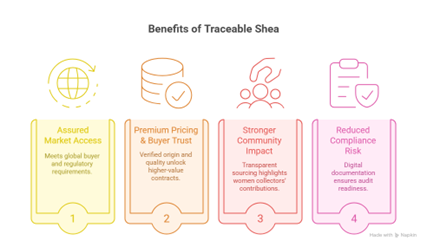
Kenya’s shea sector is increasingly exposed to global regulatory and market pressures that make traceability a strategic necessity. Regulations require exporters to provide verifiable, deforestation-free proof of origin for all raw shea and derivatives, including butter and powders. Non-compliance risks shipment blocks, fines, and restricted market access.
For Kenyan exporters, adopting digitized traceability solutions including GPS-based farm mapping, batch-level digital IDs, and blockchain-backed chain-of-custody is no longer optional. It ensures regulatory compliance, protects market access, and positions Kenya as a reliable supplier of sustainable, premium shea products.
This convergence of regulation and market demand makes traceability both a compliance tool and a competitive differentiator for Kenya’s shea sector.
Traceability is now a critical enabler for Kenya’s shea sector, linking smallholder collectors, cooperatives, processors, and exporters in a transparent and verifiable supply chain. By implementing digital solutions such as farm GPS mapping, batch-level IDs, and blockchain-backed records, the industry can ensure full chain-of-custody, meet stringent global regulations, and respond to growing buyer demand for sustainable, ethically sourced shea. Strengthening traceability not only safeguards export markets but also enhances value for collectors, improves quality monitoring, and positions Kenya as a trusted, competitive supplier in the global shea market.
Struggling with visibility gaps? Discover how traceability can fix them in our Supply Chain Traceability Blog.
Transform your food supply chain with digital tools—explore the Digital Traceability for Food Systems Blog.
See how blockchain improves trust, transparency, and auditability—start with our Blockchain Traceability Blog.
Because global markets especially the EU, US, and Asia now demand verified origin, legal sourcing, and deforestation-free supply chains. Without traceability, shipments risk rejection.
Fragmented smallholder networks, lack of farm mapping, multi-tier aggregation, limited documentation, and poor data visibility across the supply chain.
Digital platforms enable farmer onboarding, plantation mapping, batch-level tracking, blockchain proof of origin, and automated compliance reporting.
Not necessarily. Many solutions offer offline data capture, cooperative-based data entry, and low-tech mobile tools that work even in low-connectivity regions.
It provides better access to formal markets, potential price premiums, stronger buyer relationships, reduced exploitation, and inclusion in certified and compliant export value chains.