
Quick summary: Learn how EUDR Due Diligence (DDS) affects Italy’s gloves supply chain. Understand traceability, risk assessment, origin verification, and compliance requirements for importers.
EUDR DDS for Gloves Supply Chain in Italy requires importers and manufacturers of rubber-based gloves to prove that all natural rubber used originates from deforestation-free, legally compliant plantations. Because Italy sources most medical, industrial, and household gloves from Malaysia, Thailand, Indonesia, Vietnam, and China regions with complex smallholder rubber systems, companies must ensure plot-level geolocation, risk assessments, and full chain-of-custody documentation. Italian importers must submit a complete Due Diligence Statement (DDS) for every shipment, making digital traceability, supplier verification, and deforestation-free evidence essential for uninterrupted market access.
Italy is a major importer and distributor of medical, industrial, and household gloves, with strong consumption in healthcare, manufacturing, food processing, and sanitation services. Like other EU markets, Italy relies heavily on natural rubber–based gloves sourced from Malaysia, Thailand, Vietnam, Indonesia, China, and rubber-producing countries in West Africa and Southeast Asia. These origins operate under diverse land-use regulations and forest-governance systems, making EUDR-aligned traceability and legality verification difficult to standardize.
In 2023, Italy’s imports of rubber surgical and protective gloves (HS 401511 & 401519) were valued at roughly US$850M–1B, reflecting the country’s high dependence on global supply. Much of the natural rubber used in glove production passes through multi-tier networks smallholders, aggregators, sheet processors, TSR plants, compounders, and glove manufacturers where geolocation mapping, land-rights proof, and deforestation-free validation are often incomplete or entirely unavailable. Commingling during latex collection increases traceability complexity and elevates EUDR compliance risk.
Under the EUDR, Italian glove importers must submit a fully compliant Due Diligence Statement (DDS) containing precise plantation coordinates, traceable chain-of-custody, legality documentation, and a risk-mitigation assessment for every shipment containing natural rubber. Missing farm data, undocumented intermediaries, and inconsistent origin records significantly raise the risk of shipment delays, penalties, and even blocked entry into the EU.
These structural vulnerabilities make end-to-end digital traceability, geospatial farm mapping, supplier onboarding, and automated compliance systems essential for Italy’s glove sector to meet EUDR enforcement requirements and avoid supply chain disruptions.
Italy’s glove ecosystem supports:
Upstream, sourcing links to millions of rubber farmers and glove factory workers across Southeast Asia.
Major importers/distributors:
Italy re-exports gloves to:
Italy functions as a Southern European PPE hub.
Italy converts global glove imports into certified, value-added PPE for the EU.
Although gloves are not a listed EUDR commodity, natural rubber critical for medical and household gloves is fully regulated under EUDR. This places Italy among Europe’s most exposed glove markets, especially given its heavy reliance on Southeast Asian rubber.
For Italy a major EU PPE consumer and distributor EUDR DDS readiness is now a strategic necessity to safeguard supply continuity and maintain compliance across healthcare and industrial sectors.
Master the step-by-step process of submitting Due Diligence Statements under the new EUDR rules.
Read the blog on filing DDS for EUDR compliance
Stay Ahead of EUDR in Healthcare Supply Chains
Germany’s medical and PPE sector is entering a new era of transparency. Don’t wait for regulatory audits or shipment blocks—learn how healthcare manufacturers and importers can streamline EUDR DDS, secure supplier data, and protect market access.
Read the full guide on EUDR compliance for the healthcare sector
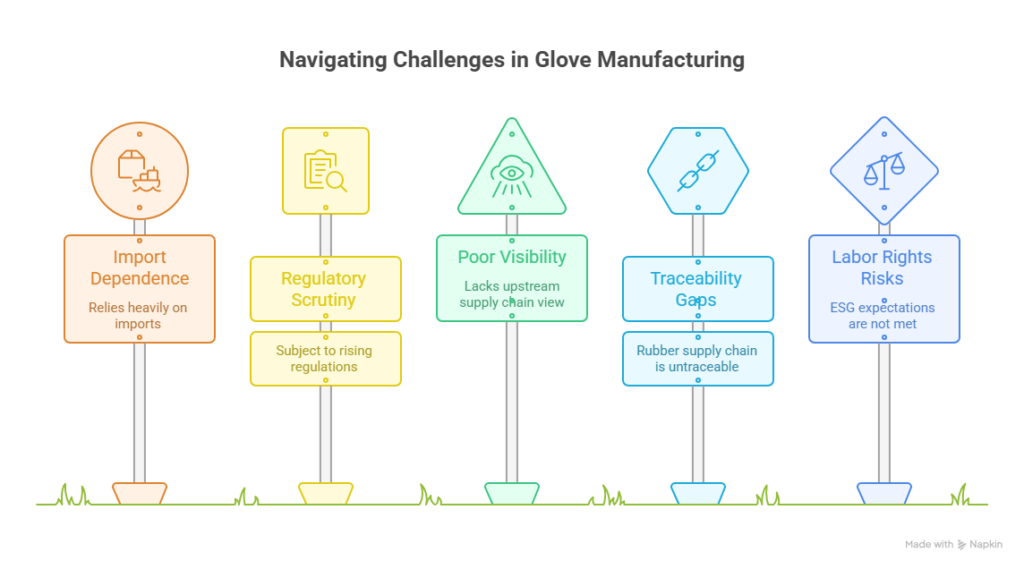
Italy imports the vast majority of its nitrile, latex, and natural rubber for medical and industrial gloves from Malaysia, Thailand, China, Vietnam, and Indonesia.
This creates vulnerabilities because:
Italian glove manufacturers and distributors typically work with multi-layered supply chains:
This creates traceability challenges such as:
Italy must comply with EU Deforestation Regulation (EUDR) for any gloves containing natural rubber. Italian importers face new expectations to provide:
For many non-EU suppliers, these requirements are still unfamiliar or operationally difficult.
Many rubber-producing countries lack:
Italian importers therefore carry the burden of upskilling and onboarding suppliers to avoid compliance failures.
Italy’s demand is driven by:
Any delay in shipments due to compliance gaps directly affects critical industries, making supply reliability a major pressure point.
Italy competes with the Netherlands, Germany, and Belgium countries with:
Italian distributors risk losing EU market share if they cannot ensure fast, compliant, and traceable rubber glove supply chains.
Meeting EUDR expectations increases operational costs:
Smaller Italian importers struggle the most.
Because of the upstream complexity and commingling in rubber processing, Italian companies often lack:
This increases the risk of non-compliance, delays, and penalties.
Italy’s glove importers and manufacturers face rising risk due to complex international supply chains, EUDR compliance requirements, and supplier readiness gaps. Without digital traceability, geolocation mapping, and automated documentation workflows, Italy’s glove sector will face escalating compliance costs, supply disruptions, and competitive disadvantages across the EU market.
TraceX delivers a unified digital compliance infrastructure that helps Italian glove importers, manufacturers, medical distributors, and industrial supply chains meet emerging EUDR-aligned due diligence expectations especially for natural-rubber-based gloves sourced from Southeast Asia and West Africa. Italy’s glove market, strongly driven by healthcare, pharma, food processing, and industrial safety, relies heavily on imported rubber and finished gloves. This creates upstream traceability challenges. TraceX EUDR Compliance Platform digitizes supplier data, plantation geolocation, processing documents, and risk intelligence, enabling Italian companies to generate complete and audit-ready Due Diligence Statements (DDS) with minimal workflow disruption.
Most rubber used in medical and industrial gloves originates from smallholder farms with limited documentation. TraceX platform enables suppliers to upload:
This equips Italian importers with verified origin data required for EUDR legality and sustainability assurance.
TraceX digitally connects all tiers of Italy’s glove supply chain:
latex → cup lumps → processing (RSS, TSR) → compounders → glove manufacturers → exporters → Italian importers.
Each batch receives a unique digital ID, eliminating blind spots from aggregation, commingling, or re-processing—a critical capability for validating deforestation-free rubber sourcing.
The platform automates the capture and validation of:
TraceX platform flags missing or inconsistent documents early, reducing compliance risks for Italian glove companies.
With GIS tools, satellite imagery, and AI models, TraceX continuously monitors:
Every plantation, supplier cluster, or shipment receives an automated EUDR-aligned risk score.
TraceX platform consolidates geolocation, legality documents, risk data, and chain-of-custody traces into a submission-ready DDS for each glove shipment entering Italy—ensuring EUDR-aligned due diligence at scale.
TraceX supports multilingual onboarding for suppliers across Malaysia, Thailand, Indonesia, Côte d’Ivoire, and other rubber-producing countries, enabling:
to adopt EUDR-ready traceability workflows rapidly.
All records are time-stamped and stored on blockchain, offering tamper-proof evidence required for Italian customs checks, regulatory audits, and buyer-driven sustainability verification.
Italian companies gain real-time visibility into:
This helps compliance teams resolve issues before shipments reach Italian ports or distributors.
TraceX connects with SAP, Oracle, Microsoft Dynamics, PPE logistics systems, and healthcare procurement platforms widely used in Italy, allowing compliance workflows to run seamlessly with purchasing, quality, and inventory operations.
As Italy prepares for tighter EU scrutiny on natural-rubber sourcing, adopting digital traceability and automated DDS workflows is becoming a strategic necessity not just a regulatory task. Platforms like TraceX enable Italian importers, manufacturers, and medical distributors to verify plantation origins, monitor deforestation risks, and maintain audit-ready documentation across complex global supply chains. By building end-to-end visibility now, Italy’s gloves sector can safeguard market access, reduce compliance disruptions, and strengthen its reputation as a trusted supplier to European healthcare and industrial markets.
Understand the key components of EUDR compliance and how to streamline your DDS process efficiently.
Read the blog on EUDR Due Diligence
Learn how AI-driven automation and intelligent workflows simplify data collection, verification, and reporting.
Explore the blog on Agentic AI for EUDR
Unpack the biggest hurdles faced by importers under EUDR and how technology can turn compliance into a competitive edge.
Read blog on Challenges for EU Importers
Gloves made from natural rubber fall under EUDR because rubber is a regulated commodity. Italian’s glove importers must prove deforestation-free, legally sourced rubber.
Importers must collect plot-level geolocation of rubber farms, verify legal harvesting, assess deforestation risk, and submit a Digital Due Diligence Statement before placing gloves on the EU market.
Most natural rubber comes from smallholder farmers in Southeast Asia and Africa, where limited mapping, informal trade, and supply commingling create traceability gaps.
Manufacturers must ensure full traceability for rubber used in surgical, household, and industrial gloves. Non-compliance risks shipment delays, fines, and market restrictions.
They must provide farm geolocation, legality records, land-use rights, supply chain traceability documents, and proof of deforestation-free sourcing.
Yes. Platforms like TraceX automate origin mapping, supplier data collection, risk scoring, and DDS generation, reducing manual compliance efforts and ensuring audit-ready records.