
Quick summary: Brazil and Vietnam lead global coffee exports, dominating over 50% of the market. The top 10 exporters including Colombia, Ethiopia, and Honduras face climate volatility, compliance pressures, and traceability gaps. The future demands climate resilience, digital traceability, and premium certified coffees to meet shifting consumer and regulatory demands.

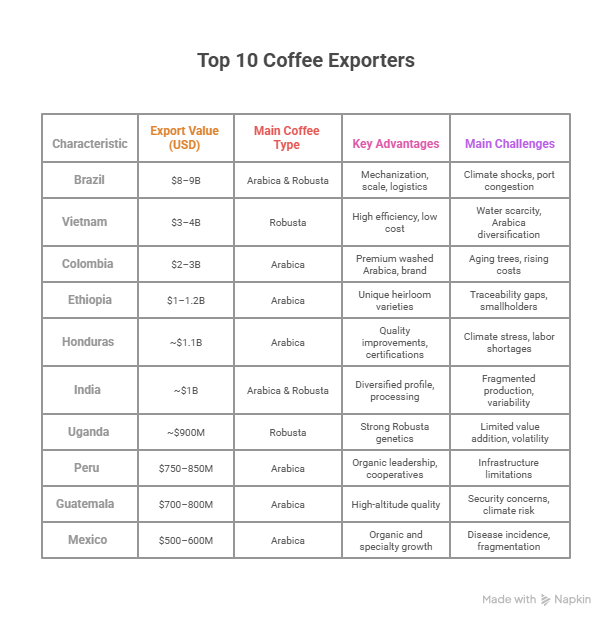
The top Global Coffee Exporters are led by Brazil and Vietnam, which dominate over half of the world’s coffee supply. Colombia, Ethiopia, and Honduras follow as major Arabica producers, while Uganda and India contribute strong Robusta volumes. Peru, Guatemala, and Mexico round out the top exporters with growing specialty and organic segments. These Global Coffee Exporters face common challenges, including climate volatility, rising compliance requirements, and price fluctuations. Despite this, they continue to shape global supply through strong production capacity, diverse coffee profiles, and expanding certified and traceable value chains.
Key Takeaways
The global coffee export market continues to expand steadily, driven by rising consumption and growing demand for differentiated coffee profiles. Valued at over $40 billion, the market maintains a 4–5% annual growth rate, with developing economies contributing increasingly to global consumption. A key shift is the rapid rise of specialty, premium, and sustainably certified coffees, including Organic, Fairtrade, and Rainforest Alliance (RA) as buyers prioritize traceability, ethical sourcing, and environmental stewardship. This premiumization trend is pushing exporters to adopt more rigorous quality control and sustainability protocols.
Consumer patterns are shifting fastest in the EU and USA, which remain the largest importers, while China and the Middle East are emerging as high-growth markets with expanding café cultures and a strong appetite for premium blends. These regions are reshaping demand dynamics by moving beyond mass-market instant coffee toward higher-value roasts and single origins.
However, the market is becoming more unpredictable due to climate variability, which affects yields, production stability, and origin reliability. Increasing temperatures, erratic rainfall, and disease outbreaks (like coffee rust) are causing more frequent supply shocks. Exporters that rely on climate-sensitive Arabica varieties face greater volatility, making resilience, diversification, and digital traceability critical for long-term competitiveness.
The future of coffee exports will not be determined solely by production volume but by origin credibility, data-backed sustainability claims, and climate resilience strategies. Exporters able to combine high-quality production with transparent, traceable, and compliant supply chains will have a strategic advantage in a market where buyers are no longer purchasing coffee, they’re purchasing proof of how it was produced.
Brazil dominates global coffee exports with over $8–9 billion annually and unmatched production volumes. Its strengths lie in favorable agroclimatic conditions, large-scale plantations, advanced mechanization, and efficient logistics. However, Brazil remains vulnerable to climate shocks—notably frost and drought, causing significant year-to-year volatility. Export logistics have also faced strain due to port congestion. Key players include Cooxupé, Olam, Volcafe, and major Brazilian cooperatives.
Vietnam exports roughly $3–4 billion in coffee annually, driven largely by high-yield Robusta. Its strengths include production efficiency, low costs, and strong government support. However, the country faces challenges such as climate stress, water scarcity, and the push to diversify into higher-value Arabica. Major exporters include VinaCafe and Intimex.
Colombia generates $2–3 billion in export value, built on its heritage of premium, high-altitude washed Arabica. Its strengths include strong origin branding and a sophisticated farmer support system. Key challenges include aging coffee trees, rising production costs, and climate-driven disease pressures. Major players include the FNC (Federación Nacional de Cafeteros) and Nespresso-affiliated partners.
Ethiopia exports an estimated $1–1.2 billion annually, known for its unique heirloom varieties and rich flavor profiles, highly valued in specialty markets. Strengths include a globally attractive terroir and rising specialty demand. Challenges include traceability gaps, informal market channels, and a fragmented smallholder base. Key actors are ECX-linked exporters and the Oromia Coffee Farmers’ Cooperative Union.
With exports worth $1–1.1 billion, Honduras has emerged as a major origin for both mainstream and specialty coffee. Strengths include improvements in quality grading, processing, and sustainability certifications. Key challenges remain climate variability, disease outbreaks, and labor shortages. Key players include exporters associated with IHCAFE (Honduran Coffee Institute).
India’s coffee exports, valued at $900 million–$1 billion, benefit from a unique mix of Robusta, Arabica, and specialty monsooned coffee. Strengths include strong domestic processing and integrated plantations. Challenges involve high smallholder fragmentation and climate variability. Leading exporters include Tata Coffee, Allanasons, and several plantation groups.
Uganda exports $800 million–$900 million annually, with a strong base in natural Robusta genetics and an expanding Arabica segment. Strengths lie in resilience and government-led expansion programs. Key challenges include low domestic value addition, price volatility, and infrastructure gaps. Major players include UCDA-affiliated exporters and Kyagalanyi Coffee.
Peru exports around $750–850 million in coffee, widely recognized for its high share of Organic-certified production and growing specialty footprint. Strengths include clean flavor profiles and strong cooperative networks. Challenges include transport and infrastructure limitations, affecting quality consistency. Key actors include COOP Norandino and Volcafe Peru.
Guatemala generates $700–800 million in export value, anchored in its high-altitude, volcanic-soil-grown Arabica, renowned in specialty circles. Strengths include strong regional appellations (e.g., Antigua, Huehuetenango). Challenges include security risks, labor shortages, and ongoing climate stress. Leading exporters work closely with Anacafé.
Mexico exports $500–600 million annually, growing steadily in organic and specialty segments. Strengths include certifications, micro-lots, and diverse terroirs. Challenges involve climate risk, coffee rust prevalence, and fragmented smallholder systems. Key players include AMSA, Nestlé-sourcing networks, and regional cooperatives.
Climate volatility remains the most urgent challenge for coffee-producing nations. El Niño-driven droughts, prolonged heat waves, and shifting rainfall patterns directly reduce yields particularly for Arabica, which is highly climate-sensitive. Outbreaks of coffee leaf rust (CLR), berry borers, and other pests intensify under warmer temperatures, leading to significant production losses in Colombia, Central America, and East Africa. As climate shocks become more frequent, export volumes fluctuate, global prices become unstable, and smaller producers struggle to adapt.
Across Brazil, Ethiopia, Uganda, Peru, and most coffee origins, 70–95% of production is driven by smallholders, many of whom operate at extremely low margins. Fragmented farm sizes limit mechanization, productivity, and access to finance. Low and volatile farmgate prices prevent investment in quality improvements or climate-resilient practices. This perpetuates a cycle where farmers remain vulnerable, cooperatives face inconsistent supply, and exporters struggle to secure uniform-quality beans.
Global buyers, particularly in the EU, USA, and Asia, now demand strict compliance with sustainability metrics. New regulations like the EU Deforestation Regulation (EUDR) require plot-level geolocation, deforestation verification, and chain-of-custody visibility capabilities many origins currently lack. Certifications (Organic, RA, Fairtrade, UEBT) are growing prerequisites in specialty markets. Exporters must now deliver audit-ready data, supplier risk assessments, and ESG disclosures, increasing operational complexity and cost.
Many major exporters especially Ethiopia, Uganda, Honduras, and Peru still rely on manual, paper-based traceability systems. Coffee often changes hands multiple times through informal intermediaries, making it difficult to track farm-level origin, verify quality, or meet buyer documentation requirements. Mixed sourcing at aggregation points creates risks of origin misrepresentation, data loss, and non-compliance, especially for markets demanding deforestation-free and ethically sourced coffee. The absence of digital traceability reduces transparency and jeopardizes access to premium markets.
Port congestion, rising freight costs, inland transport delays, and limited storage infrastructure continue to challenge exporters. Countries like Brazil and Vietnam face seasonal bottlenecks due to harvest surges, whereas African exporters struggle with poor road connectivity and inadequate warehousing. Global disruptions from container shortages to geopolitical tensions further increase export lead times and reduce reliability. These bottlenecks affect contract fulfillment, elevate shipping costs, and weaken competitiveness in time-sensitive markets.
Stay ahead of regulatory shifts, buyer expectations, and global market trends with our expert guides:
• Coffee Traceability Explained – Why origin visibility is now a market requirement and how exporters can build transparent supply chains.
• EUDR Compliance for Coffee Exporters – A step-by-step playbook to prepare your coffee supply chain for EU deforestation regulations.
• Coffee Sustainability Insights – Explore sustainability certifications, climate resilience strategies, and ESG best practices for coffee origins.
The 2025 rankings reaffirm the dominance of Brazil and Vietnam, which together account for more than half of global coffee exports. Brazil continues to leverage its massive mechanized farms and advanced logistics, while Vietnam’s high-yield Robusta sector remains unmatched in consistency and cost-efficiency. Their combined scale gives them major pricing influence and stabilizes supply for global roasters.
African origins are becoming more competitive in the global market. Ethiopia’s specialty Arabica is commanding premium prices due to unique flavor profiles, while Uganda is rapidly expanding Robusta exports, backed by genetic improvements and rising production. Together, they reinforce Africa’s growing role in both specialty and commercial-grade markets, attracting greater investment in quality, processing, and traceability systems.
Global demand for specialty, organic, Fairtrade, and Rainforest Alliance-certified coffee is expanding faster than traditional segments. Consumers in the EU, US, Japan, and Gulf markets are prioritizing ethically sourced, higher-quality beans. Exporters with certification-ready supply chains such as Colombia, Peru, Guatemala, and Honduras are capturing premium segments and strengthening long-term buyer relationships.
In 2025, major buyers are prioritizing suppliers that can demonstrate transparent, origin-verified coffee supported by digital traceability and geolocation. Countries unable to provide farm-level data risk losing access to regulated markets like the EU. Exporters adopting digital ecosystems mapping farms, verifying supply chains, and tracking batches end-to-end are securing more contracts and premium pricing opportunities.
As climate instability intensifies, buyers are diversifying sourcing strategies to reduce risk. This includes:
Countries investing in climate adaptation and sustainable farm management are better positioned to maintain export volumes and reliability.
The global coffee trade is heavily shaped by large multinational exporters that operate extensive sourcing networks across Latin America, Africa, and Asia. These companies manage logistics, quality control, risk hedging, and market distribution at massive scale, making them crucial intermediaries between smallholder farmers and global roasters.
These multinational players are key in stabilizing global supply, ensuring consistent quality, and driving sustainability investments at origin.
National cooperatives and coffee boards play an essential role in export governance, farmer training, price stabilization, and quality management. Their influence is especially critical in smallholder-heavy origins.
These national systems safeguard origin identity, promote farmer inclusivity, and maintain global trust in country-branded coffee.
High-end specialty importers and global roasting brands set quality trends and shape consumer preferences. Their demand for traceability, ethical sourcing, and unique flavor profiles drives innovation throughout the supply chain.
These roasters not only dictate quality expectations but also accelerate the adoption of traceability, digital sourcing, and sustainability frameworks across origins.
As climate volatility intensifies driven by erratic rainfall, rising temperatures, and more frequent pests exporters that invest in climate-resilient farming systems will emerge as long-term winners. This includes adopting drought- and disease-resistant coffee varieties, promoting agroforestry, and strengthening farmer training. Quality improvement programs, such as improved processing and moisture control, will also become essential. Pairing these with robust digital traceability solutions will help exporters meet growing compliance expectations and differentiate their coffee in premium markets.
Consumers in the EU, US, Japan, and Middle East are increasingly choosing certified, ethically sourced, and high-quality coffee. As the specialty market continues to grow, coffee origins that can offer transparent, story-rich, and sustainably produced beans will command better prices and long-term contracts. Certifications Organic, Fairtrade, Rainforest Alliance will remain important, but buyers now expect deeper proof of sustainability, including carbon reporting, deforestation-free sourcing, and social impact data.
Regulatory pressure, especially from the EU Deforestation Regulation (EUDR), is reshaping global procurement expectations. Exporters that digitize farmer records, geolocate plots, and maintain end-to-end chain-of-custody tracking will be best positioned to retain market access. Digital platforms capable of real-time monitoring, blockchain-backed integrity, and automated documentation will become essential operational tools not optional upgrades. Those who fail to modernize risk losing contracts to origins that offer transparent, verifiable supply chains.
TraceX provides coffee exporters with an end-to-end digital traceability and supply chain management platform that ensures full visibility from farm to export. By digitizing farmer profiles, geolocation mapping, harvest data, processing records, and chain-of-custody movement, TraceX helps exporters meet growing global requirements for transparency, sustainability, and compliance including EUDR, Organic, RA, and Fairtrade standards. Exporters can verify origin, track Arabica and Robusta lots, ensure quality consistency, and generate audit-ready documentation for buyers in the EU, USA, and Asia. With blockchain-backed data integrity and automated reporting, TraceX strengthens trust, reduces compliance risks, and enhances market access for global coffee brands.