
Quick summary: Explore 5 key impacts of EUDR traceability aggregation on supply chains, including compliance risks, data challenges, and how aggregation affects geolocation accuracy, DDS readiness, and EU market access.
Aggregation, the common practice of pooling commodities from multiple smallholder farmers before sale, is the single biggest obstacle to EUDR-compliant traceability. It severs the chain of custody required by the EU Deforestation Regulation, making it impossible to link a shipment of coffee, cocoa, or palm oil to a specific geo-located plot of land. For exporters targeting EU markets, this isn’t a technicality; it’s a market-access risk. This is where EUDR traceability aggregation becomes critical: companies must redesign aggregation models to preserve plot-level traceability even after mixing, ensuring every batch remains linked to verified, deforestation-free sources.
TraceX EUDR Solution enables this by digitizing farm-level data, maintaining batch-level traceability through aggregation points, and ensuring every shipment remains linked to validated geolocation and DDS-ready compliance data.
The EU Deforestation Regulation (EUDR) is unambiguous: every commodity shipment entering the EU must be traceable to the specific plot of land where it was produced, and that land must be verified as deforestation-free as of December 31, 2020. What the regulation doesn’t acknowledge is the messy agricultural reality that governs most tropical supply chains.
In India, Africa, and Southeast Asia, regions that produce the vast majority of EUDR-listed commodities, the norm is smallholder aggregation. Hundreds, sometimes thousands, of individual farmers sell their harvest to a local collector or cooperative. That collector pools the produce. It’s mixed, transported, processed, and eventually exported as a single lot.
By the time that lot reaches a European buyer, it carries no memory of its farm-level origins. That is aggregation’s EUDR problem.
This article breaks down the five specific ways aggregation creates traceability failures and shows how digitally-enabled supply chain platforms from TraceX are bridging the gap.
Understand what’s required before you act. Explore key EUDR requirements every business must meet.
Avoid costly compliance mistakes. Learn about the most common DDS errors and how to fix them.
EUDR Requirement
Article 9 of the EUDR mandates GPS polygon coordinates for every plot of land in a due diligence statement (DDS). Without plot-level geolocation, a DDS cannot be submitted to the EU TRACES system.
The first and most fundamental aggregation impact is data destruction. When a collector buys coffee or cocoa from 200 smallholder farmers in a single market day, they record one transaction, the total weight, and the price paid. The farm-of-origin data, GPS coordinates, land tenure records, and plot sizes were either never captured or are instantly discarded.
This happens at the collection point, before the commodity even enters the formal supply chain. For exporters building their EUDR DDS upstream from this point, the geolocation gap is structural.
According to the European Commission’s EUDR guidance (2023), approximately 85% of cocoa and 65% of coffee reaching EU markets originate from smallholder farms of less than 2 hectares. The majority of these operate without formal land tenure documentation or digital farm records.
TraceX’s sustainable sourcing solutions address this at the source. Field agents use the offline-first mobile application to capture GPS-polygon geotagged plot boundaries for each farmer at onboarding, even in areas with no internet connectivity. Data syncs when connectivity is restored, building a geo-verified farmer registry that underpins every future DDS submission.
See how farm mapping in Nigeria enabled deforestation-free cocoa sourcing. Explore the full case study.
Even when some farm-level geolocation data exists, aggregation introduces a second failure: commingling. Once commodities from multiple farms are mixed in a single collection bag, sack, or transport vehicle, it’s physically impossible to segregate deforestation-risk material from verified material.
This creates a binary compliance problem. EUDR’s risk-based approach requires that every component of a lot be verified. A shipment that is 98% deforestation-free but 2% unverified is non-compliant. Commingling makes that 2% invisible, and legally, it makes the entire shipment suspect.
The Commingling Cascade
Commingling is rarely a single event. In most tropical supply chains, a commodity commingles 3-5 times: at the farm gate, at the local collection centre, at the processing facility, at the export warehouse, and again during blending for quality standardisation. Each commingling event multiplies the traceability gap exponentially; what started as 50 farms becomes 500 unverifiable sources by the time of export.
IDH’s 2024 work on traceability and environmental footprint mapping shows that smallholder supply chains often face major documentation and data-gap challenges, especially where sourcing is commingled or multi-tiered.
For compliance officers at food exporters, this represents a structural audit failure, one that EUDR’s mandatory DDS submission process will make impossible to obscure starting in 2026.
The answer is upstream digitisation before aggregation occurs. TraceX’s farm management solutions capture farmgate transaction data at the point of first purchase, recording which farmer sold, what quantity, from which geolocation, on what date, before commodities are pooled. This creates a digital aggregation ledger that preserves traceability even as physical commodities commingle.
Most EUDR conversations focus on what exporters must document. They overlook who sits between the farmer and the exporter: the informal intermediary network, local traders, commission agents, and village collectors who handle the first 2-4 steps of the supply chain in most emerging market contexts.
These actors are typically unregistered, operate on paper or verbal agreements, and have no digital footprint. They represent the chain-of-custody void that makes EUDR due diligence statements difficult to complete with integrity.
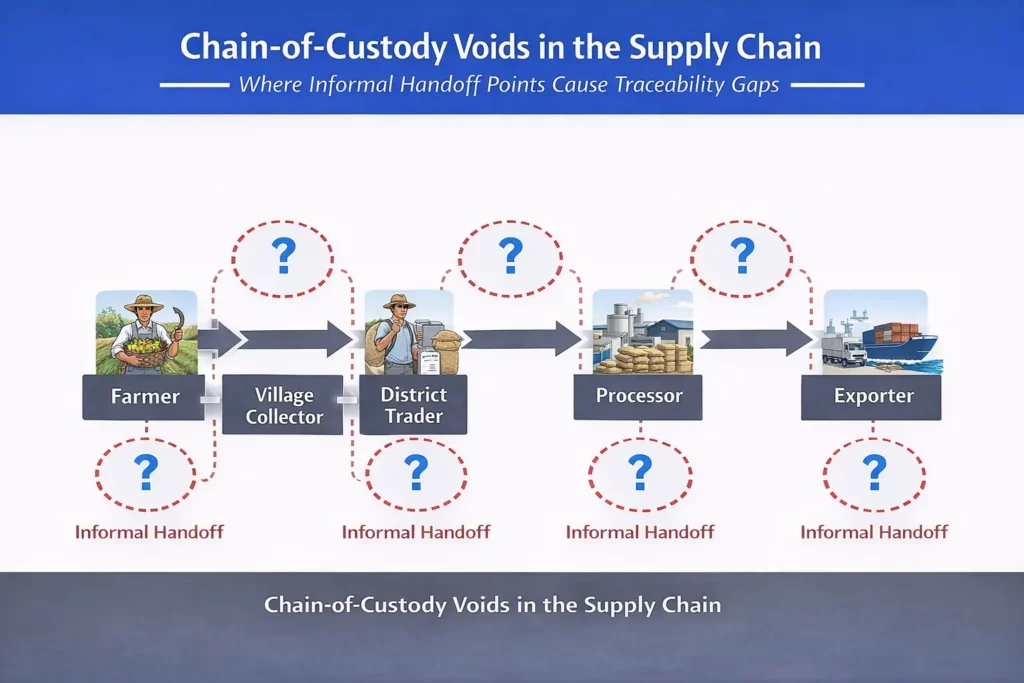
EUDR Article 10 requires that operators apply enhanced due diligence for high-risk supply chains. An exporter sourcing through informal intermediaries with no documentation trail will struggle to demonstrate a credible due diligence process, even if the final product is deforestation-free.
The Tropical Forest Alliance works on improving commodity supply-chain traceability and deforestation-free sourcing in producing countries such as Indonesia and India, where first-mile trade can be highly fragmented and informally structured.
TraceX’s multilingual supplier portal and offline mobile tools are designed specifically for this challenge. The platform onboards intermediaries as registered nodes in the supply chain: each farmgate purchase is recorded with timestamp, GPS, and farmer identity, even by agents with limited literacy, using simplified voice-guided and pictographic interfaces.
This transforms the informal intermediary from a chain-of-custody void into a documented supply chain node, a prerequisite for credible EUDR due diligence.
Struggling with first-mile traceability gaps?
TraceX has onboarded farmer networks across India, Africa, and Southeast Asia, capturing GPS plot data and farmgate transactions before commodities aggregate.
See how TraceX’s EUDR Compliance Solutions work.
EUDR risk assessment is not a one-time event. The regulation requires operators to demonstrate due diligence before each shipment, meaning that a coffee exporter who shifts sourcing from Coorg to Wayanad for one season must reassess deforestation risk for the new geography.
Aggregation amplifies this challenge because aggregated lots frequently cross multiple sourcing geographies within a single collection cycle. A collector serving three districts may source from 200 farms across zones with different deforestation risk profiles and create a single mixed lot.
EUDR mandates cross-referencing of GPS plot coordinates against JRC Global Forest Watch and Hansen deforestation datasets to generate a deforestation-free verification. For aggregated lots without individual farm GPS data, this cross-referencing is impossible, meaning the lot fails the EUDR risk assessment by default.
This creates a timing and geography problem. Seasonal sourcing shifts, supply disruptions, and opportunistic spot purchases from new geographies, common in commodity trading, each trigger a new EUDR compliance requirement that static due diligence systems can’t accommodate.
TraceX integrates JRC and Hansen Data Sets to provide real-time deforestation alerts on a farm-by-farm basis. As new farms are onboarded or new sourcing geographies are added, the platform automatically cross-references their GPS coordinates against deforestation datasets, flagging risk before aggregation occurs.
This means exporters receive dynamic, shipment-level deforestation risk scores rather than static annual assessments, a critical capability as sourcing geographies shift with climate patterns and supply conditions.

The EUDR Due Diligence Statement (DDS) is the culmination of traceability, a formal document submitted to the EU TRACES system before each shipment, asserting that commodities are deforestation-free and legally produced. For aggregated supply chains, building a DDS is a document management nightmare.
A credible EUDR DDS for an aggregated lot requires:
For a lot aggregated from 500 smallholder farms, typical for a mid-size coffee exporter, manual assembly of this documentation is operationally infeasible. Exporters face the choice between fabricating documentation (regulatory risk) or missing shipment windows (commercial risk).
Proforest’s 2024-2025 EUDR work shows that a key barrier for tropical commodity exporters is collecting reliable upstream-supplier documentation, alongside plot-level traceability requirements.
This is precisely the problem TraceX’s agentic AI capability addresses. The platform’s document parsing engine automatically extracts KYC data, land tenure records, and certifications from supplier emails, PDFs, and scanned documents, eliminating manual data entry and document chasing at scale.
Coupled with automated DDS generation and one-click export to EU TRACES, TraceX transforms a week-long compliance documentation process into hours, regardless of how many farms are in the aggregated lot.
| Aggregation Challenge | EUDR Compliance Risk | TraceX Solution |
|---|---|---|
| Farmgate digital ledger records the farmer, quantity and GPS before pooling | 1. Geolocation data loss at the collection point | Offline-first GPS polygon capture at farmer onboarding; syncs when online |
| 2. Physical commingling of commodities | Cannot verify deforestation-free status of individual lot components | DDS cannot be submitted without a GPS polygon per plot (Article 9) |
| 3. Informal intermediary chain-of-custody voids | Farmgate digital ledger records the farmer, quantity, and GPS before pooling | Multilingual, pictographic supplier onboarding portal; intermediaries become documented nodes |
| 4. Dynamic sourcing geographies vs. static risk assessments | Seasonal shifts trigger new DDS requirements; no real-time risk update | JRC and Hansen Data integration; real-time deforestation alerts per farm polygon |
| 5. Document fragmentation at scale | Manual DDS assembly from 500+ farms is operationally infeasible | Agentic AI parses supplier docs; auto-generates and submits DDS to EU TRACES |
For compliance officers and sustainability heads at agri-food exporters, the question is no longer whether EUDR applies; it’s whether your current systems can produce a defensible DDS for an aggregated supply chain by December 2026.
The answer requires addressing all five aggregation impacts simultaneously, not sequentially. Capturing GPS data without solving document fragmentation still results in a non-submittable DDS. Onboarding intermediaries without real-time deforestation alerts still produces a static risk assessment.
A fully EUDR-ready digital supply chain should deliver:
This is the operational standard TraceX has built for customers.
EUDR compliance is not a documentation exercise. It’s a fundamental rethinking of how agri-food supply chains collect, store, and transmit data, starting from the moment a farmer harvests a crop, not when it arrives at an export warehouse.
The five aggregation impacts outlined here, geolocation loss, commingling, informal intermediaries, dynamic sourcing risk, and document fragmentation, are not theoretical compliance risks. They are the operational reality for every exporter sourcing from smallholder-dominated tropical supply chains.
The June 2026 deadline is closer than it appears. Building an EUDR-ready digital infrastructure is a 6-12 month implementation project, not a quick software deployment. For exporters who have not yet begun, the time to act is now.
Struggling with traceability gaps? Explore how the chain of custody works under EUDR.
Move beyond spreadsheets. Discover how digital traceability transforms EUDR compliance.
Make smarter sourcing decisions. Explore supplier assessment strategies for EUDR compliance.
No. EUDR requires physical traceability meaning each shipment must be traceable to specific geo-located plots. Mass balance accounting, used under Rainforest Alliance or RSPO, does not satisfy EUDR’s plot-level geolocation requirement under Article 9. This is a critical distinction for exporters transitioning from existing sustainability certification frameworks.
It depends on supply chain structure, but a 20-container coffee export from an Indian processor may involve 500–3,000 individual smallholder plots. Each plot requires GPS polygon coordinates in the DDS. This is why manual DDS assembly is operationally infeasible for aggregated supply chains without digital infrastructure in place.
Under EUDR, operators cannot place non-compliant products on the EU market. Practically, this means shipment blocking at EU ports, potential fines (up to 4% of annual turnover in some member states), and loss of EU buyer contracts. The June 2026 deadline for SMEs makes this an urgent near-term risk, not a future concern.
EUDR allows risk-based sampling in low-risk countries, but for high-risk producing regions (which include most tropical smallholder landscapes), full documentation is required. For most agri-food exporters sourcing from India, Africa, or Southeast Asia, sampling exemptions are unlikely to apply full traceability is the standard.
TraceX’s offline-first mobile app is designed for field agents, not individual farmers. A single trained agent can onboard 30–50 farmers per day using GPS plot capture tools that work without connectivity. Multilingual interfaces (supporting 12+ regional languages) and pictographic workflows remove literacy barriers from the onboarding process.