Quick summary: Learn how to achieve multi-tier supply chain transparency with proven strategies, digital tools, and frameworks that enable end-to-end visibility, compliance, and risk management.
Most companies believe they have visibility into their supply chain. Most of them are wrong. If you are a supply chain, compliance, or sustainability leader, the moment a regulator, a major buyer, or a PR crisis asks “Where does this product come from?”, you need an answer in minutes, not weeks. But right now, for most businesses, that answer doesn’t exist beyond Tier 1 suppliers. Without true multi-tier supply chain transparency, companies struggle to trace raw materials, verify sourcing practices, and respond quickly to regulatory or reputational risks buried deeper in the supply network.
The result? Failed audits. Blocked shipments. Lost contracts. Regulatory fines under EUDR, CSRD, and emerging global frameworks. And reputational damage that takes years to rebuild.
This guide breaks down exactly what multi-tier supply chain transparency means, why it has become non-negotiable, and most importantly how companies like yours are achieving it today with the right strategies and technology solutions from TraceX
Only 15% of Chief Procurement Officers report having visibility beyond their Tier-1 suppliers, Deloitte Survey on CPOs
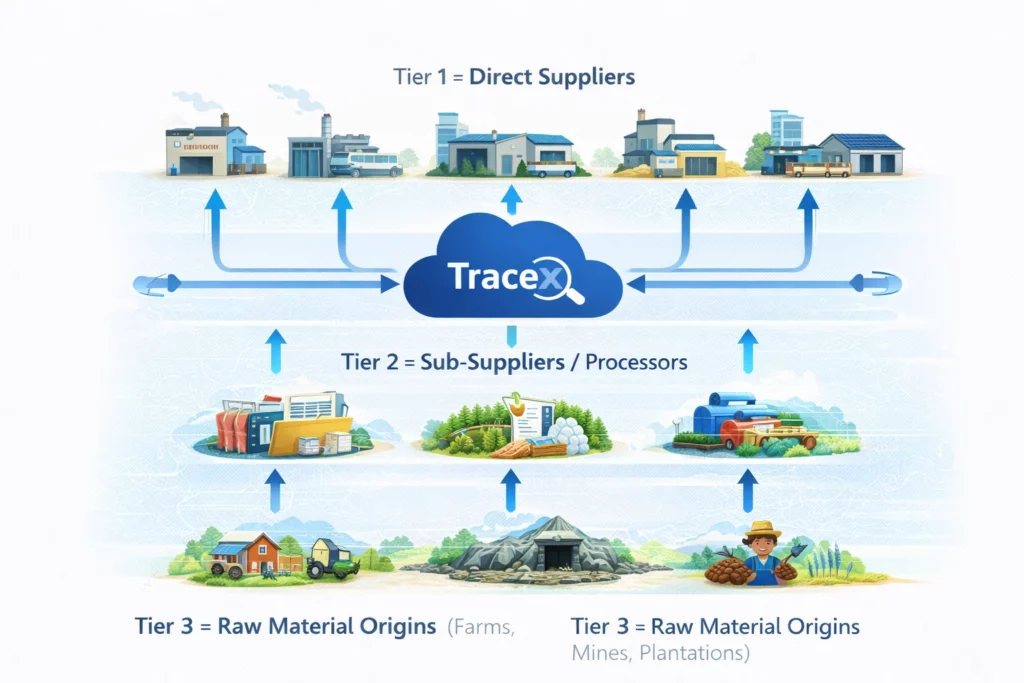
Supply chain transparency means more than knowing who your direct supplier is. It means having verified, auditable visibility into every tier from Tier-1 manufacturers all the way down to the farms, mines, and raw material sources at Tier-3 and beyond.
The regulatory landscape has fundamentally changed what ‘transparency’ requires:
62% of consumers expect companies to actively demonstrate transparency and ethical sourcing – Accenture Strategy Survey
Without multi-tier visibility, businesses are not just at regulatory risk they are commercially exposed. Global buyers now demand verifiable source-level data, not supplier declarations. Companies that cannot provide it are losing contracts to those who can.
Want to build a structured traceability system across your supply chain?
Explore our guide to the Supply Chain Traceability Framework and learn how to design scalable, end-to-end transparency.
Struggling to map suppliers beyond Tier 1?
Read our blog on Supplier Mapping in Traceability to see how businesses uncover hidden supply chain tiers and improve compliance readiness.
Understanding why transparency breaks down is the first step to fixing it. These are the five most common failure points we see across industries:
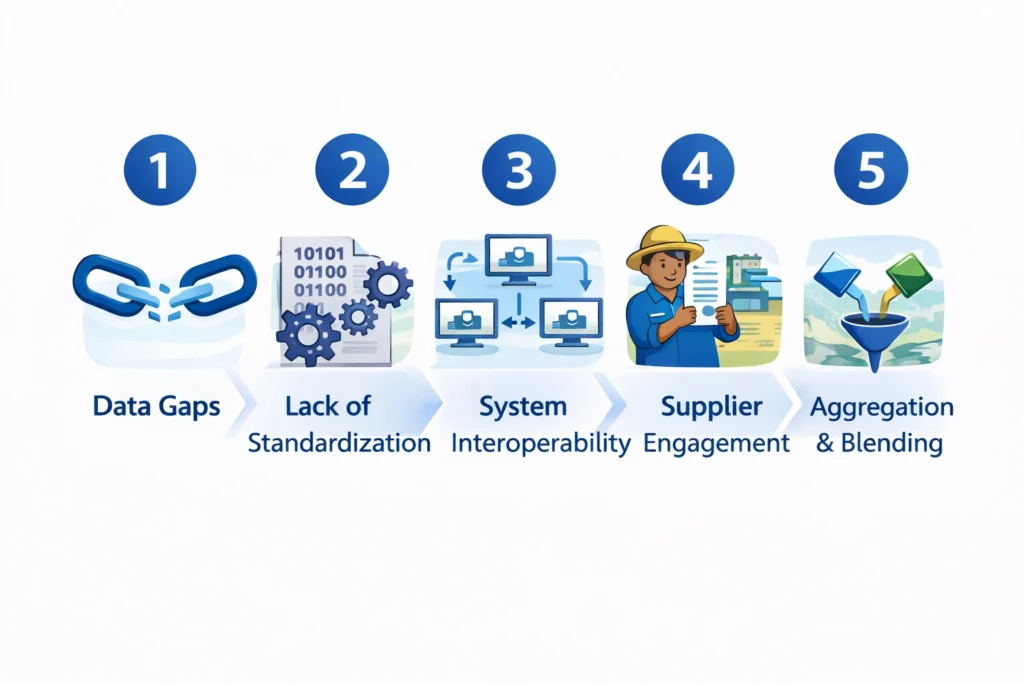
Most supply chains collect data inconsistently. Tier-2 and Tier-3 suppliers often rely on manual spreadsheets, paper records, or disconnected systems. The result is incomplete, unverifiable data that fails under regulatory scrutiny. Without accurate, real-time data, product traceability becomes guesswork and guesswork doesn’t hold up in an audit.
Varying data formats, different reporting processes, and fragmented systems across supplier tiers make sharing information chaotic. When suppliers use incompatible formats, tracking products across multiple levels becomes exponentially harder and collaboration breaks down.
Connecting new traceability systems with legacy ERP, procurement, and logistics platforms is a genuine technical barrier. Interoperability issues limit data flow and prevent organizations from building the continuous, connected supply chain view they need.
See how a multi-state agribusiness integrated ERP with digital traceability to gain real-time supply chain visibility.
Read the full case study
This is where most traceability systems collapse entirely. When raw materials like soy, cocoa, or palm oil are pooled from multiple farms into aggregators and blended in processing, the direct link to origin is broken. Without proper volume reconciliation and allocation logic, farm-level data becomes useless at the export stage even if it was perfectly collected.
Most companies have reasonable visibility into their direct suppliers. The problem is everything below that. Sub-suppliers, sub-contractors, and raw material origins remain largely invisible. And that’s exactly where the highest compliance risks, deforestation, forced labor, and illegal sourcing tend to hide.
85% of companies lack visibility beyond Tier-1 suppliers, meaning the vast majority are flying blind on their biggest compliance risks
The following strategies are drawn from real-world deployments across food, agri, and manufacturing supply chains. They are not theoretical frameworks they are the operational approaches that deliver verified, audit-ready transparency at scale.
The most effective approach is phased, not all-at-once. Start by achieving solid visibility into your Tier-1 suppliers onboard them onto a standardized digital platform, collect verified data on sourcing, certifications, and volumes. Once Tier-1 is mapped and integrated, work your way down to Tier-2 and Tier-3.
This creates a strong data foundation that makes each subsequent tier easier and faster to add. Companies that try to tackle all tiers simultaneously typically stall and fail.
Paper-based and spreadsheet-driven data collection is the single biggest source of supply chain opacity. Digitizing the entire supplier data process from farmer registration to processor certification to export documentation creates the continuous, tamper-proof data flow that traceability requires.
Key digitization milestones to target:
Blockchain creates a secure, transparent record of every transaction and movement in the supply chain. Once data is recorded, it cannot be altered, making it the gold standard for audit-ready traceability. Every transfer of goods, every certification, and every processing event is verified and permanently logged.
This is particularly critical for responding to regulatory audits and buyer due diligence requests. With blockchain, you can prove the provenance of any product at any point in time in seconds, not weeks.
IoT sensors and RFID tags automate tracking at every stage of the physical supply chain, reducing human error, eliminating manual reporting delays, and delivering real-time updates on product location, condition, and compliance status.
Satellite data extends this capability to large-scale monitoring of land use and environmental compliance, critical for regulations like EUDR that require proof of no deforestation on specific plots of land.
Technology alone is not enough. Robust multi-tier transparency requires a supplier engagement program, systematic mapping of every supplier and sub-supplier, regular audits, and validation through recognized third-party certifications like FSC, PEFC, Rainforest Alliance, and others relevant to your commodity.
Third-party auditors provide independent verification that what your platform records matches what is actually happening on the ground. This dual layer of digital records and physical audit creates the strongest possible evidence for regulatory and buyer compliance.
For commodity supply chains, this is the strategy most organizations overlook and the one that most often causes compliance to collapse at the export stage. Your traceability system must include explicit allocation logic that reconciles farm-level volumes with processing and export volumes.
This means: declared volumes from farms must match processing capacity. Blended lots must remain attributable to their source origins. Any volume discrepancy must be flagged before shipment approval.
TraceX Traceability Solutions is built specifically to solve the challenges outlined above from Tier-1 digitization all the way to farm-level origin verification, regulatory compliance, and real-time monitoring across global supply chains.
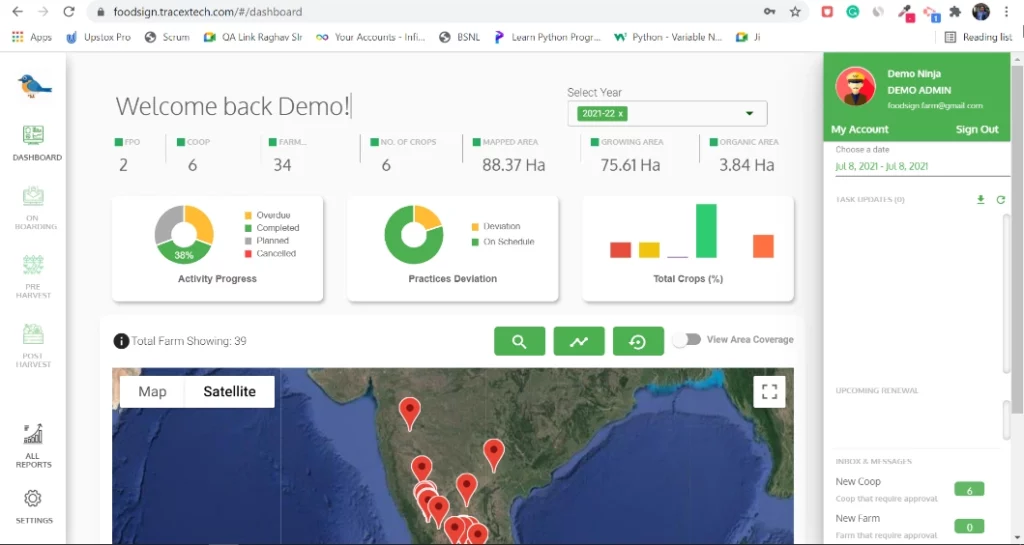
| Capability | Traditional Approach | TraceX Platform |
| Tier Mapping | Manual spreadsheets, limited to Tier-1 | Automated digital mapping across all tiers |
| Origin Verification | Supplier declarations, periodic audits | GPS polygon mapping + satellite validation |
| Blockchain Records | None or third-party bolt-on | Native blockchain — tamper-proof and audit-ready |
| Volume Reconciliation | Manual, error-prone | Automated allocation logic and reconciliation |
| Regulatory Compliance | Manual documentation, delayed reporting | One-click EUDR DDS filing, CSRD-ready reports |
| Real-Time Monitoring | Periodic updates, batch reporting | Live tracking, satellite alerts, IoT integration |
TraceX’s platform is built on a structured five-layer architecture that ensures no data gaps between origin and market:
Achieving supply chain transparency is not just about compliance checkboxes. The business impact extends across operations, commercial relationships, and long-term competitive position.
| Outcome | Without Transparency | With TraceX Multi-Tier Visibility |
| Regulatory Audits | Failed audits, shipment delays, fines | Audit-ready 24/7, one-click reporting |
| Buyer Relationships | Losing contracts to transparent competitors | Premium contract access, preferred supplier status |
| Risk Management | Reactive — problems found after they happen | Proactive — risks flagged before shipments |
| Recall Response | Weeks of manual investigation | Minutes — traced to source instantly |
| ESG Reporting | Fragmented, self-declared, unverifiable | Verified, automated, defensible |
A leading Nigerian cocoa exporter faced a critical compliance deadline: EU buyers required deforestation-free certification under EUDR, with plot-level verification for all sourcing origins. Manual systems could not provide this at scale.
Using TraceX’s Farm Mapping and Restricted Zone technology, the exporter:
The result: full EUDR compliance achieved before deadline, zero shipment rejections, and expanded access to premium EU market buyers.
The right technology stack is what makes multi-tier transparency scalable and sustainable. Here is how the core technologies work together in a modern traceability platform:
Creates immutable, tamper-proof records of every supply chain transaction. Every movement of goods is verified and permanently logged, providing the audit trail that regulators and buyers require. TraceX’s native blockchain implementation means no third-party integration is needed.
Automates physical tracking at every supply chain stage. Products, containers, and shipments are monitored in real time, reducing manual errors, accelerating compliance documentation, and enabling rapid response to disruptions or deviations.
Enables large-scale monitoring of land use at the farm and plot levels. Satellite feeds verify that sourcing origins comply with deforestation regulations, detecting land-use changes that would otherwise remain invisible until after a regulatory violation has occurred.
Converts raw traceability data into actionable risk intelligence. TraceX’s AI layer automatically flags high-risk municipalities, suppliers, or batches before they enter the supply chain, enabling proactive due diligence instead of reactive damage control.
The emerging standard for end-to-end product transparency. DPPs function as the operational record connecting product identity, supplier data, lifecycle events, and sustainability attributes in a single digital record, enabling compliance with ESPR and circular economy regulations while building buyer trust.
Achieving multi-tier supply chain transparency is a transformation, not a one-time project.
Here is the proven roadmap TraceX uses with clients across food, agri, and manufacturing sectors:
Assess your current state. Map your known suppliers, identify data gaps, and prioritize the tiers and commodities that carry the highest compliance risk. This gives you a clear picture of where to start and how to sequence your investment.
Onboard your direct suppliers onto a standardized digital platform. Collect baseline data on sourcing origins, volumes, certifications, and processing practices. Establish your data foundation before expanding to deeper tiers.
Work with your Tier-1 suppliers to map their sub-suppliers. Provide tools, training, and incentives to bring lower-tier suppliers into the digital traceability system. Focus first on the suppliers in highest-risk geographies or commodities.
Deploy your end-to-end traceability platform connecting blockchain records, IoT tracking, geospatial mapping, and risk scoring into a unified system. Integrate with your existing ERP and logistics platforms to ensure continuous data flow.
Configure your platform to generate regulatory-ready outputs EUDR Due Diligence Statements, CSRD ESG reports, FSMA traceability records. Automate where possible to reduce manual compliance burden and enable rapid response to audits.
Compliance is not a destination it is an ongoing operational state. Set up automated monitoring workflows that detect new risks, track certification renewals, flag volume anomalies, and alert your team to emerging issues before they become violations.
TraceX clients typically achieve Tier-1 digitization and initial EUDR compliance readiness within their first 90 days of implementation
Build Transparent, Audit-Ready Supply Chains with TraceX
Multi-tier supply chain transparency is no longer optional. Regulators require it. Buyers demand it. And the commercial risks of not having it lost contracts, failed audits, blocked market access are real and growing.
TraceX gives you the technology, frameworks, and expert support to achieve end-to-end visibility across every tier of your supply chain from farm to market with the speed and reliability that modern compliance demands.
Looking to digitize your supply chain and improve traceability at scale?
Read our blog on Digital Traceability Systems to learn how technology enables transparent, compliant supply chains.
Want a complete roadmap to implementing traceability across your supply chain?
Explore our comprehensive Guide to Supply Chain Traceability and learn the key steps to building end-to-end visibility.
Need real-time insights into your supply chain operations?
Discover how real-time supply chain visibility helps businesses monitor risks, improve decision-making, and strengthen transparency.
Tier-1 refers to your direct suppliers. Tier-2 are their suppliers — the processors, manufacturers, and sub-contractors you don’t directly contract with. Tier-3 refers to raw material origins — farms, plantations, mines. Most companies have reasonable Tier-1 visibility but lack the data, systems, and processes to see beyond it.
EUDR requires that products entering the EU market can be traced to the specific geographic origin where they were produced — including verification that the land was not deforested after December 31, 2020. This requires visibility to the farm or plantation level, which is a Tier-3 requirement for most food and agri supply chains.
With TraceX, most organizations achieve initial Tier-1 digitization and compliance activation within 60-90 days. Full multi-tier visibility across complex supply chains typically takes 6-12 months, depending on the number of supplier tiers, geographies, and commodities involved.
Yes. TraceX is designed to integrate with leading ERP platforms, procurement systems, and logistics tools. Our integration layer ensures that traceability data flows continuously without requiring manual data re-entry or duplicate systems.
TraceX combines native blockchain immutability, geospatial polygon mapping, satellite monitoring, AI risk scoring, and one-click regulatory reporting in a single platform — purpose-built for food, agri, and climate-tech supply chains. Unlike generic supply chain tools, TraceX addresses the specific data and compliance requirements of EUDR, CSRD, ESPR, and other sustainability regulations.