
Quick summary: Sustainability frameworks and standards explained learn how ESG, CSRD, OECD, and ISO frameworks work, why they matter, and how digital traceability enables compliance.

Sustainability reporting has become one of the most confusing and high-risk areas for global businesses. Companies are under pressure to comply with ESG requirements, supply-chain due-diligence laws, and buyer mandates, yet face a growing maze of frameworks, standards, and overlapping regulations. GRI, CSRD, ISO, OECD, UN SDGs each asks for different data, at different levels, on different timelines. Sustainability frameworks and standards exist to bring structure to this complexity.
According to a KPMG survey of corporate responsibility reporting, more than 90% of the world’s largest companies report on their sustainability performance through various frameworks and standards.
Without clarity and reliable data, many organizations struggle with fragmented reporting, audit fatigue, and exposure to compliance risk. Understanding how these frameworks work and how to operationalize them across supply chains is now essential for maintaining market access and long-term competitiveness. From climate action to ethical labour practices, the path to sustainability is multifaceted and can be overwhelming. But by aligning with the right frameworks, you can not only meet compliance requirements but also drive long-term value and credibility for your business. Let’s dive in!
Key Takeaways
Sustainability frameworks and standards are structured systems that guide how organizations manage, measure, and communicate their environmental, social, and governance (ESG) impacts. Sustainability frameworks define what organizations should assess and disclose such as climate risks, labour practices, or supply-chain impacts while sustainability standards define how this information is collected, measured, verified, and reported in a consistent and comparable way.
Together, frameworks and standards provide a common language for regulators, investors, buyers, and auditors, enabling transparent, credible, and decision-useful sustainability reporting across industries and global supply chains.
Key considerations in assessing sustainability frameworks are as follows:
Sustainability frameworks have moved from voluntary guidance to business-critical infrastructure. Regulatory pressure, buyer expectations, and supply-chain accountability now require organizations to demonstrate sustainability performance with verifiable data not statements of intent.
In this environment, sustainability frameworks are no longer about reporting alone they are essential tools for risk management, market access, and long-term competitiveness.
Supply-chain due diligence is becoming a legal and commercial requirement not a best practice. Learn how leading organizations are identifying risks, documenting controls, and meeting emerging regulatory obligations across global supply chains.
Read the blog: Supply Chain Due Diligence Explained
ESG reporting is evolving from high-level disclosures to data-driven, audit-ready reporting. Understand what regulators and buyers expect, which frameworks apply, and how organizations are operationalizing ESG compliance.
Read the blog: ESG Reporting Requirements and Best Practices
Purpose
GRI is the world’s most widely used sustainability reporting framework. It provides a comprehensive structure for organizations to disclose their environmental, social, and economic impacts in a transparent and comparable way.
Who it applies to
GRI applies to organizations of all sizes and sectors, including multinational companies, SMEs, public institutions, and NGOs. It is especially common among companies with complex global supply chains.
Voluntary vs mandatory
GRI is technically voluntary, but it is widely required by investors, buyers, and regulators and is often used as a foundational framework for compliance with mandatory regimes such as CSRD.
Industry-specific reporting
SASB focuses on financially material sustainability issues and provides industry-specific standards across 77 sectors. It identifies which ESG topics are most likely to affect a company’s financial performance.
Investor focus
SASB is designed primarily for investors and capital markets. Its metrics are structured to support decision-useful, comparable disclosures related to risk, opportunity, and long-term value creation.
Climate risk focus
TCFD provides a framework for disclosing climate-related risks and opportunities, including governance, strategy, risk management, and metrics and targets. It emphasizes both physical and transition climate risks.
Transition to ISSB
TCFD has been formally incorporated into the International Sustainability Standards Board (ISSB) standards. While TCFD remains influential, new climate disclosures are increasingly aligned with ISSB requirements.
EU mandatory regulation
CSRD is a legally binding European Union regulation that significantly expands mandatory sustainability reporting requirements for companies operating in or selling into the EU.
Supply-chain data requirements
CSRD requires companies to report on environmental and social impacts across their entire value chain, including suppliers and sub-suppliers. This makes traceability, supplier data collection, and audit-ready documentation essential for compliance.
Strategic alignment
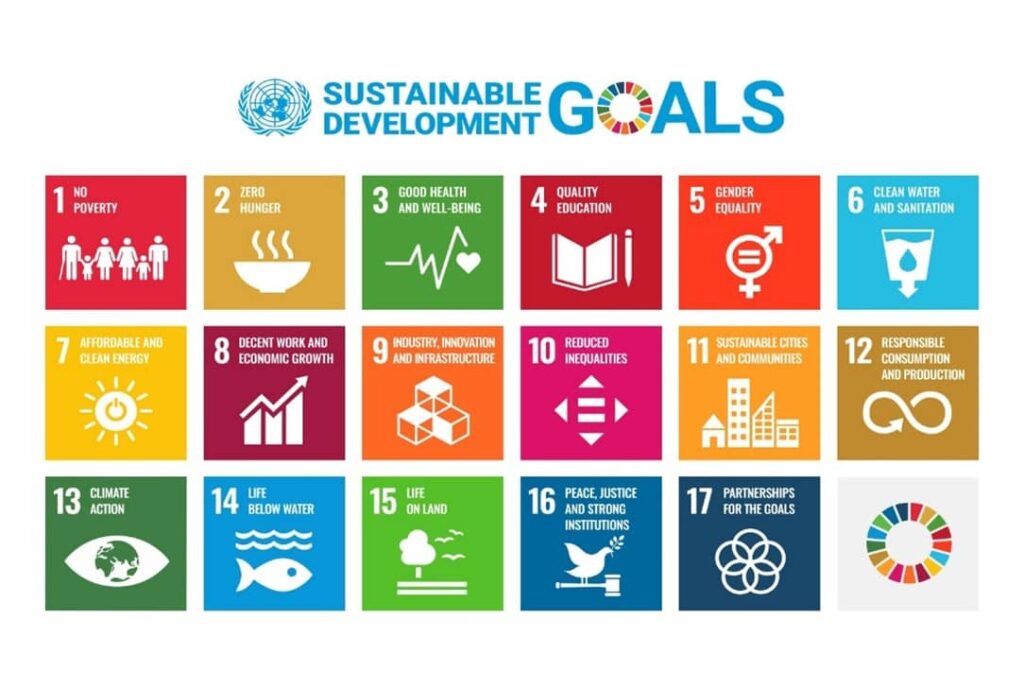
The UN SDGs provide a global framework of 17 goals addressing issues such as climate action, decent work, responsible consumption, and biodiversity. Companies use them to align sustainability strategies with global priorities.
Not a reporting standard
The UN SDGs are not a reporting or compliance standard. They do not define metrics or disclosure requirements but are often referenced alongside frameworks like GRI and CSRD for strategic positioning.
Human rights & environmental risk
The OECD Due Diligence Guidelines provide a framework for identifying, preventing, mitigating, and accounting for adverse human rights and environmental impacts.
Supply-chain focus
These guidelines are heavily focused on supply chains and underpin many emerging due-diligence laws. They require companies to demonstrate risk-based monitoring, supplier engagement, and documented corrective actions.
Management systems
ISO standards such as ISO 14001 (Environmental Management) and ISO 26000 (Social Responsibility) provide structured management-system approaches for embedding sustainability into daily operations.
Certification role
Some ISO standards are certifiable (e.g., ISO 14001), meaning organizations can undergo third-party audits to demonstrate compliance. ISO standards are often used to operationalize sustainability commitments and support broader ESG reporting.
No single framework operates in isolation. In practice:
Together, they form a layered sustainability architecture that increasingly depends on digital traceability, structured data capture, and audit-ready evidence across supply chains.
Sustainability frameworks increasingly apply across entire value chains, not just a company’s direct operations. Regulators, investors, and buyers now expect organizations to identify, measure, and manage environmental and social impacts upstream (suppliers and raw materials) and downstream (processing, distribution, and end use). The most relevant frameworks vary by sector but share a common requirement: supply-chain transparency and traceability.
Agricultural supply chains are highly exposed to environmental, labour, and food-safety risks, making traceability central to compliance.
Applicable frameworks include:
Upstream accountability: farm-level practices, inputs, labour conditions
Downstream accountability: processing, storage, transport, and export conditions
Manufacturing supply chains involve complex multi-tier sourcing, often across multiple countries.
Applicable frameworks include:
Upstream accountability: raw materials, energy use, supplier labour standards
Downstream accountability: product safety, emissions, waste, and logistics
Mining supply chains face heightened scrutiny due to environmental impact and human-rights risks.
Applicable frameworks include:
Upstream accountability: extraction practices, worker safety, environmental controls
Downstream accountability: traceability of materials, responsible sourcing, emissions
Consumer-facing brands are under pressure to demonstrate ethical sourcing and product-level transparency.
Applicable frameworks include:
Upstream accountability: supplier labour practices, material sourcing, environmental impact
Downstream accountability: product transparency, recycling, reuse, and end-of-life impacts
Across all sectors, sustainability frameworks increasingly require companies to:
This shift means sustainability compliance is no longer achievable without end-to-end supply-chain visibility, making digital traceability a foundational capability rather than a supporting tool.
| Feature | Mandatory Frameworks | Voluntary Frameworks |
| Enforcement | Legally Binding: Enforced by government regulators (e.g., SEC, EFRAG). | Discretionary: Driven by market pressure and stakeholder expectations. |
| Consequences | Fines, legal litigation, and potential export bans (e.g., EUDR). | Reputational damage, higher cost of capital, or loss of “Preferred Supplier” status. |
| Auditing | Third-Party Assurance: Often requires “Limited” or “Reasonable” assurance by an auditor. | Self-Reported: Internal verification is common; external audit is optional. |
| Data Standard | Prescriptive: Requires specific metrics (Scope 1, 2, 3) and geolocated plot data. | Flexible: Companies choose which “Material” topics to report on. |
| Core Examples | CSRD/ESRS (EU), SB 253 (California), EUDR (Deforestation), UK SDR. | GRI, UN SDGs, CDP, ISO 26000. |
While sustainability frameworks provide structure and clarity, implementing them in practice is often complex, especially across multi-tier global supply chains. Organizations frequently encounter operational and data-related challenges that slow compliance, increase cost, and raise regulatory risk.
Sustainability data is often scattered across multiple systems, teams, and suppliers. Environmental, social, and governance information may exist in spreadsheets, ERP systems, emails, paper records, or third-party portals making it difficult to consolidate and verify.
Impact:
Fragmented data leads to inconsistencies, reporting gaps, and limited visibility into supply-chain risks.
Solution:
Centralized, digital data systems that standardize sustainability data capture across farms, factories, and suppliers enabling a single source of truth.
Many organizations still rely on manual data collection and reporting processes to meet sustainability requirements. This approach is time-consuming, error-prone, and difficult to scale as reporting obligations expand.
Impact:
Manual reporting increases compliance costs, delays disclosures, and raises the likelihood of errors during audits or regulatory reviews.
Solution:
Automated data capture, batch-level tracking, and system-generated reports that align with recognized sustainability frameworks and standards.
Lack of visibility beyond Tier 1 suppliers is one of the biggest barriers to sustainability compliance. Many organizations have limited insight into upstream sourcing practices, labour conditions, and environmental impacts.
Impact:
Supplier opacity exposes companies to hidden risks such as human-rights violations, environmental damage, and regulatory non-compliance.
Solution:
Digital onboarding of suppliers, farm- or site-level traceability, and continuous monitoring that links sustainability data to specific sources.
As sustainability regulations expand, organizations face overlapping audits from regulators, buyers, investors, and certification bodies. Each audit often requires similar data presented in different formats.
Impact:
Audit fatigue strains internal teams, increases operational disruption, and diverts resources away from improvement initiatives.
Solution:
Audit-ready systems that maintain verifiable, standardized records and allow rapid generation of framework- and buyer-specific reports.
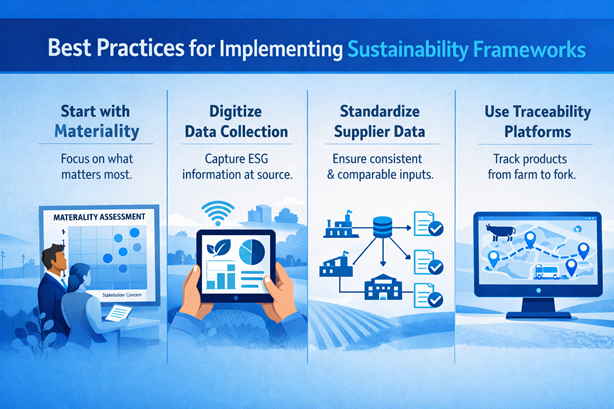
Digital traceability is the operational backbone of modern sustainability compliance. As sustainability frameworks move from high-level reporting to verifiable, data-driven accountability, organizations must be able to trace products, materials, and practices across their entire supply chain. Digital traceability transforms sustainability commitments into provable evidence.
Sustainability frameworks require consistent, comparable ESG data across operations and suppliers. Digital traceability captures sustainability data at the source and links it to specific suppliers, locations, and processes.
Human-rights and environmental due-diligence frameworks require companies to identify, assess, mitigate, and monitor risks throughout their supply chains.
CSRD mandates detailed sustainability reporting across the entire value chain, including indirect suppliers.
Digital Product Passports require product-level sustainability and origin data to be accessible, accurate, and standardized.
Without digital traceability, sustainability compliance relies on assumptions, averages, and self-declarations. With traceability, organizations gain evidence-based sustainability, reduced compliance risk, faster audits, and stronger market credibility making traceability a foundational capability for meeting ESG, due-diligence, CSRD, and DPP requirements.
TraceX Sustainable Sourcing Platform empowers organizations to operationalize sustainability compliance across complex supply chains by digitizing origin data, supplier practices, and product-level traceability. With TraceX, every batch and product is linked to verified sustainability information from farm-level practices and environmental metrics to audit-ready records enabling real-time visibility and proof-based reporting for ESG frameworks, due-diligence laws, CSRD compliance, and Digital Product Passports (DPPs). By replacing manual processes with structured, verifiable digital data, TraceX helps reduce compliance risk, accelerate audits, and build trusted relationships with buyers, regulators, and stakeholders.
Sustainability frameworks and standards are no longer optional reporting tools they are core business infrastructure. As regulations tighten and buyers demand proof-based accountability, organizations must move beyond high-level commitments to verifiable, data-driven compliance. Frameworks such as GRI, CSRD, OECD Due Diligence, and climate standards provide the structure, but digital traceability is what makes them operational. Companies that align sustainability frameworks with real-time supply-chain data are better positioned to reduce risk, meet regulatory expectations, and secure long-term access to global markets.
Supply chain compliance is becoming more complex as regulations expand across food safety, ESG, and due diligence. Learn what compliance means today, which risks matter most, and how organizations are meeting regulatory and buyer requirements.
Read the blog: Supply Chain Compliance Explained
Sustainability reporting now requires structured, verifiable data across farms, suppliers, and value chains. Discover how leading organizations approach sustainability reporting and prepare for audits with confidence.
Read the blog: Sustainability Reporting Requirements & Best Practices
Agricultural sustainability certifications play a critical role in market access and buyer trust. Learn how major certification schemes work, what they require from farmers and exporters, and how digital traceability supports certification readiness.
Read the blog: Sustainability Certifications in Agriculture Explained
Sustainability frameworks define what organizations should measure and disclose about ESG impacts, while sustainability standards specify how that data is collected, verified, and reported in a consistent and auditable way.
Some frameworks are voluntary, but many are becoming mandatory through regulations such as CSRD in the European Union or through buyer and investor requirements that make compliance a condition of market access.
Most modern frameworks require companies to assess and manage risks upstream and downstream, including suppliers, subcontractors, logistics partners, and product end-of-life impacts.
Traceability provides verifiable evidence of origin, handling, and sustainability practices, enabling accurate ESG reporting, effective due diligence, faster audits, and reduced compliance risk.
Yes. Most organizations use multiple frameworks together, combining reporting frameworks (like GRI or CSRD), due-diligence guidelines (OECD), and operational standards (ISO) to meet regulatory, buyer, and investor expectations.