
Quick summary: Discover the key strategies and best practices for driving sustainability in the pulse value chain. Learn how to optimize operations, enhance traceability, and promote environmental responsibility. Explore the path to a more sustainable and resilient pulse industry.

Global demand for pulses is rising but visibility across pulse value chains is not. Most pulses still pass through multiple smallholders, traders, and aggregators with little documentation, making it hard to verify origin, quality, or sustainability claims. This lack of traceability exposes exporters to rejected shipments, buyer disputes, and growing regulatory risk. As global buyers tighten food safety, ESG, and sourcing requirements, traceability in pulse value chains is no longer optional it is the foundation for market access, risk management, and long-term competitiveness.
Traceability in Pulse Value Chains refers to the ability to track pulses from farm-level production through aggregation, processing, and export to the final buyer. It enables verification of origin, quality, food safety, and sustainability claims across fragmented, smallholder-driven supply chains. As global buyers and regulators demand proof-based sourcing, traceability in pulse value chains has become essential for reducing compliance risk, preventing batch mixing and contamination, and ensuring audit-ready documentation. Digitally enabled traceability systems now form the backbone of resilient, transparent, and competitive pulse trade from farm to fork.
Key Takeaways
Traceability in pulse value chains refers to the systematic ability to track pulses and their associated data at every stage of the supply chain from farm-level production through aggregation, processing, storage, and export. In agri-commodities, traceability ensures that information on origin, quality, handling, and compliance can be reliably linked to each batch or lot of product.
For pulses, traceability requires end-to-end tracking across multiple handoffs, starting with smallholder farmers, moving through village aggregators and processors, and ending with exporters and global buyers. Each stage must capture and preserve batch identity, quality parameters, and documentation.
Pulses are uniquely challenging to trace because supply chains are highly fragmented, volumes are frequently mixed during aggregation, and records are often manual or informal. Without digital systems, maintaining product integrity and audit-ready proof becomes difficult making traceability essential for quality assurance, compliance, and market access.
Food supply chains are becoming faster, more complex, and more regulated.
Learn how digital traceability is transforming food processing, quality control, and compliance from raw material intake to finished product.
Read how digital traceability is reshaping food transformation
Trust in food supply chains now depends on data integrity, not declarations.
Explore how blockchain technology strengthens food traceability by ensuring tamper-proof records, transparent transactions, and verifiable provenance.
Discover how blockchain enables trusted food traceability
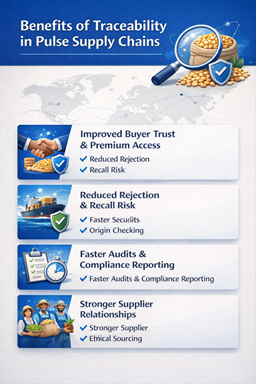
Traceability is becoming a critical requirement in pulse supply chains as global markets shift from trust-based sourcing to proof-based procurement. Pulses move through complex, multi-actor networks, and without reliable traceability, exporters face growing commercial, regulatory, and reputational risks.
Global pulses trade ~$10-12B annually (India 25% share), but contamination (e.g., salmonella in lentils) triggers recalls costing $10M+ per incident; 87% consumers pay premiums for traceable products. In India (world #1 exporter, $4.5B 2023), 71% supply chain opacity leads to 20-30% post-harvest losses; blockchain/QR pilots cut this 40% via farm-to-fork tracking
Global buyers increasingly expect clear visibility into where pulses are grown, how they are handled, and whether quality standards are met. Traceability allows exporters to link batches to specific origins, farming practices, and quality parameters, reducing disputes and strengthening long-term buyer relationships especially in premium and specialty markets.
Pulses are vulnerable to contamination, adulteration, and quality degradation during aggregation, storage, and transport. Traceability enables rapid identification of affected batches, supports targeted recalls, and prevents widespread shipment rejections. This level of control is essential for meeting food safety regulations and protecting brand reputation.
As companies expand ESG and Scope 3 emissions reporting, pulses sourced from smallholders represent a significant data challenge. Traceability provides the foundation for capturing farm-level information on inputs, practices, and sourcing regions, enabling credible sustainability claims and alignment with corporate climate and social commitments.
Importing regions such as the EU, UK, and US are tightening due diligence requirements around origin verification, ethical sourcing, and environmental compliance. Traceability ensures exporters can produce audit-ready documentation, demonstrate responsible sourcing, and maintain uninterrupted access to regulated markets.
Pulse value chains face structural challenges that make traceability and compliance significantly more complex than in many other agri-commodities. These challenges stem from how pulses are produced, aggregated, and traded across fragmented networks.
Pulse production is dominated by millions of smallholder farmers, often operating on fragmented plots and supplying through multiple layers of intermediaries. Informal aggregation at village or trader level makes it difficult to consistently identify source farms, standardize data collection, or enforce uniform quality and sustainability practices. This fragmentation limits visibility beyond Tier 1 suppliers and increases the risk of incomplete or inconsistent traceability.
Pulses are frequently mixed during aggregation, storage, and transport to achieve volume and efficiency. While operationally convenient, this practice dilutes batch identity and introduces wide quality variability across lots. Once mixed, it becomes difficult to link final shipments back to specific farms or quality parameters, increasing the risk of buyer disputes, shipment rejections, and loss of premium pricing.
Many pulse supply chains still rely on paper-based or semi-manual record-keeping, resulting in data gaps, errors, and delayed reporting. These systems are not designed to support audits, regulatory checks, or buyer verification. The lack of structured, digital data limits audit readiness and makes it challenging for exporters to meet growing demands for transparency, compliance, and sustainability reporting.
Traceability in pulse value chains functions by capturing, preserving, and linking data at each stage of product movement, ensuring that origin, quality, and compliance information travels with the pulses from farm to buyer.
Traceability begins at the farm with farmer registration and plot identification. Each farmer is uniquely identified, and their fields are mapped to establish origin and production context. Data on crop type, seed variety, inputs used, and harvest volumes is captured at source, creating the first verified data layer. This step is critical for linking pulses to specific growing regions, practices, and sustainability indicators.
See how digital traceability transforms farm input management in real-world operations.
Explore how TraceX helped streamline input tracking, improve compliance, and strengthen farm-level visibility.
As pulses move through aggregation points, lots and batches are created and tracked to maintain product identity. During cleaning, grading, and milling, quality parameters and process data are recorded against each batch. Controlled batch management reduces uncontrolled mixing, preserves quality differentiation, and ensures traceability is maintained despite volume consolidation.
At the export stage, batch-level data is consolidated into shipment-level traceability, linking final consignments to underlying farm and processing records. Digital documentation including quality certificates, compliance records, and buyer-specific reports can be generated quickly and shared with importers. This end-to-end visibility enables exporters to demonstrate origin, quality, and compliance with confidence while meeting buyer and regulatory expectations.
TraceX provides a purpose-built digital traceability platform designed to address the complexity and fragmentation of pulse value chains. By replacing manual records with structured, end-to-end data capture, TraceX enables exporters, processors, and aggregators to achieve full visibility, compliance, and buyer confidence.
TraceX delivers farmer-to-export batch visibility by digitally onboarding farmers, mapping plots, and linking production data to aggregation, processing, and export batches. Each movement from harvest to shipment is tracked using unique digital batch IDs, ensuring product integrity even as volumes are consolidated.
The platform streamlines digital documentation and audit readiness by automatically organizing farm records, quality data, and transaction logs into verifiable, export-ready formats. This reduces audit preparation time, minimizes errors, and supports faster buyer verification.
TraceX also integrates ESG and sustainability data into core traceability workflows, enabling pulse exporters to capture sourcing, social, and environmental indicators alongside product data. This allows companies to meet growing buyer expectations for transparency, support Scope 3 and sustainability reporting, and strengthen access to premium and regulated markets.
Traceability in pulse value chains is increasingly shaped by regulatory mandates and evolving buyer expectations. Exporters can no longer rely on basic documentation or supplier declarations markets now demand verifiable, data-backed proof of origin, quality, and responsible sourcing.
Importing regions such as the EU, UK, and US enforce strict food safety and quality regulations for pulses, covering contamination limits, residue levels, and handling standards. Buyers and regulators require exporters to demonstrate where products were grown, how they were processed, and how risks were managed throughout the supply chain. Traceability enables rapid identification of affected batches in the event of quality issues or recalls, reducing shipment rejections and protecting market access. For exporters, having structured, traceable data is essential to meet importer audits, certification checks, and buyer due diligence.
Beyond food safety, global buyers are increasingly focused on ESG performance, Scope 3 emissions, and deforestation-free sourcing. Pulses, often sourced from smallholder systems, carry environmental and social risks that buyers expect exporters to manage and document. Traceability provides the foundation for proof-based sourcing, enabling companies to link products to sourcing regions, farming practices, and sustainability indicators. As regulations and voluntary frameworks tighten, exporters without credible traceability risk losing access to premium and regulated markets.
Traceability is the backbone of resilient pulse trade because it transforms fragmented, risk-prone supply chains into transparent, accountable, and market-ready systems. By enabling end-to-end visibility from farm to export, traceability helps pulse exporters manage quality, meet regulatory and buyer expectations, reduce disruptions, and build long-term trust with global markets. As food safety standards tighten and sustainability requirements become proof-based, exporters that invest in digital traceability will be better positioned to secure premium buyers, protect margins, and future-proof their pulse value chains against growing operational and compliance risks.
Food safety requirements are tightening across global markets.
Understand the key food safety regulations affecting exporters and how traceability and documentation help ensure compliance.
Read our guide to food safety regulations for exporters
Export compliance starts at the farm, not at the port.
Learn how better farm management practices and digital records help meet buyer, certification, and regulatory requirements.
Explore farm management strategies for export compliance
Post-harvest losses silently erode margins and quality.
Discover practical approaches to reducing losses during storage, handling, and transport while improving traceability and market access.
Learn how to reduce post-harvest losses in agri supply chains
Traceability in pulse value chains is the ability to track pulses and their associated data from farm-level production through aggregation, processing, and export. It links each batch to its origin, handling, and documentation, enabling verification of quality, safety, and sourcing practices.
Traceability is critical for pulse exports because global buyers and regulators require proof of origin, quality, and responsible sourcing. It reduces shipment rejections, supports food safety compliance, and strengthens buyer trust in increasingly regulated markets.
Key challenges include smallholder fragmentation, frequent batch mixing during aggregation, and reliance on manual or paper-based records. These factors make it difficult to maintain product identity and produce audit-ready documentation.
Digital traceability systems capture structured data at each supply chain stage, maintain batch integrity, and provide real-time visibility. This improves quality control, reduces compliance risk, and accelerates audits and buyer verification.
Yes. Traceability provides the data foundation needed for ESG reporting, Scope 3 disclosures, and due diligence requirements by linking pulses to sourcing regions, farming practices, and sustainability indicators.