
Quick summary: Discover how agroforestry empowers modern farmers to boost yields, enhance biodiversity, meet EUDR compliance, and unlock new revenue streams through traceable, sustainable practices.

Climate change, soil degradation, and declining farm resilience are putting unprecedented pressure on agricultural systems worldwide. Conventional, input-intensive farming models often struggle to protect yields while restoring soil health, biodiversity, and long-term productivity. Agroforestry for Sustainable Agriculture addresses this challenge by integrating trees into farming systems to create climate-smart, resilient landscapes
As weather extremes intensify and sustainability expectations rise, farmers and agribusinesses are searching for approaches that can deliver both productivity and resilience without forcing trade-offs. By combining crops, trees, and sometimes livestock on the same land, agroforestry improves soil health, stabilizes yields, enhances biodiversity, and strengthens farmer livelihoods while contributing to climate mitigation. This integrated approach is increasingly recognized as a practical pathway to build sustainable agriculture systems that can withstand climate stress and meet evolving environmental and market demands.
Key Takeaways
Agroforestry for Sustainable Agriculture is a farming approach that integrates trees with crops and/or livestock to improve soil health, increase farm resilience, enhance biodiversity, and support long-term agricultural productivity while delivering environmental and climate benefits.
Agroforestry is not just a farming technique; it’s a systems-level redesign of how we use land.
Agroforestry turns farms into regenerative ecosystems, helping farmers shift from extractive practices to land stewardship, an approach increasingly rewarded by conscious buyers and regulators.
While many see agroforestry as an old practice, its modern application is highly techenabled geospatial mapping, IoT soil sensors, and compliance dashboards now making it measurable and auditable. For forward-thinking farmers, agroforestry isn’t just sustainable farming; it’s a market access strategy and a bridge between tradition and next-gen agritech.
Want to dive deeper into building resilient, future-ready farms?
Explore our latest blogs on
Climatesmart farming practices
packed with insights, best practices, and tools to help you grow smarter and stay compliant in evolving markets.
Modern agriculture is under increasing strain as conventional and monoculture farming systems reach their limits. Practices that rely heavily on single crops, intensive inputs, and short-term yield optimization have led to declining soil fertility, reduced biodiversity, and greater vulnerability to pests and diseases. Over time, these systems degrade the natural resource base that agriculture depends on, making farms less productive and more exposed to risk.
These structural weaknesses are now amplified by climate stress. Rising temperatures, unpredictable rainfall, prolonged droughts, and extreme weather events are driving yield instability across regions. Soil degradation caused by erosion, loss of organic matter, and compaction reduces water retention and nutrient availability, further undermining farm resilience. For many producers, maintaining consistent yields is becoming increasingly difficult and costly.
At the same time, agriculture faces growing external pressure. Climate change commitments are pushing governments to reduce emissions and restore degraded land. Sustainability regulations and voluntary standards increasingly require proof of responsible land use and environmental stewardship. Buyers, particularly in global supply chains, are demanding transparent, sustainable sourcing practices that go beyond minimum compliance.
Agroforestry addresses these challenges systemically rather than in isolation. By integrating trees into agricultural landscapes, agroforestry rebuilds soil organic matter, improves water cycling, and creates microclimates that protect crops from heat and wind stress. Trees enhance biodiversity, reduce erosion, and diversify farm income, making systems more resilient both ecologically and economically. This holistic approach allows agroforestry to simultaneously support productivity, climate adaptation, and sustainability goals, making it a critical foundation for sustainable agriculture in today’s changing climate.
Agroforestry for sustainable agriculture is implemented through several proven system designs that can be adapted to different climates, farm sizes, and production goals. These systems intentionally combine trees with crops and/or livestock to enhance productivity, resilience, and environmental performance.
Alley cropping systems integrate rows of trees or shrubs with annual or perennial crops grown in the “alleys” between them. The trees are strategically spaced to minimize competition while delivering ecological benefits. Their roots and leaf litter improve soil fertility by increasing organic matter, enhancing nutrient cycling, and reducing erosion. In many systems, nitrogen-fixing trees further support soil health.
From a productivity perspective, alley cropping contributes to yield stability, especially under climate stress. Trees help regulate microclimates by reducing wind speed and temperature extremes, which protects crops during heatwaves or dry periods. Over time, the improved soil structure and moisture retention provided by trees can lead to more consistent yields compared to monoculture cropping.
Silvopasture combines livestock grazing with trees on the same land, creating a more integrated and resilient production system. Trees provide shade and shelter for animals, significantly reducing heat stress, which is increasingly important as temperatures rise. Reduced heat stress improves animal welfare, productivity, and overall herd health.
In addition, silvopasture supports pasture regeneration. Tree roots improve soil structure and water infiltration, while leaf litter adds organic matter to the soil. This results in more productive and resilient pastures that can recover more quickly from grazing pressure and drought. For farmers, silvopasture offers diversified income through timber, fodder, or fruit alongside livestock production.
Multistrata and tree-based intercropping systems are common in tropical and smallholder contexts, where diverse cropping systems mimic natural forest structures. These systems layer vegetation vertically, combining canopy trees, understory trees or shrubs, and crops to maximize land-use efficiency.
The layered structure delivers strong biodiversity benefits, providing habitats for beneficial insects, birds, and soil organisms. This biodiversity contributes to natural pest control and ecosystem stability. At the same time, productivity is enhanced by diversified outputs, including fruits, spices, timber, and staple crops. Multistrata systems are particularly well-suited to smallholders seeking to balance food security, income diversification, and long-term sustainability, making them a cornerstone of agroforestry for sustainable agriculture.
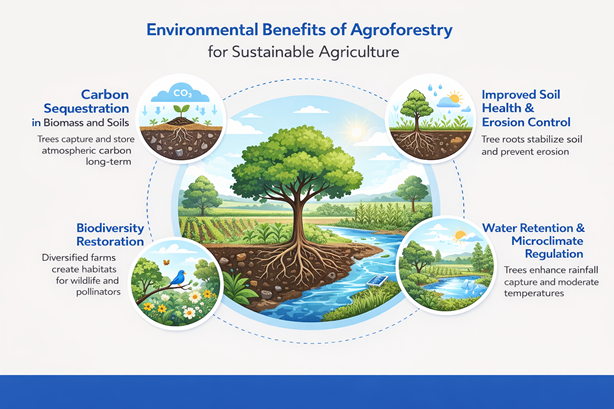
Agroforestry sits at the intersection of climate-smart agriculture (CSA) and regenerative farming, making it one of the most comprehensive land-use approaches for addressing climate change while sustaining food production. Climate-smart agriculture focuses on three core objectives: increasing productivity, enhancing resilience, and reducing or removing greenhouse gas emissions. Agroforestry aligns naturally with all three. By integrating trees into farming systems, it stabilizes yields, improves resilience to climate stress, and sequesters carbon in both biomass and soils without requiring farmers to abandon productive land.
From a regenerative agriculture perspective, agroforestry goes beyond minimizing harm to actively restoring ecosystems. Trees rebuild soil organic matter, improve nutrient cycling, and support biodiversity, helping degraded land recover over time. Unlike input-intensive models that rely on external fertilizers and chemicals, agroforestry strengthens natural processes such as soil regeneration, water infiltration, and biological pest control. This regenerative capacity makes agroforestry particularly valuable in regions facing long-term soil degradation and declining productivity.
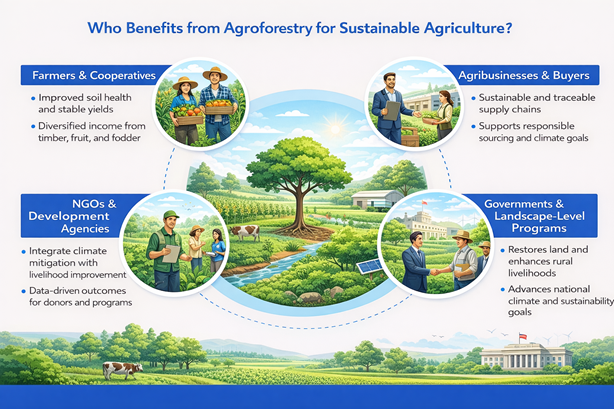
Agroforestry also plays an increasingly important role in national climate strategies and Nationally Determined Contributions (NDCs) under the Paris Agreement. Many countries now recognize agroforestry as a scalable solution for land-based mitigation and adaptation, especially in smallholder-dominated agricultural landscapes. By combining climate mitigation with rural development and food security, agroforestry allows governments to advance climate goals while supporting livelihoods and landscape restoration.
Critically, agroforestry addresses the trade-off between long-term sustainability and short-term productivity that often challenges agricultural transitions. While tree-based systems may require upfront investment and patience, they deliver more stable yields, reduced input costs, and diversified income over time. This balance between immediate production and long-term resilience is what distinguishes agroforestry from short-term productivity models, positioning it as a foundational practice for climate-smart and regenerative agriculture in a changing world.
Under the EU Deforestation Regulation (EUDR), any product entering the EU market must be proven deforestation-free and legally sourced. Agroforestry systems, by design, integrate trees into farmland rather than clearing them, making it easier to demonstrate compliance with these strict environmental standards.
In India, the average carbon sequestration potential in agroforestry has been estimated to be 25 t/ha over 96 million ha, but it varies substantially by regions depending upon the production of biomass
Agroforestry supports carbon and sustainability programs by functioning as a high-impact nature-based solution that delivers measurable climate, environmental, and social outcomes within productive agricultural landscapes. By integrating trees into farming systems, agroforestry enables long-term carbon sequestration in biomass and soils, making it well suited for climate finance mechanisms that prioritize durable, land-based removals. When supported by digital monitoring and verification, agroforestry projects become certification-ready, with structured data that meets the requirements of sustainability standards, ESG reporting frameworks, and corporate disclosure obligations. This same data foundation connects agroforestry directly to carbon markets, enabling the generation of high-integrity carbon credits, and to insetting strategies, where companies reduce Scope 3 emissions within their own supply chains. In this way, agroforestry bridges on-farm sustainability practices with compliance, climate finance, and corporate climate action.
Despite its strong potential, agroforestry faces significant data and traceability challenges that limit its ability to scale and demonstrate impact. These challenges are particularly acute in regions dominated by smallholder agriculture, where complexity and informality are common.
Together, these gaps make it difficult to prove sustainability outcomes at scale. Buyers, regulators, and investors increasingly expect transparent, verifiable evidence of impact. Without robust traceability and monitoring systems, agroforestry projects risk underperforming in audits, failing verification, or losing access to climate finance and premium markets. Addressing data and traceability challenges is therefore essential to unlock the full potential of agroforestry as a credible, scalable solution.

Digitization is becoming essential to scale agroforestry for sustainable agriculture from localized interventions to landscape-level solutions. As agroforestry systems grow in complexity and scale, digital tools provide the structure and transparency needed to manage data, monitor outcomes, and demonstrate impact.
At the foundation of digitization is farm mapping and farmer profiling. Accurate digital maps of farm and plot boundaries establish where agroforestry activities take place and prevent overlap or duplication. Farmer profiling links each plot to a verified participant, capturing details such as crop systems, tree species, and management practices. This creates accountability, continuity, and a reliable data backbone for long-term monitoring.
Tree and plot-level monitoring builds on this foundation by tracking survival, growth, and canopy development over time. Digital monitoring supported by satellite imagery, GIS, and field data collection allows projects to observe changes across dispersed farms without relying solely on costly field visits. This visibility is critical for assessing performance, identifying risks early, and maintaining data consistency.
Digitization also enables linking on-ground practices to measurable outcomes. When tree planting, management actions, and land-use changes are recorded digitally, they can be directly connected to indicators such as carbon sequestration, soil health improvement, and biodiversity outcomes. This traceability transforms agroforestry from a set of practices into a measurable system with quantifiable results.
Ultimately, digital systems are critical for scaling agroforestry. Manual processes cannot keep pace with the data volume, verification demands, and reporting requirements of large programs. Digital platforms standardize data collection, reduce errors, and support automation making it possible to scale agroforestry initiatives while maintaining credibility, transparency, and long-term sustainability.
See how real change happens on the ground.
Discover how The Sustainability Foundation used the TraceX DMRV platform to drive operational efficiency, achieve full transparency with partners, and scale treeplanting initiatives with measurable impact.
Read the Full Case Study
TraceX DMRV solutions for agroforestry provide the digital backbone needed to turn agroforestry practices into measurable, verifiable outcomes at scale. TraceX enables end-to-end digitization from farmer profiling and farm mapping to tree monitoring, geo-mapping, and carbon-ready reporting within a single, integrated platform. By combining satellite data, GIS-based plot validation, and farm-level records, TraceX supports continuous monitoring and audit-ready data trails aligned with carbon standards and sustainability programs. This allows agroforestry initiatives to reduce MRV costs, improve data accuracy, and scale across regions while maintaining the credibility required for climate finance, carbon markets, and long-term sustainable agriculture programs.
Agroforestry for Sustainable Agriculture offers a practical and scalable pathway to address today’s most pressing agricultural challenges: climate change, soil degradation, and livelihood vulnerability, without compromising productivity. By integrating trees into farming systems, agroforestry strengthens resilience, restores ecosystems, and supports long-term farm viability while aligning with climate-smart, regenerative, and sustainability goals. As pressures from regulators, buyers, and climate risks intensify, agroforestry is no longer a niche practice but a foundational approach for building resilient, future-ready agricultural systems at farm, landscape, and national levels.
Explore our blog on Agroforestry for Carbon Solutions to understand how tree-based farming systems deliver measurable carbon sequestration and sustainability outcomes.
Read our guide on Agroforestry Carbon Credits to learn how carbon is measured, verified, and brought to market through credible methodologies.
Discover how dMRV for Agroforestry uses satellite data, geo-mapping, and farm-level records to enable scalable, audit-ready carbon verification.
It is a farming approach that integrates trees with crops and/or livestock to improve soil health, resilience, biodiversity, and long-term agricultural productivity.
Trees enhance soil structure, water retention, and microclimate regulation, helping farms withstand droughts, heat stress, and extreme weather.
Yes. Agroforestry is widely used in smallholder systems, offering diversified income, improved food security, and reduced climate risk.
Agroforestry sequesters carbon in biomass and soils while supporting adaptation, making it a key component of climate-smart and regenerative agriculture.
Yes. Agroforestry systems are adaptable across climates, geographies, and value chains, making them suitable for large-scale sustainability and landscape programs.